











Remote work in the Philippines has shifted from a temporary response into a more permanent and regulated part of employment. As flexible work arrangements become more common, DOLE requires employers to formalize these setups properly to protect both workers and businesses.
For HR teams, legal staff, and business owners, this means understanding telecommuting rules, reporting requirements, and internal policy standards. Proper compliance, including submitting the required DOLE telecommuting report, helps companies avoid legal risks while supporting a more productive remote workforce.
Table of Contents
Key Takeaways
|
Understanding DOLE Telecommuting Compliance in the Philippines
 Remote work in the Philippines is no longer an informal arrangement employers can manage casually. Under Republic Act No. 11165, DOLE first issued Department Order No. 202-19, then later revised the rules through Department Order No. 237-22. As a result, companies need to focus not only on telecommuting policies, but also on proper reporting and recordkeeping.
For HR teams, legal officers, and business owners, compliance starts once telecommuting is adopted. DOLE expects employers to report these arrangements through its Online Compliance Portal, making the telecommuting report a key part of lawful remote-work implementation.
DOLE Telecommuting Rules at a Glance
The Telecommuting Act allows private-sector employers to adopt telecommuting only through mutual agreement, not a one-sided decision. Under the revised IRR, employers must also notify DOLE through the Establishment Report System in the Online Compliance Portal. In short, compliance means having a valid arrangement and reporting it properly.
This means employers cannot treat remote or hybrid work as an informal setup handled only through internal approval. Once telecommuting is adopted, the company also needs clear documentation, proper reporting, and records that show the arrangement follows current labor requirements.
Who Needs to File the DOLE Telecommuting Report?
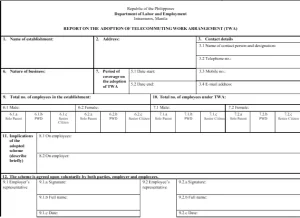 Private-sector employers that adopt telecommuting arrangements should submit the report to DOLE. This applies not only to full work-from-home setups, but also to hybrid arrangements where employees work from an alternative workplace for part of the time.
In short, if a company implements telecommuting for any part of its workforce, it should treat the arrangement as reportable.
When Should Employers Submit the Report?
The best approach is to submit the report once the telecommuting agreement is in place and the arrangement is about to start. DOLE’s guidance points employers to file through the Online Compliance Portal as soon as telecommuting is adopted.
In practice, do not wait for a fixed deadline. Early filing is the safer approach, especially at rollout.
What Must Be Reported?
The report usually asks whether the filing is for the head office or a branch, then requires the employer to complete and certify the submission. HR may also need to prepare establishment details, contact information, the number of affected employees, and the employee list when required.
The main filing route today is the online Establishment Report System. Manual or regional forms may still be used, but only when the local DOLE office asks for them.
How to Submit the DOLE Telecommuting Report
Submitting the DOLE telecommuting report is a basic compliance step once a company adopts a remote or hybrid work arrangement. Employers need to make sure the setup is properly documented, then file it through the correct DOLE channel to avoid gaps in reporting.
| Online Submission | Manual Submission |
|
|
What If a Company Does Not Report?
DOLE does not clearly state a fixed standalone fine for a missed telecommuting report. Still, failing to report creates compliance risk because the company may have weaker records if a labor inspection or dispute happens later.
In practice, missing the report can make it harder to show that the telecommuting setup was properly approved, documented, and managed under current labor rules. This can leave the company in a weaker position when DOLE or employees ask for proof.
How HRIS Helps Manage Telecommuting Compliance
 An HRIS or human resource management software helps HR keep telecommuting records in one place, including employee data, work arrangements, attendance, and policy acknowledgments. This makes it easier to prepare the DOLE report and keep remote-work records organized.
It also gives companies a clearer compliance trail. With human resource management software, HR can quickly check who is covered by the telecommuting setup, whether policies have been acknowledged, and whether supporting documents are complete if DOLE requests proof later.
Conclusion
DOLE telecommuting compliance is now a basic requirement for companies with remote or hybrid work arrangements. Proper reporting and clear documentation help reduce legal risk and show that the setup follows current labor rules.
To manage this more consistently, HR teams need accurate records and a clear process. Using human resource management software can help keep telecommuting data organized and compliance easier to handle.
FAQ About DOLE Telecommuting Compliance
-
Who needs to file the DOLE telecommuting report?
Private-sector employers that adopt telecommuting arrangements should submit the report to DOLE. This includes full work-from-home setups as well as hybrid arrangements where employees work from an alternative workplace for part of the time.
-
When should employers submit the telecommuting report?
The safest approach is to submit the report once the telecommuting agreement is in place and the arrangement is about to start. In practice, employers should file as early as possible instead of waiting for a fixed deadline.
-
What information must be included in the report?
The report usually asks whether the filing is for the head office or a branch, then requires the employer to complete and certify the submission. HR may also need to prepare establishment details, contact information, the number of affected employees, and the employee list when required.
-
What happens if a company does not submit the report?
DOLE does not clearly state a fixed stand-alone fine for a missed telecommuting report. However, failure to report creates compliance risk because the company may have weaker documentation if a labor inspection or dispute happens later.
-
How can human resource management software help with telecommuting compliance?
Human resource management software helps HR keep telecommuting records in one place, including employee data, work arrangements, attendance, and policy acknowledgments. This makes reporting easier and helps companies keep a clearer compliance trail.