












Delivery orders have become very convenient for customers. But behind the simplicity lies an intricate, complex logistical network. Starting from the shelves, then packaging, after that transportation, routed through the distribution networks, and finally the delivery. This is what we call outbound logistics.
It is a tightly coordinated system involving warehousing, order management, transportation, last-mile delivery, and reverse logistics. A simple logistical hindrance can cause the entire system to stand still.
Table of Contents
Key Takeaways
|
What It Actually Means (And Why Most People Oversimplify It)
People often simplify Outbound logistics to just the delivery part, but in reality, it refers to a set of processes involved in moving finished goods from a company’s storage or production facility to the end customer, whether that customer is a retailer, a distributor, or an individual consumer.
Outbound logistics encompasses the entire logistical system from order processing to returns handling and many more. Each of these components carries its own cost structure, failure points, and optimization opportunities. Which is why outbound logistics is challenging, as it operates at the intersection of customer expectations and operational capability.
Inbound to Outbound and How It Differs

Supply chains have two core flows: inbound logistics brings materials and goods into your business, while outbound logistics moves finished products to customers or partners. These flows are interdependent, not linear. Inbound delays trigger stockouts and late deliveries, while poor outbound logistics planning creates warehouse congestion that slows receiving and disrupts inbound operations.
Outbound logistics is connected with demand planning and sales forecasting; if the demand forecast is off, you are either carrying too much or too little. The best outbound logistics operations are deeply connected to real-time demand data, as it allows teams to anticipate volume spikes, pre-position inventory, and allocate transportation capacity before problems arise.
The handoff between inbound and outbound logistics typically happens at the warehouse or distribution center. After goods are processed, outbound logistics covers everything required to deliver them to customers, from order entry and pick lists to picking, packing, quality checks, labeling, carrier pickup, last-mile delivery, and even returns. Defining this boundary clarifies ownership, speeds troubleshooting, and prevents blame-shifting when delays, damage, or errors occur.
The Hidden Moving Parts That Keep Orders Flowing
There are many interlocking processes in outbound logistics, each of which must run smoothly for the whole system to work. Understanding each component helps you identify where your operation is strong and where it is vulnerable.
From Warehouse Shelf to Customer’s Doorstep
The moment a customer order enters your system, you get an order receipt which will trigger a pick list directing warehouse staff or automated systems to locate and retrieve the correct item from storage.
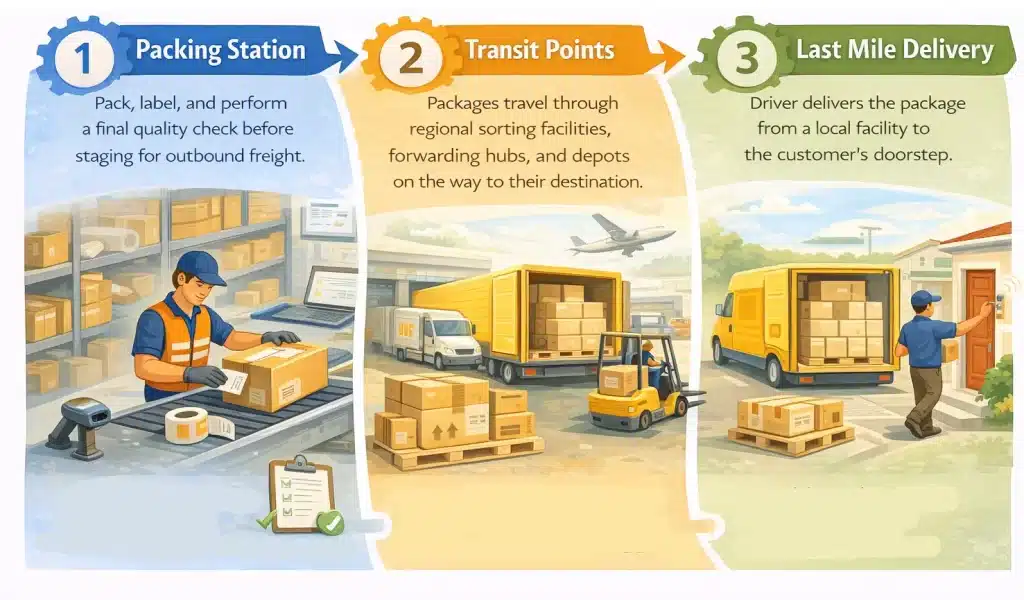
Once items are picked, they move to a packing station where they are prepared for shipment. This involves selecting appropriate packaging, inserting any required documentation, applying shipping labels, and performing a final quality check. The packed order is then staged for carrier pickup or moved to a loading dock for outbound freight.
From there, the shipment enters the carrier’s network and begins its journey to the customer. Customers today expect to know exactly where their order is at any given moment, so providing real-time delivery information builds trust and reduces inbound customer service contacts dramatically.
Why the Final Stretch of Delivery Costs the Most
Around 40 to 53 percent of total shipping costs comes from last-mile delivery as it does not have the scale of freight and linehaul operations. Businesses are solving this problem by trying to optimize routes to minimize delivery time, concentrating on deliveries in smaller geographic zones, reducing the average distance between stops, or eliminating the doorstep attempt by using alternative delivery models such as parcel lockers, click-and-collect points, and crowdsourced delivery platforms.
For businesses operating in markets with emerging infrastructure, particularly in Southeast Asia, last-mile complexity is even more pronounced. Addressing systems may be incomplete, traffic conditions are unpredictable, and customers may be scattered across both urban and rural areas. Building a resilient last-mile strategy in these markets often requires working with multiple carriers rather than relying on a single provider.
The Role of Packaging Nobody Talks About
Packaging is the unsung hero of outbound logistics. Most conversations about packaging focus on branding and aesthetics. But from a logistics standpoint, packaging serves several critical functions that have direct implications for cost and product integrity.
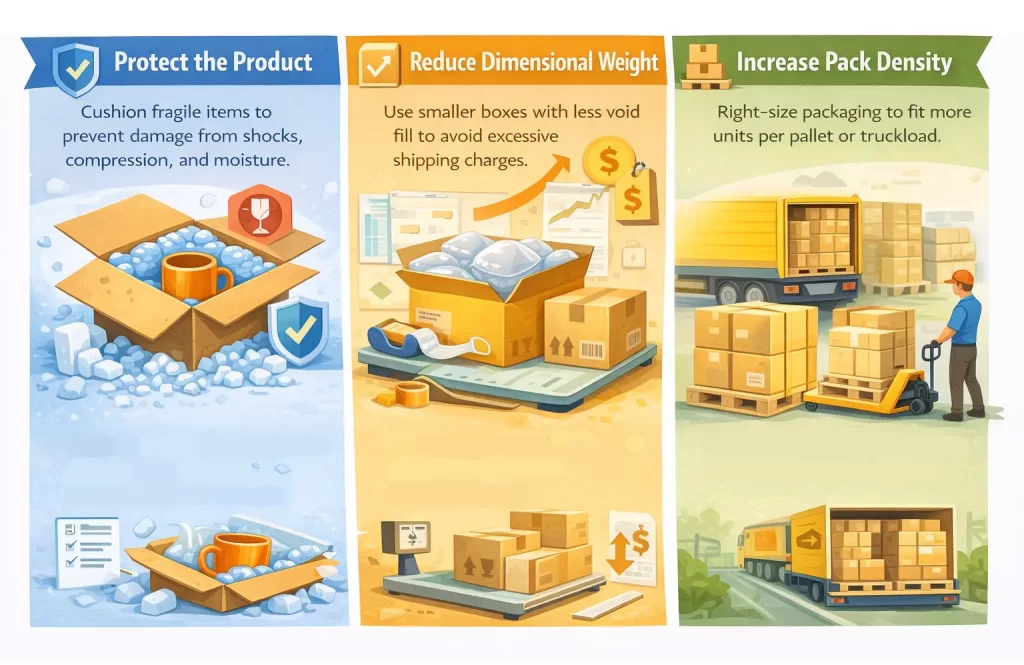
Sustainable packaging has also become a strategic consideration. Customers increasingly prefer businesses that use recyclable or minimal packaging. Beyond the environmental benefit, lighter and smaller packaging reduces material costs and freight expenses, simultaneously making sustainability and profitability rather than competing goals.
In-House vs Third Party
One of the most consequential decisions any trading or distribution business makes is whether to manage outbound logistics internally or outsource it to a third-party logistics provider (3PL). Both models have legitimate advantages and serious drawbacks, and the right answer depends heavily on your business stage, order volume, product complexity, and growth trajectory.
Outsourcing fulfillment gain and loss
Outsourcing fulfillment to a 3PL means handing over warehouse operations, pick-and-pack, carrier management, and often returns processing to a specialized provider. In exchange, you gain access to established infrastructure, carrier relationships, technology platforms, and operational expertise without having to build those capabilities yourself.
| Pros of Outsourcing fulfillment | Cons of Outsourcing fulfillment |
| Converts fixed costs into variable costs (pay per storage/order) | Less direct control over packing quality, speed, and issue resolution |
| Access to existing warehouse infrastructure and trained labor | Errors by the 3PL still impact your customers and brand reputation |
| Benefit from carrier relationships, negotiated rates, and shipping expertise | Service level agreements help, but cannot fully remove dependency risk |
| Faster scalability during peak seasons or rapid growth | Harder to customize workflows for special handling or unique branding |
| Ability to position inventory closer to customers via multi-site networks | Communication friction can slow fixes when problems occur |
| Potentially faster delivery times and reduced transit costs | Operational visibility may be limited compared to in-house execution |
| Often includes returns processing and reverse logistics support | Data dependency: key operational insights sit with the 3PL, affecting leverage and switching |
Outsourcing fulfilment can be cheaper in the short run and faster as the vast infrastructure is already placed and all you need to do is pay for their service. But on the downside, you will have less control and insight into the delivery process. Your brand reputation can be harmed even if the mistake was made by the provider, and switching over to another service or negotiating better deals will be harder as the delivery data are held by the provider.
In-house fulfillment gain and risk
When a business is still doing things DIY due to its small size and scope, many fulfill orders in-house. The business has to handle all the processes and infrastructure, but the biggest advantage is control and keeping operational data, performance insights, and process know-how inside your team, which can be a strategic asset as order volume grows and customer expectations rise.
| Pros of In-House fulfillment | Cons of In-House fulfillment |
| Full control over packing quality, brand unboxing, and service standards | High fixed costs (lease, labor, equipment) even when order volume dips |
| Faster process changes (new SKUs, packing rules, promotions, cut-off times) | Scaling is slower and riskier, especially in peak seasons |
| Direct visibility into inventory accuracy, picking errors, and root causes | Requires strong ops capability (warehouse leadership, training, SOPs) |
| Stronger data ownership (inventory levels, demand patterns, customer locations) | Higher complexity managing carriers, rates, and delivery exceptions |
| Potentially lower cost per order at high volume once operations are optimized | Geographic limitations: if you only have one warehouse location |
| Tighter integration with production, procurement, and sales planning | CapEx burden for racking, scanners, WMS, packing lines, and safety needs |
| Greater flexibility for custom orders. bundles, and special handling | Harder to maintain service levels without robust systems and governance |
In-house fulfillment becomes a competitive advantage when you have enough volume to justify fixed infrastructure and the discipline to run warehouse operations well. However, it can become a cost trap if demand is volatile, processes are undocumented, or the team lacks operational maturity. The right choice depends on your order profile, service expectations, and whether fulfillment is a core capability you want to own long-term.
How to Handle Return Flows

Returns are an inevitable feature of modern commerce, and how you handle them is a direct extension of your outbound logistics strategy. In some industries like fashion retail, electronics, and online marketplaces, return rates can exceed 20 to 30 percent of shipped orders. Treating returns as an afterthought is a costly mistake.
The economic challenge of returns is that each returned item creates costs in both directions. A clear, consistent policy that is easy for customers to follow and a quick, accurate, and automated triaged process are needed to make a cost-effective returns process. The faster a returned product gets back either to be resold at a discount or disposed of, the sooner the value returns.
Paradoxically, customers who have returned a product are more likely to buy again than those who never did. This is because a hassle-free return builds trust and confidence in your business. This means your returns process should be designed as a customer experience touchpoint, not just an operational function. Proactive communication also removes anxiety and reinforces the customer relationship, potentially converting them into repeat buyers. A business that treats product returns as a burden actively drives customers away.
Tracking What Matters: Numbers That Actually Move the Needle
You cannot improve what you do not measure. Outbound logistics generates a rich stream of operational data, but not all of it is equally actionable. Knowing which metrics matter is what separates businesses that improve continuously from those that react to problems after they become crises.
The figures worth watching every day
- Order fulfillment cycle time measures how long it takes from the moment an order is placed to the moment it is delivered to the customer. This is the metric your customers care about most. Breaking it into sub-components helps you identify exactly where delays are accumulating.
- On-time delivery rate measures the percentage of orders that arrive by the promised delivery date. This is a direct input into customer satisfaction and a leading indicator of customer churn. Even a small improvement in the on-time delivery rate can have a measurable impact on repeat purchase rates.
- Order accuracy rate tracks the percentage of orders that are picked, packed, and delivered correctly. It also tracks if it was the right item, with the right quantity, delivered to the right address, and in the right condition. Targeting and maintaining an accuracy rate above 99.5 percent should be a standard expectation as order accuracy errors are expensive: each one generates a customer service contact, a return shipment, a replacement order, and a damaged customer relationship.
- Cost per order captures the total outbound logistics cost divided by the number of orders fulfilled. This is your primary efficiency metric. Tracking it over time and breaking it down into components gives you a clear picture of where costs are moving and why.
- Warehouse utilization rate measures how efficiently you are using your available storage capacity. Running too close to 100 percent utilization creates congestion that slows pick-and-pack operations, but running too far below capacity means you are paying for space you are not using. Most operations aim to keep utilization in the 80 to 85 percent range to balance efficiency with operational flexibility.
- Return rate by product, category, or customer segment reveals patterns that can inform purchasing decisions, product quality improvements, or customer targeting adjustments. A high return rate for a specific product might indicate a quality issue, a misleading product description, or a size/fit problem.
The figures are unworthy of being watched every day
- Average delivery time can be misleading when tracked daily without context. A single long-distance shipment or weather disruption can skew the number. Instead of reacting to daily averages, compare performance against a rolling benchmark, such as a 30-day moving average or service-level commitment, to detect structural shifts rather than normal variance.
- Total shipping spend is another metric that often causes overreaction. Higher shipping costs may reflect increased sales volume, heavier baskets, or premium service selections, not inefficiency. The more useful benchmark is cost per order or cost per unit versus historical trends and margin targets, rather than absolute daily spend.
- Overall return rate rarely provides actionable daily insight. Returns often lag delivery by days or weeks, making daily tracking misleading. A better approach is benchmarking return rates by SKU, category, or channel over a monthly period, then comparing them to historical norms or industry standards to identify abnormal patterns.
- Headcount and labor hours can also distort decision-making when reviewed in isolation. Daily labor increases might align with promotional peaks or inbound surges. Instead, benchmark labor productivity metrics such as orders per labor hour or cost per labor unit over time to assess efficiency properly.
What Changes as Your Order Volume Grows
Outbound logistics is not a static problem. The approach that works well when you are shipping fifty orders a day becomes inadequate at five hundred orders a day and completely unworkable at five thousand. Understanding how the requirements change at different scales allows you to build proactively rather than react to breakdowns.
Online Stores vs Physical Retail: Different Playbooks
The outbound logistics requirements for e-commerce and physical retail are fundamentally different, even when the same product is involved. E-commerce fulfillment involves thousands of individual parcel shipments, each going to a different address, each requiring its own packaging and label.
Physical retail replenishment involves far fewer, larger shipments going to a small number of store locations or distribution centers, but with strict compliance requirements around pallet configuration, labeling, and delivery windows.
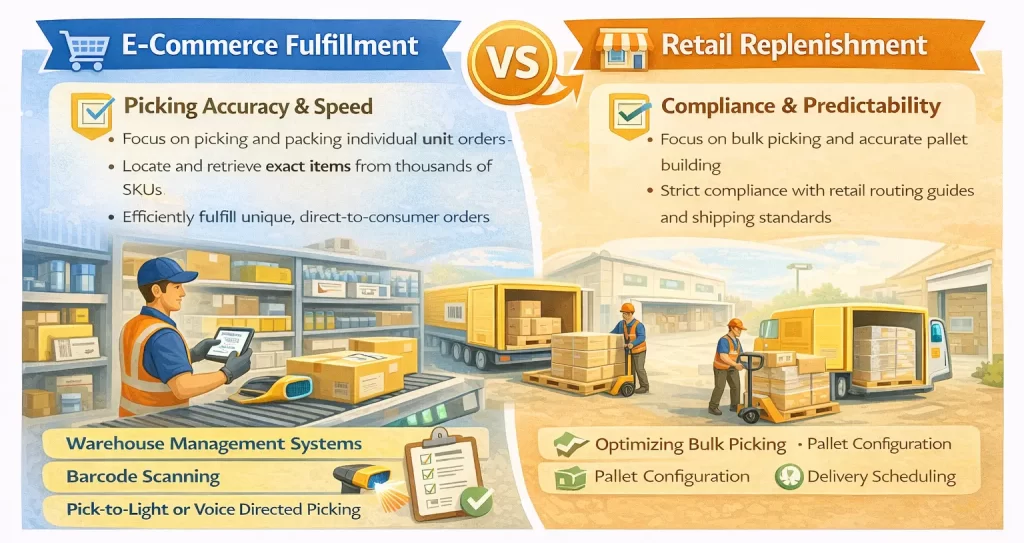
Many businesses serve both channels simultaneously, a strategy known as omnichannel fulfillment. Managing both from the same warehouse requires careful slotting (positioning inventory optimally for both parcel and pallet picking), clear pick path separation, and often dedicated zones or shifts for each channel.
Adjusting your approach when demand spikes
Seasonal demand spikes during Ramadan, Christmas, or year-end sales can push order volumes two to five times higher than normal. Without preparation, businesses face backlogs, fulfillment errors, carrier congestion, and unhappy customers. Planning ahead with safety stock, pre-positioned inventory, trained temporary labor, and secured carrier capacity prevents breakdowns.
Technology strengthens peak execution. WMS forecasting improves labor and equipment planning, while real-time carrier integrations support rerouting during congestion. Because some surges are unpredictable, resilience comes from flexible carriers, modular capacity, cross-trained teams, automation, and a peak-season playbook that is reviewed after each cycle to improve speed, accuracy, and loyalty.
Conclusion
Outbound logistics is an integral part of a successful business. Those who can deliver items to the customers in the quickest way possible are the ones who are going to win the natural selection of the market. Thus, a business must create an outbound logistical system that is the fastest while also not exceeding its capabilities.
Businesses that have huge, efficient outbound logistics are those that can return products effectively, have superb customer service, know what components to track and proactively take actions if needed, and handle fluctuating volume orders.
Some outsource the responsibility to third-party providers, which could be cheaper and more efficient, but they will have less control. Others try to do things themselves to have greater control and not have to share their profits, but they have to bear all the costs and operational functions by themselves. Automation and having the best logistical software are utilised in both methods.
FAQ About Outbound Logistics
-
What is the difference between inbound and outbound logistics?
Inbound logistics covers the movement of goods into your business. Outbound logistics covers the movement of finished goods out of your business. Warehouses typically serve as the handoff point between the two flows.
-
Why is last-mile delivery so expensive compared to other shipping stages?
Last-mile delivery is expensive because it involves individual stops at dispersed addresses, unlike consolidated linehaul freight that moves large volumes point-to-point. Each delivery stop has fixed costs for parking, walking, attempting delivery, and potentially returning for failed attempts. Last-mile can account for 40 to 53 percent of total shipping costs despite being the shortest segment of the journey.
-
When should a business switch from in-house fulfillment to a third-party logistics provider?
Clear signals include rising order error rates due to volume overwhelm, shipping costs that significantly exceed 3PL market rates, and leadership time being consumed by fulfillment operations rather than strategic activities. If a 3PL’s aggregated carrier discounts and operational infrastructure would reduce total fulfillment costs, the switch is worth serious consideration.
-
What are the most important metrics to track in outbound logistics?
The most actionable outbound logistics metrics include Order fulfillment Cycle Time, On-Time Delivery Rate, Order Accuracy Rate, Cost Per Order, Warehouse Utilization Rate, and Return Rate by product or category. Tracking these consistently and benchmarking against industry standards reveals where to invest improvement efforts for the greatest impact.
-
How can businesses prepare for seasonal demand spikes in outbound logistics?
Effective preparation starts weeks or months in advance: building safety stock and pre-positioning inventory, hiring and training temporary warehouse staff before the peak begins, booking carrier capacity early, and implementing a documented peak season operating playbook. Technology investments in demand forecasting and warehouse management systems also help predict and manage volume surges.
-
How does packaging affect outbound logistics costs?
Packaging affects costs in three key ways: it determines product protection (poor packaging leads to damage claims and returns), it affects dimensional weight pricing used by most parcel carriers (oversized boxes increase freight bills even for light items), and it influences pallet density for freight shipments (inefficient shapes reduce trailer utilization and increase cost per unit).
-
Can a good returns process actually improve customer retention?
Yes. Research consistently shows that customers who experience a smooth, hassle-free return are more likely to purchase again than customers who never returned anything. A well-designed returns process, with pre-printed labels, fast refund processing, and proactive communication, functions as a customer loyalty tool rather than merely a cost center.