














Compensation extends far beyond a paycheck. It shapes how employees feel about their work, how long they stay with a company, and how effectively a business competes for talent. Understanding the full scope of compensation management helps organizations make informed decisions about pay, benefits, and performance rewards.
This article covers the core components of a compensation system, the different forms compensation takes, and the process employees in the Philippines can follow when filing a workers’ compensation claim.
Table of Contents
Key Takeaways
|
What is Compensation?
Compensation generally refers to the financial payment provided to an individual in return for their work or services. In a workplace context, compensation encompasses more than just salary or wages; it also includes commissions, bonuses, incentive pay, and additional perks tied to the employee’s role.
Employers understand the challenge of finding top talent. Developing a competitive compensation package is crucial for attracting and retaining the ideal employees who can drive the success of your business.
To secure top-notch talent, it’s important to offer attractive pay and comprehensive benefits. However, there’s no need to panic about costs, there’s always a way to strike a balance that benefits everyone involved.
How is Compensation Used?

Compensation serves as a strategic tool for management to support and enhance the company’s operations. It can be adjusted based on the organization’s needs, goals, and available resources. Compensation strategies are often utilized to:
- Attract and retain skilled employees.
- Boost morale and employee satisfaction.
- Reward and motivate high performance.
- Ensure fairness internally and externally.
- Minimize turnover and foster loyalty.
- Negotiate practices with unions effectively.
One of the primary objectives of compensation is to recruit and retain qualified employees. However, the availability and cost of talent are often influenced by market factors beyond an employer’s control.
While companies can establish and advertise salary ranges for new hires, these figures must align with those offered by competitors vying for the same talent pool. Hence, offering fair and competitive compensation retains top talent and improves the overall employee experience.
Components of a Compensation System
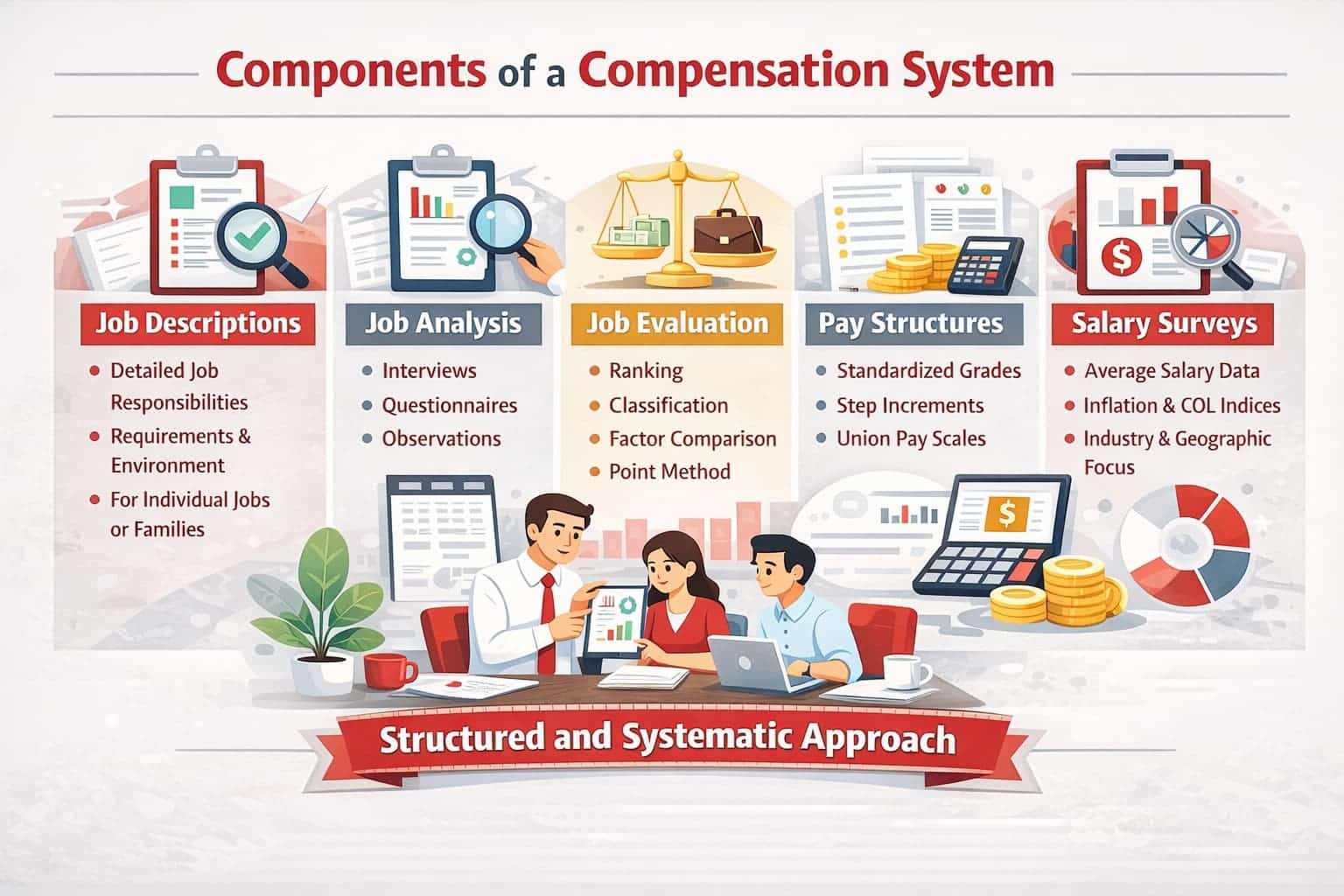
Employees are more likely to perceive compensation as fair if it is based on a structured and systematic approach. Various compensation systems have been developed to assess the value of positions.
1. Job Descriptions
These are essential for both Compensation, providing detailed documentation of job responsibilities, requirements, functions, duties, work environment, location, and conditions. Job descriptions can be developed for individual roles or broader job families.
2. Job Analysis
This process involves evaluating jobs to create accurate job descriptions. Methods include interviews, questionnaires, and direct observation to gather necessary data.
3. Job Evaluation
A systematic method to compare jobs and determine appropriate compensation levels. Common techniques include:
- Ranking: Ordering jobs by their relative value.
- Classification: Grouping jobs into predefined categories.
- Factor Comparison: Comparing jobs based on specific factors.
- Point Method: Assigning points to job elements for comparison.
4. Pay Structures
These provide a framework for standardized compensation practices. Pay structures typically include several grades, each with a minimum salary or wage and increments based on steps or ranges.
Step increments are especially common in unionized roles, where pay is determined through collective bargaining. Accurate payroll processing is a cornerstone of effective compensation management, so the company must also pay attention to this component.
5. Salary Surveys
These compile data on average salaries, inflation rates, cost-of-living indices, and salary budget trends. Surveys may be purchased from vendors or conducted in house. When using third party surveys, it’s crucial to consider their focus.
Whether they pertain to a specific industry, multiple industries, a single geographic region, or a broader area, make sure the data aligns with your company’s context. Using a HRIS system will help with automating and sorting out the data as well.
Examples of Compensation
Compensation packages vary widely across companies, with diverse options tailored to meet unique organizational needs. Below are the examples of compensation:
1. Annual Salary
Salaried employees receive a fixed annual rate, based on the value they bring to the organization, regardless of hours worked. These employees, often classified as exempt, are not eligible for overtime pay when exceeding 40 hours per week.
2. Hourly Wage
Hourly employees are paid a set rate for each hour worked, up to 40 hours weekly. Beyond that, non exempt employees qualify for overtime pay, usually calculated at one and a half times their standard hourly rate, commonly referred to as “time and a half.”
3. Raises
Salary or wage increases are typically tied to individual or team performance. Annual raises are a standard practice for both salaried and hourly employees.
4. Retirement Plans
Many companies provide retirement savings options, such as 401(k) plans. Employees contribute a small portion of their earnings, often matched partially by the employer. These plans are subject to vesting periods, which determine when the employer’s contributions become fully accessible, usually within one to five years.
5. Bonuses and Incentives
To encourage exceptional performance, employers may offer bonuses or incentives tied to specific, pre defined goals. These supplementary payments reward employees for meeting or exceeding targets.
6. Health Benefits
Health care benefits are a common inclusion in compensation packages. Employers typically cover a significant portion of the monthly premiums, with the remainder deducted from employees’ gross pay. Most companies provide multiple plan options, allowing employees to select coverage that suits their needs.
How Much Does a Worker’s Compensation Cost?
 The cost of workers’ compensation insurance in the Philippines varies depending on industry regulations and the nature of the work. Rates are influenced by factors such as employee risk levels and company payroll.
While specific costs may differ, companies can expect the following considerations based on real life scenarios:
- For low risk jobs, such as office based roles, the insurance rate may be relatively minimal, with fees calculated as a small percentage of the company’s payroll.
- For high risk jobs, such as those in construction or manufacturing, rates are significantly higher due to the increased likelihood of workplace injuries.
For instance, a construction firm in the Philippines might allocate higher insurance premiums for workers operating heavy machinery, while a BPO company would face lower costs for their desk based employees.
These costs are essential for compliance with local labor laws and for protecting both employees and employers from unexpected financial liabilities.
How to Apply for Compensation

The process for claiming workers’ compensation in the Philippines is governed by the Employees’ Compensation Program (ECP). While the specifics may vary slightly depending on the company and sector, employees who experience a work related injury or illness should generally follow these steps:
- Document the Incident: Record the details of the injury or illness as accurately as possible. Include photos, if applicable, and the names of witnesses to strengthen your claim.
- Notify Your Employer: Report the injury or illness to your employer immediately. Employers are responsible for processing the claim through the Social Security System (SSS) for private sector employees or the Government Service Insurance System (GSIS) for public sector employees.
- Coordinate with SSS or GSIS: Verify with your employer that the claim has been submitted to the relevant agency. You may also follow up directly with the SSS or GSIS to ensure the claim’s progress.
- Appeal if Necessary: If the claim is denied, employees have the right to file an appeal with the Employees’ Compensation Commission (ECC). The ECC reviews cases and ensures fair treatment of employees under the ECP.
Compliance with the ECP is mandatory, and employers must ensure workers can access their entitled benefits without undue delays or complications.
Conclusion
Compensation is one of the most consequential decisions an organization makes. A well designed system covers not just base pay, but also bonuses, incentives, and benefits that reflect the genuine value employees contribute. When compensation is structured fairly and transparently, it strengthens retention, supports morale, and helps organizations stay competitive in their hiring efforts.
For companies looking to put these principles into practice, it helps to see how other organizations have structured their programs. Reviewing the best HRIS software options in the Philippines can help HR teams find a system that supports fair, consistent compensation management across the organization.
FAQ on Compensation
-
What is the 13th Month Pay in the Philippines?
The 13th Month Pay is a mandatory benefit in the Philippines, requiring employers to provide employees with an additional month’s salary, typically paid out before December 24.
-
How is Overtime Pay Calculated in the Philippines?
Overtime work is compensated with an additional 25% of the regular hourly wage for work beyond eight hours on ordinary days, and 30% for work on rest days or special holidays.
-
How Does the Employees’ Compensation Program (ECP) Work?
The ECP is a government program providing compensation to public and private employees or their dependents in cases of work related sickness, injury, or death.
-
What are the Mandatory Employee Benefits in the Philippines?
Mandatory benefits include Social Security System (SSS) contributions, PhilHealth insurance, Pag-IBIG Fund (housing development mutual fund) contributions, and 13th Month Pay.