














Did you know that employees who are held accountable for their performance are 2.5 times more likely to be engaged in their work? Performance appraisal form is not just for evaluations; they are powerful tools to motivate and develop your team.
When designed thoughtfully, these forms can inspire growth and help align individual efforts with company goals. However, crafting an effective appraisal form that captures both achievements and areas for improvement can be challenging.
In this guide, we’ll walk you through the essentials of creating performance appraisal forms, complete with templates, examples, and actionable tips to make sure that every review adds value.
Table of Contents
Key Takeaways
|
What is a Performance Appraisal Form?

An appraisal form is a tool that managers and HR professionals employ to assess how well employees are performing. It typically contains a rating system and space for feedback about accomplishments and overall performance.
In this form, supervisors note each employee’s achievements over a given timeframe, as well as the individual’s strengths and areas needing growth. Managers often use the performance appraisal form to guide them during performance reviews, drawing attention to key points for discussion, a process that becomes even more effective when supported by dedicated tools for managing ongoing employee evaluations.
As they review the appraisal form together, both the staff and manager can collaboratively establish goals to improve the staff’s performance. Integrating appraisal forms with platforms built for tracking and developing employee competencies can streamline this process by providing detailed insights into growth areas and aligning individual development with organizational standards.
What to Include in a Performance Appraisal Form Template
Performance appraisal forms, whether utilized by supervisors, HR teams, or employees, contain essential elements designed to ensure a comprehensive review process. Below are three key components of an appraisal form, along with examples:
1. Rating System
A rating system is used to evaluate employee performance over a specific period using key metrics such as attendance, productivity, and quality of work. Supervisors, and sometimes employees, assign scores based on these metrics. Examples include:
- Attendance:
- 5 = Perfect attendance, no tardiness, and willingness to handle urgent tasks.
- 4 = No absences or lateness within the appraisal period.
- 3 = Late or absent less than three times during the appraisal period.
- 2 = Late or absent three times during the appraisal period.
- 1 = Late or absent more than three times during the appraisal period.
- Job Knowledge and Skills:
- 5 = Far exceeds job requirements.
- 4 = Exceeds job requirements.
- 3 = Meets job requirements.
- 2 = Partially meets job requirements.
- 1 = Fails to meet most job requirements.
Other assessment areas may include quality of work, teamwork, initiative, motivation, general conduct, and discipline. For the attendance component specifically, organizations can improve accuracy by relying on an automated system for monitoring workforce attendance rather than manual records when scoring employees on this metric.
2. Feedback
Appraisal forms often include sections for qualitative feedback, where peers or supervisors provide insights into an employee’s strengths and areas for improvement.
Example using the rating guidelines:
- Attendance
- Score: 5
- Feedback: Maria consistently arrives on time, plans her leaves effectively, and willingly works overtime when necessary.
- Job Knowledge and Skills
- Score: 4
- Feedback: Maria actively enhances her skills by completing tutorials and applying them effectively in her work.
3. Acknowledgment
To validate the appraisal, both the employee and supervisor must review and confirm the evaluation. This is typically done through signatures, ensuring mutual agreement, and acknowledgment of the appraisal’s contents.
How to Create a Performance Appraisal Form
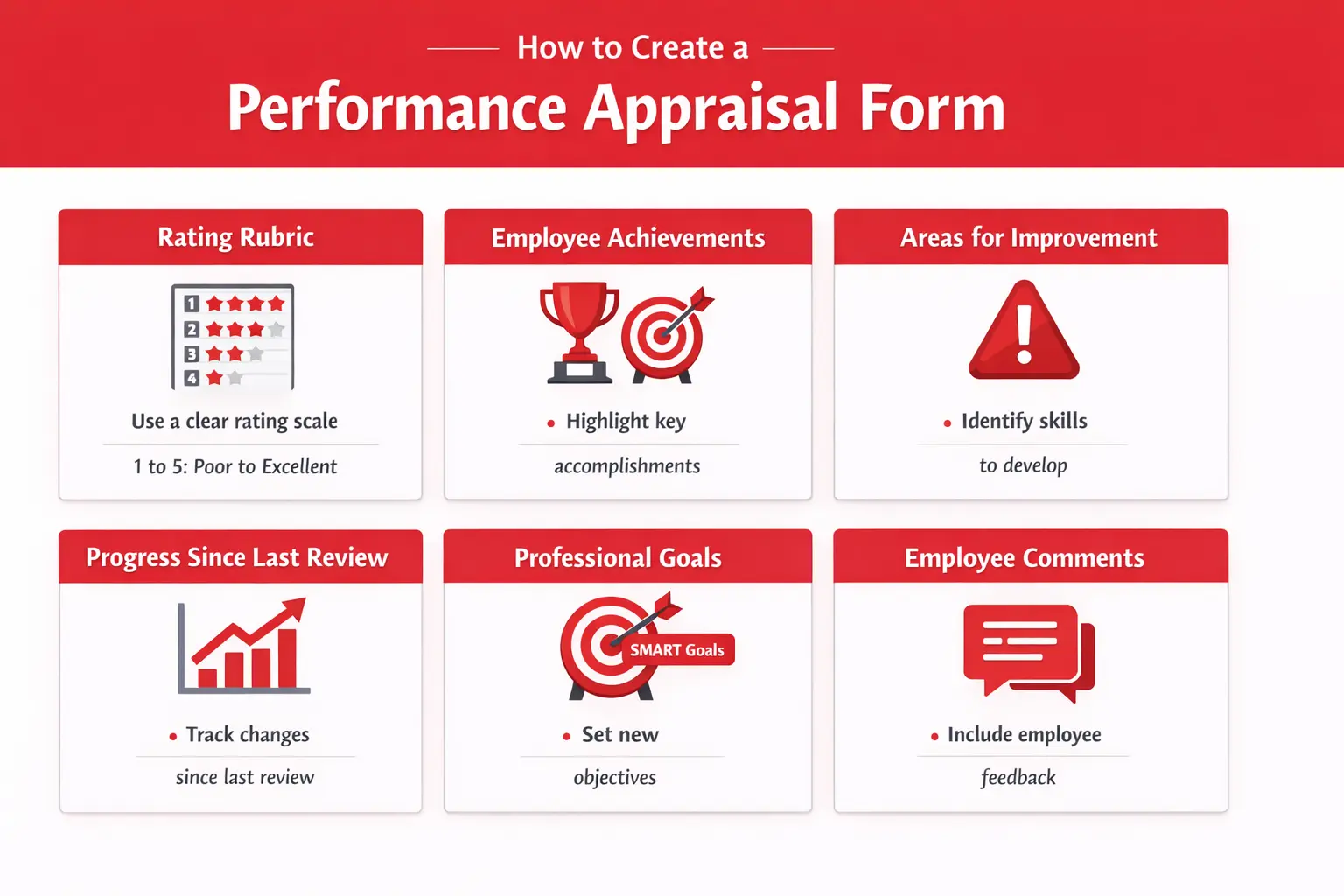
A well designed performance appraisal form benefits both employers and employees by identifying strengths and areas for improvement. Include specific evaluation factors that assess different skills and qualities, and tailor the form to align with your company’s objectives and metrics.
Below are the six most important components you should include when creating a performance appraisal form:
1. Rating Rubric
Identify the key responsibilities of an employee’s role and categorize them for evaluation. Use a clear rating scale, such as a 5 point system, and define what each score represents for consistency across departments:
- 1 = Poor (fails to meet expectations)
- 2 = Fair (frequently falls short)
- 3 = Good (meets expectations)
- 4 = Very Good (often exceeds expectations)
- 5 = Excellent (consistently exceeds expectations)
2. Employee Achievements
Highlight the employee’s significant accomplishments during the review period, such as successful project completions or noteworthy contributions.
3. Areas for Improvement
Identify specific areas where the employee could improve, like communication skills or punctuality, and explain how these issues affect their performance. When recurring issues are identified, it may be worth formalizing them through a structured plan for addressing performance gaps to provide the employee with clear steps and timelines for improvement.
4. Progress Since Last Review
If applicable, document changes since the last performance review. Note improvements, missed goals, and the steps taken to meet past objectives, providing insights for future development.
5. Professional Goals
Collaborate with the employee to establish new goals for the next review period. Use SMART criteria (Specific, Measurable, Attainable, Relevant, Time-bound) to create achievable and meaningful objectives. To further support goal-setting and track progress more efficiently, many HR departments are now leveraging AI-powered solutions now available for HR teams that can analyze performance trends and suggest targeted development areas.
6. Employee Comments
Include a section for the employee to share their thoughts in writing. They can explain challenges affecting their performance or express what they enjoy about their role.
Performance Appraisal Form Template
Performance Appraisal Form Template
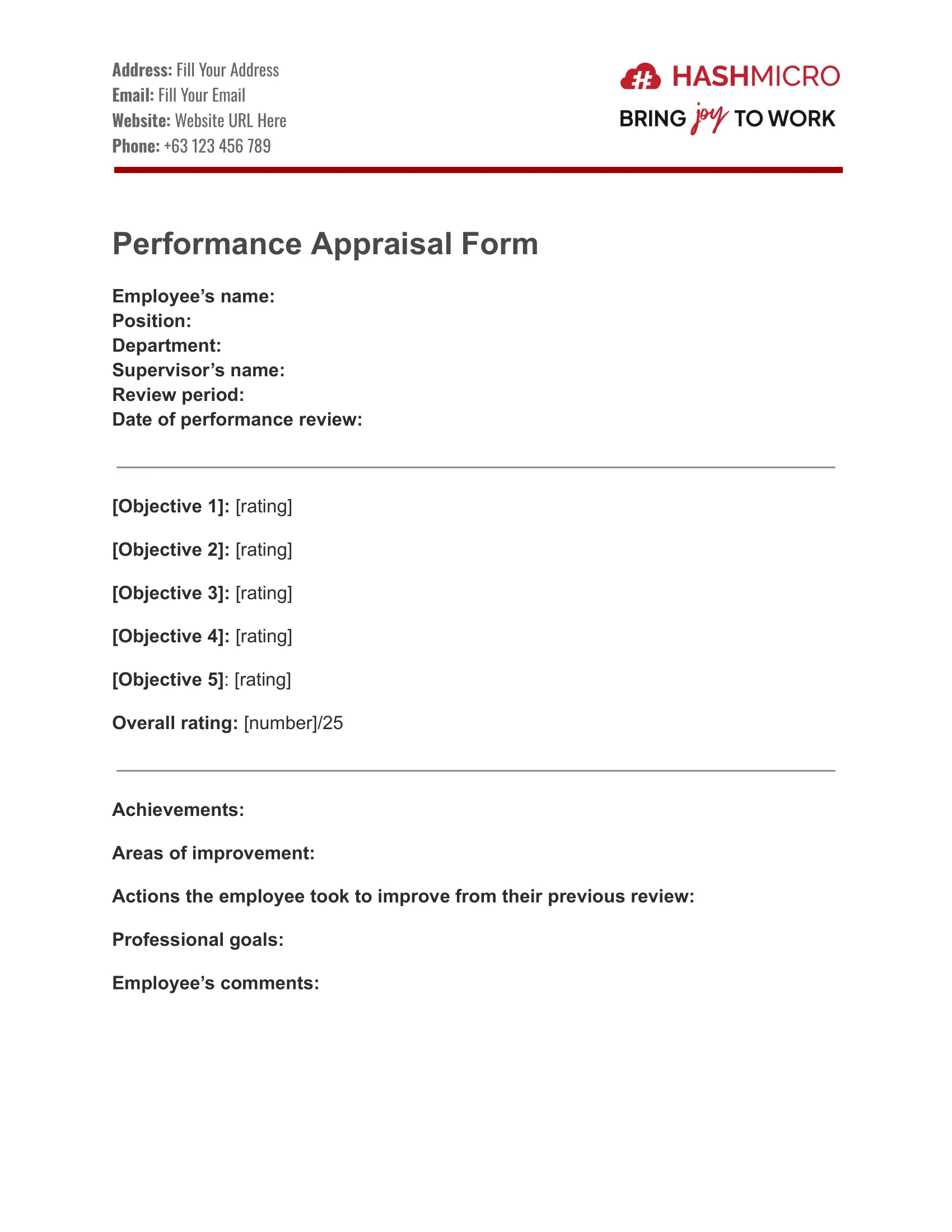
The above is a sample template of a performance appraisal form. As you can see, there are various aspects to fill out according to the employee being evaluated. The scale used to appraise each rating is 1-5, with 1 being Poor quality while 5 is Excellent.
As there might be concerns that the employee appraisal isn’t done objectively, there are sections in which the staff can review the appraisal before adding their own inputs. The template usually ends with both the higher-up and the employee signing it over.
Performance Appraisal Form Examples

Now you already have some ideas about what a performance appraisal form looks like. However, you might still be confused about how to fill up the form. To solve that, here’s an example showcasing both positive and constructive performance evaluations to guide you:
Examples of Positive Performance Appraisals
These highlight what employees are doing well, which should be spelled out clearly and objectively:
- You always meet your daily call targets, and this has helped the team achieve its goals.
- Your creative ideas for solving customer issues have made clients happier and more satisfied.
- You did a great job leading training sessions, making it easier for new team members to get started.
- You share helpful ideas during team meetings, which encourages everyone to work better together.
- Your quick actions to fix system problems have saved time and kept the work running smoothly.
Examples of Constructive Performance Appraisals
These focus on areas to improve, and would be along the lines of:
- You’ve had some trouble keeping your reports accurate, and this slows down the process. Let’s plan a session to practice this skill.
- While you’re getting better at staying calm under pressure, improving how you explain things will help customers more.
- Sometimes you take on too much work, and this makes it harder to finish on time. Learning to share tasks with teammates will make things easier for you.
- Your attendance could be more consistent because it affects the team’s work. Let’s work on managing your schedule better.
- You’re a valuable team player, but responding to emails faster would make things smoother for everyone.
Conclusion
Performance appraisal forms are vital instruments for evaluating employee contributions and nurturing both personal and professional growth. When thoughtfully designed and consistently applied, they help align individual efforts with organizational goals while surfacing opportunities for meaningful improvement.
The key to effective appraisals lies in combining clear evaluation criteria, including structured rating rubrics, qualitative feedback, and collaborative goal-setting, with reliable systems that reduce bias and ensure consistency. Organizations that invest in streamlining their review processes are better positioned to build a culture of accountability, transparency, and continuous development.
For teams thinking about how to make that process more manageable, it is worth looking at some of the leading HR systems available in the Philippines to see which one fits how your organization handles evaluations.
FAQ on Performance Appraisal Form
-
How often should performance appraisals be conducted?
While traditionally conducted annually, many organizations are shifting to more frequent evaluations, such as quarterly or even monthly, to provide timely feedback and support continuous employee development.
-
What are the common methods used in performance appraisals?
Common methods include graphic rating scales, 360-degree feedback, self-assessments, and behavioral checklists, each offering unique insights into employee performance.
-
What role does self-assessment play in performance appraisals?
Self-assessment encourages employees to reflect on their performance, fostering self-awareness and active participation in the appraisal process.
-
How can performance appraisals impact employee motivation?
Effective appraisals can enhance motivation by recognizing achievements and identifying opportunities for growth, while poorly conducted evaluations may lead to decreased morale.