














Starting a new job comes with excitement and responsibilities, but it also involves important paperwork, like signing an employment contract. This document is more than just a formality, it forms the foundation of your professional relationship with your employer. Yet, many employees overlook the details, risking confusion about their rights and responsibilities down the line.
In this article, we’ll explore the key elements of employment contracts, their types, and practical examples to help you better understand this critical aspect of workforce management.
Key Takeaways
|
What is an Employment Contract Letter?

Employment contracts are legal documents commonly used to outline the terms and conditions of a job, the role for which an employee is hired, and the responsibilities associated with the position. These contracts also include critical details such as the employment period, salary and benefits, and the terms for termination.
When properly drafted, an employment contract provides clarity and protection for both the employer and the employee. Employers often rely on these agreements to safeguard the business and protect confidential information, including trade secrets.
Additionally, an employment contract may contain a “Non Compete Agreement,” which restricts former employees from working directly with competitors for a specified period after leaving the company. This helps ensure the company’s competitive advantage remains secure.
10 Things That Must Be Included in an Employment Contract 

As your business grows, you need to fill new roles to support expansion. Therefore, establish a clear HR policy and start with a well structured employment contract that protects both the employee and the company.
In addition, incentives boost motivation and align individual goals with company objectives. With this in mind, every contract should include essential clauses. The following ten key elements help prevent misunderstandings and strengthen the employment relationship:
1. Job information
The “Job Information” section defines the employee’s role, responsibilities, and tasks. It includes details like the job title and scope of work, helping ensure both parties have a clear understanding of expectations and reducing misunderstandings.
Accurate job information also supports goal setting and performance evaluation, aligning the employee’s contributions with the company’s objectives.
2. Compensations and benefits
Compensations and benefits refer to the terms outlined in an employment contract that detail the employee’s salary, bonuses, allowances, and any other forms of financial rewards.
This section ensures transparency regarding the employee’s pay amount, payment frequency (e.g., monthly, annually), and any additional perks such as health insurance, retirement plans, or other benefits.
Clearly defining compensations and benefits helps set clear expectations for the employer and employee, contributing to job satisfaction, motivation, and adherence to labor regulations.
3. Time off, sick days, and vacation policy
The “Time off, sick days, and vacation policy” section is essential in an employment contract to provide clarity on the employee’s entitlement to leave. This includes details on paid time off, sick leave, vacation days, and any conditions or processes required to request leave.
Clearly outlining this policy ensures both the employer and employee understand the expectations for managing absences. By specifying leave policies, employers can promote fairness and transparency while helping employees maintain a healthy work life balance.
This section also protects the company by setting clear guidelines for planned and unplanned absences, minimizing disruptions to operations.
4. Employee classifications
To maintain compliance with tax and insurance regulations, it is crucial to determine whether a new hire is classified as an employee or a contractor. Misclassification can lead to legal challenges, as seen in Uber’s repeated lawsuits over this issue.
Understanding the key differences between employees and contractors allows you to classify your workforce correctly from the beginning, ensuring peace of mind and avoiding potential disputes.
5. The schedule and employment period
The employment contract should clearly state whether the position is permanent or for a fixed term. It should also outline the expected working hours to define the nature of the employer-employee relationship.
Include details about the number of hours the employee is expected to work and any options for flexible arrangements, such as remote or work from home opportunities. If the role requires night or weekend shifts, specify when and how frequently these will occur to ensure clarity and alignment of expectations.
6. Confidentiality agreement
Safeguard sensitive information, such as company trade secrets and customer data, by including a confidentiality agreement within the employment contract in accordance with employment law. Rather than creating a separate document, make it an integrated section of the contract, with a designated area for new employees to provide their digital signature.
7. A technology privacy policy
A technology privacy policy sets clear guidelines for employees on the proper use of company technology and data. It helps protect sensitive information and ensures the organization’s digital resources are used responsibly and securely.
8. Termination terms and conditions of the employment contract
Clearly define the procedures for terminating the employment relationship, specifying the required notice period and whether a written notice is mandatory from either party.
9. Severance or outplacement plan information
Outline the conditions for ending the employment relationship, including the required notice period and whether written notice is necessary from either party.
10. Requirements after termination
Post-employment restrictions are essential in any contract. These clauses can prevent former employees from starting a competing business, working with existing clients, or joining a direct competitor for a specific period.
By defining these terms clearly, companies protect customer relationships and preserve their competitive advantage.
Types of Employment Contract Letters
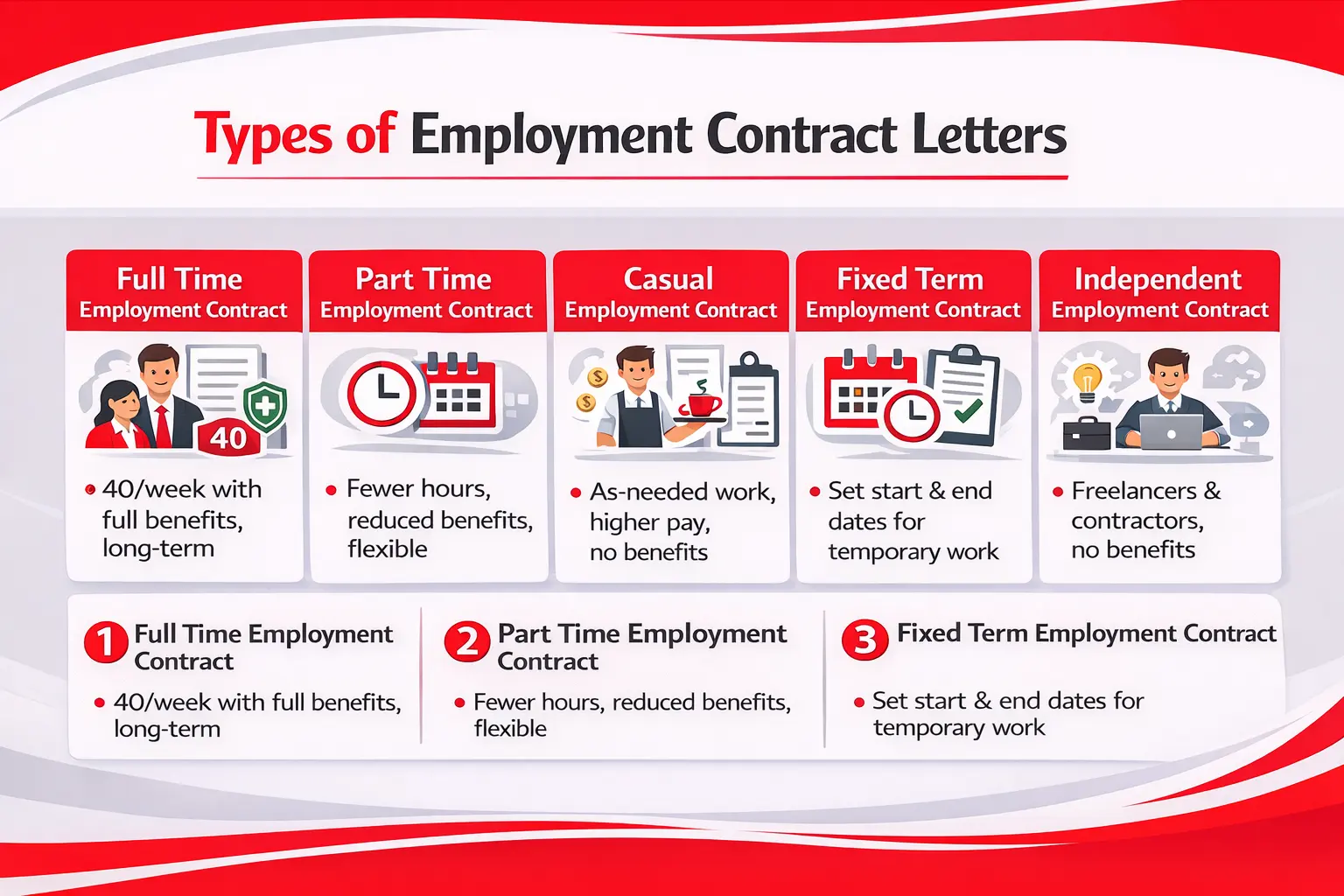
Table of Contents
Each type of employment arrangement comes with its own set of benefits and drawbacks, but it is essential to document agreements in writing.
The choice of employment style should align with your company’s specific needs while also considering industry standards for each role and the potential impact on your organization’s financial performance. Here are the most common types of workers businesses typically hire:
1. Full time employment contract
A full time employment contract is one of the most common agreements. It usually sets fixed working hours, typically 40 hours per week, and provides stable income and benefits.
In addition, this contract clearly defines the employee’s role, responsibilities, salary, working hours, and benefits such as health insurance and paid leave. Therefore, it creates stability for both the employer and the employee while ensuring clear expectations and long-term commitment.
2. Part time employment contract
A part time employment contract typically covers employees who work fewer hours than full time staff. These contracts specify the number of hours per week or month that the employee is expected to work. Part time positions often offer fewer benefits compared to full time roles, such as reduced access to health insurance and paid time off.
However, they provide flexibility, which can be beneficial for both employers and employees who may require a balanced work life approach. Part time contracts are commonly used in industries where full time positions may not be necessary or feasible.
3. Casual employment contract
A casual employment contract applies to workers hired on an as needed basis. Since there is no fixed schedule or guaranteed hours, both employers and employees gain flexibility. As a result, businesses can quickly handle short-term or unpredictable workloads.
In addition, casual employees often receive higher hourly wages. However, they usually do not receive benefits such as paid leave or sick pay.
Therefore, industries with fluctuating demand commonly use casual contracts. For example, hospitality, retail, and seasonal sectors frequently rely on this arrangement.
4. Fixed term employment contract
A fixed term employment contract is established for a specific period, usually based on the duration of a particular project, seasonal needs, or other defined circumstances. This contract clearly states the start and end dates of employment, providing certainty for both the employer and the employee.
Fixed term contracts are commonly used in industries with temporary requirements, such as construction, education, or project based roles. While these contracts may offer limited benefits, such as paid leave and health coverage, they provide flexibility for employers who need to address short term staffing needs without long term commitments.
5. Independent employment contracts
An independent employment contract, also known as a contractor or freelance agreement, applies when a person provides services on a self-employed basis. This contract defines the scope of work, payment terms, and specific deliverables.
Unlike traditional employment contracts, it does not provide standard benefits such as health insurance or paid leave. Instead, independent contractors manage their own taxes and insurance.
Therefore, companies commonly use this contract for specialized skills or short-term projects.
Conclusion
Employment contracts form the legal and professional foundation of every working relationship. They define job scope, compensation, termination terms, and confidentiality obligations. Clear contracts help both employers and employees avoid misunderstandings. They also ensure protection under applicable labor laws.
As workforce arrangements become more complex, managing contracts effectively is increasingly important. Businesses must choose the right tools to create, track, and maintain compliance. Using reliable HR software can streamline these processes. It also helps organizations meet operational and regulatory requirements more efficiently.
FAQ Employment Contract
-
What happens if either party breaches the employment contract?
If an employer or employee fails to uphold the terms of the contract, the affected party may seek legal remedies, such as compensation or contract termination, depending on the situation and applicable laws.
-
How long is an employment contract valid?
The validity of an employment contract depends on the type (e.g., fixed term, permanent) and the specific terms agreed upon by both parties.
-
How can I ensure my employment contracts are compliant and efficient?
Using digital tools such as contract management software, can help ensure accuracy, compliance with labor laws, and efficient handling of contracts.