














Raw material inventory refers to the stock of unprocessed materials a company holds before they enter the production process. Managing this inventory well is critical too little leads to production delays, while too much drives up storage costs and ties up working capital. For manufacturers, food producers, and other product-based businesses in the Philippines, getting this balance right directly affects operational efficiency and profitability.
This article covers the definition of raw material inventory, the most common techniques used to manage it, how to calculate both its value and turnover ratio, and practical steps businesses can take to keep raw material levels optimized.
Table of Contents
Key Takeaways
|
What is a Raw Material Inventory?
Raw material inventory refers to the stock of unprocessed materials a company holds before they enter the production process. Across industries such as manufacturing, food production, and automotive, these materials take many forms, from bulk commodities to individual components, all waiting to be transformed into finished goods. Managing this inventory well is essential to maintaining the balance between production needs and material availability.
Good inventory control ensures a company has enough raw materials to meet production demand without creating excess stock that drives up storage costs or risks material damage. When managed properly, raw material inventory also helps optimize operational costs giving companies clearer visibility into when and how much to purchase, which directly supports production efficiency and overall profitability.
Commonly Used Techniques for Managing Raw Material Inventory

We have discussed the definition of raw material inventory before. Next, we will discuss the techniques/methods commonly used to manage raw material inventory efficiently. Below is an explanation of the various methods that are commonly used:
Just-in-Time (JIT)
The JIT method aims to minimize the amount of raw materials stored in the warehouse by only ordering raw materials according to production needs. This means that raw materials arrive exactly when they are to be used in production, thus reducing storage costs and the risk of overstocking.
This technique is very useful in reducing waste, but requires very good coordination with suppliers to avoid delays in delivery.
Economic Order Quantity (EOQ)
EOQ is a method for determining the optimal amount of raw materials to order each time an order is placed. The goal of EOQ is to minimize the total cost of inventory, which includes storage costs, ordering costs, and stock shortage costs.
Companies can use a mathematical formula to calculate the ideal order quantity that balances ordering frequency and storage costs.
ABC analysis
This method involves grouping raw materials based on their value. Typically, raw materials are divided into three categories: A (high value and low volume raw materials), B (medium value and medium volume raw materials), and C (low value but high volume raw materials).
This method focuses stricter management on category A to ensure these important raw materials never run out and inventory costs are controlled. The company can then allocate the right resources and attention to each inventory group.
First-In, First-Out (FIFO)
This technique ensures that the raw materials that have been in the warehouse the longest (first-in) are used first in production (first-out). The FIFO method is often used for raw materials with a limited shelf life, such as food or medicine, to avoid spoilage or expiration.
Material Requirements Planning (MRP)
MRP is a computer-based system used to plan raw material requirements based on production schedules. Taking into account existing orders, production time, and delivery schedules, MRP helps ensure that the required raw materials are available on time and in the right quantity, thus avoiding shortages or overstocks. Businesses can also explore inventory software options built for the construction industry to find tools suited to their project scale.
How to Calculate Raw Material Inventory
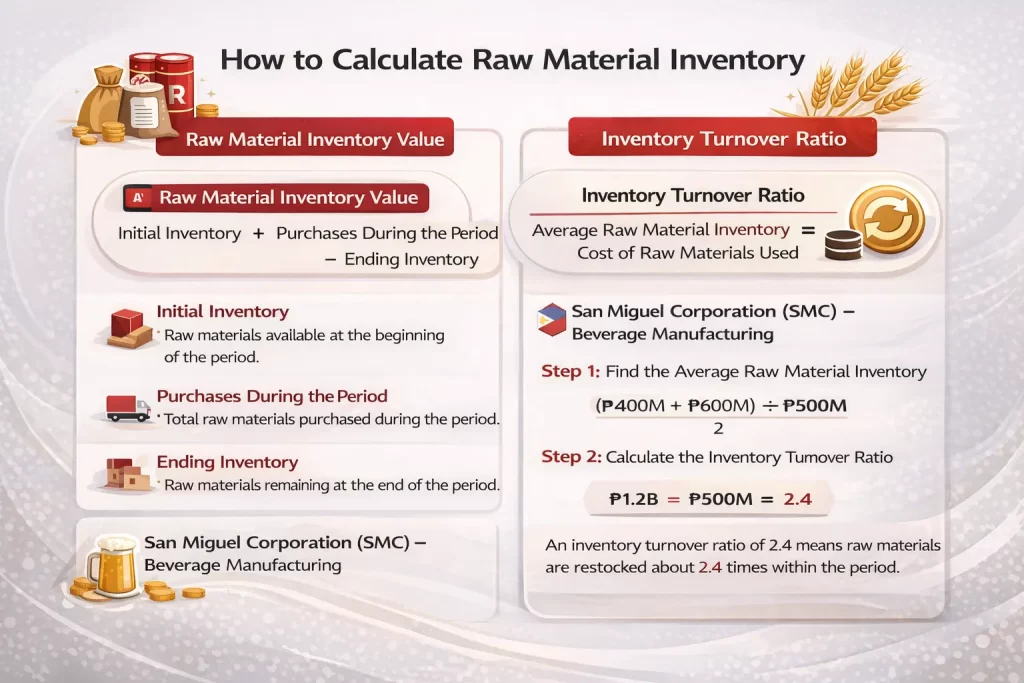
There are several methods that can be used to calculate raw material inventory, depending on the purpose of the calculation, such as determining the value of inventory or analyzing the use of raw materials. Here is how to calculate the raw material inventory formula:
1. Calculating the inventory value of available raw materials
The value of raw material inventory formula is calculated by summing up the cost of raw materials owned by the company at the end of a certain period. The formula is
Raw Material Inventory Value = Initial Inventory + Purchases During the Period – Ending Inventory
- Initial Inventory The amount of raw materials available at the beginning of the period
- Purchases During the Period Total raw materials purchased during the period
- Ending Inventory The amount of raw materials remaining at the end of the period.
2. Calculating turnover ratio
To find out how quickly raw materials are used in the production process, you can calculate the inventory turnover ratio using the formula:
Inventory Turnover Ratio = Average Raw Material Inventory ÷ Cost of Raw Materials Used
Example: San Miguel Corporation (SMC) – Beverage Manufacturing
San Miguel Corporation (SMC), a well-known food and beverage company in the Philippines, uses raw materials like barley, hops, sugar, and water to produce its products. To understand how efficiently they use their raw materials, we can calculate their Inventory Turnover Ratio using a simple method.
Step 1: Find the Average Raw Material Inventory
First, we take the raw material inventory at the start of the period (₱400 million) and at the end of the period (₱600 million). The average inventory is the sum of these two amounts divided by two.
- (₱400 million + ₱600 million) ÷ 2 = ₱500 million
Step 2: Calculate the Inventory Turnover Ratio
Now, we take the total cost of raw materials used during the period (₱1.2 billion) and divide it by the average raw material inventory (₱500 million).
- ₱1.2 billion ÷ ₱500 million = 2.4
What Does This Mean?
An inventory turnover ratio of 2.4 means that SMC uses up and restocks its raw materials about 2.4 times within the given period.
- A higher ratio means materials are moving quickly, which is good for efficiency but could risk running out of stock.
- A lower ratio suggests slow movement, which could lead to excess inventory and higher storage costs.
By analyzing this number, SMC can adjust its raw material orders to maintain the right balance. For manufacturers specifically, reviewing inventory tools designed for production environments can help identify features that align with raw material tracking needs.
How to Manage Raw Material Inventory
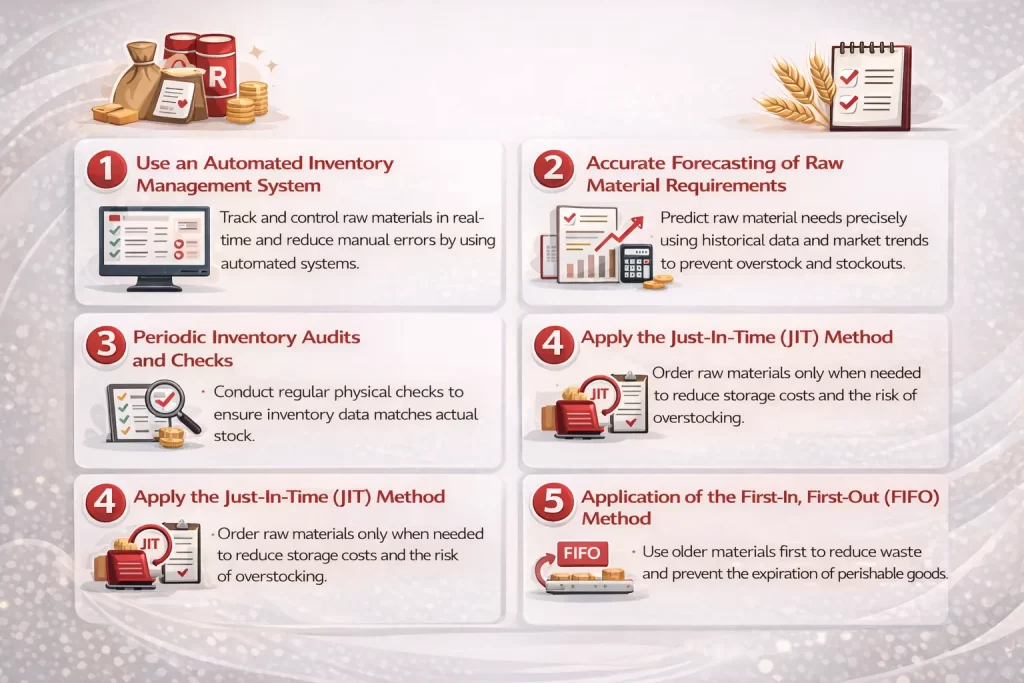
Here are 5 steps that can be taken to keep raw material inventory management efficient and minimize errors:
1. Use an automated inventory management system
Implementing an automated inventory management system is essential to monitor raw material stocks in real-time. These systems provide accurate stock counting and tracking across multiple locations, reducing the risk of manual errors such as incorrect data entry or miscalculated quantities. Beyond basic tracking, most automated systems also support reorder alerts, consumption-based forecasting, and integration with procurement workflows giving teams the visibility they need to make timely purchasing decisions before shortages or overstock situations develop.
For businesses managing stock across multiple locations, understanding how warehouse management systems support inventory accuracy can help inform the right system setup.
2. Accurate forecasting of raw material requirements
Performing proper forecasting based on historical data, market trends, and anticipated demand is very important. With accurate forecasting, companies can know when and how much raw materials to order. This helps prevent overstock or stockouts, which can lead to costly waste or production disruptions.
3. Periodic inventory audits and checks
Conducting audits and physical checks of raw material inventory on a regular basis is an important step to ensure inventory data matches physical stock quantities. Periodic audits can help companies identify potential errors, such as missing raw materials, damage, or data discrepancies, so that corrective steps can be taken immediately to avoid bigger problems in the future.
4. Apply the just-in-time (JIT) method
Just-in-Time is a method that organizes the ordering of raw materials based on actual production needs. With this system, companies only order raw materials when needed, reducing storage costs and the risk of overstocking. This method is very effective in improving the efficiency of raw material management, but requires good coordination with suppliers to ensure timely delivery.
5. Application of the first-in, first-out (FIFO) method
It is important to apply the FIFO method for raw materials with a limited shelf life, such as food ingredients or medicines. This means that the raw materials that first enter the warehouse will be used first in production. Thus, the risk of damage or expiration of raw materials can be reduced, thereby minimizing waste and maintaining the quality of the products produced.
Choosing the Right System for Raw Material Inventory Management

The five management steps above: automated tracking, accurate forecasting, periodic audits, JIT ordering, and FIFO application are significantly easier to execute consistently when supported by a dedicated inventory management system. Manual methods work at low volumes, but as a business scales, the complexity of tracking raw materials across multiple suppliers, warehouses, and production lines quickly exceeds what spreadsheets can reliably handle.
When evaluating inventory software for raw material management, the key capabilities to look for include real-time stock visibility, automated reorder rules based on consumption rates, integration with procurement and production workflows, and reporting tools that support periodic audit reconciliation. Systems that connect raw material data to financial reporting also provide better visibility into how inventory levels affect overall production costs and margins.
Conclusions
Effective raw material inventory management comes down to three fundamentals: knowing how much stock you have (accurate calculation), knowing how fast it moves (turnover ratio), and applying the right method for your business type, whether that’s JIT for lean operations, FIFO for perishables, or MRP for complex production schedules. Businesses that get these right reduce waste, avoid costly production stoppages, and maintain better control over their operating costs.
As inventory complexity grows more SKUs, more suppliers, more production lines, the case for moving beyond manual tracking becomes stronger. For businesses in the Philippines looking to evaluate their options, reviewing leading inventory management platforms suited for manufacturing and production can help identify tools that match both your raw material volume and operational workflow.
FAQ Around Raw Material Inventory
-
What is raw material inventory and why is it important?
Raw material inventory is the stock of unprocessed inputs a company holds before they are used in production. It is important because insufficient raw materials cause production delays, while excess inventory increases storage costs, ties up capital, and raises the risk of material spoilage or obsolescence. Proper management ensures production runs smoothly without unnecessary overhead.
-
How do you calculate raw material inventory value?
Raw material inventory value is calculated using this formula: Initial Inventory + Purchases During the Period – Ending Inventory. This gives the total cost of raw materials consumed or on hand during a given period. To measure how efficiently those materials are being used, divide the cost of raw materials used by the average raw material inventory to get the inventory turnover ratio.
-
What are the most common problems in raw material inventory management?
The most common problems are: overstocking (excess inventory that increases storage costs and spoilage risk), understocking (insufficient supply that halts production), inaccurate records (caused by manual data entry errors or lack of real-time tracking), and poor supplier coordination (which causes delays when using JIT methods). Most of these issues can be significantly reduced by switching from manual tracking to an automated inventory system.
-
What is the difference between JIT and FIFO in raw material management?
JIT (Just-in-Time) is an ordering strategy — it means raw materials are ordered and received only when needed for production, minimizing storage costs. FIFO (First-In, First-Out) is a usage strategy — it means the oldest stock in the warehouse is used first in production, reducing the risk of spoilage or expiration. Both can be used together: JIT governs when you order, FIFO governs how you use what you have.