













The skills your team needs today may not match what the business needs in three years. Upskilling improves employees’ current-role skills, while reskilling prepares them for a different role. In Malaysia, Randstad’s 2025 research found that 57% of workers would leave if they lacked development and advancement opportunities.
According to HRD Corp’s training effectiveness evaluation, employers need to assess whether training creates measurable outputs and outcomes. Government support and training budgets can help, but execution often breaks down when companies run training without clear skill gap analysis, proper tracking, or a link between training completion and performance outcomes.
For 2026, Malaysian employers need a practical way to identify training needs, fund programmes, and measure results through better HR management processes. This handbook explains how upskilling and reskilling work, how to use available support, and how to build a programme aligned with business goals.
Key Takeaways
|
Upskilling and reskilling are easier to manage when skill gaps, training records, and performance outcomes are tracked in one system.
Upskilling vs Reskilling: Definitions and Key Differences
Formal HR references such as SHRM and CIPD generally define upskilling as building on existing skills, while reskilling prepares employees for different work.
| Aspect | Upskilling | Reskilling | HR Perspective |
|---|---|---|---|
| Definition | Improving an employee’s existing skills for their current role | Teaching new skills so an employee can move into a different role | Choose based on whether the goal is role enhancement or role transition |
| Goal | Help employees perform better as their current job changes | Help employees transition when their current role no longer fits business needs | Supports workforce adaptability and long-term talent development |
| When Triggered | New tools, updated processes, automation, or higher performance expectations | Role redesign, department restructuring, digital transformation, or declining demand for old skills | Driven by organizational change and evolving business requirements |
| Malaysian Example | A finance executive learns cloud accounting and e-invoicing workflows | A factory operator is trained for data technician tasks in a smart manufacturing environment | Reflects workforce development priorities in Malaysia’s digital economy |
| HRD Corp Claimable | May be claimable if the course is HRD Corp-approved and linked to business training needs | May also be claimable when reskilling supports workforce redeployment or operational requirements | Employers should verify eligibility based on current HRD Corp guidelines |
Which Does Your Employee Need?
- Choose upskilling if the employee stays in the same role but needs stronger skills.
- Choose reskilling if the employee must move into a new role or function.
- Start with skill gap analysis before choosing any training programme.
Knowing the difference is step one, but most Malaysian employers struggle at execution. Without proper tracking, training can happen in isolation and fail to show whether skills actually improve performance outcomes.
What Are Upskilling and Reskilling?
Upskilling means improving an employee’s existing skills so they can perform better in their current role. For example, a payroll executive learning e-invoicing, HR analytics, or cloud-based HR tools is being upskilled because the role remains the same, but the skill requirement has changed.
Reskilling means training an employee for a different role or function. For example, a factory operator learning data monitoring or machine maintenance skills may be reskilled for a more technical role as automation increases in the workplace.
| Aspect | Upskilling | Reskilling |
|---|---|---|
| Main purpose | Improve current-role capability | Prepare for a new role |
| Best used when | The job is evolving | The job or business need is changing |
| Example | HR staff learns workforce analytics | Admin staff moves into recruitment operations |
For Malaysian employers, the difference matters because upskilling improves current-role performance, while reskilling prepares employees for new roles. HR should identify this before choosing any training course.
Why Malaysian Employers Can’t Ignore This in 2026

Imagine your best manager resigns, not because of salary, but because there is no clear development path. According to Randstad 2025 Workmonitor Malaysia, 57% of Malaysians would consider quitting if their managers did not support their professional development.
The same report shows that 55% would consider leaving if managers showed no interest in their long-term career growth. This pressure is higher among Gen Z at 63%, compared with Baby Boomers at 51%.
The bigger issue is execution. Randstad 2025 also found that 35% of respondents said their employers had not implemented career development opportunities in the past 12 months. This shows why Malaysian employers need a structured process to identify skill gaps, run training, and connect learning outcomes with performance. For 50+ employee companies, tracking training in a spreadsheet is not a system.
How to Fund Upskilling and Reskilling Through HRD Corp and TalentCorp
Every Malaysian employer with 10+ workers is likely already contributing to the Human Resource Development Corporation (HRD Corp) training fund, which can support structured upskilling and reskilling programmes. As part of HR compliance in Malaysia, employers with 10 or more Malaysian employees in covered sectors must register and contribute a 1% monthly levy, while employers with 5 to 9 Malaysian employees may register voluntarily at 0.5%.
HRD Corp Levy
HRD Corp levy is a training fund contributed by eligible Malaysian employers to support employee upskilling and reskilling programmes. Through HRD Corp Claimable Courses, previously known as SBL-Khas, employers can use levy funds for approved training. The claim process should be prepared before training starts:
- Check e-TRiS: Confirm registration status and available levy balance.
- Source provider: Choose an HRD Corp-registered training provider.
- Submit grant: Apply before training begins to secure approval.
- Run training: Keep attendance, invoices, and supporting documents.
- Submit claim: File the claim after completion for reimbursement.
Underutilisation matters. HRD Corp’s Program Latihan Madani FAQ states that employers with RM50,000 or more in unused levy and below 50% levy utilisation may face a 15% deduction.
TalentCorp Industry-Academia Programmes for Employers
TalentCorp Industry-Academia programmes connect employers with education and skills development partners to support Malaysia’s workforce readiness. TalentCorp’s Centre of Excellence, launched in 2021, supports industry-academia collaboration. Employers can also use UpSkill Malaysia to find government-linked skills programmes.
Funding is available, but execution determines impact. The next step is building a programme that identifies skill gaps, assigns training, and tracks results.
How to Build an Upskilling and Reskilling Programme in 5 Steps
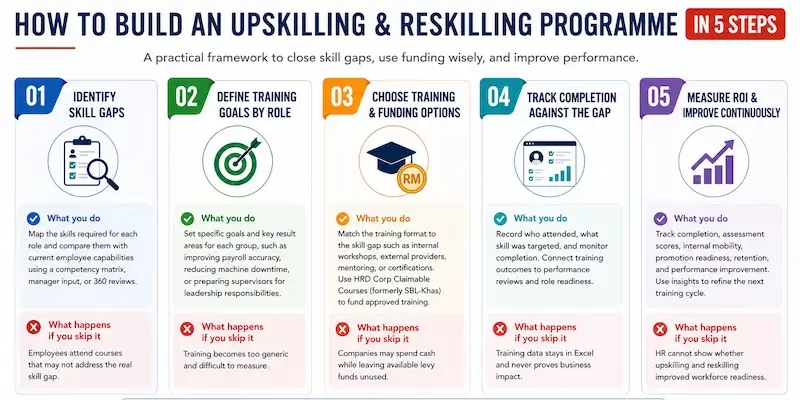
A strong upskilling and reskilling programme starts with skill gaps, not course lists. These five steps help HR teams plan training, use funding properly, and measure whether learning improves performance.
Step 1: Build a skill gap matrix
Compare each role’s required skills with current employee capability using a competency matrix, manager interviews, or 360 reviews. This keeps training tied to actual business needs, not assumptions.
What breaks without it: employees attend courses that may not close the real skill gap.
Step 2: Define training goals by role
Set specific goals and key result areas for each group, such as improving payroll accuracy, reducing machine downtime, or preparing supervisors for leadership responsibilities.
What breaks without it: training becomes too generic and difficult to measure.
Step 3: Choose training and funding options
Match the training format to the skill gap, such as internal workshops, external providers, mentoring, or certifications. For Malaysian employers, HRD Corp Claimable Courses, formerly SBL-Khas, can help fund approved training when applications are submitted correctly.
What breaks without it: companies may spend cash while leaving available levy funds unused.
Step 4: Track completion against the skill gap matrix
This is where most programmes die: training is completed but never tracked, never connects to a performance review. HR should record who attended, what skill was targeted, and whether performance changed after training.
What breaks without it: training data stays in Excel and never proves business impact.
Step 5: Measure ROI and update the next cycle
Track completion, assessment scores, internal mobility, promotion readiness, retention, and performance review improvement. LinkedIn’s 2025 Workplace Learning Report found that career development champions are more confident in retaining qualified talent than other organisations, at 67% versus 50%.
What breaks without it: HR cannot show whether upskilling and reskilling improved workforce readiness.
How HR Software Makes Upskilling and Reskilling Scalable
Most training records still live in shared Excel files and the manager’s memory. Without an HR information system to centralize employee and training data, you are running training as a cost, not an investment.
| Process | Manual Approach | With HR Software | Business Impact |
|---|---|---|---|
| Skill Gap Identification | HR depends on manager notes and scattered performance feedback | A skill gap dashboard shows which employees need which training | Improves visibility into workforce development needs and training priorities |
| Training Record Update | Attendance and certificates are updated manually after each session | Training records are stored in each employee profile automatically | Reduces administrative workload and minimizes record-keeping errors |
| Progress Visibility | Managers only see updates when HR sends reports | HR and managers can track completion, pending training, and follow-up actions | Provides real-time monitoring of employee development progress |
| Link to Performance Review | Training results often stay separate from appraisal data | Completed training can be reviewed alongside performance scores and role readiness | Supports better talent management and succession planning decisions |
When HR Does Not Know Who Needs What Training
An integrated HR and workforce management system helps HR identify training needs by role, department, or employee group through a more structured skill gap dashboard. This prevents companies from sending employees to the same course when their actual skill gaps are different.
When Completed Training Never Reaches Performance Reviews
Automated training records make it easier to connect course completion, assessment results, and manager feedback with performance reviews. This helps HR see whether upskilling and reskilling efforts are improving workforce readiness.
For Malaysian employers managing more employees, outlets, or departments, an integrated ERP system with HR capabilities can help connect training records, performance reviews, attendance, and employee data in one place. This makes upskilling and reskilling easier to track, measure, and scale without relying on scattered spreadsheets.
Mistakes to Avoid When Rolling Out Training Programmes
Waiting until employees are ready to leave
According to Randstad 2025 Workmonitor Malaysia, 35% of respondents said their employers had not implemented career development opportunities in the past 12 months. Doing this costs you retention because employees see no clear growth path.
Treating training as a one-time event
ATD discusses the Ebbinghaus forgetting curve, where learners may forget up to 70% of new information after 24 hours without reinforcement. Doing this costs you application because employees forget before they use the skill.
Choosing courses before skill gap analysis
Training should begin with role requirements, manager feedback, and performance gaps. Doing this backward costs you budget because the course may not solve the real problem.
Leaving HRD Corp levy unused
If your levy is not claimed properly, you are effectively donating your training budget back to the government. Doing this costs you funding that could support approved upskilling and reskilling programmes.
Tracking training in spreadsheets only
Spreadsheets cannot reliably connect training completion with performance reviews, role readiness, or skill gap closure. This is why many employers later compare HR software options in Malaysia to manage training, performance reviews, and skill gap tracking properly.
Conclusion
The 57% of employees ready to leave without development support are not waiting for a perfect training programme. They are waiting for an employer who takes execution seriously, from identifying skill gaps to tracking whether training improves performance.
Upskilling and reskilling only create long-term value when they are planned, recorded, and measured properly. Government support, HRD Corp funding, and training providers can support the process, but employers still need a clear system to connect training activity with workforce readiness.
A free demo can help employers see how skill gap tracking, training records, performance reviews, and employee data can work together in one HR system before deciding how to manage their upskilling and reskilling programme.
FAQ About Upskilling and Reskilling
-
What is the difference between upskilling and reskilling?
Upskilling improves skills for an employee’s current role, while reskilling teaches new skills for a different role. Employers use upskilling when a role is evolving and reskilling when an employee needs to move into a new function.
-
How do I know if an employee needs upskilling or reskilling?
Choose upskilling if the employee will stay in the same role but needs stronger skills. Choose reskilling if the employee must shift into a different role, department, or job function because business needs have changed.
-
How can Malaysian employers claim HRD Corp training funds?
Employers can claim HRD Corp training funds by checking levy balance, choosing an HRD Corp-registered provider, submitting a grant application before training, completing the programme, and filing the claim with supporting documents through the required HRD Corp process.
-
How much budget is needed for upskilling and reskilling?
Training budget depends on the programme type, provider, duration, and number of employees. For eligible employers, HRD Corp can offset 80–100% of approved programme costs when the training meets claim requirements.
-
How does HR software help manage upskilling and reskilling?
HR software helps track skill gaps, training records, completion status, and performance review links in one system. This makes it easier to measure whether training improves workforce readiness. Learn more through HR software Malaysia.