












For any new brand entering the Malaysian market, price is often the only competitive lever that actually moves buyers. Established players, like Lazada and Maxis, already own the brand recognition, distribution, and marketing spend. Penetration pricing turns that price gap into a market-share gain.
This works in Malaysia because local consumers are unusually price-conscious. Smartphone penetration is among the highest in Southeast Asia, and shoppers routinely compare prices across Shopee, Lazada, and Foodpanda before buying. Price consistently ranks as the top reason Malaysians switch brands, making the country one of the most fertile markets for penetration pricing.
Whether you are launching a D2C brand, SaaS product, food chain, or supply chain business, this article helps you decide if penetration pricing fits your market and how to apply it without locking customers at low prices.
Key Takeaways
|
Boost business growth with smarter pricing strategies and a fully integrated ERP system that helps manage sales, inventory, and customer retention more efficiently.

What is Penetration Pricing Strategy?
Penetration pricing is a market entry strategy where businesses launch products at low prices to quickly attract customers and gain market share before gradually increasing prices later. The strategy focuses on sacrificing short-term profits to build a stronger long-term market position through rapid adoption and customer retention.
This approach works best in competitive markets with price-sensitive customers, especially for new brands trying to compete with established players. Unlike price skimming method, which starts with high prices and lowers them over time, penetration pricing begins low and increases gradually later on.
Key Objectives of a Penetration Pricing Strategy
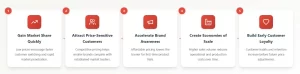
A well-designed penetration pricing strategy is not just about being cheap. It is about hitting specific commercial objectives. For Malaysian SMBs operating in highly competitive sectors like F&B, e-commerce, and SaaS, the strategy serves five clear goals.
- Gain market share quickly
In categories with one or two dominant players, organic growth is slow. A low launch price gives buyers a concrete reason to switch immediately. Malaysian consumers, particularly Gen Z and millennials, respond strongly to price-led promotions on TikTok Shop and Shopee. - Attract price-sensitive customers away from incumbents
Price-sensitive buyers do not leave incumbents like Lazada because they are unhappy. They leave when someone gives them a concrete reason to switch, and a lower entry price removes the perceived risk of trying an unfamiliar brand. The comparison shifts from “familiar vs unknown” to actual value delivered, which the incumbent cannot win on brand alone. - Accelerate brand awareness and product trial
A cheaper price lowers the psychological cost of trying. This is especially powerful for unknown brands. The customer thinks, “if it is bad, I have not lost much”. That single mental shift is what unlocks first-time trial volume in a saturated MY market. - Create economies of scale at volume
Higher unit volume drives down per-unit cost across procurement, logistics, and fulfilment. Local manufacturers and distributors recover real margin once volume crosses break-even. The low price funds the volume, the volume funds the lower unit cost. - Establish early loyalty before raising prices
Habit, app usage, and switching cost build over months. By the time prices rise, customers are already on autopay or have the app installed. Loss aversion does the rest, which is why penetration pricing rewards patience over short windows.
Real Examples of Penetration Pricing in Malaysia
Malaysia has produced some of Southeast Asia’s most decisive penetration pricing case studies. The pattern is consistent: a well-funded challenger uses aggressive launch pricing to undercut a complacent incumbent, then locks in users before the incumbent can react.
- Grab vs Uber Malaysia (2012 to 2018)
Grab used aggressive discounts, promo codes, and driver incentives to undercut Uber in Malaysia’s ride-hailing market. The strategy helped Grab dominate the market before Uber exited Southeast Asia in 2018. - Shopee vs Lazada Malaysia (2015 to 2018)
Shopee entered the Malaysian e-commerce market with free shipping, zero seller fees, and heavy promotions to attract users and sellers. By 2019, Shopee had surpassed Lazada in monthly active users before gradually introducing more platform fees. - Disney+ Hotstar Malaysia (2021 launch)
Disney+ Hotstar launched in Malaysia with a much lower annual subscription price compared to Netflix. The affordable entry pricing quickly attracted a large subscriber base before later price adjustments. - Telco intro pricing (Celcom, Digi, Maxis)
Malaysian telcos such as Celcom, Digi, and Maxis often launch fibre or postpaid plans at discounted introductory prices before increasing rates after the promo period. This approach helps attract customers from competitors while building long-term retention.
The common thread across all four cases is operational readiness. Each company had the inventory, financial management, and pricing infrastructure to absorb the demand surge before launching the offer. Without that backbone, the strategy collapses into stockouts and refunds.
Advantages and Disadvantages of Penetration Pricing
Advantages
- Fast customer acquisition
Low launch prices help businesses attract customers quickly by reducing hesitation during the buying process. In price-sensitive markets, discounts can generate strong trial volume much faster than relying only on marketing campaigns.However, rapid growth is only valuable if customers continue using the product after prices increase. Businesses still need strong retention strategies such as loyalty features, subscriptions, or good user experience to maintain long-term growth. - Disrupts market leaders
Penetration pricing allows smaller businesses to compete against established brands by offering more attractive prices. Large incumbents often struggle to match aggressive discounts without hurting their own profitability.This creates an opportunity for new entrants to gain market share in crowded industries like retail, F&B, and SaaS. For many smaller Malaysian businesses, pricing flexibility becomes one of their biggest competitive advantages. - Builds brand familiarity early
Lower prices reduce the risk for first-time buyers who are unfamiliar with a brand. This encourages more people to try the product and increases brand visibility in competitive markets.As more customers try the product, brand awareness and consideration grow naturally over time. In highly competitive digital markets, lower pricing can sometimes attract attention more effectively than advertising alone.
Disadvantages
- Price anchoring risk
Customers often treat the first price they see as the “normal” price. When businesses later increase prices, customers may perceive it negatively even if the pricing becomes more sustainable.To reduce this risk, companies should clearly communicate that the low price is a temporary launch promotion. Showing expiry dates or limited-time labels can help manage customer expectations early. - Race to the bottom
Competitors may continue lowering prices to protect their market share, creating aggressive price wars that reduce profitability for everyone involved. Businesses with stronger financial resources usually survive longer in these situations.To avoid damaging margins, companies should set minimum pricing limits and maintain strong cost control. ERP and pricing systems can also help prevent unsustainable discounting across sales channels. - Attracts price-sensitive customers
Penetration pricing often attracts customers who mainly care about discounts. These users may quickly switch to another brand if a cheaper option becomes available later.Businesses need to focus on customer experience, onboarding, and loyalty-building during the promotional period. Referral programs, memberships, and subscriptions can help turn short-term buyers into long-term customers.
Summary:
| Advantages | Disadvantages |
|---|---|
| Fast Customer Acquisition
Low launch prices help businesses attract customers quickly and generate faster trial volume in price-sensitive markets. Long-term success still depends on retention strategies such as subscriptions, loyalty features, and strong user experience. |
Price Anchoring Risk
Customers may become attached to the initial low price and react negatively when prices increase later. Businesses should clearly frame the discount as a temporary launch offer to manage expectations early. |
| Disrupts Market Leaders
Penetration pricing helps smaller businesses compete with established brands by forcing incumbents to balance profitability and market share. This creates opportunities for new entrants in crowded industries. |
Race to the Bottom
Competitors may continue lowering prices, leading to aggressive price wars that hurt profitability. Businesses need pricing controls and cost management to avoid unsustainable margins. |
| Builds Brand Familiarity Early
Lower prices encourage first-time buyers to try unfamiliar brands, helping businesses increase visibility and brand awareness more quickly in competitive markets. |
Attracts Price-Sensitive Customers
Discount-driven customers may switch once cheaper alternatives appear. Businesses should strengthen onboarding, loyalty programs, and customer experience to improve long-term retention. |
When Should You Use Penetration Pricing?

Penetration pricing is powerful, but it is not the right move for every Malaysian business. Use this checklist before committing.
Use penetration pricing when:
- Your product is in a price-sensitive, competitive MY category. F&B, retail sales, e-commerce, telco, and SaaS are textbook fits.
- You have sufficient cash flow to sustain lower margins for at least 6 to 12 months without compromising payroll or supplier obligations.
- Your product delivers enough genuine value to retain customers after prices normalize. Quality, service, or convenience must justify the higher price later.
- You have operational capacity to handle demand spikes. A successful launch can overwhelm fulfilment, warehousing, and customer service.
- You have a clear exit plan. Decide before launch HOW and WHEN prices will be raised. Vague exits create customer backlash.
- You can track key metrics: market share, customer acquisition cost, churn, and unit economics. Without an ERP or analytics layer, you are flying blind.
- You are aware of Malaysia’s Price Control and Anti-Profiteering Act 2011. Predatory pricing aimed solely at destroying competition can attract KPDNHEP scrutiny. Penetration pricing is generally legal, pricing below cost with anti-competitive intent is not.
When NOT to use it
Avoid penetration pricing if you sell luxury or premium goods, where a low price actively damages perceived value. Also skip it if demand is inelastic or if your product has no real moat to defend the price increase later. In those cases, value-based or skim pricing usually serves the business better than chasing volume.
Penetration Pricing vs Price Skimming: Key Differences
The simplest way to choose between the two is to look at who you want to attract first. Penetration pricing chases volume early, meanwhile price skimming chases margin from premium buyers first. Both work, but in opposite contexts.
| Factor | Penetration Pricing | Price Skimming |
|---|---|---|
| Initial Price | Low, below incumbent | High, above market |
| Target Audience | Price-sensitive mass market | Early adopters, premium buyers |
| Primary Goal | Capture market share fast | Recover margin upfront |
| Brand Positioning | Accessible, value-driven | Premium, exclusive |
| Price Direction | Rises gradually over time | Drops gradually over time |
| Best For | Crowded, elastic markets | Innovative, scarce products |
| MY Example | Shopee, Grab, Disney+ Hotstar | Apple iPhone launch pricing |
For most Malaysian SMBs, the question is not “which is better” but “which fits my market”. If you are entering an existing category dominated by larger players, penetration pricing is usually the structural answer. If you are launching something genuinely new, scarce, or premium-positioned, skimming may serve you better.
How Accounting Software Supports Penetration Pricing Execution?
Executing a penetration pricing strategy at scale is a financial discipline, not just a marketing one. Keeping margin from leaking, tracking cash flow during the low-margin phase, and connecting short-term discounts to long-term customer lifetime value is the hard part. An integrated accounting system gives operators the financial visibility to run the strategy without losing control.
- Real-time margin and COGS tracking
A low-price launch can quietly erode margin if cost of goods sold is not updated in real time. Accounting software with live COGS tracking shows actual gross margin per SKU, channel, and customer segment, so finance can spot leaks before they accumulate into a quarter-end surprise. - Cash flow forecasting for the discount phase
Penetration pricing strains cash because volume rises while per-unit margin drops. An accounting platform with cash flow forecasting projects runway across the launch window, flags shortfalls early, and helps finance time supplier payments to avoid liquidity gaps. - Discount, promotion, and revenue reconciliation
Penetration pricing usually runs across multiple channels with different discount structures. Accounting software consolidates revenue, discount, and rebate entries automatically, preventing the manual reconciliation errors that often distort the campaign’s reported profitability. - Tax compliance and e-Invoice readiness
Malaysia’s e-Invoice mandate (LHDN) requires accurate, real-time invoicing including promotional discounts. Accounting software that integrates with LHDN’s MyInvois system ensures every penetration-priced transaction is captured correctly, avoiding compliance penalties that can wipe out the campaign’s gains.
Conclusion
Penetration pricing is powerful, but only if executed with clear margin, a plan, and an exit strategy. Three conditions separate the success stories from the cautionary tales.
First, the product itself has to be worth keeping at the post-launch price. Without genuine value, you are subsidising churn. Second, the launch price has to be framed transparently as a launch offer with a known expiry. Anchoring customers to the low price permanently destroys margin recovery. Third, the operations behind the strategy must be ready before the first promotional ad runs.
If you can hit those three, penetration pricing remains one of the most effective ways for a Malaysian SMB to take share from a larger competitor. See how the right ERP and pricing strategy can help your business in the Malaysian market through a free demo today.

FAQ about Penetration Pricing Strategy
-
How long should a business run penetration pricing in Malaysia?
Most successful Malaysian campaigns run 6 to 12 months before stepping prices up. Shorter windows rarely build enough habit or switching cost to retain customers through the price rise. Longer windows anchor expectations to the low price and erode margin recovery. Subscription services usually need 6 to 9 months to build app habit; physical retail and F&B can often step up within 4 to 6 months.
-
What are the main risks of penetration pricing for Malaysian businesses?
The three main risks are price anchoring, margin race-to-the-bottom, and attracting non-loyal price-switchers. Anchoring locks customer expectations to the launch price. Race-to-the-bottom occurs when a deeper-funded competitor outlasts your discount. Price-switchers churn the moment a cheaper option appears. Mitigation: transparent launch framing, hard margin floors in your pricing system, and strong onboarding during the introductory window.
-
What metrics should Malaysian businesses track during a penetration pricing campaign?
Track six core metrics: customer acquisition cost (CAC), market share by segment, gross margin per SKU, churn rate by cohort, repeat purchase rate, and time to second purchase. CAC tells you if the discount is acquiring customers efficiently. Margin per SKU prevents undetected losses. Churn and repeat purchase together reveal whether the strategy builds loyalty or attracts bargain-hunters.
-
Is penetration pricing legal in Malaysia?
Penetration pricing is legal in Malaysia for genuine market-entry. The Price Control and Anti-Profiteering Act 2011 prohibits predatory pricing aimed solely at destroying competition. Pricing temporarily below the incumbent to gain share is permitted, pricing below cost with anti-competitive intent can attract KPDNHEP scrutiny. Document the commercial rationale and set a clear exit timeline to show genuine market-entry intent.