













Commercial farming in Malaysia is a battle against rising costs and tropical rains that wash away your investment. Traditional methods are failing because heavy leaching leaves crops starving despite high operational spending. Without precision delivery, you are simply losing money to the soil.
Research proves conventional methods lose up to 40% of nitrogen to the environment, a massive waste for those targeting MyGAP or export standards. Switching to controlled delivery boosts Nutrient Use Efficiency, ensuring every Ringgit spent on inputs drives yield. This approach allows for spoon feeding nutrients that match plant growth even during humid monsoon seasons.
For Malaysian farm operators evaluating fertigation in 2026, the right system depends on crop type, field scale, water quality, and MyGAP requirements. This guide covers how fertigation works, its core components, ROI factors, common mistakes, and how a smart agriculture solution for farm efficiency can support better decisions.
Key Takeaways
|
What is a Fertigation System and How Does it Work?

A fertigation system is an agricultural setup that injects water soluble fertilizers directly into your irrigation network. This method delivers nutrients straight to the root zone, ensuring Malaysian growers maintain high efficiency even during heavy monsoon seasons . Whether using drip or sprinkler systems, the goal is to use water as a delivery vehicle to reach plants where they need it most.
The system operates through controlled injection and pressure differentials. Concentrated nutrients from stock tanks are introduced into the waterline using mechanisms like venturi injectors or computer controlled pumps. This precision is vital for meeting LHDN MyInvois digital tracking requirements for large scale commercial inputs. Once mixed, the balanced solution is distributed uniformly across the field via emitters.
The Evolution of Irrigation and Fertilization
Traditional irrigation was inefficient
Farmers used flood irrigation and manual fertilizer broadcasting, which often caused uneven water distribution, waterlogged soil, drought stress, and nutrient loss.
Malaysia’s tropical weather made the issue harder
Heavy rainfall could wash away nutrients before crops absorbed them, making fertilizer use less efficient and increasing runoff risk.
Sprinkler and drip irrigation improved precision
Sprinkler systems became common in the mid 20th century, while drip irrigation in the 1960s allowed water to reach the plant base more accurately.
Fertigation made nutrient delivery more controlled
Instead of relying on rainfall, growers could apply water and nutrients together, supporting more consistent crop growth and better alignment with MyGAP standards.
Modern fertigation is now more automated
With injection pumps and filtration systems, automated systems help commercial farms reduce manual errors, lower labour costs, and cut resource waste.
The Science of Nutrient Delivery in Fertigation
Fertigation delivers dissolved nutrients directly to the root zone, bypassing the slow absorption of surface spreading. This method ensures faster nutrient uptake by reducing dependence on unpredictable soil conditions. For growers in Malaysia, this precision prevents expensive fertilizers from being washed away by heavy rainfall, securing your investment against the elements.
Nutrient compatibility is vital because mixing incompatible fertilizers can cause chemical reactions that clog your system. Calcium based fertilizers often react with sulfates to form solids that damage emitters. Using separate stock tanks keeps these nutrients apart until dilution, a necessary step to maintain infrastructure and meet MyGAP operational standards.
Monitoring pH and electrical conductivity is essential for optimal plant health. These metrics determine how well plants absorb nutrients and the salt concentration in the solution. Keeping these within range prevents crop toxicity, helping your farm stay compliant with local regulations while maximizing yield.
Essential Components of a Modern Fertigation System
A reliable fertigation system uses several connected parts to deliver nutrients safely while protecting your farm assets. While the setup changes based on your farm size, the basic structure stays the same for all professional operations.
Injection Mechanisms
The injector is the most important part because it controls exactly how much fertilizer enters your water line. There are three common types:
- Venturi Injectors: These affordable tools use vacuum pressure to pull fertilizer into the pipes.
- Proportional Injection Pumps: These pumps are driven by water and keep a steady fertilizer ratio even if your water flow changes.
- Positive Displacement Pumps: These electric pumps work with computers to give you very high precision for real time feeding.
Filtration Systems
Good filters are your main defense against clogged emitters, which happens often with water soluble fertilizers. Most setups use sand filters to catch organic dirt and disc filters after the injection point to catch any leftover particles. This two step cleaning is a must to meet MyGAP standards and keep your equipment running for years.
Backflow Prevention Devices
Safety is a major concern because you do not want chemicals flowing back into local water supplies. Special check valves stop the fertilizer mix from moving backward if your pump suddenly stops. In Malaysia, these safety parts are required by law to protect groundwater and stay compliant with local regulations.
To make your equipment last longer, you should track the total performance and productivity of their machinery to catch mechanical issues early. Regular habits like calibrating your pumps and washing your filters are necessary to keep your farm running at a high standard.
Advantages of Fertigation for Modern Agriculture
Switching from traditional methods to a complete fertigation system offers major agronomic and economic wins. These advantages are why Malaysian farms are rapidly adopting this technology to stay competitive.
Enhanced Nutrient Use Efficiency (NUE)
NUE tracks how much fertilizer actually feeds the plant instead of being wasted. Conventional broadcasting fails when heavy Malaysian rain washes away granules before roots can grab them. Fertigation delivers soluble nutrients straight to the root zone through spoon feeding. This smart farming and data driven approach ensures crops get a steady supply during critical stages like flowering.
Environmental Sustainability and Emission Reduction
Over applying fertilizer causes pollution, but a managed system keeps your farm eco friendly. By applying only what is necessary, you stop nitrates from leaking into local groundwater or rivers. Mixing nutrients directly into the water also cuts harmful gas emissions, helping your business stay compliant with local environmental laws.
Labor and Operational Savings
Traditional pemupukan requires heavy labor and tractors that burn fuel and compact your soil. A fertigation system automates the process by letting nutrients flow through your existing pipes. This saves on labor and protects soil quality, which is vital for long term yield and meeting MyGAP standards.
Economic Analysis: Costs and ROI
Deciding to install a fertigation system usually depends on the numbers despite the clear environmental perks. Managers must weigh setup costs against future savings to find the true Return on Investment.
For example, if a farm invests RM80,000 in fertigation equipment and saves RM25,000 per year from lower fertilizer use, labour costs, and water waste, the payback period would be around 3.2 years.
Formula:
Payback Period = Initial Investment ÷ Annual Savings
RM80,000 ÷ RM25,000 = 3.2 years
This simple calculation helps farm operators estimate how long it may take before the system starts giving financial returns.
Initial Investment vs. Long-Term Gains
Initial investment refers to the upfront cost needed to set up the fertigation system. This usually includes pumps, tanks, safety valves, filters, injectors, and drip lines if your farm does not already have them. Because of this, farm operators need to compare the permanent overhead versus the ongoing operational spending before deciding whether the system fits their budget.
Long-term gains come from lower recurring costs and better resource control. With improved Nutrient Use Efficiency, farms can spend less on supplies because fertilizers, water, fuel, and labour are used more efficiently. Over time, better input control can also improve crop quality, produce more uniform yields, and help high value Malaysian farms recover their investment within two to three seasons.
Industry Use Cases: Fertigation Across Different Agricultural Sectors
While the basic principles of injecting nutrients stay the same, the application of a fertigation system changes based on your agricultural sector. This technology is flexible enough to meet the specific needs of various crops, from high tech indoor farms to massive open fields. In Malaysia, understanding these specific use cases helps you pick the right setup for local soil and weather.
Greenhouse and Controlled Environment Agriculture (CEA)
In greenhouses and vertical farms, fertigation is the lifeblood of the operation because plants often grow without soil. Since substrates like coco coir lack natural nutrients, every element must be supplied artificially. High precision systems in CEA use dosing cabinets to monitor EC and pH in real time. For crops like greenhouse tomatoes or cucumbers, the ability to instantly change the nutrient recipe results in higher yield densities and standard quality.
Orchards and Vineyards (High-Value Crops)
For high value perennial crops like citrus or mangoes, fertigation offers a strategic way to manage long term tree health. These farms use drip networks to deliver nutrients directly to the active root zone. This targeted approach is vital for deep rooted trees, ensuring nitrogen is not lost to leaching during heavy Malaysian rains. Post harvest feeding also helps trees replenish reserves before the next season starts.
Open-Field Row Crops
Historically, row crops like corn relied on heavy machinery, but modern center pivot fertigation has revolutionized broad acre farming. Farmers can now spoon feed nitrogen and potassium during peak demand periods. This practice significantly reduces the risk of nutrient runoff into local Malaysian waterways. It also allows for mid season corrections if a sudden deficiency is found without waiting for a tractor to pass through mature crops.
Turfgrass and Commercial Landscaping
The turfgrass industry, including golf courses and stadiums, uses fertigation to maintain perfect aesthetic standards. Superintendents use low dose applications of nitrogen and iron to maintain uniform color and quick recovery. This micro dosing strategy prevents rapid growth flushes and reduces the risk of fungal diseases that thrive in Malaysia’s humid tropical climate.
Step-by-Step Implementation Guide for Fertigation Systems
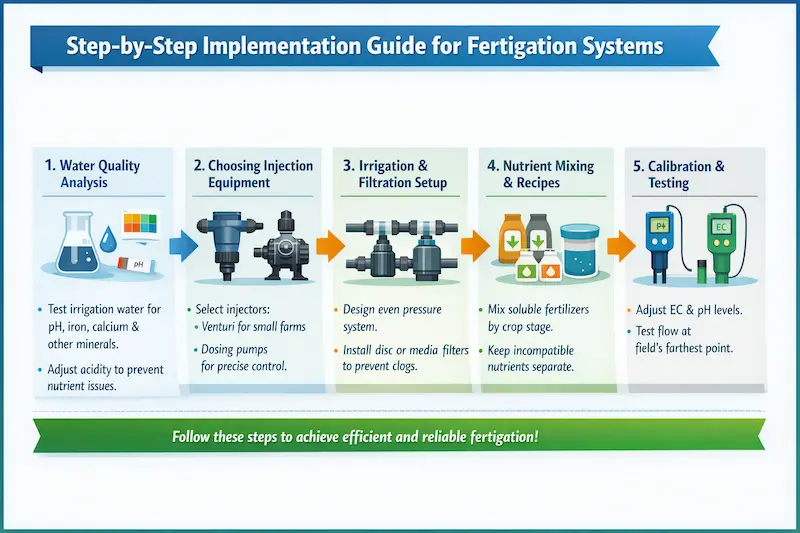
Switching from traditional methods to an integrated fertigation system is a major operational shift that requires careful planning. A poor design can lead to crop failure or expensive equipment damage, so growers must follow a systematic process.
Step 1: Comprehensive Water Quality Analysis
The first step is getting a detailed chemical analysis of your irrigation water. Your water chemistry dictates which fertilizers you can use safely. High alkalinity might require injecting agricultural acids to lower the pH to an optimal range and prevent nutrient lockout. For Malaysian growers, checking for high levels of iron or calcium is vital to prevent chemical reactions that cause emitter clogging.
Step 2: Selecting the Right Injection Equipment
Choosing the right injector depends on your farm scale and budget. Venturi injectors are affordable but sensitive to pressure changes. For larger or more precise operations, positive displacement pumps are better because they inject a steady volume regardless of flow changes. This consistency is key to meeting high commercial standards.
Step 3: Designing the Irrigation Infrastructure and Filtration
Your system is only as good as the network delivering the solution. The design must ensure uniform pressure so every plant receives the same dose. Reliable filtration is non negotiable, requiring disc or media filters both before and after the injection point. This multi stage cleaning prevents clogged emitters and uneven distribution.
Step 4: Formulating the Nutrient Recipe
With the hardware ready, you must create water soluble nutrient recipes tailored to your crops growth stage. It is essential to keep incompatible fertilizers in separate stock tanks. For example, calcium based fertilizers must stay away from sulfates until they are diluted in the main line to avoid blockages.
Step 5: System Calibration and Testing
Before feeding your crops, calibrate the entire system using plain water. Use EC and pH meters to verify that the solution reaching the furthest corner of the field is correct. Regular calibration schedules help you account for pump wear and keep your farm running at peak efficiency.
Common Mistakes and How to Avoid Them
Even with its benefits, fertigation has challenges that require careful management to protect your crops and gear . Recognizing these risks is the first step toward keeping your farm running smoothly.
Emitter Clogging and Chemical Precipitation
Clogged emitters happen when incompatible fertilizers react to form solids inside your lines. Mixing Calcium Nitrate with Magnesium Sulfate, for example, creates gypsum that cements pipes shut. To avoid this, always do a jar test by mixing fertilizers in a glass for 24 hours to check for cloudiness . Using multi channel injectors to keep solutions separate is also a must to meet MyGAP operational standards.
Backflow Prevention Failures
Injecting chemicals creates a risk of back siphoning if your pump loses power . This can suck fertilizer backward and contaminate local Malaysian groundwater or wells. To stay compliant with local laws, you must install high quality check valves or RPZ valves upstream. These safety devices require annual inspection to ensure total environmental protection.
Over-Fertigation and Salinity Buildup
Easy application can tempt you to overdo it, leading to toxic salt buildup in the soil. This salt causes fertilizer burn and dehydrates your plants. You should use routine soil testing to verify what your plants actually need. Adding plain water leaching cycles to your schedule will also help flush out excess salts and keep your ROI high.
Ignoring System Flushing Protocols
Leaving nutrient rich water in your pipes creates a breeding ground for algae and slime. This stagnant water will quickly clog your system during the next cycle. Always finish every session with a clean water flush to completely clear the lines. This simple habit is vital for maintaining system longevity and avoiding expensive repairs.
Conclusion
Adopting a fertigation system is a turning point for high efficiency farming in Malaysia. By turning your irrigation network into a precision delivery tool, you gain control over crop growth and resource saving. Whether in a greenhouse or open fields, this technology ensures your farm stays competitive and compliant with MyGAP standards.
While setup requires careful water management, the return on investment is undeniable. Avoiding pitfalls like clogging ensures your infrastructure stays safe for years. As smart farming and data driven approaches evolve, fertigation remains the best way to produce higher quality food with fewer resources in our tropical climate.
Seeing the benefits in theory is one thing, but experiencing the precision firsthand will truly transform your farm management. Stop guessing your nutrient levels or letting bad weather wash away your hard earned investment. Access our free demo today to see how real time data can boost your yield accuracy and operational efficiency.

Frequently Asked Questions About Fertigation Systems
-
What is the difference between fertigation and drip irrigation?
Drip irrigation refers to the physical delivery system, including pipes, emitters, and pressure networks that transport water directly to plant roots. Fertigation expands this process by injecting dissolved fertilisers into the irrigation water, allowing nutrients and water to be delivered together in a single application. While all fertigation systems rely on irrigation infrastructure, not every drip irrigation setup is designed for fertigation.
-
Is a fertigation system suitable for Malaysian smallholder farms?
Yes. Small-scale fertigation systems are practical and cost-effective for Malaysian smallholders. Low-cost Venturi injectors can operate without electricity and work with existing gravity-fed or pump-based irrigation systems. Many vegetable, chilli, and herb farmers in Malaysia already use simple fertigation methods through drip irrigation networks. Larger systems can also become more affordable through cooperative equipment sharing.
-
How does fertigation help with MyGAP certification compliance?
MyGAP certification requires proper documentation of fertiliser usage, including application frequency, quantity, and input types. Fertigation systems equipped with injection logs and EC/pH monitoring provide a more accurate and auditable record compared to manual fertiliser application methods, helping farms meet compliance requirements more consistently.
-
What fertilisers are compatible with fertigation systems in Malaysia?
Water-soluble fertilisers such as mono ammonium phosphate (MAP), potassium nitrate, calcium nitrate, urea, and chelated micronutrients are commonly used in fertigation systems. These fertilisers dissolve properly and flow smoothly through irrigation lines. Granular and slow-release fertilisers are generally unsuitable because they may clog filters and emitters.
-
How long does it take to see ROI from a fertigation system?
For high-value crops such as vegetables, herbs, and fruit trees, businesses often see returns within one to two growing cycles due to reduced fertiliser waste and more stable crop yields. Larger open-field systems may require two to three planting seasons to achieve full return on investment, depending on infrastructure costs, crop value, and efficiency improvements.