








Some days in construction feel like you’re managing two projects at once. One is the plan you approved. The other is the version that keeps changing on-site, after a late update, a missing material, or a trade that didn’t arrive when expected. That’s usually how small schedule slips turn into bigger problems.
McKinsey notes that large construction projects typically finish 20% later than planned and can run up to 80% over budget. When coordination lives in scattered spreadsheets and disconnected updates, it’s easy to lose a single source of truth across timeline, resources, and costs.
Construction project management is what brings that clarity back. With a structured approach and the right tools, teams can align schedules, keep site progress visible, and make decisions faster when conditions shift, without sacrificing quality or client trust.
Key Takeaways
|
What Is Construction Project Management?
Construction project management is the discipline of planning, coordinating, and controlling a construction project from initiation to completion. Its goal is to deliver work on time, within budget, and to defined quality standards while managing labor, materials, equipment, and stakeholders.
It also focuses on risk control, clear communication, and strict safety compliance to keep execution aligned across teams. A construction project manager anticipates issues early and makes data-driven decisions to keep the project on track through to final handover.
Why Is Construction Project Management Important for Your Business?
Construction project management is essential because it turns complex builds into a controlled process that protects profit and reputation. With structured cost planning and real-time tracking, your team can spot overruns early and keep projects financially healthy.
It also improves efficiency through tighter scheduling and smarter resource allocation, reducing downtime and boosting productivity. When clients see transparent progress and on-time delivery, trust increases and repeat business becomes more likely.
5 Key Phases in Construction Project Management
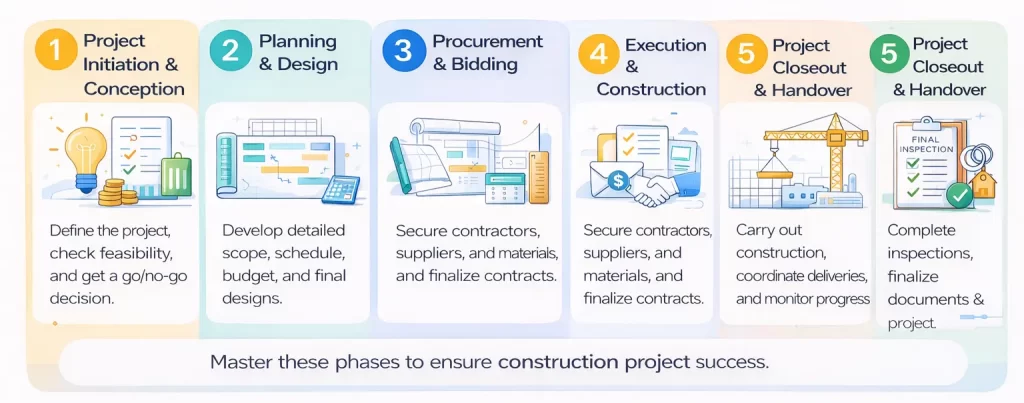 Every construction project, regardless of its scale or complexity, follows a structured lifecycle to ensure a smooth transition from an idea to a finished building. Here are the five fundamental stages in the construction project lifecycle that you need to master to ensure project success.
- Project initiation and conception
In this phase, the project idea is defined and tested through feasibility checks across financial, technical, and legal aspects. The main output is a clear business case and a go/no-go decision to move forward. - Planning and design
Here, the team builds a complete plan covering scope, schedule, cost estimate (RAB), resources, and risk controls while architects and engineers finalize technical designs. Strong planning in this stage sets the foundation for smoother execution and fewer field surprises. - Procurement and bidding
The project team prepares tender documents and collects bids to secure the right contractors, suppliers, materials, and equipment. Proposals are evaluated on price, quality, and capability before contracts are negotiated and signed. - Execution and construction
This is where work happens on-site, with deliveries, construction activities, and daily coordination to meet design requirements. The project manager monitors progress, budget, quality, and safety while maintaining tight communication with all parties. - Project closeout and handover
After construction is complete, the team completes inspections, commissioning tests, and final documentation, such as as-built drawings and manuals. Once requirements are met and issues are resolved, the project is handed over and formally closed.
Key Roles and Responsibilities in a Construction Project Team
The success of a construction project depends not only on its processes but also on the people who execute them. Here are some of the key roles that form the foundation of a successful construction project team.
- Project owner
The project owner is the person or entity that initiates and funds the project, setting the vision, scope, and budget. They approve significant changes and accept the outcome, so precise alignment with the project manager is essential. - Construction project manager
The construction project manager leads day-to-day planning, execution, and closeout while coordinating all stakeholders. This role requires strong technical and leadership skills to manage schedule, budget, resources, and risk, as highlighted by the Project Management Institute. - Architect and engineer
Architects and engineers translate the owner’s vision into buildable technical plans and specifications. Architects focus on function and space, while engineers ensure safety, compliance, and structural or system integrity throughout design and construction. - Contractor and subcontractor
The general contractor executes on-site work in accordance with approved designs and manages labor, materials, and equipment. Subcontractors handle specialized scopes like electrical, plumbing, or HVAC, and tight coordination is key to protecting quality and timelines.
Common Challenges in Construction Project Management
Construction projects move fast, and small issues can escalate when teams rely on fragmented updates and manual controls. By recognizing the most common construction project management challenges early, you can respond with clearer workflows and stronger on-site coordination.
- Inaccurate cost estimation
Inaccurate estimates quickly lead to budget overruns when quantities, labor productivity, or prices change. Reduce this risk by standardizing takeoff methods, validating assumptions with historical data, and setting up a contingency plan based on project risk. - Poor scheduling and weak sequencing
A schedule that ignores dependencies can lead to idle labor, clashes between trades, and rushed work that harms quality. Prevent this by building a realistic baseline, reviewing logic with site leads, and updating the schedule routinely using real progress data. - Material delivery delays
Late materials create a domino effect, disrupting the work sequence and forcing costly rescheduling. Overcome it with tighter procurement planning, supplier lead-time tracking, and buffer strategies for critical items. - Ineffective communication between teams
Miscommunication leads to rework, unclear responsibilities, and slow issue resolution between the office and the site. Fix this by setting clear reporting routines, using a single source of truth for drawings and updates, and defining escalation paths for urgent decisions. - Scope creep and uncontrolled changes
Mid-project changes can expand work without matching the budget or timeline, putting profitability at risk. Control it with a formal change order process, approval gates, and precise documentation of impact on cost, time, and resources. - Safety and regulatory compliance issues
Weak safety controls can result in incidents, stoppages, and penalties that delay delivery and harm reputation. Strengthen compliance by enforcing toolbox talks, routine inspections, and strict adherence to workplace safety and regulatory requirements on-site.
KPIs in Construction Project Management
To ensure a project is progressing toward its goals, project managers need objective tools to consistently monitor performance. By tracking the right KPIs, teams can identify areas that are performing well and those that require more attention, enabling data-driven decision-making rather than assumptions.
- Budget performance
This KPI measures the gap between actual spending and the planned budget using metrics such as the Cost Performance Index (CPI) and the Cost Variance (CV). Tracking it consistently helps you catch overruns early and protect project profitability. - Schedule adherence
This KPI compares real progress against the baseline schedule using metrics such as Schedule Performance Index (SPI) and Schedule Variance (SV). Monitoring it helps prevent minor delays from cascading into missed deadlines and reduced stakeholder trust. - Quality and defects
Quality KPIs track issues such as rework requests, punch-list items, and audit results to ensure the build meets agreed-upon standards. Fewer defects mean less rework, stronger client satisfaction, and a better reputation. - Safety metrics
Safety KPIs measure incidents and program effectiveness using metrics like Lost Time Injury Frequency Rate (LTIFR) and days without accidents. These indicators support consistent compliance with construction site safety protocols and protect workers on-site.
The Role of Technology in Optimizing Construction Project Management
In today’s digital environment, spreadsheets and paper-based workflows are no longer sufficient to handle the complexity of modern construction. Construction management software streamlines work by automating routine tasks, improving collaboration, and providing teams with real-time visibility from planning through closeout.
Integrated construction software goes further by connecting project management, accounting, procurement, and inventory on a single centralized platform. This reduces double-entry, minimizes errors, and keeps budgets, purchasing, and project costs up to date in real time.
Take Your Construction Business Management to the Next Level with the Right Tools
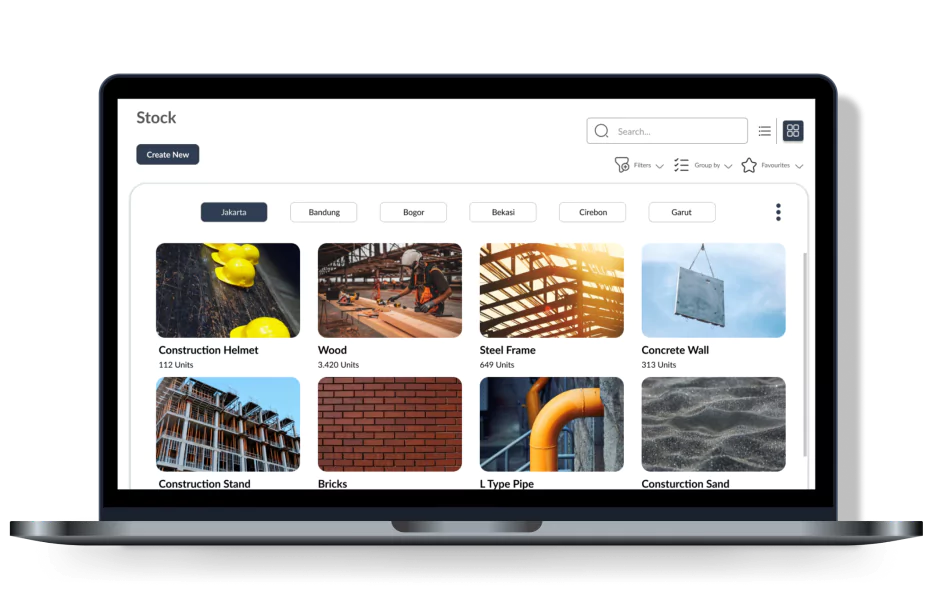 Construction projects demand fast coordination, accurate cost tracking, and reliable data across multiple departments. When approvals, budgeting, procurement, and accounting operate separately, teams often face delays, duplicated entries, and inconsistent reporting. An integrated construction management system helps streamline transactions, reduce manual errors, and provide real-time project visibility from a single platform.
Modern construction software is typically designed to connect core functions such as accounting, inventory, procurement, and sales. By linking these modules, project data flows automatically between departments, reducing administrative work and improving decision accuracy.
Core Capabilities That Support Better Project Oversight
- Budget S-Curve Management: Provides a comprehensive visual comparison of budget plans against actual expenditures, helping to identify financial trends and deviations early for proactive control.
- In-Depth Job Estimates (RAB): Facilitates highly accurate cost estimation and detailed expense tracking from the initial bidding phase, ensuring project profitability is maintained.
- Real-Time Project Dashboard: Offers a centralized and intuitive dashboard to monitor project progress, resource allocation, and critical KPIs, enabling data-driven decision-making.
- Integrated Contract Management: Streamlines the creation, tracking, and management of contracts with clients and subcontractors, ensuring all parties adhere to agreed-upon terms.
- Integration with Accounting & Procurement: Seamlessly connects project data with financial and procurement systems to automate workflows, eliminate manual entry, and ensure data accuracy.
Construction teams can decrease preventable delays, maintain financial discipline, and enhance coordination by centralizing operational data and automating repetitive workflows. Project control becomes more organized, transparent, and manageable at scale when it is backed by the appropriate system.
Conclusion
Construction project management requires clear planning, disciplined execution, and consistent control across each phase. When responsibilities, risks, and key metrics are managed well, teams are more likely to avoid delays, keep budgets stable, and deliver predictable results.
One practical way to support this is by using a construction management system that centralizes project data, connects workflows across teams, and provides real-time reporting. With fewer manual files and less back-and-forth, it becomes easier to coordinate site activities, track progress, and monitor resource usage in a single view.
If you want to see how it fits your project workflow, try a free demo. Explore the features firsthand and evaluate the impact on scheduling, cost control, and team coordination.
FAQ About Construction Project Management
-
What are the 5 phases of construction project management?
The five key phases are Initiation and Conception, Planning and Design, Procurement and Bidding, Execution and Construction, and finally Project Closeout and Handover. Each phase has specific goals and deliverables that build upon the last.
-
What is the main role of a construction project manager?
A construction project manager is the operational leader responsible for planning, executing, and closing the project. They manage the schedule, budget, resources, and risks, acting as the central point of communication for all stakeholders.
-
Why is cost control crucial in construction projects?
Cost control is crucial because it directly impacts a project’s profitability. Effective cost management prevents budget overruns, ensures financial resources are used efficiently, and helps the company remain competitive and financially stable.