






Feeling the pinch with inventory mishaps? Imagine never facing a “sold out” sign again, all thanks to mastering the reorder point formula. This guide is your new best friend, tailored just for the vibrant Philippine market.
It’s here to ensure your business not only survives but thrives by avoiding the common pitfalls of overstocking and understocking. Intrigued? With the right reorder point (ROP) strategy, you can fine-tune your inventory to meet demand perfectly.
Stick around to discover how these essential tweaks can revolutionize your business logistics and boost your bottom line.
Key Takeaways
|
Table of Contents
What Is a Reorder Point and Why Does It Matter?

A reorder point (ROP) is the stock level that tells your business when to replenish inventory. It helps prevent stockouts by ensuring you still have enough items while waiting for the next delivery. This makes ROP essential for keeping operations steady, meeting customer demand, and avoiding lost sales.
Setting the right reorder point also helps balance inventory levels. It reduces the risk of overstocking, which can tie up capital and raise storage and inventory costs. With a well-defined ROP, your business can respond faster to demand while keeping stock under control.
How to Calculate a Reorder Point
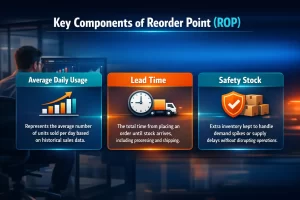 Calculating the reorder point requires understanding your business’s average daily sales and the lead time for receiving new stock. Start by determining the average daily unit sales to form the basis of your reorder calculations. Therefore, for better security, especially in unpredictable markets like the Philippines, consider adding safety stock to this equation.
The components of this calculation include:
1. Average Daily Usage
Represents the average number of units sold per day, calculated based on your business’s historical sales data.
2. Lead Time
The total time taken from placing the order to receiving the stock, which includes supplier processing time and shipping.
3. Safety Stock
Additional inventory kept on hand to protect against fluctuations in demand or unexpected delays in supply, ensuring you can meet customer demand without interruption.
By accurately calculating these components, businesses can set reorder points that are both efficient and responsive to market dynamics.
How to Calculate Reorder Point with the Right Formula


The basic formula for determining the reorder point (ROP) is ROP = (Average Daily Usage Rate × Lead Time) + Safety Stock. This formula helps businesses calculate how much inventory to order and when to order it, ensuring that they do not run out of stock.
For example, if a company has an average daily sale of 100 units, a lead time of 7 days, and maintains a safety stock of 200 units, the reorder point would be calculated as follows:

This means when your inventory reaches 900 units, it’s time to reorder. This calculation with safety stock ensures you have a buffer against unexpected delays or spikes in demand, which is crucial for maintaining customer satisfaction and operational efficiency.
Reorder Point Strategies
Different strategies for setting and adjusting reorder points can significantly enhance inventory management. One effective strategy is the periodic review system, where reorder points are adjusted based on changes in demand patterns and supply chain conditions.
This approach is particularly relevant in the Philippines, where economic activities can fluctuate significantly due to seasonal trends and economic policies. Tips for optimizing reorder points include using technology to track inventory and sales patterns levels in real-time, and regularly consulting with suppliers to understand potential lead time changes.
These practices help businesses adapt their reorder points to current market conditions, ensuring they are always aligned with operational needs and market opportunities.
How Are Reorder Points Used?

Reorder points find practical application in various business scenarios, from retail management to manufacturing. In retail, ROP helps store managers maintain shelf stock levels to meet customer demand consistently.
For manufacturers in the Philippines, reorder points ensure that production lines are not halted due to a lack of raw materials, facilitating smooth operations and timely product deliveries.
By utilizing inventory management software, businesses can automate reorder triggers to improve their inventory processes. This automation ensures timely reordering, reducing the administrative burden and allowing business owners to focus on growth and expansion strategies.
Conclusion
A reorder point helps your business restock on time and avoid stockouts. It also keeps inventory levels balanced, so you can meet demand without holding too much stock.
When you calculate it accurately, you can control inventory costs, protect cash flow, and keep operations running smoothly. This makes it easier to respond to changing demand and serve customers more consistently.
Frequently Asked Questions
-
What is the meaning of order point?
The reorder point is the specific stock level at which an order must be placed. This is used to replenish inventory before it runs out, ensuring continuous availability.
-
When to use reorder point planning?
Businesses usually use reorder point planning when managing inventory. This is to prevent stockouts, particularly in businesses with fluctuating demand or longer lead times.
-
What is the purpose of the reorder point?
The purpose of the reorder point is to maintain a seamless supply of inventory by triggering timely reorders. Thus avoiding both stockouts and overstock situations.