Product traceability matters to manufacturers, distributors, retailers, and supply chain professionals who need clear visibility into the journey of their goods. As supply networks grow more complex, many businesses struggle to track products accurately from raw materials to finished items in customers’ hands.
Without reliable tracking, companies face data gaps, compliance risks, and costly operational delays that can disrupt performance. Inconsistent records and limited transparency also make it harder to maintain quality standards and respond quickly to recalls or customer concerns.
This article explores how product traceability works, the technologies that support it, and the key components of an effective tracking system. It also explains the practical benefits of end-to-end visibility, including stronger compliance, improved efficiency, better inventory control, and greater customer trust.
Key Takeaways
|
Table of Contents
Understanding the Imperative of Product Traceability
The concept of traceability is often misunderstood as simply a labeling requirement or a logistics task. In reality, it is a comprehensive data framework that connects the physical movement of goods with digital information, answering who, what, when, where, and why across the supply chain.
In the food industry, for example, detecting contamination without proper tracking can force companies into large-scale recalls with severe financial and reputational impact. With precise traceability in place, businesses can isolate affected batches quickly, limit product withdrawals, and protect both consumers and brand integrity.
Beyond risk control, traceability strengthens operational performance by revealing production bottlenecks, supplier inconsistencies, and real-time inventory movement. By digitizing the chain of custody, organizations shift from reactive crisis handling to proactive quality management and more resilient supply chain planning.
In-depth Definitions and Core Concepts
To fully grasp the scope of product traceability, it is essential to dissect its fundamental components and types. Traceability is not a monolith; it consists of various tracking directions and data granularities that serve different business objectives.
1. Traceability Direction: Upstream and Downstream
Traceability is categorized by the direction in which information is followed, starting with upstream traceability that looks backward along the supply chain. This approach identifies a product’s origin, such as raw materials, processing facilities, and production batches, to verify sourcing, ensure compliance, and investigate quality issues.
In contrast, downstream traceability tracks products forward from production to distribution and finally to retailers or end consumers. By integrating both directions, companies build a complete product history that strengthens logistics control, supports efficient recalls, and improves overall supply chain management.
2. Internal vs. External Traceability
The scope of tracking also differs between internal and external traceability. Internal traceability monitors materials and products within one organization, including warehouse transfers, WIP processes, and final assembly, typically supported by systems like Manufacturing Execution System and Enterprise Resource Planning platforms.
External traceability extends across supply chain partners and requires consistent data sharing between suppliers, manufacturers, and retailers. This approach depends on standardized protocols such as GS1 to ensure interoperability, making implementation more complex but essential for end-to-end visibility.
3. Granularity: From Lot to Item Level
The precision of traceability depends on its level of granularity, starting with lot-level tracking that groups products by batch or production run. This method is widely used in high-volume industries, where a defect in one batch can place the entire lot under review.
Item-level traceability, or serialization, assigns a unique identifier to each individual unit for maximum accuracy. Common in pharmaceuticals and high-value goods, this approach generates more data but enables precise inventory control and detailed lifecycle management.
Detailed Benefits of Robust Traceability Systems
Investing in traceability technology yields returns that go far beyond regulatory compliance. The benefits ripple through every department, from quality assurance to marketing and finance.
1. Risk Mitigation and Recall Efficiency
Traceability immediately reduces financial risk from product defects by enabling companies to identify and isolate issues within minutes, cutting recall volumes and saving millions in wasted stock and logistics. Rapid, transparent responses also protect brand equity, often surpassing the value of the inventory itself.
2. Supply Chain Optimization and Efficiency
Traceability data offers detailed insight into supply chain performance, helping manufacturers spot bottlenecks and optimize material flow. Real-time inventory visibility prevents overstocking and stockouts, while strategies like First-Expiry-First-Out (FEFO) reduce spoilage and improve working capital.
3. Regulatory Compliance and Market Access
Governments worldwide are tightening product safety and transparency rules, such as the U.S. FSMA Section 204 and the EU Digital Product Passport initiative. A robust traceability system automates compliance, prevents fines, ensures market access, and turns regulatory obligations into a seamless background process.
4. Brand Protection and Anti-Counterfeiting
In industries like pharmaceuticals, luxury fashion, and automotive parts, counterfeiting threatens both safety and revenue, but serialization lets stakeholders verify product authenticity throughout the supply chain. By enabling consumers and professionals to confirm genuineness, it builds trust and safeguards manufacturers’ revenue.
Common Challenges and Strategic Solutions
Despite the clear advantages, implementing a comprehensive traceability system is fraught with challenges. Understanding these hurdles is the first step toward overcoming them.
1. Data Silos and Fragmentation
Data silos in spreadsheets, legacy software, and paper records block a unified view of the product journey, but integrated ERP platforms create a single source of truth. To maintain this digital thread, organizations should adopt unified ERP architectures or robust middleware that synchronizes MES, WMS, and other peripheral systems in real time.
2. Supplier Interoperability
A manufacturer’s traceability is only as strong as the data from its suppliers, yet small suppliers often rely on manual records, creating “blind spots” in the upstream supply chain. To ensure full visibility, larger enterprises support suppliers through digital portals or mandate standardized labels, such as GS1 barcodes, as a condition of doing business.
3. Cost of Implementation
Implementing sensors, scanners, and software can be costly for SMEs, but the expense of lacking traceability, through recalls or lost contracts, is often greater. A phased approach, starting with lot-level barcoding and scaling to RFID or item-level serialization, allows ROI to guide investment.
4. Data Standardization
Inconsistent data formats between suppliers and manufacturers hinder automated traceability, making standardization essential. Global frameworks from organizations like ISO and GS1 ensure universal understanding, so a GTIN is interpreted the same way worldwide.
5. The Data Entry Bottleneck
The biggest failure point is manual data entry, typing 12-digit lot numbers or serial codes leads to high errors, slow operations, and incomplete traceability. Automating with barcode scanners, QR codes, or RFID on mobile handhelds integrated with the ERP lets workers validate transactions instantly at the point of activity.
6. Scope Creep and Over-Tracking
Tracking everything at the lowest granularity is costly and often unnecessary, as item-level serialization for every screw or washer rarely justifies the effort. A risk-based approach is best, applying item-level serialization to high-risk items like motors and control boards while low-risk components such as fasteners or labels use batch-level tracking.
Step-by-Step Implementation Guide
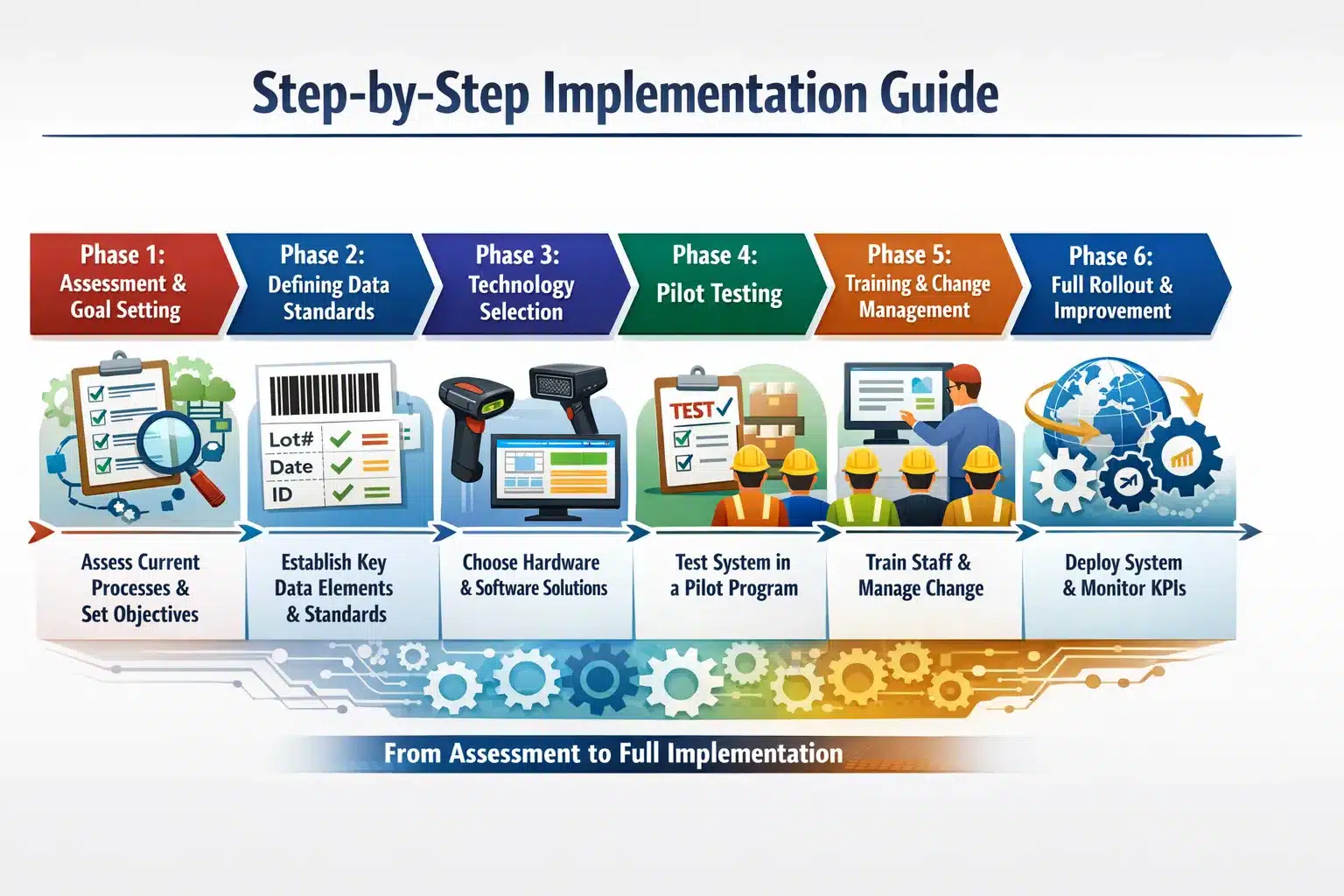
Transitioning from a manual or fragmented tracking system to a fully digital traceability solution requires a structured approach. This guide outlines the critical phases for a successful deployment.
Phase 1: Assessment and Goal Setting
Before purchasing technology, an organization must audit its current processes and map its physical supply chain against its digital data structures. Common blind spots include temporary storage areas, rework stations, and subcontractor locations, and regulatory requirements must also be considered.
Goal setting should be specific, defining both the scope and metrics for success. Data standardization is equally critical, as inconsistent naming conventions prevent effective traceability and a master data governance policy ensures SKUs, units of measure, and lot number formats are consistent across the organization and its trading partners.
Phase 2: Defining Data Standards
Decide on the tracking unit, whether by pallet, case, or individual item, and establish the Key Data Elements that must be recorded at each Critical Tracking Event, such as lot numbers, expiration dates, production timestamps, and operator IDs. Adopting GS1 standards at this stage is highly recommended to ensure future compatibility with trading partners.
Phase 3: Technology Selection
Select the hardware and software that align with the defined goals, with hardware options including barcode printers, handheld scanners, or fixed RFID portals. The software layer is crucial, as it must ingest tracking data and correlate it with business transactions, and many modern ERP solutions include modules designed to handle this complexity.
The core of implementation involves configuring the ERP to capture data at critical points where ownership or status changes. Key integration points include inbound receiving, production staging, quality control, and packaging and shipping, ensuring parent-child relationships are preserved while linking raw materials, batches, and serial numbers.
Phase 4: Pilot Testing
Do not roll out the system across the entire enterprise simultaneously. Choose a single product line or a single facility for a pilot program. This allows the team to identify technical glitches and process gaps in a controlled environment. The pilot phase is also the time to refine user interfaces to ensure they are intuitive for floor staff.
Phase 5: Training and Change Management
Technology is only as effective as the people using it. Comprehensive training is essential for warehouse staff, production operators, and quality managers. They must understand not just how to scan a label, but why it matters. Building a culture of quality ensures that data entry is accurate and consistent.
Phase 6: Full Rollout and Continuous Improvement
Once the pilot is stabilized, the system can be expanded to other lines and facilities. Organizations must track Key Performance Indicators such as recall response time, mock recall accuracy, waste reduction, and supplier defect rates to measure ROI.
Traceability systems generate vast amounts of data that can reveal new efficiencies. Periodically reviewing this data, such as identifying suppliers with frequent quality variances, turns the traceability cost center into a value generator.
Industry-Specific Use Cases
While the principles of traceability are universal, the application varies significantly across different sectors.
1. Food and Beverage: Farm-to-Fork Safety
In the food industry, traceability is a matter of public health, requiring manufacturers to track ingredients from the farm to the processing plant and onto the retailer. In the event of a contamination, such as a Salmonella outbreak linked to peanut butter, traceability allows precise identification of affected batches, preventing safe products from being destroyed and protecting consumers.
Modern food traceability also integrates IoT sensors with ERP (Enterprise Resource Planning) systems to monitor the cold chain and ensure perishable goods stay within strict temperature and humidity ranges. Advanced systems record conditions throughout transit and can automatically flag affected lots upon arrival, providing the visibility needed to comply with regulations like the Food Safety Modernization Act.
2. Pharmaceuticals: Serialization and Compliance
The pharmaceutical supply chain is heavily regulated, and the U.S. Drug Supply Chain Security Act requires prescription drugs to be traceable at the package level using 2D Data Matrix barcodes. This serialization allows distributors and dispensers to verify a drug’s legitimacy before it reaches the patient, ensuring safety and efficacy.
3. Automotive: Component Lifecycle Management
A modern vehicle contains thousands of parts sourced from hundreds of suppliers, and if a specific airbag sensor is defective, the automaker must identify which Vehicle Identification Numbers contain that lot. Traceability links supplier lot data to each vehicle chassis, enabling targeted recalls that save billions in warranty costs.
In the broader manufacturing sector, discrete and process manufacturing have different traceability needs. Discrete manufacturers track individual serial numbers through assembly, while process manufacturers rely on batch and lot tracking, recording ingredient weights, lot numbers, potency, and environmental variables during production.
4. Fashion, Retail, and E-commerce: Provenance, Sustainability, and Brand Protection
In the fashion industry, traceability is increasingly driven by consumer demand for sustainability, allowing brands to prove the provenance of materials like organic cotton or recycled polyester. Consumers can scan a tag to see a garment’s journey from the cotton field to the retail shelf, promoting transparency, combating greenwashing, and validating ethical labor practices.
In retail and e-commerce, traceability also combats counterfeiting and protects margins through item-level serialization using RFID or NFC tags linked to the ERP. This system lets consumers verify authenticity, supports reverse logistics by confirming returned items, and provides granular data to identify return patterns for better vendor management.
Comparison with Alternatives

Organizations often rely on disjointed methods before adopting a dedicated traceability solution. Understanding the limitations of these alternatives highlights the necessity of professional systems.
1. Manual Paper Records
Historically, traceability relied on clipboards and filing cabinets, which were low-cost but prone to errors, illegible handwriting, and physical damage. In recall scenarios, this method is slow, unscalable, and unsuitable for modern compliance, whereas digital systems can provide the same information in seconds.
2. Spreadsheet Management
Many SMEs upgrade from paper to spreadsheets, which provide digital records but do not offer real-time integration. Spreadsheets can have delayed data entry, risk formula loss or version errors, and are unable to handle the automated data capture required in high-volume manufacturing.
3. Legacy Systems vs. Modern Integrated Suites
Some companies rely on older, standalone inventory systems that create data silos and lack connectivity. Modern traceability solutions integrated into ERP suites automatically update inventory, costs, and associate lot numbers with finished goods in a single seamless transaction.
Future Trends and Predictions (2026 Onwards)
The field of traceability is evolving rapidly, driven by advancements in digital technology and shifting market expectations. As organizations mature in their traceability journey, they can leverage advanced technologies to transform compliance data into competitive intelligence.
1. Blockchain for Immutable Trust
Blockchain technology is moving from hype to practical application by creating a decentralized, immutable ledger that provides a single version of the truth all supply chain parties can trust. This is especially valuable in complex supply chains with low trust, such as those for ethically sourced diamonds, coffee, or cobalt.
In 2026, permissioned blockchains will allow suppliers and manufacturers to share data securely without revealing trade secrets. Integrating the ERP with blockchain nodes lets shipments be cryptographically verified, ensuring authenticity mathematically rather than relying on paper certificates.
2. The Digital Product Passport (DPP)
Spearheaded by the European Union, the Digital Product Passport creates a digital twin of a product containing data on composition, origin, repairability, and carbon footprint. This enables a circular economy by simplifying recycling and remanufacturing at the end of a product’s life.
3. AI and Predictive Quality
Artificial Intelligence will shift traceability from descriptive to predictive by using data to fuel digital twins, virtual replicas of physical products. By aggregating information on raw materials, machines, operators, and environmental conditions, AI can uncover correlations that humans might miss.
For example, an algorithm might identify that a specific alloy from a certain supplier processed on a particular machine during the night shift leads to higher failure rates. This enables manufacturers to intervene before defects occur, transforming quality control from reactive to proactive.
4. IoT and Real-Time Condition Monitoring
Traceability is evolving from tracking location to monitoring condition, using IoT sensors on pallets to record temperature, humidity, and shock in real-time. 5G networks enable large-scale deployment, giving companies detailed visibility into supply chain conditions and allowing proactive protection of sensitive products.
5. Consumer-Facing Transparency
The final frontier of traceability is marketing, where companies selectively share ERP data with consumers. By scanning a QR code, customers can see ingredient origins, manufacture dates, and the supply chain’s sustainability profile, creating transparency that builds brand loyalty and adds market value.
Conclusion
Product traceability has transcended its origins as a compliance checklist to become a cornerstone of modern business strategy. In an interconnected global economy, the ability to trace the history, application, or location of an item is essential for operational resilience, consumer safety, and brand integrity.
The risks of opacity, ranging from financial ruin due to recalls to the loss of consumer trust, are simply too high to ignore. Companies that invest in strong traceability practices protect their reputation and ensure compliance across their supply chains.
Looking ahead, the convergence of digital technologies like blockchain, AI, and IoT will enhance traceability systems. Businesses that adopt these tools can reduce risk, uncover new efficiencies, and create value, making transparency the new currency of the supply chain.
Frequently Asked Question about Product Traceability
-
What is the difference between tracking and tracing?
Tracking (downstream) follows a product’s path from the manufacturer to the consumer, useful for delivery monitoring. Tracing (upstream) looks backward to identify the origin of materials, essential for investigating the root cause of quality issues.
-
Why is product traceability important for regulatory compliance?
Traceability ensures businesses can quickly provide data required by laws like the FDA’s FSMA or EU regulations. It proves adherence to safety standards and facilitates rapid recalls, helping companies avoid legal penalties and fines.
-
How does traceability reduce the cost of product recalls?
By identifying the exact batches or lot numbers affected by a defect, traceability allows companies to recall only the specific impacted units. This prevents the waste of safe products and significantly lowers logistics and replacement costs.
-
What technologies are used in modern traceability systems?
Modern systems utilize barcodes (1D and 2D), RFID tags, and IoT sensors for data capture. This data is managed by integrated software like ERP systems, and increasingly, blockchain is used to ensure data immutability and trust.
-
What is the Digital Product Passport mentioned in 2025 trends?
The Digital Product Passport (DPP) is an initiative, primarily in the EU, creating a digital record for products. It contains information on sustainability, recyclability, and sourcing to promote a circular economy and transparency.