






Every business that sells physical products needs a reliable way to track what’s in stock, what’s been sold, and what needs to be reordered. The choice comes down to two key inventory systems periodic and perpetual. These systems differ in how they handle stock movements, update financial records, and provide insights into business operations. Choosing the wrong one can lead to significant costs in terms of time, money, and accuracy.
In this guide, we’ll explore the differences between the two systems, how they work, and their impact on accounting. We’ll also cover real world examples, cost factors, and how to determine which system fits your business best. By the end, you’ll have a solid understanding of which inventory system is right for you.
Table of Contents
Key Takeaways
|
What Is a Periodic Inventory System?
 A periodic inventory system tracks inventory at specific intervals, such as monthly or quarterly. Unlike real time systems, it updates records only after a physical count. Purchases are recorded in a separate “Purchases” account, and the cost of goods sold (COGS) is calculated at the end of each period using the formula:
Cost of Goods Sold = Beginning Inventory + Purchases – Ending Inventory
After counting items and applying unit costs, the ending inventory is determined, and the COGS is calculated for financial reporting.
How the Periodic System Works in Practice
In a small hardware store using a periodic inventory system, purchases like bolts and paint are recorded in a “Purchases” account, and sales are noted as revenue without an immediate cost entry. At the end of the month, a physical count updates the inventory and calculates the cost of goods sold. This system provides insights only after the period ends, not in real time.
When evaluating inventory systems, it’s important to weigh the pros and cons. The Periodic Inventory System is often used by businesses that don’t need real-time tracking. Below, we outline its pros and cons:
| Pros | Cons |
| ✓ Easy to manage with fewer accounting entries. | × Lacks real-time stock visibility. |
| ✓ No need for advanced software or POS integration. | × Stockouts may go unnoticed without monitoring. |
| ✓ Ideal for small or low-volume businesses. | × Susceptible to shrinkage errors (theft, damage, etc.). |
| ✓ Aligns with periodic tax and regulatory reporting. | × Requires labor-intensive physical counts. |
| ✓ Provides limited financial insights until period-end process is completed. |
Unlocking the Benefits of a Perpetual Inventory System for Your Business
 A perpetual inventory system continuously updates inventory records in real time with every sale, purchase, return, or adjustment. This allows businesses to know their stock levels at any given moment without the need for physical counts.
The inventory account acts as a running balance, increasing with purchases and decreasing with sales. Both the sale revenue and the corresponding cost of goods sold (COGS) are recorded simultaneously, ensuring accurate and up-to-date books.
How the Perpetual System Works in Practice
A midsized electronics retailer with a perpetual inventory system and barcode scanning POS records every sale instantly. When a laptop is purchased, the system updates the inventory, posts the COGS, and records the sale revenue. New stock, like smartphones, is scanned and added immediately.
This provides real-time insights into stock levels, COGS, and gross profit, helping managers make quick reorder decisions, spot slow-moving items, and address discrepancies promptly.
Technology Behind Perpetual Inventory
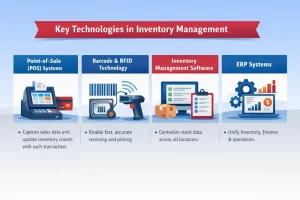 The perpetual system typically relies on technology to function effectively. Common tools include:
- Point-of-sale (POS) systems: Capture sales data and automatically update inventory counts with each transaction
- Barcode scanners and RFID tags: Enable fast, accurate receiving and picking processes
- Inventory management software: Centralizes stock data across multiple locations and integrates with accounting, procurement, and sales platforms
- Enterprise Resource Planning (ERP) systems: Provide a unified data environment where inventory, finance, and operations are seamlessly connected
The Perpetual Inventory System Advantages and Pitfalls You Should Consider
When evaluating inventory systems, the Perpetual Inventory System offers several benefits and challenges. Below, we outline the pros and cons to help you assess whether this system fits your business needs:
| Pros | Cons |
|---|---|
| ✓ Real-time accuracy — Always up-to-date inventory balances. | × Higher implementation cost — Investment in software, hardware, and training. |
| ✓ Automated COGS calculation — Continuous profitability insights. | × Technology dependency — Downtime or failures can disrupt operations. |
| ✓ Better demand planning — Real-time data improves forecasting. | × Data entry errors — Inaccurate scans or mishandled returns can compromise the system. |
| ✓ Faster discrepancy detection — Detect theft, spoilage, and errors promptly. | × Complexity — Requires skilled staff or IT support for maintenance. |
| ✓ Scalability — Grows with business volume, locations, and product range. | × Physical counts still necessary — Periodic audits are recommended to verify accuracy. |
| ✓ Stronger audit trail — Every transaction is logged for compliance. |
Key Differences Between Periodic and Perpetual Inventory Systems
Now that we’ve explored each system individually, let’s bring them together in a direct comparison across the dimensions that matter most to business decision-makers.
1. Frequency of Inventory Updates
A periodic system updates inventory only at the end of each period after a physical count. while a perpetual system updates inventory continuously, providing real-time visibility.
2. Cost of Goods Sold Calculation
In a periodic system, COGS is calculated at period end, while a perpetual system calculates it with every sale, offering timely profit analysis.
3. Accounting Complexity and Journal Entries
The periodic system requires simpler entries during the period but complex adjustments at period end. The perpetual system has detailed transaction entries, but simplifies period-end closings, especially with automation.
4. Physical Inventory Counts
The periodic system depends on physical counts for accuracy, while the perpetual system doesn’t require scheduled counts, though audits are still recommended.
5. Technology Requirements
The periodic system works with basic tools and doesn’t need specialized hardware. The perpetual system requires integrated technology, like POS and barcode scanners, which comes with a higher investment but offers better data quality.
6. Accuracy and Reliability
The periodic system’s accuracy depends on the quality of physical counts. The perpetual system provides real time accuracy and is more reliable, especially with automated scanning.
7. Suitability for Different Business Scales
Small businesses with fewer products and low transaction volumes often use the periodic system, while larger businesses rely on the perpetual system for better control, especially with multiple warehouses or diverse inventories.
Side-by-Side Comparison Table
| Feature | Periodic Inventory System | Perpetual Inventory System |
|---|---|---|
| Update Frequency | At end of accounting period | Continuously (real time) |
| COGS Calculation | Derived at period end | Calculated per transaction |
| Physical Count Required | Mandatory | Recommended but not required |
| Technology Needed | Minimal | POS, scanners, inventory software |
| Real Time Visibility | None | Full |
| Implementation Cost | Low | Moderate to high |
| Accuracy | Moderate (count-dependent) | High (transaction-dependent) |
| Best For | Small, low-volume businesses | Medium to large businesses |
| Scalability | Limited | High |
| Accounting Complexity | Simple during period, complex at close | Detailed per transaction, simple at close |
Industry-Specific Use Cases: Which System Fits Where?
The choice of the right inventory system can vary greatly depending on the specific needs and challenges of each industry. Let’s explore how different sectors approach this decision and the factors that influence their choice of system.
Retail
Large retail chains, with high transaction volumes and multiple locations, rely on perpetual systems for real-time stock visibility. Integrated POS systems ensure seamless tracking and data-driven replenishment. Smaller retailers may still use periodic systems if their product range is limited and stock is reviewed manually.
Manufacturing
Manufacturers use perpetual systems to track raw materials, work-in-progress (WIP), and finished goods. Real-time tracking is essential for cost accounting and scheduling, often integrated with ERP platforms for seamless procurement and production planning.
Wholesale and Distribution
Wholesale distributors managing large volumes across warehouses use perpetual systems to maintain accuracy and efficiency. Cycle counting helps verify inventory without disrupting operations.
Restaurants and Food Service
Restaurants face unique challenges with perishable goods and frequent purchases. Smaller establishments often use periodic methods for key ingredients, while larger chains invest in perpetual systems integrated with kitchen and ordering platforms.
E-Commerce
E-commerce businesses almost universally adopt perpetual inventory systems for real-time stock visibility and efficient order fulfillment. Integration between the e-commerce platform, warehouse management, and accounting software is essential for smooth operations.
Professional Services and Low-Inventory Businesses
Businesses with minimal physical inventory, like consultancies or software companies, often find that a basic periodic system meets their needs for tracking limited products.
Transitioning from a Periodic to a Perpetual System
Many growing businesses start with a periodic inventory system and eventually outgrow it. The transition to perpetual tracking is an important operational milestone and it requires careful planning to execute successfully.
Step 1: Conduct a Physical Count
Perform a full physical inventory count and reconcile it with existing records to establish the opening inventory balance in the new system.
Step 2: Choose the Right Software
Select inventory or ERP software that supports perpetual tracking and integrates with your sales, purchasing, and accounting systems.
Step 3: Implement Barcode or RFID
Label products with barcodes or RFID tags and equip stations with scanners to ensure long-term accuracy.
Step 4: Train Your Team
Provide training for staff on new procedures for receiving, issuing, returning, and adjusting inventory.
Step 5: Run Parallel Systems
Run both systems concurrently for one accounting period to compare results and identify discrepancies.
Step 6: Establish Cycle Counting
Replace annual physical counts with cycle counting, rotating inventory checks throughout the year.
Financial Reporting and Audit Implications
The choice between periodic and perpetual inventory doesn’t just affect operations it has meaningful implications for financial reporting, auditing, and regulatory compliance.
| Feature | Periodic Inventory System | Perpetual Inventory System |
|---|---|---|
| Income Statement Accuracy | Accurate only after period end count. Mid period statements are estimates. | Always up to date. COGS and gross profit are continuously calculated. |
| Balance Sheet Accuracy | Balance is based on the last physical count and may be misleading. | Real time stock levels, ensuring an accurate balance sheet. |
| Audit Preparedness | Relies on year end physical count and limited documentation. | Detailed transaction logs with timestamps and user IDs, offering a stronger audit trail. |
| Tax Implications | May rely on estimated inventory values for tax purposes. | Accurate inventory for tax calculations and reporting, especially when LIFO is used. |
Which Inventory System Is Right for Your Business?
After examining both systems from every angle, it’s time to address the central question which approach is right for your business? The answer isn’t universal it depends on a constellation of factors unique to your operation. Here’s a practical decision framework.
Choose a Periodic Inventory System If:
- You’re a small business with limited resources. If you’re running a small shop with a handful of product lines and modest transaction volumes, the simplicity and low cost of periodic inventory make it a pragmatic choice.
- You sell a small number of high-value items infrequently. A car dealership, for example, might sell only a few dozen vehicles per month. Counting those vehicles periodically is straightforward and doesn’t require a real-time tracking system.
- Your transactions are low in volume and high in value. When each transaction is significant and infrequent, the risk of losing track of inventory is much lower.
- Budget constraints prevent technology investment. If the capital required for POS systems and inventory software is prohibitive, starting with a periodic system while you grow is a reasonable approach.
- You have a stable, predictable product mix. If your product range doesn’t change frequently and you have predictable sales patterns, periodic inventory may provide sufficient oversight.
Choose a Perpetual Inventory System If:
- You’re running a medium to large business. As transaction volumes grow, manual periodic counting becomes increasingly error prone and labor intensive. The perpetual system scales with your growth.
- You operate multiple locations. Managing inventory across several warehouses or retail outlets requires real time visibility that only a perpetual system can provide.
- You need continuous financial reporting. If your stakeholders investors, management, lenders expect timely and accurate financial data, a perpetual system is essential.
- Stockouts are costly. In industries where running out of stock means losing customers or halting production, real-time inventory visibility is not optional.
- You want to leverage data analytics. A perpetual system generates rich transactional data that can be analyzed for demand forecasting, supplier performance, and profitability optimization.
Common Mistakes to Avoid in Inventory System Management
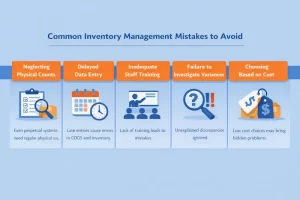 Regardless of which system you use, certain management errors are common and avoidable.
1. Neglecting Physical Counts in Perpetual Systems
Even with a perpetual system, physical counts are necessary to prevent discrepancies from theft, damage, or errors. Regular cycle counts ensure accuracy.
2. Delayed Data Entry in Periodic Systems
Delaying purchase entries or period-end counts in periodic systems can lead to significant errors in COGS and inventory. Timely data entry is essential.
3. Inadequate Staff Training
Proper training is critical for maintaining system accuracy, whether it’s for physical counts or using barcode scanners and inventory software.
4. Failure to Investigate Variances
Discrepancies in physical counts or unexpected results should be investigated, not written off, as they signal potential operational issues.
5. Choosing a System Based Solely on Cost
While cost is a factor, basing your choice on it alone can lead to hidden costs from stockouts and inefficiencies. Consider the total cost of accuracy and reliability.
Conclusion
In conclusion, selecting the right inventory system depends on your business size and requirements. The periodic system is ideal for small businesses with low transaction volumes, while the perpetual system provides real-time updates and scalability for larger operations.
By considering factors like cost, technology, and the need for real-time visibility, you can choose the system that best fits your business and ensures smooth inventory management.
FAQ About Periodic vs. Perpetual Inventory Systems
-
What’s the main difference between periodic and perpetual inventory systems?
The key difference is how inventory records are updated. In a periodic system, updates occur at the end of each period after a physical count, while in a perpetual system, inventory is updated in real time with each transaction.
-
Which inventory system is better for small businesses?
The periodic system is generally better for small businesses with low transaction volumes, as it is simpler and more cost-effective. However, businesses with high transaction volumes or multiple locations may benefit from a perpetual system.
-
Does the perpetual system provide real-time financial reporting?
Yes, the perpetual system provides continuous updates to the income statement and balance sheet, allowing businesses to monitor profitability and inventory levels in real time.
-
Is the perpetual system more expensive to implement?
Yes, the perpetual system typically requires higher upfront costs due to the need for integrated technology, such as POS systems, barcode scanners, and inventory management software.
-
Can I switch from a periodic to a perpetual system?
Yes, businesses can transition from a periodic to a perpetual system as they grow. The transition involves steps such as conducting a physical count, selecting appropriate software, and setting up barcode or RFID infrastructure.