






Integrating advanced HR management tools, such as an ERP HR module, into daily operations plays a crucial role in maintaining efficiency. As organizations grow, managing employee data, payroll, and compliance manually becomes increasingly complex.
Manual HR processes often increase the risk of administrative errors, payroll inaccuracies, and delays in benefits administration. These inefficiencies can affect employee satisfaction and make it difficult for HR teams to focus on strategic initiatives.
Without modern analytical capabilities, businesses may also struggle with workforce planning and regulatory compliance. As operations expand, the lack of structured HR systems can create operational bottlenecks and elevate compliance risks.
Table of Contents
Key Takeaways
|
Introduction to the ERP HR Module

The ERP HR module is a core component of ERP management software that helps organizations manage the entire employee lifecycle. It centralizes employee data and automates HR processes to improve efficiency and workforce performance.
The ERP HR module encompasses various core submodules that cover the key aspects of human resource management. These submodules include:
- Organizational Management: This submodule allows businesses to create and manage organizational structures, define roles and responsibilities, and establish workflows for approvals and communication.
- E-Recruitment and Timesheet Management: This submodule facilitates the entire recruitment software and processes, including job requisitions and job offers. It also handles timesheet management, attendance tracking, and absence management.
- Personnel Administration and Payroll: This submodule enables efficient management of employee records, personnel data, payroll processing, tax deductions, and compliance reporting.
- Training, Resource Planning, and Staff Appraisal: This submodule supports employee training programs and performance evaluations, empowering businesses to drive employee development, improve performance, and identify growth opportunities.
Core Submodules of the ERP HR Module

Organizational management is a key submodule of the ERP HR module that enables businesses to manage employee profiles, organizational structures, and internal workflows efficiently.
With features such as employee records, organizational charts, and approval workflows, companies gain better visibility into their workforce while improving coordination and decision-making.
The e-recruitment system and timesheet management submodule support the hiring process from creating job requisitions to posting job postings and issuing job offers. It also tracks employee attendance, working hours, and leave requests.
The personnel administration and payroll submodule manages employee records, payroll processing, tax calculations, and compliance reporting. By centralizing personnel data and automating payroll tasks, businesses can generate accurate salaries.
The training management submodule focuses on employee development by organizing training programs, resource planning, and performance evaluations. It helps businesses identify career paths and support continuous workforce improvement.
Key Features and Functionalities
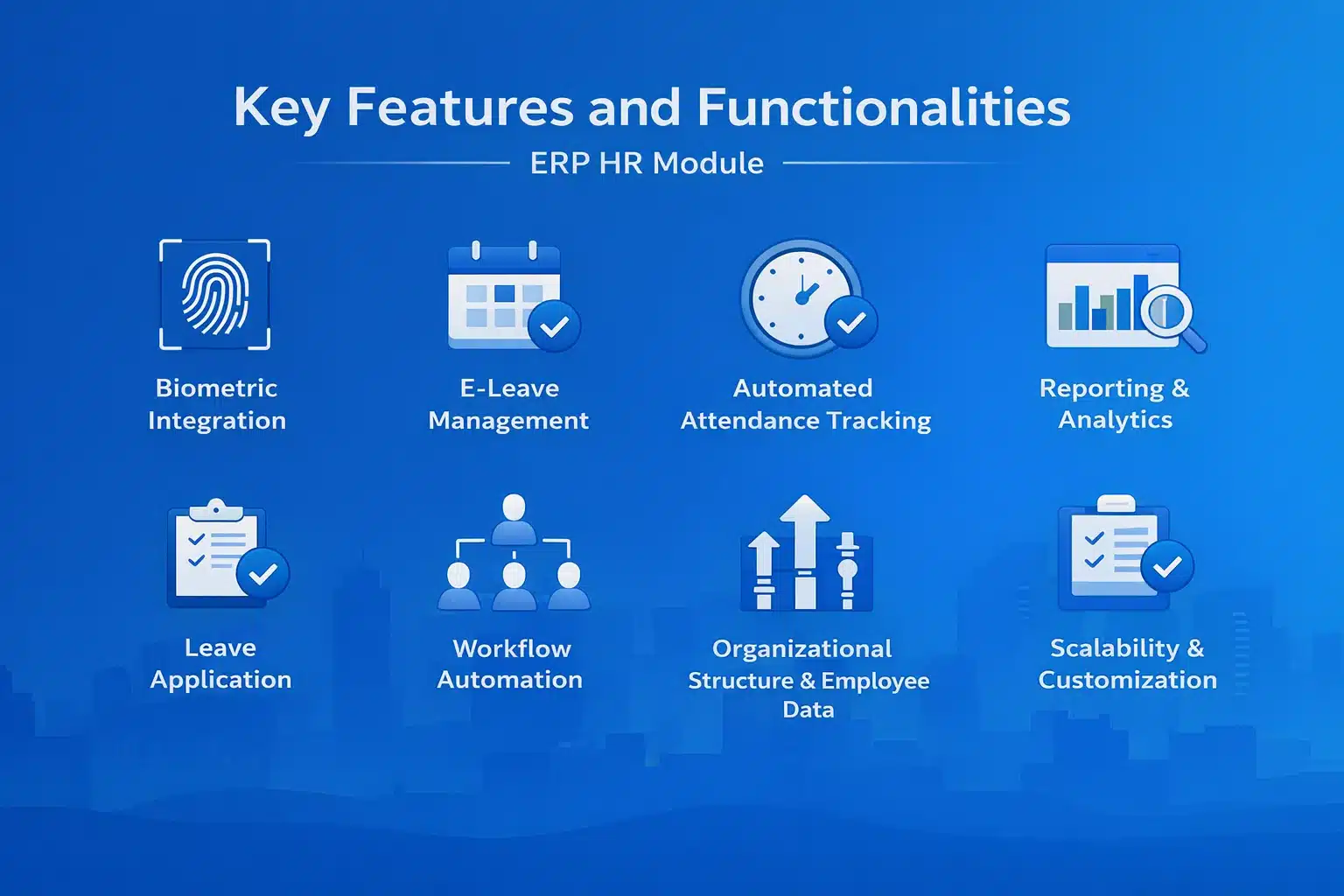
The ERP HR module offers a range of key features and functionalities designed to optimize human resource management within your organization. These features include:
- Biometric Integration: The HRIS Philippines allows businesses to integrate biometric devices for automated attendance tracking. This eliminates manual attendance recording and ensures accurate attendance data.
- E-leave Management: The module includes e-leave management, providing employees with a self-service portal to apply for leaves and managers to approve leaves electronically.
- Automated Attendance Tracking: By leveraging biometric integration and other attendance tracking mechanisms, the ERP HR module automates the process of tracking employee attendance, reducing the need for manual record-keeping and ensuring accuracy.
- Leave Application: Through the module’s e-leave management functionality, employees can easily submit leave administration applications through a self-service portal, streamlining the leave request process.
- Reporting and Analytics: The ERP HR module offers robust reporting and analytics capabilities, allowing businesses to generate customizable reports and derive valuable insights from HR metrics.
- Workflow Automation: With powerful workflow automation capabilities, the module enables businesses to define and automate HR processes, including approvals and notifications.
- Organizational Structure and Employee Data: The ERP HR module allows for the creation and management of the organizational structure, providing a clear view of departments, hierarchies, and employee data.
- Scalability and Customization: The ERP HR module is designed to be adaptable to various business types and sizes, offering scalability to accommodate business growth. It also provides customization options to align with unique HR processes.
Advantages of Integrating an HR Module into Your ERP System

Integrating an HR module into your ERP system offers significant benefits by streamlining HR workflows and reducing manual processes. Seamless integration ensures accurate and consistent data across departments, enabling better information flow.
With real-time HR data and analytics, organizations can support more strategic decision-making. Access to key performance metrics, such as employee performance and training needs allows management to align workforce strategies with broader business objectives.
The ERP HR module also enhances employee experience by minimizing administrative burdens and reducing errors. By optimizing HR processes and centralizing data, businesses can improve operational efficiency.
Selecting ERP HR Software for Philippine Businesses

When it comes to selecting ERP HR software for your Philippine business, you need to consider several factors to ensure it meets your HR management needs. Here are some key considerations to keep in mind:
- Local Compliance Requirements: Make sure the ERP HR software you choose complies with local labor laws and regulations in the Philippines. This will ensure that your HR processes are in line with legal requirements.
- Scalability: Look for software that can easily scale with the growth of your business. As your workforce expands, you want to be able to add more users and functionality without facing limitations.
- Customization Options: Every business has unique HR requirements. Choose software that allows you to customize workflows, forms, and reports to align with your specific needs.
- Vendor Reputation: Research the reputation and track record of ERP HR software vendors. Look for testimonials, customer testimonial reviews, and case studies to assess their reliability and customer satisfaction levels.
- User-Friendliness: The software should be intuitive and easy to use for both HR professionals and employees. A user-friendly interface will help streamline adoption and minimize training requirements.

Implementation Challenges and Solutions
Implementing an ERP HR module often involves challenges, such as change management, data migration, and system integration. Without proper preparation, these issues can delay deployment and reduce the system’s overall effectiveness.
One major challenge is change management and user adoption. Employees may resist new processes or feel uncertain about unfamiliar systems. To address this, organizations should provide clear communication, structured training, and continuous support to help users.
Data migration and system integration also require careful planning. Inaccurate data transfers and compatibility issues can disrupt operations. To overcome this, businesses should conduct data validation and collaborate closely with IT teams.
By proactively identifying these challenges and applying practical solutions, organizations can ensure a smoother ERP HR module implementation and effectively leverage AI-powered HR solutions to improve efficiency, accuracy, and long-term HR performance.
Conclusion
In summary, adopting a reliable ERP HR module helps streamline HR operations and improve overall efficiency. By centralizing functions such as organizational management, recruitment, and payroll, businesses can manage the employee lifecycle more effectively.
As HR technology evolves with AI and analytics, organizations can benefit from smarter workforce planning, predictive insights, and more efficient decision-making, especially in today’s flexible work environment.
Implementing a modern ERP HR module strengthens HR performance and employee satisfaction. To find the right solution for your business, consider scheduling a free consultation with our professional expert.
Frequently Asked Questions
-
What is an ERP HR module?
An ERP HR module is a component of an ERP system that manages core human resource functions such as employee data, payroll, attendance, recruitment, and performance management within one integrated platform.
-
How does an ERP HR module improve HR efficiency?
It automates routine tasks, reduces manual errors, centralizes employee information, and provides real-time reporting, allowing HR teams to focus more on strategic initiatives instead of administrative work.
-
Is an ERP HR module suitable for growing businesses?
Yes. Most ERP HR modules are scalable and customizable, making them suitable for businesses of different sizes that need structured HR processes and better workforce visibility.