







The employee benefits a company offers play a crucial role in today’s job market. Salary alone is no longer enough to keep employees engaged or attract job seekers, who now expect more well rounded compensation packages.
Employee benefits vary in type. Some are legally required, while others are optional. If you’re in charge of managing benefits at your company, it’s important to understand the different options available to provide the best support for employees.
As such, this article will explore common employee benefits and how companies incorporate them into their benefits strategies.
Table of Contents
Key Takeaways
|
What are Employee Benefits?
Employee benefits are extra perks or payments that employers give to their workers on top of regular salaries. These benefits can include things like health, dental, or life insurance, retirement plans, education or housing loans, sick leave, vacation days, and flexible work schedules.
Since employees are a company’s most valuable asset, it’s important to meet their needs and keep them happy. Providing benefits helps improve employee satisfaction and boosts performance.
With globalization growing and companies expanding worldwide, it’s also important to offer flexible work hours, as it is essential to meet employees’ preferences and availability, so that productivity can increase without sacrificing basic needs.
Who is Entitled to Employee Benefits in the Philippines?

In the Philippines, entitlement to employee benefits is primarily determined by the nature of one’s employment status as defined under the Labor Code. Here’s a breakdown of each type of employee getting the benefits:
1. Regular Employees
Individuals engaged in activities necessary or desirable to the employer’s usual business are considered regular employees. They are entitled to the full range of statutory benefits, including:
- Social Security System (SSS): Provides sickness, maternity, disability, retirement, and death benefits.
- PhilHealth: Offers health insurance coverage.
- Pag-IBIG Fund: Facilitates housing loans and savings programs.
- 13th Month Pay: Equivalent to one-twelfth of the total basic salary earned within a calendar year.
- Service Incentive Leave: Five days of paid leave annually after one year of service.
2. Project Based and Seasonal Employees
Those employed for specific projects or seasons have entitlements that depend on the duration and nature of their employment. If they render at least one year of service, whether continuous or broken, they may be considered regular employees for that activity and become eligible for certain benefits.
3. Casual Employees
Workers performing tasks not usually necessary or desirable to the employer’s main business are deemed casual employees. If their employment exceeds one year, they may also be entitled to certain benefits similar to regular employees.
4. Probationary Employees
Individuals on a trial period (not exceeding six months) to assess their suitability for regular employment. During this period, they are generally entitled to benefits like SSS, PhilHealth, and Pag-IBIG contributions.
5. Managerial Employees
Those whose primary duty involves management of the establishment or a department. While they are entitled to basic benefits, certain provisions like overtime pay may not apply to them.
6. Field Personnel
Employees who regularly perform their duties away from the principal place of business and whose actual work hours cannot be determined with certainty, and usually rely on employee scheduling. Specific benefits related to work hours, such as overtime pay, may not be applicable.
7. Independent Contractors
Individuals or entities contracted to perform specific tasks or services independently. They are not covered by the Labor Code’s provisions on employee benefits, and any entitlements are based solely on their contractual agreement with the hiring party.
Importance of Employee Benefits

Offering competitive benefits helps companies attract top talent, retain employees, and boost workplace morale. Here is why employee perks matter:
1. Finding and Retaining Talent
Providing attractive perks helps employers hire and retain the best people in their industry, as well as reducing employee turnover. As jobseekers now have more options than ever, employers need to stay competitive with their offers.
2. Boosting Employee Morale
When employees feel valued and supported, they are more likely to be happy and engaged. Benefits such as paid time off and health insurance motivate employees and strengthen their commitment to the organization.
3. Enhancing Health and Well-being
Many benefits, including health insurance, wellness programs, and fitness allowances, directly support employees’ physical and mental health. When companies invest in these programs, workers tend to perform better and take fewer unplanned absences.
4. Increasing Productivity
Happy, healthy, and motivated employees are more productive and effective in their roles. Employers benefit financially when employees perform at their best as a result of these perks.
5. Meeting Legal Requirements
Philippine labor law requires employers to provide specific benefits, including workers’ compensation and government mandated contributions. Companies that fail to comply risk legal claims and reputational damage as an employer. To stay current with statutory obligations, many HR teams use an attendance tracking system that eliminates manual logging errors.
Types of Employee Benefits in the Philippines
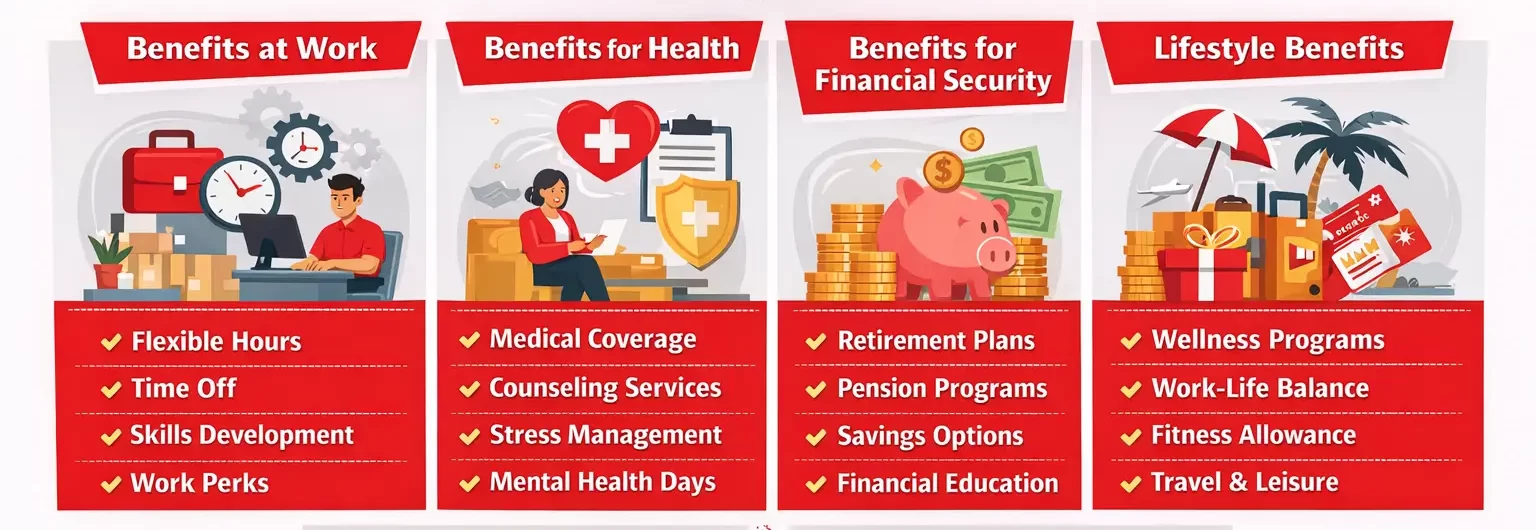
As employee needs evolve, organizations in the Philippines are adapting by offering a wider variety of benefits. These can be grouped into four main types:
1. Benefits at Work
These benefits directly impact how employees experience their jobs and include flexible working hours, time off, skills development, and perks like food, beverages, and gifts that support employee empowerment.
- Working Hours and Time Off
Control over work schedules and locations has become essential for employees, especially after the pandemic normalized remote and hybrid work.
- Skills Development
With rapid technological advancements, employees recognize the importance of staying skilled. In the Philippines, 68% of workers need to upskill or reskill by 2030, which is higher than the global average of 59%.
Of these, 28% would be upskilled in their current role, 27% would be upskilled and redeployed to other roles within the organization, while 13% are at risk of job displacement or redundancy.
2. Benefits for Health
These benefits focus on maintaining and improving employees’ physical and mental well-being. In the Philippines, there is an increased awareness of mental health issues in the workplace, leading many employers to offer programs that support the mental well-being of their employees.
These benefits may include counseling services, stress management workshops, or mental health days. Prioritizing mental health is a clear sign that a company values its employees beyond just their productivity.
3. Benefits for Financial Security
Financial stability is a significant concern for employees and directly impacts focus, motivation, and employee productivity. In the Philippines, employers are increasingly offering retirement plans beyond the mandatory Social Security System (SSS) contributions.
These may include company sponsored pension plans or investment based savings options. With an aging workforce and rising living costs, comprehensive financial benefits help reduce employee stress and improve long term employee productivity and retention.
4. Lifestyle Benefits
Lifestyle benefits cater to employees’ personal interests and life outside of work. As the workplace evolves, companies are focusing on benefits that address mental health, work life balance, and overall wellness.
More companies are recognizing the importance of mental health support, offering programs and initiatives to support employees’ mental well-being.
Mandatory and Common Employee Benefits in the Philippines
 Mandatory benefits are legally required entitlements that employers must provide to employees. In the Philippines, these are regulated by various laws and cover the following key areas:
1. Social Security System (SSS)
The SSS is a government managed insurance program providing benefits under Social Security and Employees’ Compensation (EC) schemes.
- Coverage: Includes private sector employees, self employed workers, household workers, and spouses of insured individuals.
- Benefits: Maternity pay, sickness pay, pensions, disability benefits, salary loans, life insurance, and funeral grants.
- Contributions: The employer contributes 7.37%, and the employee contributes 3.36%, based on the salary bracket.
2. Health Insurance (PhilHealth)
PhilHealth is the mandatory health insurance program for private employees in the Philippines.
- Contributions: As of 2021, 3.5% of an employee’s basic salary, shared equally by employer and employee. Salary contributions range from PHP 10,000 to PHP 70,000.
- Coverage: Includes inpatient care, outpatient services, Z benefits (for prolonged, costly treatments), and SDG benefits (for diseases like malaria, tuberculosis, and HIV/AIDS).
- Additional Insurance: Employers often provide secondary health insurance as part of their employee compensation package to cover specialized care or reduce wait times, which helps attract and retain talent.
3. Home Development Mutual Fund (Pag-IBIG)
Pag-IBIG provides housing loans and financial assistance for affordable housing.
- Contributions: Employees earning less than PHP 1,500 contribute 1%, while others contribute 2%. Employers contribute 2%, regardless of salary. The maximum contribution is PHP 200, split equally between employer and employee.
4. Working Hours and Holidays
Employees in the Philippines work up to eight hours daily, excluding a one hour lunch break, with rest periods included.
- Weekly Rest Days: Employees are entitled to a 24 hour rest day after six consecutive workdays.
- Holidays:
- Regular Holidays: Employees are entitled to pay on 12 public holidays annually.
- Special Non-Working Holidays: These days follow a no work, no pay policy unless the employee works, in which case additional pay is provided.
5. Minimum Wage and Overtime
The minimum wage varies by region and sector (agriculture or non agriculture), ranging from PHP 282 to PHP 537 daily.
- Overtime: Employees working beyond eight hours receive an additional 25% of their hourly rate.
- Night Shifts: Employees working between 10 PM and 6 AM receive at least 10% extra pay.
- Premium Pay: Employees earn:
- 30% extra for working on rest days or special holidays.
- 50% extra if a special day falls on a rest day.
- 260% of their salary if working on a regular holiday that falls on a rest day.
6. 13th Month Pay Entitlement
The 13th month pay, often called the “13th month salary,” is a mandatory benefit that employers must provide to eligible employees.
- Eligibility: All non management employees who have worked for at least one month are entitled to this benefit.
- Payment Schedule: It must be paid by December 24, but employees can opt to receive it in two installments, typically in May and December.
- Compliance: Employers are required to submit a compliance report by January 15 of the following year to confirm the payment.
- Service Incentive Leave
Employers in the Philippines must provide five days of paid leave annually to employees who have completed at least one year of service. This leave can be used as either vacation or sick leave.
8. Sick Leave
Employees insured under the Social Security System (SSS) are entitled to sickness benefits under specific conditions.
- Eligibility: The employee must have contributed to SSS for at least three months in the previous year.
- Benefits: Employees receive 90% of their average daily salary for up to 120 days per year. This benefit is capped at 240 days for the same illness.
- Employer Responsibility: Employers initially pay the benefit and later get reimbursed by SSS.
9. Maternity and Paternity Leave
Both female and male workers receive leave benefits related to childbirth or miscarriage.
- Maternity Leave: Female workers, whether married or unmarried, can take 60 days of paid leave for their first four pregnancies, including miscarriages. Moreover, if they undergo a C section or surgery due to an ectopic pregnancy, they can extend their leave to 78 days. To qualify, they must have paid at least three months of contributions to the Social Security System (SSS) within the previous year.
- Paternity Leave: Likewise, married male employees can take seven days of paternity leave for their wives’ first four pregnancies. They must apply for the leave within a reasonable period, and the couple must live together at the time of the childbirth.
10. Solo Parent Leave
Solo parents are entitled to seven days of leave per year to fulfill parental responsibilities that require their physical presence. To qualify, they must have worked for at least one year, which can be continuous or interrupted.
11. Leave for Victims of Gender Violence
Female employees who are victims of physical, sexual, psychological, or economic abuse are entitled to ten days of paid leave.
12. Special Leave for Gynecological Surgery
Women who require gynecological surgery and have worked for at least six months can take up to two months of fully paid leave.
13. Bereavement Leave
Employees can take up to three days of unpaid leave in the event of a family member’s death.
14. Retirement Benefit
In the Philippines, the Social Security System (SSS) manages retirement benefits.
- Monthly Pension: The SSS grants a monthly pension to retirees who have contributed for at least 10 years.
- Lump Sum: The SSS provides a lump sum payment to workers who have contributed for less than 10 years. It calculates the amount based on the total contributions made by both the employee and employer, plus interest.
Best Practice of Implementing Benefits for Employees
Implementing effective employee benefit programs is crucial for maximizing your investment and enhancing employee satisfaction. Here are five best practices tailored to the Philippine context:
1. Gather Employee Feedback
Conduct surveys or focus groups to understand employees’ perceptions of the benefits you offer. This approach helps identify areas for improvement and ensures that the benefits align with their needs.
A 2021 survey by Willis Towers Watson found that 76% of employers in the Philippines plan to customize their benefits strategy in the next two years, up from 36% currently.
2. Foster Inclusive Benefits
Developing inclusive benefits promotes equity within the organization. Notably, 67% of Philippine companies offer special benefits for LGBTQIA+ employees, reflecting a commitment to diversity and inclusion.
3. Enhance Benefits Communication
Regular communication about available benefits is essential. While specific data on benefits communication frequency in the Philippines is limited, global trends suggest that employees appreciate periodic updates.
Ensure that onboarding includes a comprehensive overview of benefits, and maintain ongoing communication through emails, informational materials, and Q&A sessions.
4. Personalize and Simplify Benefits
Recognize that employees have diverse needs. Allowing them to tailor their benefits ensures they receive maximum value. Additionally, ensure that the benefits platform is user friendly, enabling easy access to information and enrollment processes.
5. Monitor Benefit Utilization
Track how employees engage with the benefits offered, while respecting their privacy. This monitoring, combined with feedback, can reveal whether certain benefits are underutilized due to lack of awareness or misalignment with employee needs.
To better apply these tips, it’s best if the companies use a HRIS or HCM to manage all the employees’ benefits, as well as their aspirations and necessary factors to monitor.
Conclusion
HR professionals who understand both mandatory and supplementary employee benefits are better equipped to build compensation packages that attract qualified candidates and keep existing employees committed. In the Philippines, statutory requirements such as SSS, PhilHealth, Pag-IBIG, and 13th month pay form the baseline, while additional offerings like flexible work arrangements and wellness programs give companies a meaningful edge in retention.
As benefit structures grow more complex, organizations that manage them through a centralized system tend to reduce errors and maintain stronger compliance records. For HR teams currently evaluating their options, a review of the leading HR software platforms used in the Philippines can help identify which tools best fit their organization’s size and needs.
FAQ on Employee Benefits
-
What is the Pag-IBIG Fund, and how does it benefit employees?
The Pag-IBIG Fund, also known as the Home Development Mutual Fund (HDMF), is a government program that provides housing loans and financial assistance to Filipino citizens who seek affordable housing. Employers contribute 2% of an employee’s monthly salary to the fund, while employees contribute 1% or 2%, depending on their income.
-
Are employers in the Philippines required to provide health insurance to their employees?
Yes, employers are mandated to provide health insurance through the National Health Insurance Program, administered by PhilHealth. This program ensures universal health coverage and offers affordable healthcare services to all citizens.
-
What are the consequences for employers who fail to provide statutory monetary benefits?
Employers who refuse or fail to pay statutory monetary benefits may face employee monetary claims and criminal liability. It’s essential for employers to comply with labor laws to avoid legal repercussions.
-
What is the Employees’ Compensation Program, and who is eligible?
The Employees’ Compensation Program (ECP) is a government initiative that provides benefits to workers who suffer work related sickness, injury, or death. Coverage under the ECP starts on the first day of employment, ensuring immediate protection for employees.