







Running a dropshipping business offers flexibility, but managing inventory you never physically handle can be challenging. Limited visibility into supplier stock often leads to issues like overselling, stock shortages, and delayed deliveries.
Avoiding these problems requires clear coordination between your online store, suppliers, and order management processes, so that stock data stays accurate, orders route correctly, and customers receive what they ordered, when they expected it.
Key Takeaways
|
Table of Contents
What Is Dropship Inventory Management?
Dropship inventory management is the process of overseeing, tracking, and controlling the stock of products that your business sells but are stored and shipped directly by a third party, such as a manufacturer, wholesaler, or supplier.
Unlike traditional inventory management, where you have physical control over stock in your own warehouse, the dropshipping model demands perfect data synchronization between your digital storefront and your supplier’s inventory data.
This means monitoring available quantities across all sales channels, routing orders to the correct supplier automatically, and maintaining visibility into key metrics like sales velocity. Without an integrated system connecting your store and your suppliers, it becomes nearly impossible to prevent overselling (selling stock the supplier no longer has) or stockouts (missing restocked products that should be listed).
The Role of Technology in Dropship Inventory Automation
In a dynamic dropshipping operation, manually tracking inventory across multiple suppliers and updating it across several sales channels is not a viable long-term approach, it is time-consuming, error-prone, and impossible to scale.
Cloud-based inventory management software bridges the information gap between you, your suppliers, and your customers, acting as a central system that automates data flow across every channel.
With the right technology in place, the system handles stock updates, price changes, and order routing across hundreds of SKUs from dozens of suppliers automatically, freeing your team to focus on growth activities rather than daily operational maintenance.
Why Is Dropship Inventory Management Important for Business?
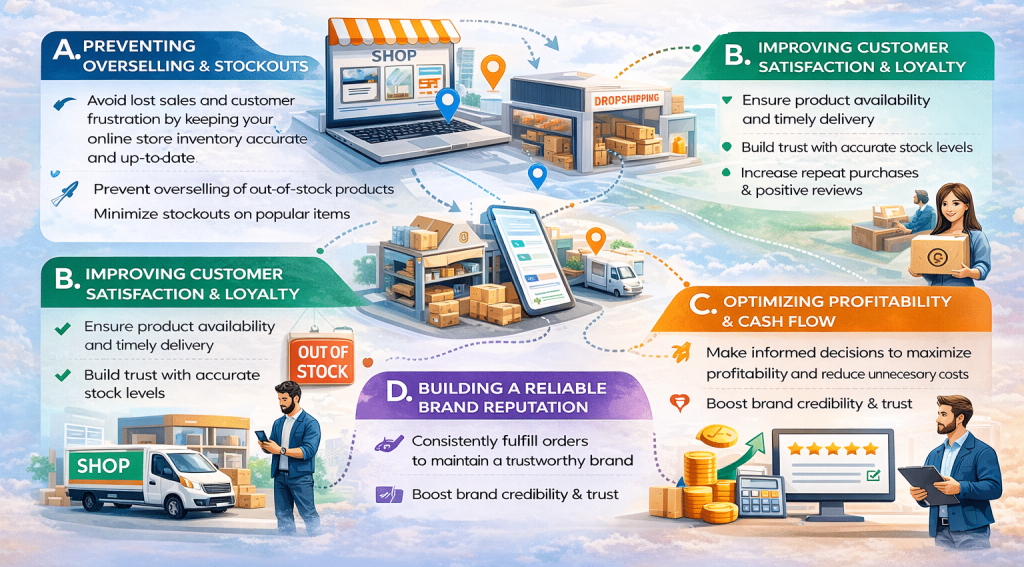
Ignoring inventory management in a dropshipping model is a recipe for failure. Although you don’t physically store products, inventory remains the heart of your business operations, dictating the customer experience and the financial health of your company.
Effective inventory management ensures every transaction runs smoothly from order placement to final delivery. It also enables faster order fulfillment and helps maintain a consistent shopping experience across all channels.
A. Preventing overselling and stockouts
Overselling, or selling a product that is already out of stock at the supplier’s warehouse, is one of the most damaging problems in the dropshipping business. It directly leads to customer disappointment, which results in order cancellations and refund requests.
On the other hand, a stockout on a popular product means you are losing valuable sales opportunities. Effective inventory management with real-time data synchronization ensures that the stock count displayed on your online store is always accurate.
B. Improving customer satisfaction and loyalty
Customer experience is the ultimate key to building a sustainable business. When customers can order the products they want and receive them on time without any issues, their trust and satisfaction levels increase significantly.
Reliable inventory management ensures product availability and helps in providing accurate shipping time estimates, two of the most critical factors in the online shopping experience. Satisfied customers are more likely to make repeat purchases and recommend your business to others.
C. Optimizing profitability and cash flow
Poor inventory management can quietly erode your profit margins. Costs arising from order cancellations, refund processing, and customer service to handle complaints due to overselling can accumulate quickly.
Furthermore, with accurate inventory data, you can make smarter decisions regarding pricing strategies, promotions, and which products to prioritize. With clear visibility into stock movement, you can allocate your marketing budget more effectively.
D. Building a reliable brand reputation
In the highly competitive e-commerce market, reputation is everything. A brand that consistently fails to fulfill orders or frequently cancels transactions will quickly be labeled as unreliable by consumers.

Key Challenges in Managing Dropship Inventory

Although the dropshipping business model frees you from the complexities of warehouse logistics, these challenges arise from the separation between the point of sale (your store) and the point of storage (the supplier’s warehouse), creating a significant potential for information gaps.
Without the right tools, these gaps compound quickly: inaccurate supplier data leads to incorrect stock synchronisation, which triggers overselling, which damages customer trust. Each challenge below is interconnected addressing them requires both the right technology and clearly defined processes.
A. Dependency on supplier inventory data
Complete reliance on the data provided by suppliers is the biggest challenge in the dropshipping model. You have no direct control to physically verify the accuracy of the stock count, so the quality of the data you receive varies greatly depending on the technological sophistication.
Some suppliers may only update their stock data once a day or even manually, creating a critical time lag where the data on your store no longer reflects the actual situation. Data entry errors on the supplier’s end or delays in updates can directly cause major problems on your sales side.
B. Non-real-time data synchronization
Even if a supplier provides accurate data, the next challenge is how to sync that data to all your sales channels instantly. In a fast-paced e-commerce environment where sales can happen at any time, a synchronization delay of even a few minutes can lead to overselling.
Manual processes like downloading a CSV file and re-uploading it to your platform are highly inefficient and prone to errors. Without real-time sync automation, maintaining data consistency across various marketplaces and online stores becomes an almost impossible task.
C. Managing multiple suppliers simultaneously
To diversify products and reduce the risk of relying on a single source, many dropshipping businesses work with multiple suppliers at once. However, this exponentially increases the complexity of inventory management, as each supplier may have different data formats.
Consolidating and standardizing all incoming data from various sources into a single, accurate, centralized view is a significant technical challenge. Moreover, you also need a strategy to route orders to the right supplier based on location or shipping costs.
D. Complex return management processes
Product return management in the dropshipping model often becomes a complicated and confusing process. Since you don’t hold stock, you can’t simply ask customers to send items back to your address.
The process involves coordination between you, the customer, and the supplier, with return policies that may differ for each supplier. Managing the communication flow, tracking the return status, and processing refunds or replacements efficiently.
E. Lack of supply chain visibility
In the dropshipping model, you often have limited visibility over the entire supply chain. Once an order is forwarded to the supplier, you may not have real-time information on when it is processed, packed, or shipped.
This limited real-time stock insight makes it difficult for you to provide accurate status updates to customers asking about their orders. This lack of transparency can cause anxiety for customers and increase the workload of your customer service team.
Strategies and Best Practices for Dropship Inventory Management
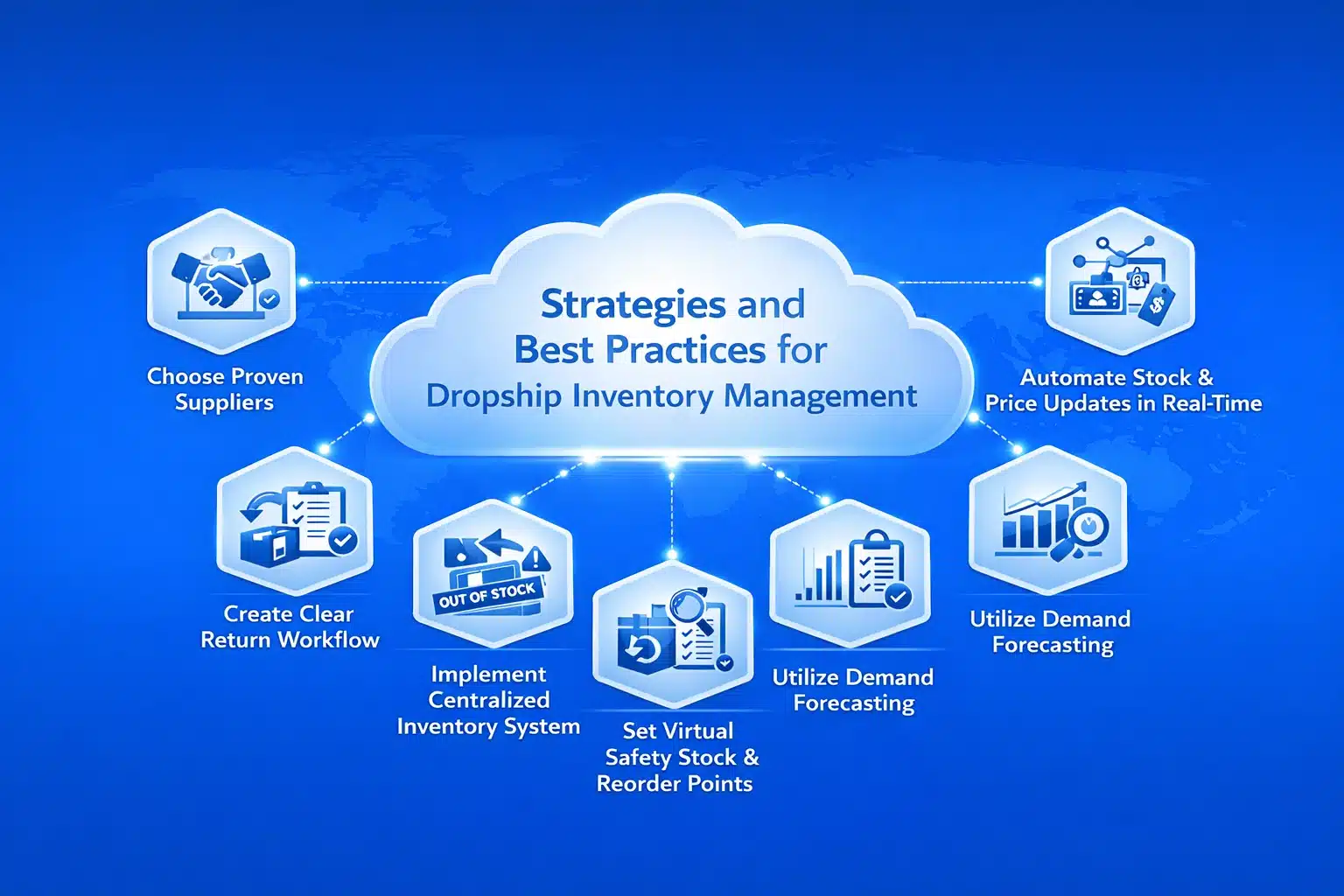
Overcoming dropship inventory challenges requires a shift from reactive problem-solving to proactive system design, choosing the right supplier partners, standardising processes, and automating workflows to reduce manual intervention.
The goal is to establish full control over data and information flow, even in a model where you don’t own the physical stock. With that foundation in place, operations become more predictable and less time-consuming to manage.
A. Choose suppliers with a proven track record
The foundation of a successful dropshipping business is a partnership with reliable and competent suppliers. Before establishing a partnership, conduct in-depth research on their reputation, policies, and technological capabilities.
Prioritize suppliers who can provide real-time inventory updates through API (Application Programming Interface) integration or at least provide automated data feeds that are updated regularly.
B. Implement a centralized inventory management system
Do not rely on spreadsheets or manual processes to manage your inventory, especially if you sell on more than one channel or work with multiple suppliers. Invest in inventory management software designed for e-commerce, which acts as a command center for all your stock data.
This system should be able to pull data from all your suppliers, consolidate it, and then automatically sync the accurate stock count to all your online stores and marketplaces. This is the only way to ensure a single source of truth for your inventory data.
C. Automate stock and price updates in real-time
Automation is the key to eliminating the critical time lag between stock changes at the supplier’s transshipment warehouse and updates on your storefront. Utilize an inventory management system that can automatically adjust stock levels on your site whenever there is a sale.
Besides stock, automation is also crucial for price updates; if a supplier changes their price, the system should be able to automatically adjust your selling price based on the markup rules you have set. This prevents you from selling at a loss or at uncompetitive prices.
D. Set virtual safety stock and reorder points
Even though you don’t manage physical stock, the concept of safety stock is still relevant. Set rules in your system to automatically display a product as “out of stock” when the supplier’s stock level reaches a certain low threshold (e.g., below 5 units).
This provides a buffer to anticipate sudden sales spikes or data inaccuracies from the supplier. Additionally, you can set a virtual reorder point that sends you a notification or even automatically hides the product when stock is low, giving you time to find alternative sources if needed.
E. Create a clear return management workflow
Simplify the complex return process by creating a clear, standard workflow for your customer service team. Use a centralized platform to manage return requests, where customers can submit requests, receive shipping labels (if provided by the supplier), and track their return status.
Ensure your team has all the information regarding each supplier’s return policy so they can provide accurate instructions to customers. Automating communication between you, the customer, and the supplier during this process will greatly improve efficiency and customer satisfaction.
F. Utilize forecasting to predict demand
Advanced inventory management focuses not only on the present but also on the future. Use historical sales data from your system to identify trends. According to a report by Forbes Advisor, demand forecasting can significantly improve business efficiency.
This feature can help you anticipate seasonal demand spikes or demand during promotional periods, allowing you to discuss with suppliers to ensure they have enough stock. This analysis also helps you make strategic decisions about which products to discontinue.
G. Conduct regular data audits
Even with an automated system, it is important to conduct regular data audits or verifications to ensure everything is running as planned. Compare sales data on your platform with reports from your inventory system and reports from suppliers to identify any discrepancies.
These audits can help uncover hidden issues, such as synchronization errors or data feed delays from specific suppliers. By performing regular checks, you can maintain data integrity and ensure the long-term reliability of your inventory management system.
Conclusion
Effective dropship inventory management is a key foundation for success in today’s e-commerce environment. Moving from manual processes to automated systems helps businesses overcome operational challenges while improving accuracy.
With better inventory visibility, control, and data insights, companies can turn operational complexity into a competitive advantage. This allows dropshipping businesses to operate more efficiently and respond quickly to changing demand.
For businesses evaluating the tools that best support this kind of automation, a comparison of the leading inventory management platforms available today is a practical starting point, particularly those built with multi-supplier, multi-channel dropshipping operations in mind.
Frequently Asked Questions
-
What is the main difference between traditional and dropship inventory management?
The main difference lies in the stock’s ownership and physical location. In traditional management, you own and store stock yourself. In dropshipping, you act as an intermediary, managing data and orders between customers and suppliers who store and ship the products.
-
How should I handle a product that suddenly goes out of stock from a dropship supplier?
Immediately disable the product on all sales channels. Contact customers who have already ordered, explain the situation honestly, and offer a full refund or a similar product. For prevention, use software with a virtual safety stock feature.
-
What are the most important metrics (KPIs) to track in a dropshipping business?
Key KPIs to track include Sell-Through Rate, Supplier Order Fulfilment Time, Order Accuracy Rate, Net Profit Margin per Product, and Product Return Rate. These metrics provide a clear picture of your operational and financial health.
-
How does HashMicro software help manage product returns in a dropshipping model?
HashMicro’s software provides a centralized platform to manage the entire return cycle. It records return requests, facilitates communication between the customer and supplier, and tracks the status of the returned item, ensuring a smooth and well-documented refund or replacement process.
-
Is it possible to do dropshipping without inventory management software?
It’s possible for very small businesses with few products and one supplier, but it is highly unrecommended and not scalable. Manual processes are time-consuming and prone to errors, which will overwhelm you as your business grows.