


The modern workplace is undergoing a profound transformation in response to the energy crisis. The Filipino government has mandated a 4-day compressed workweek for executive branch offices to reduce fuel consumption. This was soon followed by other LGUs in various cities, including Manila, Makati, Marikina, Pasay, and so on. The workplace is now going away from the rigid historical structures toward more flexible, employee-centric models.
In a globally connected economy, businesses need flexible work models to stay competitive. A compressed work week lets employees complete full-time hours in fewer days, creating a different work rhythm and improving work-life balance. However, successful implementation requires careful planning, legal compliance, and strong workforce management. This guide explains the key considerations and practical steps organizations should understand before adopting it.
Table of Contents
Key Takeaways
|
What is a Compressed Work Week?
According to the Department of Labor and Employment (DOLE), a compressed work week refers to “one where the normal workweek is reduced to less than six (6) days but the total number of work hours of 48 hours per week shall remain.”
However, the DOLE also stated that “The normal work day is increased to more than eight hours but not to exceed twelve hours, without corresponding overtime premium. The concept can be adjusted accordingly depending on the normal workweek of the company pursuant to the provisions of [DOLE DA 2-04].”
Additionally, it has to be based on voluntary agreement between employers and employees. And a compressed work week cannot be used to diminish the existing benefits of employees. Employers and employees should also manage flexible work arrangements, settle issues through grievance procedures or DOLE conciliation. Employers must keep supporting documents, and notify DOLE before implementation.
Common Types of Compressed Work Schedules
There are multiple ways to implement a compressed work week provided that the work hours do not exceed 12 hours a day. Understanding the mechanics of these common schedules is the first step in determining which model aligns best with a company’s culture and workflow:
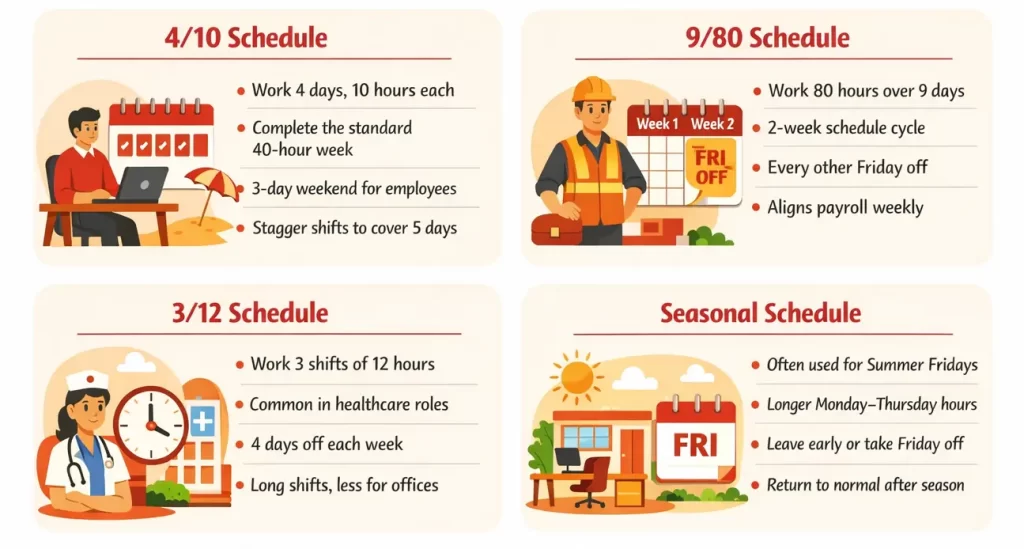
Organizations can choose from the several established models, or even create hybrid versions tailored to their specific operational needs.
Is it Mandatory for Private Businesses?
With the emergency crisis some private business owners may be concerned that they will be forced to do a compressed work week schedule. While the DOLE encourages the private sector to implement flexible schedules, they have not mandated it. To support this, under DOLE ADVISORY NO. 02, S. 2004, December 02, 2004 a compressed work week and other flexible work schedule must be voluntarily and mutually accepted by both employers and employees.
Furthermore, DOLE will grant a compressed work week itself only when there is an expressed and voluntary agreement of the majority of covered employees or their representatives. In a nutshell, a compressed work week schedule is not mandatory for private businesses.
Compressed Work Week vs Work From Home (WFH): What’s the Difference?

A compressed work week and work from home both give employers more flexibility, but they solve different problems. A compressed work week changes when employees complete their hours, while WFH changes where they do their work. In short, one adjusts the schedule, and the other adjusts the work location.
A compressed work week keeps the normal 40-hour workweek but spreads it across fewer days. DOLE’s March 2026 guidance says employers may distribute the standard 40 hours over four working days instead of five, which means employees work longer hours per day but report to work on fewer days. This setup focuses on schedule compression, not remote work.
Work from home, on the other hand, lets employees perform their jobs from an alternative workplace by using telecommunications or computer technologies. That framework comes from the Telecommuting Act, Republic Act No. 11165, which institutionalized telecommuting as an alternative work arrangement for private sector employees. MC 114 also shows the same idea in practice on the government side, as it led agencies such as the Presidential Communications Office to adopt a four-day onsite and one-day work-from-home setup as part of energy-conservation measures.
A Step-by-Step Guide to Implement a Compressed Work Week Successfully
Implementing a compressed work week requires more than a simple schedule change. Companies need to plan the setup carefully, align it with business needs, document the arrangement properly, and comply with DOLE requirements. Without a clear process, the transition can create confusion, employee resistance, and operational gaps. That is why businesses should approach compressed work week implementation in structured steps.
Step 1: Assess if a compressed work week fits your operations
First, evaluate whether your business can support a compressed schedule without disrupting service, output, or coordination. Some departments can adapt quickly, while others need fixed coverage or continuous staffing. This assessment should look at workload patterns, customer expectations, peak operating hours, and internal processes. It should also identify which teams can shift schedules without weakening daily operations.
Step 2: Consult employees before making changes
A compressed work week works best when employees understand the arrangement and agree to it. Management should explain the proposed schedule, gather feedback, and address concerns before implementation. This step matters because longer working days do not affect everyone in the same way. Some employees may welcome the extra day off, while others may worry about fatigue, commuting, or family responsibilities.
Step 3: Draft a clear policy and define the schedule
Once the company confirms the setup is workable, HR should prepare a written policy. This document should explain the approved schedule, daily work hours, break periods, attendance rules, leave deductions, overtime treatment, and communication expectations. The policy should also state which employees are covered, when the arrangement starts, and how managers will monitor compliance. A vague policy often leads to disputes, so every rule should be easy to understand.
Step 4: Set up the administration process and keep records
Next, the company should prepare the internal process for administering the arrangement. This includes designating who will manage schedules, who will handle employee concerns, and how the company will resolve grievances if issues arise. At the same time, employers should keep records that show the arrangement was adopted voluntarily. These documents matter because they support compliance and help the company respond properly if questions come up later.
Step 5: Notify DOLE before implementation
Before the compressed work week begins, the employer should notify the DOLE Regional Office that has jurisdiction over the workplace. Companies should treat this step as part of the rollout process, not as something to do later. This notice helps formalize the arrangement and shows that the company followed the required procedure. It also reduces compliance risks once the new schedule takes effect.
Step 6: Launch the schedule and monitor results closely
After rollout, management should review how the compressed work week affects attendance, productivity, coordination, and service delivery. This helps the company see whether the arrangement creates real benefits or causes new problems. If needed, the business can adjust shift coverage, improve communication rules, or refine the schedule based on actual results. In other words, successful implementation does not stop at launch. It also depends on regular review and timely adjustments.

How to Compute a Compressed Work Week Payroll
Computing payroll under a compressed work week starts with one basic principle: the employee still completes the same total weekly hours, but the company spreads those hours across fewer workdays. Because of that, the employee’s regular weekly or monthly pay should generally stay the same. Just make sure that the arrangement follows labor rules and does not reduce existing benefits.
An example on how to compute the payroll:
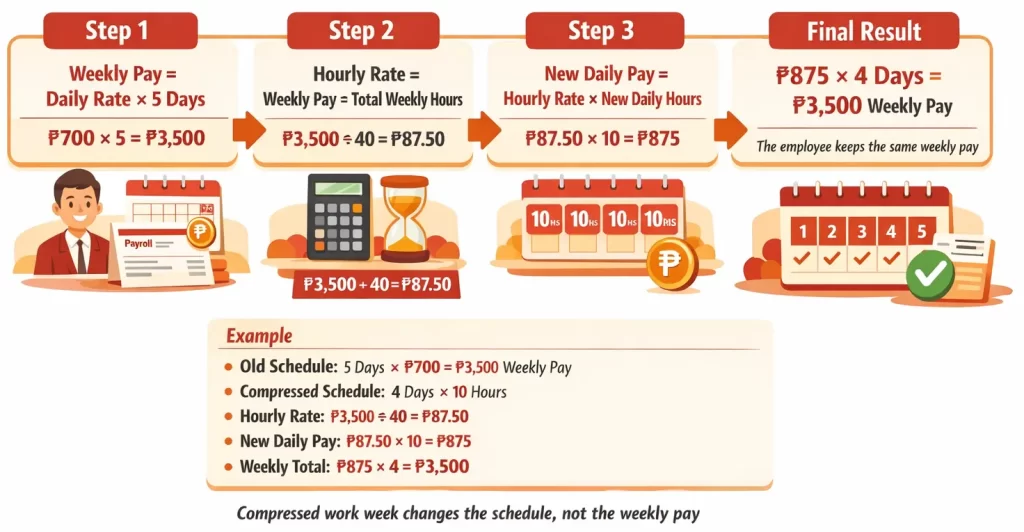
In short, a compressed work week changes the schedule, not the value of regular pay. Employers should only adjust overtime, holiday pay, or rest day pay when employees work beyond the agreed schedule or when special pay rules apply. This means payroll computation stays straightforward as long as the company keeps total weekly hours and legal compliance in check.
Legal and Non-Legal Challenges in Implementing Compressed Work Week
A compressed work week can improve flexibility, but it also creates payroll and compliance issues that many companies overlook. The biggest risks usually appear in four areas: overtime, night differential, payslip clarity, and attendance tracking. If the company fails to manage these properly, a flexible setup can quickly lead to employee complaints, payroll disputes, and compliance exposure.
- Overtime pay: Under DOLE Advisory No. 02, work beyond eight hours may stop being compensable as overtime only if the compressed workweek is voluntary, properly adopted, reported to DOLE, and kept within the allowed limits. Even then, any work beyond 12 hours a day or 48 hours a week must still be paid with overtime premium.
- Night differential: An employee working between 10:00 p.m. and 6:00 a.m must still be paid at least a 10% night shift differential for every covered hour. In other words, a compressed work week changes the schedule, but it does not cancel separate pay rules for night work.
- Payslip complexity: HR must separate compressed hours, overtime, night differential, leave deductions, and other pay adjustments in one cycle. Companies should show these calculations clearly on the payslip so employees understand how the schedule affects their pay. If the payslip looks vague, employees may think the company underpaid them or misclassified their hours.
- Attendance tracking: A company must prove how many hours the employee actually worked. The Omnibus Rules require employers to keep individual time records, and that record becomes the basis for verifying attendance, overtime, and night differential. Without accurate timekeeping, even a valid compressed work week can turn into a payroll and compliance problem.
A compressed work week can still work well, but only if the company supports it with clear policy, accurate records, and a payroll process that employees can understand.
Use HRIS & Payroll Software to Easily Apply Compressed Work Week
An HRIS helps companies manage employee data, attendance, leave, and work schedules in one system. Payroll software handles salary computation, deductions, overtime, and payslip generation. When businesses apply a compressed work week, both tools help HR teams manage longer shifts more accurately and reduce manual errors.
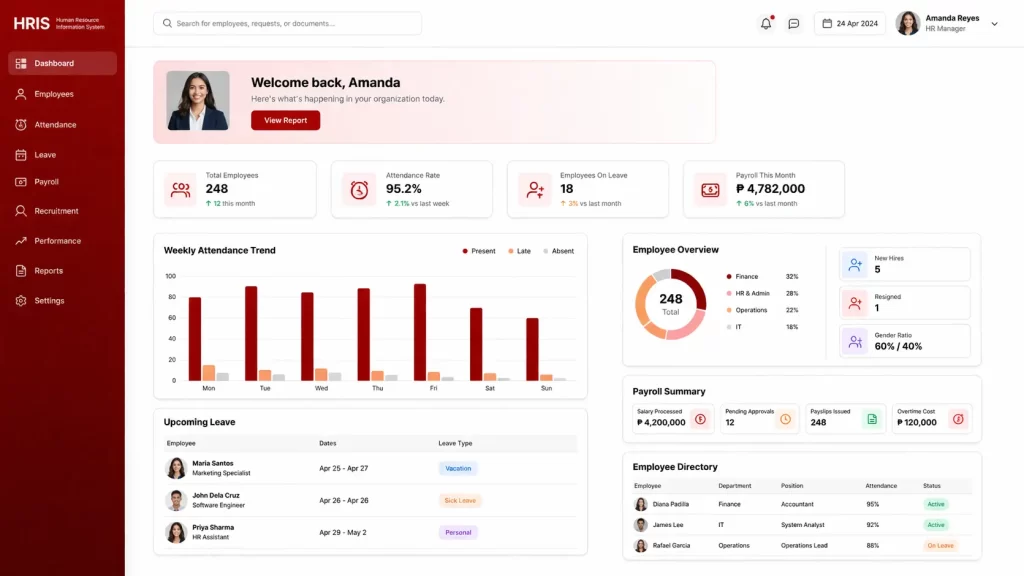
Key benefits of using HRIS and payroll software for a compressed work week:
- Automates attendance tracking for longer daily shifts
- Computes payroll based on the approved compressed schedule
- Separates regular hours, overtime, and night differential more clearly
- Reduces payroll errors caused by manual calculations
- Generates clearer payslips for better employee transparency
- Stores time records and schedule data for compliance purposes
- Helps HR monitor leave, undertime, and absences more accurately
- Gives managers better visibility into workforce costs and schedules
Having a unified system helps with applying a compressed work week without hardship with payroll and attendance management. To see how an integrated solution can support scheduling, employee records, and payroll in one platform, explore the best human resource management software.
Conclusion
A compressed work week can help businesses respond faster to rising energy costs, improve work-life balance, and keep operations flexible. However, companies should not treat it as a simple schedule change. They need clear policies, proper payroll rules, accurate timekeeping, and employee support to make the setup work smoothly.
If your business wants to apply a compressed work week with less risk, the right system can make a big difference. Explore the top HRIS systems in the Philippines to find software that helps you manage attendance, payroll, schedules, and compliance more efficiently in one platform
FAQ for Compressed Work Week
-
Can every business use a compressed work week?
No. DOLE’s 2004 advisory says the scheme may be used in establishments except those in construction, health services, heavy manual labor, and workplaces with hazardous exposure beyond OSHS thresholds for an eight-hour day.
-
Do employees need to agree before a company adopts a compressed work week?
Yes. DOLE says a valid compressed workweek must result from an express and voluntary agreement of the majority of covered employees or their authorized representatives.
-
What records should employers keep under a compressed work week?
Employers should keep documents proving that the scheme was voluntarily adopted, and they must also maintain employee time records. The Omnibus Rules require individual time records, while the CWW advisory requires records supporting voluntary adoption and OSHS compliance where applicable.
-
Can an employer later return to the normal 8-hour workday?
Yes. DOLE says the employer may revert to the normal eight-hour workday as a management prerogative, provided employees receive prior notice within a reasonable period.