










 Limited to 100 registrants

Artificial intelligence, or AI in retail, has emerged as a game changer in the retail industry, reshaping everything from customer service to inventory management. In this dynamic world where trends are changing very fast, utilizing AI, especially in retail business, is something you should master as a business owner to keep up with the latest market trends.
But how exactly is AI changing day to day retail operations, and what does this mean for both business owners and their customers? This article breaks down the core technologies, real world applications, and practical steps retailers can take when adopting AI into their workflows.
Key Takeaways
AI in retail refers to using artificial intelligence technologies to enhance various aspects of the retail business, including customer experience, inventory management, marketing, and sales operations.
In retail, AI uses various innovative technologies to improve customer experiences, accelerate processes, and enable company expansion.
Artificial intelligence (AI) transforms the retail industry by revolutionizing how businesses interact with customers, manage operations, and optimize sales strategies.
What is AI in Retail?

AI in retail refers to using artificial intelligence technologies to enhance various aspects of the retail business, including customer experience, inventory management, marketing, and sales operations. Using AI helps retailers analyze data, automate processes, and personalize shopping experiences, ultimately improving efficiency and profitability.
The impact of these technologies is already visible at scale. According to Retailasia, Unilever Philippines reported a 40% increase in conversion rates and a 59% increase in average basket size.
The statement above exemplifies how AI in retail has changed the retail business, especially regarding consumer behaviour. AI in retail has made it so much easier for consumers to shop because, for customers, an assistant from AI is like having their shopping assistant.
Technologies and Benefits in AI
In retail, AI uses various innovative technologies to improve customer experiences, accelerate processes, and enable company expansion. Among the major AI technologies utilized in retail are:
-
Machine Learning (ML)
Evaluates sales information and consumer behaviour to forecast demand, suggest items, and optimize price. Machine learning also helps merchants better control inventory and understand buying trends.
-
Computer Vision
Used for automatic checkout in cashier-less businesses. It enables visual search, allowing users to look for products using pictures rather than words. Real time monitoring improves security and prevents loss.
-
Predictive Analytics
Using historical data and AI models, AI in retail analytics forecasts sales trends, seasonal demand, and consumer preferences. It helps businesses make data-driven choices to maximize marketing campaigns and inventory levels.
-
Fraud Detection
AI in retail can help businesses identify odd transaction patterns, guarantee safe and reliable purchasing experiences, and stop online payment fraud.
-
Augmented Reality (AR) & Virtual Reality (VR)
Thanks to AI enhanced AR, customers may digitally try on clothing, furniture, or accessories before purchasing. This enhances online buying experiences by raising customer satisfaction and reducing return rates.
By utilizing these AI solutions, companies may improve consumer relations, streamline processes, and maintain competitiveness in the ever changing retail market.
How AI Change Retail Industry
Artificial intelligence (AI) transforms the retail industry by revolutionizing how businesses interact with customers, manage operations, and optimize sales strategies. One of the most significant changes AI in retail brings is personalized shopping experiences.
An example of AI in retail is Amazon Go, the company’s innovative cashier-less store idea. This is among the most well known instances of artificial intelligence in retail. These shops use sensor fusion, computer vision, and machine learning to provide a smooth, checkout free shopping experience.
Customers enter the store by scanning a QR code from the Amazon Go app linked to their Amazon account. As customers select or return items, AI powered cameras and weight sensors on shelves track these actions, adding or removing products from the virtual cart accordingly. Upon exiting, the system automatically charges the customer’s Amazon account for the items taken, eliminating the need for manual checkout.
Best Practices of Using AI in Retail
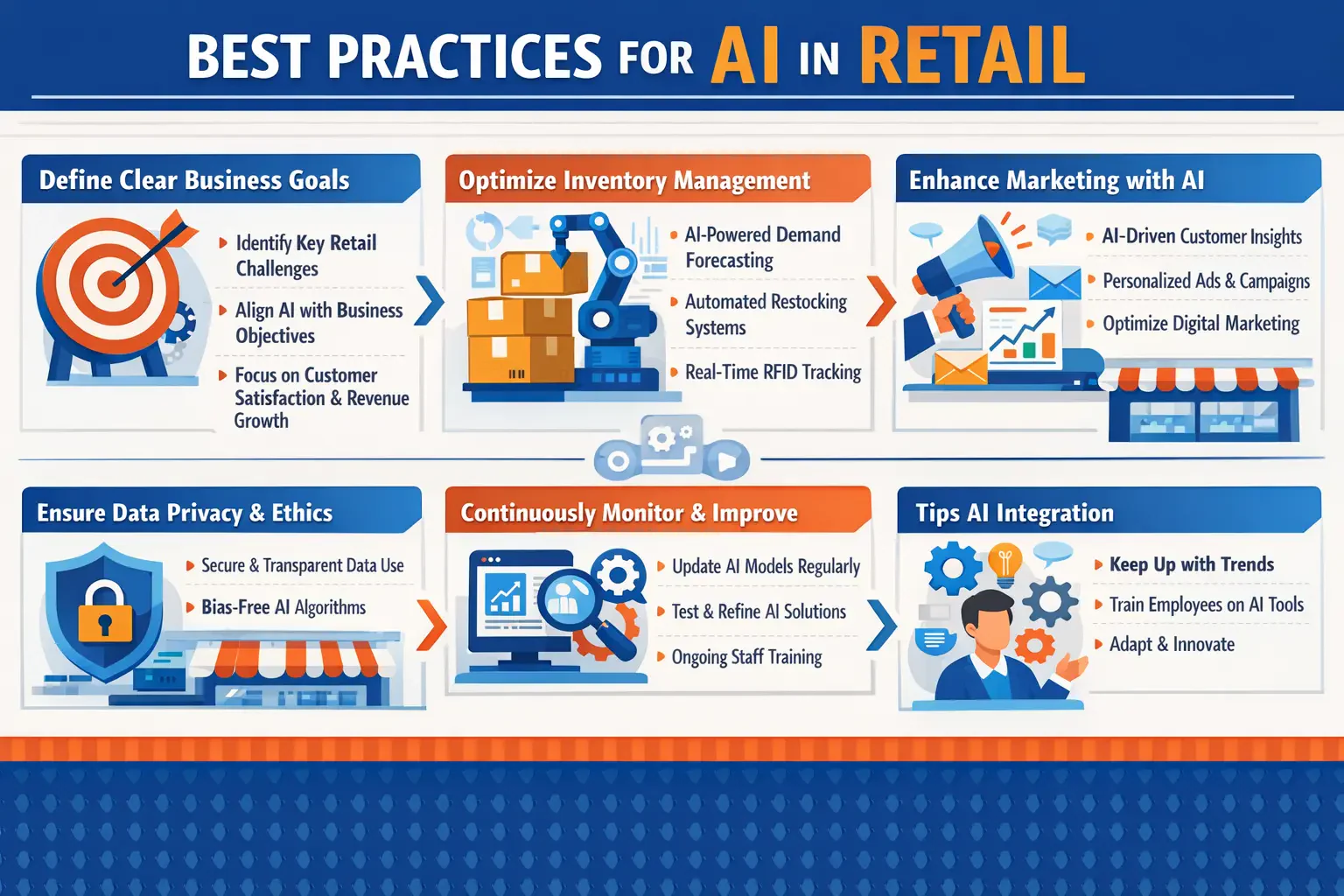
To optimize AI in retail advantages and minimize potential drawbacks, retail needs to implement a systematic approach to its application. When integrating AI into their operations, retailers ought to stick to the following best practices:
1. Define clear business goals
Determine the specific retail problems AI can address (such as fraud detection, tailored suggestions, and inventory management), and match AI projects to larger business goals like enhancing customer satisfaction, cutting expenses, or boosting revenue.
2. Optimize inventory management with AI
Use demand predictions driven by AI to maintain ideal stock levels and avoid overstocking or stockouts. Utilize real time sales and demand patterns to automate restocking procedures. AI also could utilize RFID tracking driven by AI to see your inventory in real-time.
3. Enhance marketing with AI analytics
Analyze consumer data using AI demand forecasting for focused advertising campaigns, utilize AI driven data to optimize digital marketing strategy, and automate ad placements. AI generated suggestions help personalize social media advertisements and email marketing.
4. Ensure data privacy and ethical AI usage
Obtain client approval for data acquisition and be open and honest about using AI. Use AI algorithms free from bias to guarantee that clients are treated properly.
5. Continuously Monitor and Improve AI Systems
Update AI models frequently in response to fresh data and evolving consumer trends. Regularly test AI driven solutions to identify areas for development. Lastly, staff members should be taught to incorporate AI into regular operations and use AI tools efficiently.
Conclusion
AI is changing the retail industry, transforming how businesses operate and how customers shop. From personalized recommendations and smoother checkout experiences to inventory management and AI-driven marketing, retailers are using artificial intelligence to improve efficiency, reduce costs, and deliver better customer experiences.
As more retailers look to adopt AI, one of the most practical next steps is finding the right system to support it. Reviewing a curated list of the best retail ERP software available today can help you identify which platforms are built to handle AI driven operations, from inventory automation to real time sales tracking, across different business sizes and retail categories.
FAQ about AI in Retail
With AI handling repetitive and manual activities, employees can do their jobs better and faster, enjoy more engaging work, and create greater business value. Financial and inventory planning are key areas in retail where we’re seeing AI enhance jobs, rather than replace them.
AI in retail can help improve demand forecasting, inform pricing decisions, optimize product ordering and placement, and track data from online channels to inform e-commerce and digital promotion strategies.
The future of sales jobs in an AI-driven world is not about replacement but augmentation. AI can enhance sales professionals’ productivity by automating routine tasks and providing actionable insights.