










 Limited to 100 registrants

Do you believe your current inventory management approach covers all the bases? Think again! Traditional methods often fall short when it comes to balancing high-demand items with unpredictable stock. Inefficient inventory systems lead to overstock, understock, and, ultimately, lost revenue.
Enter ABC XYZ analysis: a powerful strategy that combines product value and demand predictability for smarter management. This method categorizes items by priority and helps businesses respond dynamically to fluctuating demand. The best part? It’s rather simple to implement!
This article discusses the definition of ABC XYZ analysis, its benefits, and how to calculate it.
Key Takeaways
ABC XYZ analysis helps prioritize inventory by categorizing products based on value and demand predictability.
Combining ABC and XYZ methods improves stock management by addressing both high-value items and demand fluctuations.
Calculating demand variability helps in categorizing products as stable, moderately variable, or highly unpredictable.
What is ABC XYZ Classification?
ABC analysis is an efficient method for economic evaluation that involves categorizing items, tasks, or customers into three categories which are A (high priority), B (medium priority), and C (low priority).
In logistics, this principle translates to 20% of inventory driving 80% of warehouse movements, essential to prioritize managing these key items for optimal efficiency. XYZ analysis is a method used to categorize products according to the variability in their demand.
| Category | Description | Key Focus |
| A (Vital) | High value items that contribute the most to revenue. | Prioritize stock availability and close monitoring. |
| B (Major) | Moderate value products with a solid income contribution. | Manage regularly and maintain stable control. |
| C (Marginal) | Low value products with limited revenue impact. | Use for promotions, clearance, or supporting variety. |
| X Items | Items with stable and predictable demand. | Forecast demand with higher accuracy. |
| Y Items | Items with changing demand due to seasonality or market factors. | Review trends often and adjust forecasts carefully. |
| Z Items | Items with highly irregular and unpredictable demand. | Plan cautiously because forecasting is difficult. |
Differences between ABC and XYZ Analysis
While ABC analysis looks at value (how much a product contributes to revenue), XYZ analysis looks at demand predictability (how stable or variable the demand for a product is).
In a business, combining both methods helps you not only prioritize high-value products but also manage the variability of demand, ensuring optimal stock levels for all types of products.
Benefits of ABC XYZ Classification
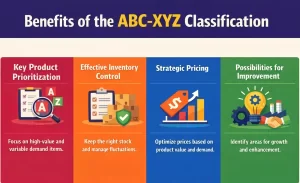 The ABC XYZ classification offers a strong framework for Category Managers to make educated judgments on product management. They benefit from using this strategy in a number of ways:
- Key product prioritization: Category managers can focus more resources and attention on these important products by identifying high-value items (Category A) and those with the most variable demand (Category Z).
- Effective inventory control: The classification helps keep the right amount of inventory on hand, so that necessary items are always available and demand fluctuations can be controlled better.
- Strategic pricing: Category managers can create price plans that optimize profitability if they have a firm understanding of each product’s significance and demand trends.
- Possibilities for improvement: The ABC XYZ classification identifies areas that require more focus and aids in locating areas that may be improved, such as introducing new products, negotiating better terms with suppliers, or enhancing supply chain processes.
This approach provides more strategic decision-making on many aspects of pricing and inventory in addition to simplifying product management.
When Your ABC XYZ Matrix Stops Reflecting Reality
 An ABC XYZ analysis only works when it matches current business conditions. As sales patterns, product value, and demand behavior change, old classifications can become less accurate and lead to poor inventory decisions.
This usually happens when stable items become harder to predict or when lower-priority products start contributing more revenue than before. If the matrix is not updated, teams may focus on the wrong items and make weaker purchasing or stocking decisions.
To avoid this, businesses should review ABC XYZ categories regularly, especially after demand shifts, seasonal changes, supplier issues, or product mix updates. Regular reclassification helps keep inventory priorities accurate and useful.
How to Calculate ABC XYZ Inventory Analysis
To calculate how much demand for a product changes (demand variability), you start by finding the average demand over a specific time period. Choosing the right time frame is important, such as using 12 months of data for items that sell more during certain seasons.
Next, for each data point, subtract the average from the actual demand, square the difference, and then find the average of these squared values. Finally, the square root of this average is taken to calculate the demand variability.
In simpler terms, demand variability is often shown using the “coefficient of variation,” which compares how much demand fluctuates. Here’s how you can categorize products into X, Y, and Z:
- Pick the products you want to analyze.
- Calculate the coefficient of variation for each item by dividing the standard deviation by the mean and multiplying by 100.
- Sort the products from the least variable to the most.
- Define the cutoff points for X (stable demand), Y (moderate variability), and Z (high variability).
Once you have your ABC (value-based) and XYZ (demand-based) categories, you can create a matrix to better manage each product group. This method will help you make better stocking and supply decisions. To make it clearer, here’s a diagram of the ABC XYZ analysis matrix:
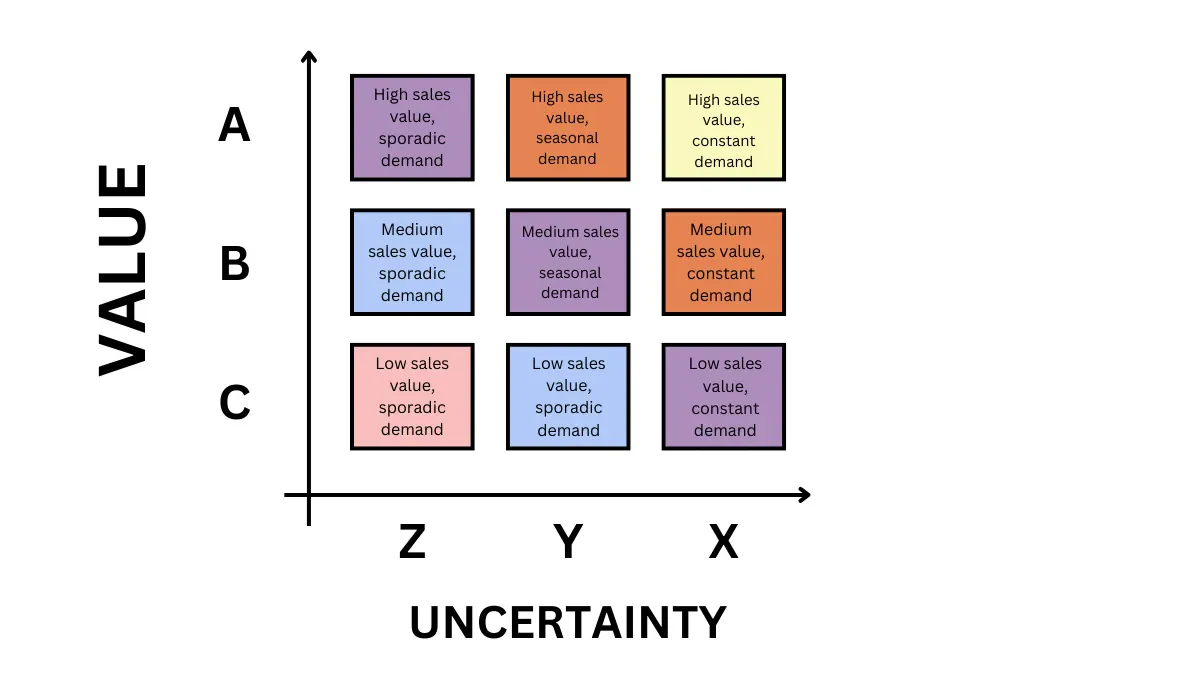
This diagram should help with determining the category of the stocks within your business. Hence, it should also lead to better inventory management in general.
Conclusion
ABC XYZ analysis is a structured approach for inventory management, focusing on prioritization and demand predictability. Categorizing items by value and demand stability aids in efficient stock handling and optimal product placement.
Regular review keeps ABC XYZ analysis useful over time. As demand, supplier performance, and product value change, businesses need to update classifications to avoid overstock, reduce stockouts, and keep inventory decisions accurate.
FAQ About ABC XYZ Inventory Analysis
ABC XYZ analysis allows companies to set safety stock based on both product importance and demand stability. High-value, stable-demand items (AX) can have lower safety stock, while high-variation items (AZ) may need higher levels to prevent stockouts.
This analysis helps tailor inventory policies by setting reorder points and restocking strategies specific to each product group, focusing resources on high-value and stable-demand items, while minimizing excess stock on unpredictable, low-value items.
Unlike methods that consider only value or demand, ABC XYZ combines both to provide a holistic view of stock needs, helping businesses allocate resources efficiently across different demand patterns.
Yes, it benefits both large and small businesses. Even with fewer items, businesses gain insights into demand and profitability patterns that guide smarter stocking and ordering decisions.