













Traditional HR processes built on manual data entry, paper forms, and email chains are increasingly recognized as a barrier to organizational growth, not just an inefficiency. This shift has accelerated adoption of employee self service (ESS) systems, which decentralize administrative tasks and give employees direct access to their own HR information. For Philippine businesses navigating rapid workforce growth, ESS is transitioning from a competitive advantage into an operational baseline
Giving employees 24/7 access to their personal data, payroll records, and career development resources signals a meaningful cultural shift from centralized HR control to workforce autonomy and transparency. Organizations that invest in this decentralization consistently report stronger engagement, faster HR service delivery, and more accurate employee data. This guide covers the core mechanics, key benefits, common challenges, and implementation steps of employee self service systems
Key Takeaways
|
Table of Contents
Understanding the Foundation of Employee Self Service
Employee self service (ESS) is an HR technology that enables employees to directly perform functions that were historically handled by HR staff such as updating personal data, accessing payslips, managing leave, and enrolling in benefits. Rather than waiting days for an HR response, employees log into a secure portal and manage their own professional information independently. This shift accelerates response times and fundamentally changes the daily workflow of both employees and the HR team.
Essential Features Every Employee Self Service System Needs
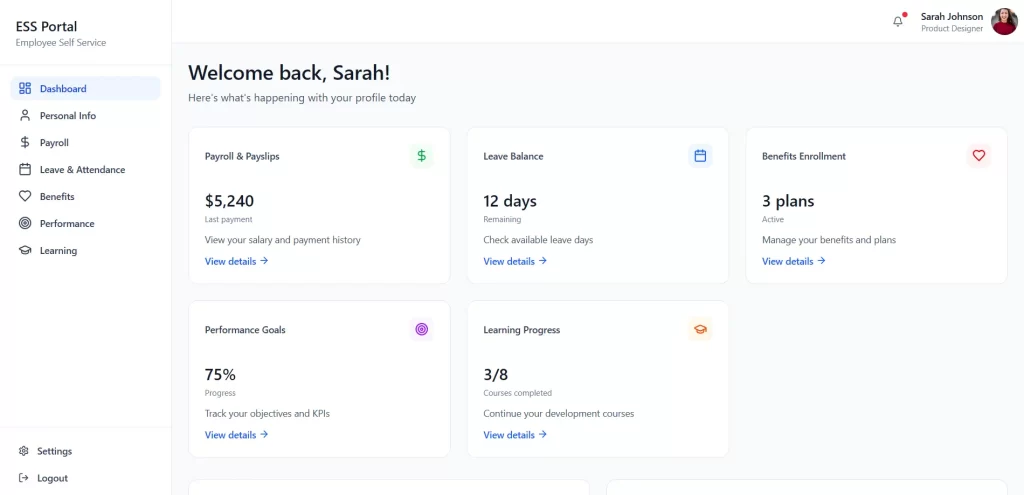
The effectiveness of an ESS platform is directly proportional to the breadth and depth of its features. While different organizations may prioritize different functionalities based on their specific industry and workforce demographics, a comprehensive system must encompass a core set of features to drive meaningful adoption and deliver tangible operational improvements.
-
Personal Information Management
At a minimum, an ESS system must allow employees to view and update their personal profiles including demographic details, contact information, emergency contacts, and banking details for payroll deposits. Decentralizing this task keeps organizational records accurate without adding to HR’s administrative workload. When an employee updates their address, the change automatically flows through to all integrated systems, including payroll and benefits.
-
Payroll and Compensation Visibility
The payroll module is consistently one of the most accessed features in any ESS portal, giving employees on-demand access to digital payslips, tax documents, and detailed deduction breakdowns. This transparency supports personal financial planning and reduces payroll-related queries to HR. Advanced platforms also allow employees to model scenarios such as adjusting retirement contributions and see the projected impact on net pay before making changes.
-
Leave and Attendance Tracking
Leave management has traditionally been a source of friction, paper requests get lost and accrual balances are frequently miscalculated. ESS portals solve this by giving employees real-time visibility into their leave balances and allowing them to submit requests digitally, routed automatically to their manager for approval. Once approved, the system updates balances and syncs with team calendars to prevent scheduling conflicts.
-
Benefits Administration and Enrollment
Annual benefits enrollment is one of the most administratively intensive periods for HR teams, but ESS platforms simplify the process by guiding employees through their options in an intuitive, step-by-step interface with comparison tools and benefit calculators. Employees can review health plans, life insurance, and spending accounts, and make selections without requiring HR to walk them through each choice. Outside of open enrollment, the portal also handles qualifying life events such as marriage or a new child to trigger mid-year benefit adjustments.
-
Performance Management and Goal Setting
Modern HR management favors continuous feedback and dynamic goal setting over rigid annual reviews, and ESS portals support this by providing a centralized space for ongoing performance documentation. Employees track their progress against KPIs, log achievements, and request peer or supervisor feedback directly in the system. Managers use the same platform to schedule check-ins, record notes, and align individual goals with organizational objectives.
-
Learning and Development Accessibility
ESS platforms frequently integrate with Learning Management Systems (LMS), giving employees direct access to training catalogs, certification programs, and development resources without going through HR. Employees can browse, enroll, and track their own learning progress at their own pace. This self-directed access to development resources supports internal talent growth and reduces reliance on externally sourced skills
The Strategic Impact of ESS on Human Resource Management
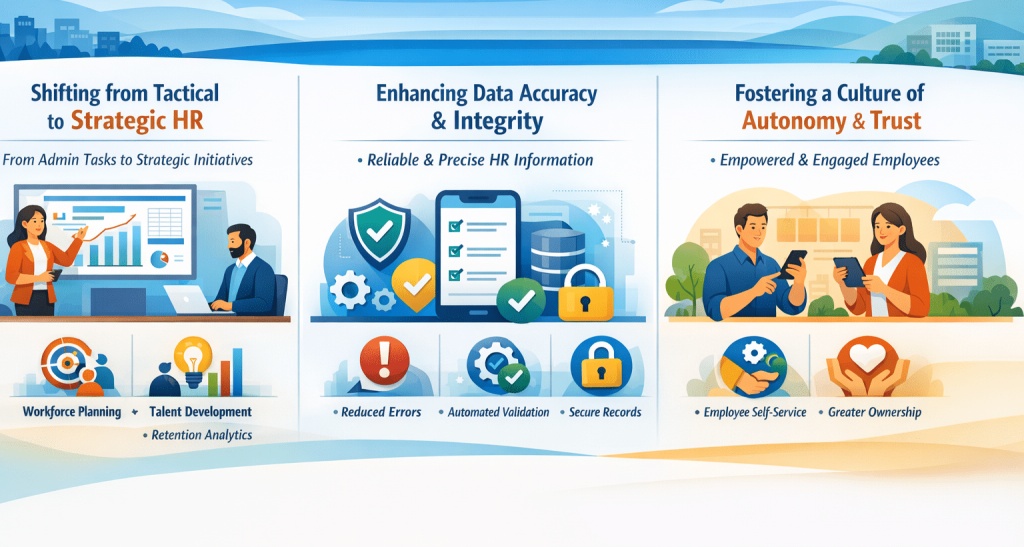
The implementation of self-service technology extends far beyond simple administrative convenience; it acts as a catalyst for a profound strategic transformation within the human resources department. By fundamentally altering how routine tasks are executed, these systems enable HR professionals to elevate their role from tactical administrators to strategic business partners.
1. Shifting from Tactical to Strategic HR
In a traditional HR model, the majority of staff time is consumed by reactive tasks, answering basic inquiries, processing paper forms, and manually updating records leaving little bandwidth for strategic work. When an ESS platform handles these routine functions, HR teams reclaim significant capacity for workforce planning, talent development, and retention analytics. The department shifts from a compliance-focused cost center to a value-generating function focused on human capital strategy.
2. Enhancing Data Accuracy and Integrity
HR data accuracy is critical for payroll, compliance, and workforce planning and centralizing data entry through a small number of administrative staff creates multiple points of transcription error. ESS mitigates this by placing data entry responsibility directly with the employee, who has the strongest interest in keeping their own pay and benefits information correct. Automated validation rules in the portal add a further layer of protection by rejecting incomplete or incorrectly formatted submissions before they reach the database.
3. Fostering a Culture of Autonomy and Trust
Providing employees with tools to manage their own professional lives sends a clear organizational signal the company trusts its workforce to act independently rather than treating them as dependents requiring constant administrative oversight. This empowerment consistently correlates with higher engagement and job satisfaction. When employees have transparent, on-demand access to their own data, their sense of ownership over their work environment deepens.
Comprehensive Benefits of Employee Self Service Deployment
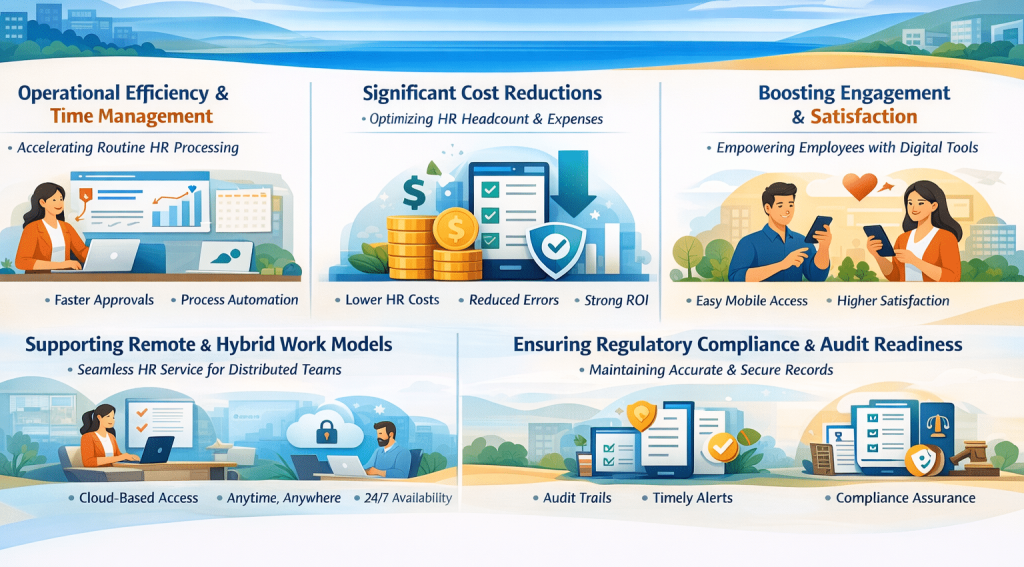
The decision to invest in and deploy an ESS platform is supported by a robust array of tangible and intangible benefits. These advantages permeate every level of the organization, delivering value to frontline employees, middle management, the human resources team, and the executive suite.
1. Operational Efficiency and Time Management
The most immediate and measurable benefit of ESS is the compression of routine HR workflows from days to minutes. A leave request that once required a paper form, manager signature, and manual HR data entry is now submitted, approved, and recorded automatically through the portal. This elimination of process bottlenecks frees time across the entire organization not just in HR.
2. Significant Cost Reductions
The most significant cost savings from ESS come not from reduced paper use but from optimizing HR headcount, organizations can scale their workforce without proportionally scaling their HR team. Improved data accuracy also reduces expensive downstream errors: payroll corrections, compliance penalties, and benefits overpayments. Over time, these compounding efficiencies produce a strong return on the initial technology investment.
3. Boosting Employee Engagement and Satisfaction
Employees accustomed to seamless digital experiences in their personal lives: banking, e-commerce, ride-hailing bring the same expectations to the workplace. An intuitive ESS portal that lets them access payslips on their phone, submit leave in seconds, and view career progression at any time meets that expectation and raises overall satisfaction. Higher satisfaction consistently correlates with lower turnover and stronger productivity making ESS a talent retention lever as much as an administrative one.
4. Supporting Remote and Hybrid Work Models
Traditional centralized HR processes designed around physical presence and synchronous communication are incompatible with distributed workforces. ESS systems are inherently built for this decentralized reality: cloud-based, accessible from any device, and available around the clock regardless of location or time zone. This accessibility ensures remote and hybrid employees receive the same quality of HR service as those working in headquarters.
5. Ensuring Regulatory Compliance and Audit Readiness
ESS platforms support regulatory compliance by standardizing HR processes and automatically generating immutable digital audit trails every policy acknowledgment, benefit selection, and leave approval is logged with a timestamp and user ID. When an audit or regulatory inquiry arises, HR can retrieve complete, organized records in minutes rather than reconstructing paper trails. Automated reminders for mandatory training and tax form updates further reduce the risk of compliance gaps slipping through.
Navigating the Challenges of Employee Self Service Implementation

While the benefits of self-service technology are compelling, the journey to successful implementation is rarely without obstacles. Organizations must proactively identify and address potential challenges to ensure a smooth transition and maximize user adoption.
1. Overcoming Resistance to Technological Change
Resistance to ESS adoption is common, some employees find the technology intimidating, while others perceive it as the organization offloading administrative work onto their shoulders. Overcoming this requires a change management approach centered on employee benefit: faster response times, 24/7 access, and greater transparency over their own data. Framing the rollout around what employees gain, rather than what HR saves, is the most effective way to drive genuine adoption.
2. Addressing Data Security and Privacy Concerns
Centralizing sensitive personal and financial data in a digital portal raises legitimate security concerns that organizations must address proactively and transparently. Employees need to understand what protections are in place, encryption standards, secure hosting, multi-factor authentication, and role-based access controls that prevent, for example, a manager from viewing an employee’s health or banking details. Clear, accessible privacy policies that specify exactly who can see what data are as important as the technical safeguards themselves.
3. Solving Integration Hurdles with Legacy Systems
Many established organizations run a patchwork of disconnected legacy systems, a standalone payroll engine, an isolated time-tracking tool, a separate recruiting database and integrating a modern ESS portal into this environment is a genuine technical challenge. If the portal cannot communicate bidirectionally with these backend systems, data silos persist and the expected efficiency gains disappear. Thorough technical audits before implementation, combined with robust API and middleware strategies, are essential for achieving real integration rather than just adding another disconnected layer.
4. Mitigating the Risk of Information Overload
A portal that overwhelms users with cluttered menus, dense language, or buried functions will drive employees back to emailing HR, defeating the purpose of the system entirely. ESS portals must be designed with a minimalist, user-first approach: logical information architecture, responsive search, and complex workflows like benefits enrollment broken into simple, wizard-driven steps. The usability test is simple: if an employee cannot complete a sick day request in a few clicks, the design needs work.
A Step-by-Step Guide to Implementing Employee Self Service
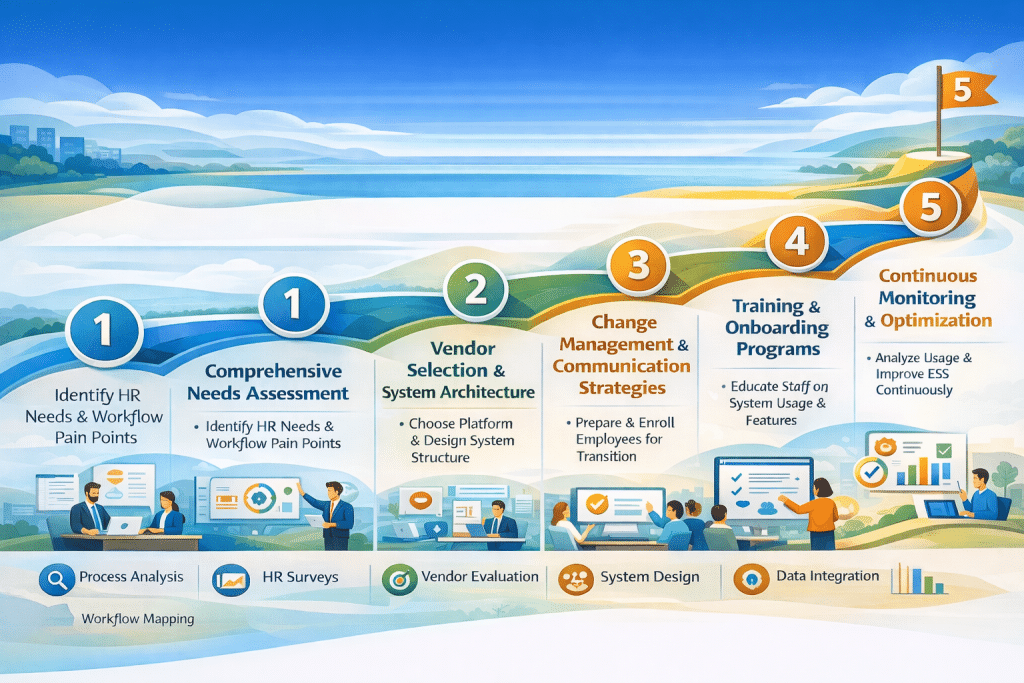
Deploying a comprehensive HR portal is a major organizational initiative that requires meticulous planning, cross-functional collaboration, and disciplined execution. Following a structured, phased methodology is essential for mitigating risks and ensuring a successful rollout.
Phase 1: Comprehensive Needs Assessment
Implementation begins with a thorough assessment of the organization’s current HR processes, pain points, and strategic objectives, conducted before any software is evaluated. This involves interviewing HR staff about where administrative time is consumed, surveying employees about current frustrations, and mapping existing workflows in detail. The output is a clear set of functional requirements that ensure the chosen system addresses actual business needs rather than generic assumptions
Phase 2: Vendor Selection and System Architecture
With requirements defined, the team evaluates vendors against criteria including user experience, security protocols, API integration depth, and scalability for future growth. Once a platform is selected, the technical architecture phase maps data fields between the new portal and existing backend systems and establishes data governance rules. Configuration follows aligning the system with organization-specific policies such as custom leave accrual rules or unique performance rating scales.
Phase 3: Change Management and Communication Strategies
Technology adoption fails without proactive change management, communication should begin early in the implementation process, clearly articulating the personal benefits for employees rather than focusing solely on organizational efficiency gains. Messaging should be multi-channel: town halls, email, intranet, and departmental briefings, all framing the rollout around the employee experience. Identifying and enlisting change champions engaged employees across departments who can advocate for the system and answer peer questions significantly improves adoption rates.
Phase 4: Training and Onboarding Programs
While modern ESS platforms are designed to be intuitive, comprehensive training is still essential to ensure users feel confident navigating the system. Training programs should be tailored to different user groups; for example, managers will require specific training on how to review and approve requests, while frontline employees will focus on accessing personal data and submitting forms. Training materials should encompass a variety of formats to accommodate different learning styles, including live webinars, recorded video tutorials, interactive digital sandboxes, and easily accessible Quick Reference Guides (QRGs) embedded directly within the portal.
Phase 5: Continuous Monitoring and Optimization
Launch is the beginning of the ESS lifecycle, not the end, post-go-live monitoring of adoption rates, module usage, and dropout points is essential for continuous improvement. When data shows employees consistently abandoning a specific workflow (such as benefits enrollment midway through), that signals a need for interface refinement or better instructional content. Treating the portal as a living tool that evolves with user feedback maximizes its long-term value.
Integrating ESS with Broader Enterprise Systems

An employee self service portal cannot exist in a vacuum. To realize its full potential, it must be deeply integrated into the broader technological fabric of the organization. This interconnected ecosystem ensures that data flows seamlessly across departments, eliminating redundancies and establishing a single source of truth for all enterprise data.
The Synergy Between ESS and Core HRIS
The most important integration in any ESS ecosystem is the bidirectional connection between the self-service portal and the core HRIS, the portal serves as the employee-facing frontend, while the HRIS acts as the central data engine. When an employee updates their banking details in the portal, that change must instantly write back to the HRIS to ensure the next payroll run is accurate. This tight synergy eliminates manual data reconciliation and ensures HR always works from the most current, employee-verified information.
Connecting ESS with Enterprise Resource Planning
For larger organizations, integrating ESS with a broader Enterprise Resource Planning (ERP) system transforms HR data from a siloed input into an operational signal across the business. When an employee submits an extended leave request through the portal, an integrated ERP can automatically adjust project resource allocation, update labor cost forecasts in finance, and trigger IT access changes, all without manual intervention. This level of cross-system automation reduces coordination overhead and improves response speed across departments.
Identity Management and Single Sign-On (SSO)
In a modern corporate environment, employees are required to access dozens of different software applications daily. Requiring a separate username and password for the HR portal creates friction, leads to forgotten passwords, and generates unnecessary IT support tickets. Integrating the ESS platform with the organization’s Identity and Access Management (IAM) system via Single Sign-On (SSO) protocols (such as SAML or OAuth) is essential. SSO allows employees to access the self-service portal using their standard corporate credentials, providing a frictionless user experience while simultaneously enforcing enterprise-grade password security and multifactor authentication
Conclusion
Employee self service platforms have moved well beyond simple convenience tools, they are now a core component of how modern HR departments operate, enabling faster decisions, better data quality, and a workforce that takes greater ownership of its own professional information. From leave tracking and payroll visibility to benefits enrollment and performance management, a well-implemented ESS system reduces friction at every touchpoint in the employee lifecycle.
For organizations in the Philippines evaluating where to start, understanding how different HR software platforms compare in terms of ESS features, integration depth, and scalability is a practical first step. A review of the leading HR management software options currently available can help narrow down which systems best match your workforce size and operational requirements.
Frequently Asked Questions Around Employee Self Service
-
What is employee self service (ESS)?
Employee self service (ESS) is an HR technology that allows employees to directly access and manage their own work-related information — including personal details, payslips, leave balances, and benefits enrollment — through a digital portal or mobile app. It reduces routine administrative requests to HR teams and gives employees 24/7 access to their own data.
-
What are the benefits of employee self service?
ESS reduces administrative workload for HR teams, speeds up routine tasks like leave approvals and payslip access, improves data accuracy, and increases employee satisfaction through round-the-clock access. For remote or distributed teams, ESS removes the need for physical presence for HR tasks.
-
What features should an ESS portal have?
A comprehensive ESS portal should include personal information management, digital payslip access, leave and attendance tracking, benefits enrollment, performance management, and learning resources. Integration with the organization’s HRIS, payroll system, and ERP is also essential for seamless data flow.
-
How do you implement an employee self service system?
ESS implementation typically follows five phases: needs assessment, vendor selection, change management and communication, role-specific training, and post-launch monitoring. The change management phase is often the most underestimated — technology adoption fails without proactive communication and support from leadership.