













Compensation is the foundational pillar of the employer-employee relationship, serving as the primary mechanism of exchange for an individual’s time, skills, and labor. When this mechanism falters, whether through administrative oversight, technological failure, or intentional wage theft, it creates a critical liability for the organization. One of the most significant financial and legal challenges a human resources department can face in this arena is the accumulation and subsequent distribution of back pay. Understanding the intricate nuances of owed wages is not merely an exercise in payroll accounting; it is a fundamental component of legal compliance, ethical business practice, and organizational integrity.
In the modern workforce, where employment contracts are increasingly complex and labor laws are continuously evolving, payroll discrepancies are more common than many organizations care to admit. From miscalculated overtime rates to the misclassification of independent contractors, the scenarios that trigger retroactive financial obligations are vast and varied. This comprehensive guide will dissect the concept of delayed compensation, exploring its root causes, legal implications, calculation methodologies, and the strategic measures organizations must implement to safeguard their financial health and maintain employee trust.
Key Takeaways
|
Table of Contents
Understanding the Concept of Back Pay
At its core, back pay refers to the amount of salary, wages, or benefits that an employer owes an employee for work that was performed in the past but was not properly compensated at the time it was completed. It represents a financial debt owed by the organization to the worker, arising from a discrepancy between what the employee was legally entitled to receive and what was actually disbursed during the relevant pay periods. This concept is deeply embedded in labor law, serving as a corrective measure to ensure that workers are made whole when their rightful earnings have been denied or delayed.
The necessity for such corrective payments can arise in almost any industry and across all levels of an organization, from entry-level hourly workers to executive management. It is crucial to recognize that this financial obligation is not limited strictly to base hourly wages or annual salaries. Depending on the jurisdiction and the specific circumstances of the employment agreement, owed compensation can also encompass unpaid overtime premiums, missed commissions, withheld bonuses, uncompensated accrued paid time off (PTO), and even the monetary value of lost fringe benefits such as health insurance premiums or retirement contributions.
Furthermore, the obligation to disburse these funds is not contingent upon the employer’s intent. While some cases stem from deliberate wage theft or malicious withholding of funds, the vast majority of instances are the result of unintentional administrative errors, misinterpretation of complex labor laws, or systemic failures within the organization’s payroll processing software. Regardless of whether the underpayment was a genuine mistake or an intentional violation, the legal and financial responsibility remains squarely on the shoulders of the employer to rectify the situation promptly and accurately.
Back Pay vs. Retroactive Pay: Key Differences
Back pay refers to the complete absence of payment for time worked, the employee performed their duties but received zero compensation for those specific hours or tasks. Retroactive pay, by contrast, applies when an employee was paid for time worked but at the wrong rate; the retro payment is simply the difference between what was received and what should have been received.
The distinction matters for payroll processing and tax reporting: back pay must be treated as compensation for a prior period of complete non-payment, while retro pay corrects a rate discrepancy for a period that was partially compensated. Mislabeling either one can cause improper tax withholding, general ledger errors, and complications during audits.
Common Causes and Scenarios Triggering Owed Wages
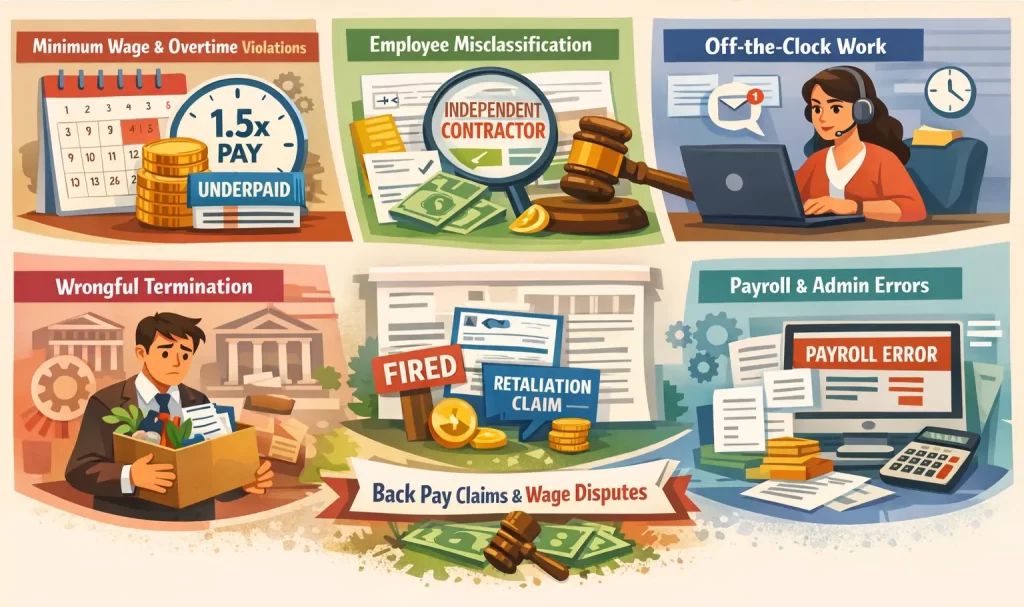
The modern workplace is a complex ecosystem of varying schedules, diverse compensation structures, and intricate employment laws. Within this environment, there are numerous pathways through which payroll discrepancies can occur. The following scenarios represent the most frequent triggers for retroactive wage obligations.
1. Minimum Wage and Overtime Violations
Overtime violations are among the most common triggers for back pay claims. Non-exempt employees are legally entitled to a premium rate typically 1.5× their regular hourly rate for any hours worked beyond 40 per week. Employers often incur liability by mistracking hours, averaging time across multiple weeks to dodge overtime thresholds, or excluding bonuses and commissions from the regular rate calculation.
2. Misclassification of Employees
Misclassifying employees as independent contractors to avoid payroll taxes, overtime, or benefits obligations is one of the most financially damaging payroll errors. When labor authorities determine a contractor was legally functioning as an employee, the employer becomes liable for years of unpaid overtime and missed entitlements. The same risk applies when non-exempt hourly workers are incorrectly classified as exempt salaried employees to sidestep overtime requirements.
3. Off-the-Clock Work
Digital connectivity has blurred the line between work time and personal time and non-exempt employees answering emails after hours, taking client calls during a commute, or completing prep tasks before clocking in are performing compensable work. When employers fail to capture this off-the-clock time, unpaid minutes compound quickly into significant wage debts. The issue is especially common in retail, healthcare, and hospitality, where pre-shift meetings and protective gear donning often go unrecorded.
4. Wrongful Termination and Retaliation
When an employee is terminated in violation of employment contracts, anti-discrimination laws, or whistleblower protections, they may pursue legal action. If a court or labor board rules the termination wrongful, back pay is one of the primary remedies awarded. The employer is ordered to pay the employee all wages and benefits they would have earned from the date of termination to the date of judgment or reinstatement.
5. Administrative and Payroll System Errors
Not all wage discrepancies are born of legal disputes or misclassifications; many are simply the result of human error or technological glitches. Data entry mistakes, failure to process timesheets on time, software bugs in legacy payroll systems, and miscommunication between department managers and HR can all lead to missing wages. While these errors are usually unintentional, they still require immediate remediation to prevent the accumulation of legal liabilities and the erosion of employee trust.
The Legal Landscape and Compliance Requirements

The obligation to pay employees accurately is a strict legal mandate, not a best practice enforced by labor authorities across jurisdictions. In the US, the Fair Labor Standards Act (FLSA) governs minimum wage, overtime requirements, and record-keeping, with the Department of Labor empowered to investigate violations and demand back wages plus penalties. Similar frameworks exist globally: the EU’s Working Time Directive, Australia’s Modern Awards system, and in the Philippines, the Labor Code enforced by the Department of Labor and Employment (DOLE) all impose comparable obligations on employers.
Statute of Limitations
A critical legal concept in wage disputes is the statute of limitations, which defines the maximum time period after an event within which legal proceedings may be initiated. Under the US FLSA, the standard statute of limitations for the recovery of unpaid wages is two years. However, if the employee or the DOL can prove that the employer’s violation was “willful” meaning the employer knew their actions were illegal or showed reckless disregard for the law, the statute of limitations is extended to three years. This means an employer could be forced to look back through three years of payroll records and compensate an entire class of employees for a systemic error.
Liquidated Damages and Penalties
The financial risk of underpaying employees extends far beyond simply paying back the original amount owed. In many jurisdictions, courts and labor boards will award “liquidated damages” to the affected employees. Liquidated damages are essentially a penalty assessed against the employer, typically equal to the amount of the unpaid wages. Therefore, if an employer owes an employee $5,000 in missed overtime, they may be ordered to pay $5,000 in actual wages plus an additional $5,000 in liquidated damages, totaling $10,000. Furthermore, the employer is almost always required to cover the employee’s attorney fees and court costs, making wage litigation an incredibly expensive ordeal.
How to Calculate Back Pay Accurately

Calculating owed wages requires reviewing historical payroll records, timesheets, employment contracts, and applicable tax tables. The methodology differs depending on whether the employee is paid hourly or on a fixed salary, and on the specific circumstances that led to the underpayment.
Scenario A: Calculating for Hourly Employees
For hourly employees, back pay typically arises from missed hours, unrecorded overtime, or minimum wage adjustments.
Step 1: Identify the missing hours. Review timecards, security access logs, or digital communications to determine exactly how many hours of work were uncompensated.
Step 2: Segregate straight time from overtime. Determine how many of the missing hours fall under the regular 40-hour workweek (straight time) and how many exceed that threshold (overtime).
Step 3: Apply the correct rates. Multiply the straight-time hours by the employee’s standard hourly rate. Multiply the overtime hours by the premium rate (usually 1.5 times the standard rate).
Step 4: Factor in other variables. If the employee earns non-discretionary bonuses, shift differentials, or commissions, these must be factored into the “regular rate of pay” before calculating the overtime premium, which often complicates the math significantly.
Example: Sarah earns $20 per hour. In a specific week, she worked 48 hours, but her timesheet only recorded 40 hours. She is owed 8 hours of overtime. Her standard rate is $20; her overtime rate is $30 ($20 x 1.5). The calculation is 8 hours x $30/hour = $240 in gross owed wages.
Scenario B: Calculating for Salaried Employees
Calculations for salaried employees typically arise in cases of wrongful termination, suspension without pay that is later overturned, or misclassification. Because salaried employees are paid a fixed amount regardless of hours worked, the calculation is based on the duration of the unpaid period.
Step 1: Determine the unpaid timeframe. Establish the exact start and end dates of the period during which the employee was wrongfully denied their salary.
Step 2: Calculate the pro-rated salary. Divide the employee’s annual salary by the number of pay periods in a year to find the pay period rate, or calculate a daily rate, and multiply it by the duration of the unpaid timeframe.
Step 3: Include lost benefits and bonuses. In wrongful termination cases, the employee is entitled to the full value of their compensation package. This includes the monetary equivalent of lost health insurance premiums, missed 401(k) matching contributions, and any bonuses or profit-sharing distributions they would have reasonably received during that time.
Step 4: Deduct interim earnings (Mitigation). Under the legal principle of mitigation of damages, wrongfully terminated employees are expected to seek new employment. If they earned money at a different job during the period of their termination, those interim earnings are generally subtracted from the total amount owed by the original employer.
Example: David, earning $72,000 annually ($6,000/month), was wrongfully terminated and out of work for exactly three months before a settlement was reached. He is owed $18,000 in base salary. However, during his second month out of work, he earned $2,000 doing freelance consulting. The final gross calculation is $18,000 (base) – $2,000 (interim earnings) = $16,000.
Industry-Specific Use Cases and Vulnerabilities

While payroll discrepancies can occur in any sector, certain industries are inherently more susceptible to the administrative complexities that result in back pay obligations. The nature of the work, the structure of compensation, and the variability of scheduling all play significant roles in creating environments where wage calculations can easily go awry. Examining these industry-specific use cases provides valuable insight into how different organizations encounter and resolve retroactive compensation challenges.
Healthcare and Medical Services
The healthcare industry operates on a continuous, 24/7 basis, necessitating complex scheduling frameworks that are ripe for payroll errors. Nurses, technicians, and support staff frequently work varied shifts that include night differentials, weekend premiums, and on-call pay. A common trigger for back pay in healthcare involves the miscalculation of the “regular rate of pay” when calculating overtime for employees who receive multiple shift differentials within a single pay period. Additionally, issues surrounding “sleep time” for on-call staff and meal break deductions—where automatic deductions are applied even if a nurse works through their lunch—frequently result in significant back pay liabilities when audited.
Manufacturing and Logistics
In manufacturing and logistics, the concept of “donning and doffing” is a frequent catalyst for owed wages. Employees are often required to put on specialized personal protective equipment (PPE) before clocking in or taking it off after clocking out. Under many labor laws, this time is considered compensable. Failure to track and pay for these few minutes each day can accumulate into massive back pay obligations over months or years, often culminating in class-action lawsuits. Furthermore, piece-rate compensation models, where workers are paid per unit produced rather than by the hour, require meticulous calculation to ensure the effective hourly rate does not fall below the mandated minimum wage, frequently necessitating retroactive makeup pay.
Technology and Startups
The fast-paced, hyper-growth environment of technology startups often leads to human resources infrastructure lagging behind hiring velocity. The most prevalent back pay issue in this sector stems from worker misclassification. Startups frequently rely on independent contractors (1099 workers) to maintain agility. However, if these workers are treated like traditional employees—dictated by set hours, using company equipment, and integrated into core business functions—regulatory agencies may reclassify them as W-2 employees. This reclassification triggers immediate back pay obligations for unpaid overtime, minimum wage adjustments, and the retroactive provision of employee benefits.
Retail and Hospitality
The retail and hospitality sectors rely heavily on minimum wage and tipped employees, creating a highly regulated payroll environment. In hospitality, tip pooling arrangements must adhere to strict federal and state guidelines. If management incorrectly participates in a tip pool, or if the “tip credit” is improperly applied when an employee spends more than 20% of their time on non-tipped side work, the employer loses the right to pay the sub-minimum tipped wage. This results in the employer owing back pay for the difference between the tipped wage and the standard minimum wage for all hours worked during the violation period.
Step-by-Step Implementation Guide for Processing Back Pay

When a payroll discrepancy is identified, swift and accurate remediation is critical to limit legal risk and restore employee trust. The following steps provide a structured framework for resolving owed compensation.
Step 1: Comprehensive Audit and Claim Investigation
The process begins with a thorough investigation of the alleged discrepancy. Whether the issue was flagged by an employee, discovered during an internal audit, or brought forward by a regulatory agency, HR and payroll teams must first isolate the root cause. This involves determining the timeframe of the error, the specific employees affected, and the exact nature of the underpayment (e.g., missed overtime, incorrect base rate, withheld commissions). Establishing a clear scope is critical before any mathematical calculations begin.
Step 2: Data Gathering and Timesheet Verification
Once the scope is defined, the next step is to pull all relevant historical data. This includes historical timesheets, original payroll registers, employment contracts, and any communications regarding pay rate changes. In cases involving unrecorded hours (such as working off the clock), employers may need to rely on secondary data sources like building access logs, computer login times, or email timestamps to reconstruct an accurate record of hours worked.
Step 3: Precise Mathematical Calculation
Calculating the gross amount of back pay requires determining the difference between what the employee was actually paid and what they should have been paid. If an employee was denied a non-discretionary bonus, for example, that bonus must be retroactively factored into the regular rate of pay for the period it covers, which in turn increases the overtime rate for any overtime hours worked during that same period. Employers must calculate these cascading effects meticulously to ensure full compliance.
Step 4: Tax Assessment and Withholding Determination
Taxation of back pay is one of the most complex hurdles in the implementation process. The Internal Revenue Service (IRS) generally considers back pay to be supplemental wages. Depending on how the payment is disbursed, it may be subject to a flat supplemental tax withholding rate, or it may be aggregated with regular wages, which can push the employee into a higher tax bracket for that specific pay period. Furthermore, employers must determine whether to apply current-year tax rates or the tax rates of the year the wages were originally earned, which often depends on whether the payment is made to settle a legal dispute or simply correct an administrative error.
Step 5: Transparent Employee Communication
Before any funds are disbursed, the organization must communicate the findings to the affected employee. This communication should be formal, documented, and transparent. It must clearly explain the nature of the error, the exact time period affected, and a detailed breakdown of how the retroactive payment was calculated. Providing the employee with a clear accounting of gross pay, tax withholdings, and the final net amount helps prevent confusion, reduces frustration, and demonstrates the company’s commitment to ethical practices.
Step 6: Disbursement and Compliance Documentation
The final step is the actual disbursement of funds. Best practices dictate running back pay as an off-cycle payroll run rather than bundling it into a regular paycheck. This ensures the payment is distinctly categorized in the general ledger and provides the employee with a separate, clear pay stub. Following disbursement, all investigative notes, calculation spreadsheets, communication logs, and proof of payment must be archived in the employee’s personnel file.
Common Pitfalls and Mistakes in Back Pay Administration

Even with a structured implementation plan, the execution of retroactive compensation is fraught with potential errors. Missteps in this process can compound the original issue, leading to further underpayments, tax penalties, and severe legal repercussions. Being aware of these common pitfalls is essential for HR and payroll professionals.
Failing to Recalculate the Regular Rate of Pay
As previously mentioned, the most frequent mathematical error in back pay administration involves the Fair Labor Standards Act (FLSA) “regular rate of pay.” When an employer retroactively pays a missed commission, a longevity bonus, or a shift differential, they often simply pay the flat amount owed. However, they frequently forget that these types of compensation legally increase the employee’s base hourly rate for the weeks they were earned. If the employee worked overtime during those weeks, the overtime was paid at too low a rate.
Mishandling W-2 Corrections and Tax Reporting
When back pay crosses over from one calendar year into the next, tax reporting becomes a significant pitfall. If an employee is paid in the current year for wages earned in a previous year, the wages are generally reported on the W-2 for the year they are actually paid. However, if the back pay is awarded as part of a specific legal settlement or court order, different reporting rules may apply, sometimes necessitating the issuance of a Form W-2c (Corrected Wage and Tax Statement) for prior years.
Ignoring State-Specific Liquidated Damages
Many employers assume that simply paying back the exact amount of owed wages resolves the issue. However, numerous jurisdictions impose mandatory liquidated damages on unpaid wages. Under federal law, an employee who successfully claims back pay may be entitled to an equal amount in liquidated damages (essentially double the owed wages) unless the employer can prove the error was made in good faith. Several states have even stricter penalties, sometimes requiring triple damages or adding daily interest penalties until the debt is settled.
Retaliation and Poor Employee Relations
A non-financial, yet highly damaging pitfall is the mismanagement of the employee relationship during a wage dispute. If an employee raises a concern about unpaid wages, any subsequent negative action taken against them, such as a sudden reduction in hours, demotion, or termination can be construed as illegal retaliation.
Conclusion
Managing back pay correctly from identifying the root cause to calculating the owed amount, communicating with affected employees, and filing the correct tax documentation is one of the more complex payroll responsibilities HR and finance teams face. The legal exposure from mishandled wage claims extends well beyond the original underpayment, with liquidated damages, state penalties, and retaliation claims all capable of multiplying the cost of a single administrative error.
For organizations looking to reduce the likelihood of payroll discrepancies in the first place, the technology layer plays a significant role. Understanding which platforms offer automated time tracking, compliance alerts, and audit-ready reporting can help HR teams move from reactive remediation to proactive control. A comparison of the leading payroll software options available to Philippine businesses is a useful starting point for teams evaluating their current setup.
FAQ Around Back Pay
-
What is back pay in the Philippines?
Back pay in the Philippines refers to the compensation an employer owes an employee for work that was performed but not properly paid. This includes unpaid wages, missed overtime, unclaimed leave conversions, and other benefits mandated under the Philippine Labor Code. Employees who resign, are terminated, or retire are typically entitled to receive their remaining compensation, commonly called final pay or last pay — within 30 days from the date of separation, as guided by DOLE regulations.
-
Why is the difference between back pay and retroactive pay?
Back pay refers to compensation for periods where an employee received no payment at all for time worked. Retroactive pay, on the other hand, covers situations where the employee was paid, but at a lower rate than they were entitled to the retroactive payment makes up the difference. Both require separate treatment in payroll processing and tax reporting.
-
How is back pay calculated?
The calculation method depends on whether the employee is paid hourly or on a salary. For hourly workers, back pay is calculated by identifying the missing hours and multiplying them by the applicable pay rate, including any overtime premium. For salaried employees, the owed amount is typically based on a daily or monthly rate applied across the unpaid period, plus the monetary value of any lost benefits or bonuses that were part of the compensation package.
-
How long does a employer have to pay back pay?
The timeframe depends on jurisdiction and the nature of the claim. Under the US Fair Labor Standards Act (FLSA), the standard statute of limitations for unpaid wage recovery is two years, extended to three years for willful violations. In the Philippines, DOLE guidelines require final pay which may include unpaid wages to be released within 30 days of an employee’s last day. Court-ordered back pay from wrongful termination cases follows the timeline set by the ruling.