













Every hotel stay follows a pattern a sequence of moments that begins long before a guest walks through the front door and continues well after they’ve checked out. This pattern is what hospitality professionals refer to as the guest cycle. Understanding it in full detail isn’t just an academic exercise. It’s the difference between a hotel that survives on average reviews and one that builds a loyal base of returning guests who genuinely talk about their experience.
This guide breaks down every phase of the guest cycle with the depth that the topic deserves. Whether you manage a boutique property, a mid-scale chain, or a large resort, what follows will help you identify the gaps in your current operation, understand what guests are actually thinking at each stage, and build a more intentional hospitality experience from start to finish.
Table of Contents
Key Takeaways
|
More Than Just Check-In and Check-Out
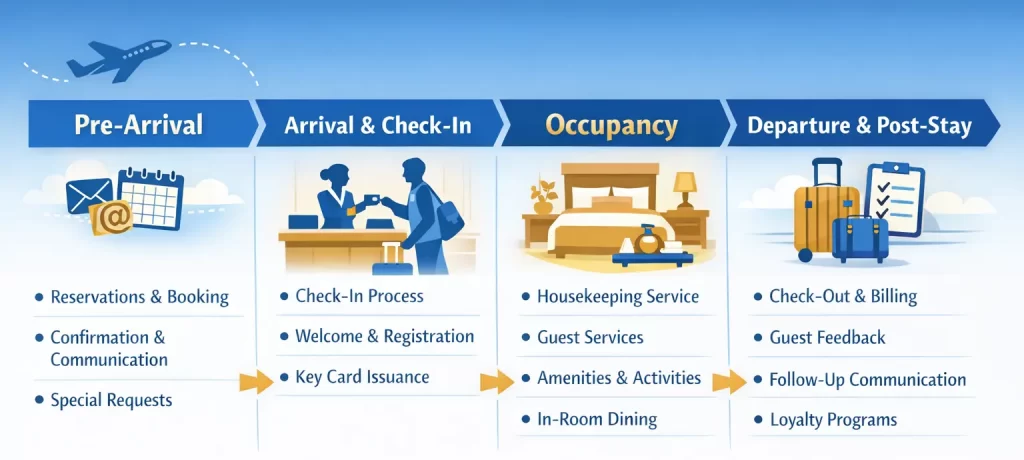
Most conversations about hotel operations focus heavily on what happens at the front desk. Check-in procedures, room allocation, key card systems, these are important, but they represent only a fraction of what the guest cycle actually encompasses. The full arc stretches across four major phases: pre-arrival, arrival and check-in, occupancy, and departure and post-stay. Each of these phases contains multiple micro-moments that individually seem small but collectively define how a guest feels about your property.
Why Every Touchpoint Shapes How Guests Remember You
Human memory doesn’t work the way hotel managers often assume. Guests don’t score their stay as an average of all the moments they experienced. Instead, they tend to remember the peak moments the best or worst parts and the ending. This is sometimes called the peak-end rule, and it has enormous implications for hospitality.
A flawless room with a stunning view can be completely overshadowed by a 20-minute wait at check-in or a dismissive response from a staff member when a concern was raised. Conversely, a recovery moment when a problem is handled quickly and graciously often becomes the most memorable part of a stay in a positive sense. This means that managing the guest cycle isn’t just about getting the basics right across all phases. It’s about understanding which moments carry the most emotional weight and investing accordingly.
The implication for hotel managers is significant. You cannot afford to treat any phase as less important than another. The pre-arrival experience influences first impressions. The in-stay experience drives immediate satisfaction. The post-stay experience determines whether that guest comes back and what they tell others. Every touchpoint belongs to a chain, and chains are only as strong as their weakest link.
What’s Going On Inside Your Guest’s Head at Each Phase

Understanding the guest cycle also means understanding guest psychology. At each phase, your guests are operating with different needs, anxieties, and expectations. During the pre-arrival phase, they’re seeking reassurance “did I make the right choice? Is this hotel going to deliver what the website promised?” During check-in, they’re often tired and want the process to be fast, warm, and frictionless. During their stay, they’re balancing relaxation or business with practical needs. At departure, they’re already mentally halfway home and evaluating whether the total experience was worth the price they paid.
These internal states should inform every decision you make about how to interact with guests at each stage. A lengthy upsell pitch at check-in when a guest has just come off a long flight is poorly timed. A gentle follow-up email three days after departure, on the other hand, catches guests when they’re reflecting fondly on the trip and open to re-engagement. Mapping these emotional states to your communication strategy is one of the most practical and often overlooked tools in improving the overall guest experience
Before They Even Pack Their Bags
The guest cycle begins not when a traveler steps into your lobby, but when they first start thinking about where to stay. This pre-arrival phase is arguably the most competitive phase of the entire cycle because this is when you’re not just competing against other hotels, you’re competing against Airbnb, vacation rentals, friends’ guest rooms, and every other accommodation option available. Getting this phase right means being visible, credible, and easy to book.
-
How Travelers Narrow Down Their Options Today
The modern traveler’s decision-making process has become extraordinarily complex. A person planning a leisure trip might start with a broad Google search, move to an OTA platform like Booking.com or Expedia to compare options, read reviews on TripAdvisor, check the hotel’s Instagram account for atmosphere, look at the property’s own website for direct booking deals, and then consult friends or travel forums before making a final decision. This journey can span days or even weeks. This means in practice is that your hotel’s digital presence isn’t just a marketing asset, it’s the first chapter of the guest cycle.
Research consistently shows that the vast majority of travelers read online reviews before booking, and a significant portion will not book a property that falls below a certain rating threshold. More importantly, travelers pay attention not just to the reviews themselves but to how the hotel responds to them. A thoughtful, empathetic response to a critical review signals to prospective guests that management is engaged and cares about the experience which paradoxically can make a negative review work in your favor.
-
From “Maybe” to “Booked” by Removing Friction in the Process
Once a traveler has decided they’re interested in your property, conversion becomes the challenge. Every extra click, every confusing navigation step, every unexpected fee that appears at checkout is a potential exit point. The booking experience should be as smooth as possible, and this is an area where many hotels still underperform significantly.
Direct booking channels deserve special attention. OTAs bring volume, but they also extract commission fees that can significantly erode margins. Hotels that invest in their direct booking experience competitive pricing, best-rate guarantees, easy navigation, clear cancellation policies can shift meaningful booking volume to channels they control. This also allows them to begin capturing guest data earlier in the cycle, which creates opportunities for personalization throughout the stay. A well-configured hotel booking system is often what makes the difference between a hesitant visitor and a confirmed guest.
-
The Pre-Arrival Window Most Hotels Waste
The period between booking and arrival is rich with opportunity that most hotels fail to fully exploit. This window might be a few days for last-minute bookings or several months for travelers planning ahead. During this time, the guest is likely thinking about their upcoming trip with some frequency, which means they’re receptive to communication from your property.
Pre-arrival communication can accomplish several things simultaneously. It can provide practical information that reduces arrival anxiety directions, parking details, check-in time, what to bring. The key is timing and tone. A pre-arrival email that arrives two weeks before check-in and offers a room upgrade or breakfast package feels like a helpful offer. The act of being asked for preferences makes guests feel seen and valued before they’ve even arrived.
The Moments That Make or Break a Stay

The arrival and in-stay phase is where the rubber meets the road. This is where promises made in the booking phase are tested against reality. It’s also where the highest concentration of emotionally charged moments occur both positively and negatively.
-
First Impressions Go Beyond the Front Desk
The moment a guest arrives at your property, they begin forming judgments that are difficult to reverse. This evaluation starts before they reach the front desk. Is the parking area clean and easy to navigate? Does the entrance look welcoming? Is there someone available to help with luggage? What does the lobby smell like? These sensory inputs happen at a pre-conscious level but they profoundly shape the emotional baseline from which the entire stay is experienced.
The check-in process itself carries enormous weight. Speed is important because guests who have traveled long distances are often tired and want to get to their rooms quickly. Mobile check-in and keyless entry technology have changed this equation somewhat. Many guests, particularly business travelers, strongly prefer to bypass the front desk entirely and proceed directly to their room using a digital key on their phone. This preference should be accommodated and not resisted. Front desk automation is increasingly a baseline expectation rather than a differentiator.
-
Hidden Revenue Sitting Inside the In-Stay Experience
Once a guest is in the property, the revenue opportunity extends well beyond the room rate. Food and beverage, spa services, tours and experiences, transportation, laundry, late checkout, these represent meaningful incremental revenue streams that are only accessible to guests who are already present and, ideally, already happy with their stay.
The challenge is presenting these opportunities in a way that enhances rather than interrupts the guest experience. In-stay technology has opened new channels here. In-room tablets, mobile apps, and well-designed physical menus in the room can present upsell opportunities in a self-directed format that puts the guest in control. When guests feel they’re choosing rather than being sold to, conversion rates and satisfaction both improve. This is where a structured hotel upselling strategy pays visible dividends not just in revenue, but in how valued guests feel during their stay.
Staff training is equally critical. Front-line team members need to understand the full range of services available and develop natural ways to surface them in conversation. This is a skill that takes time to develop, but properties that invest in it see consistent returns. The goal is for every staff interaction to leave the guest feeling cared for and, where appropriate, more aware of what else the property has to offer.
-
Reading the Room: Spotting Issues Before Guests Complain
One of the most valuable skills in hospitality management is the ability to detect dissatisfaction before it escalates. Most guests won’t tell you directly when something is wrong. They’ll suffer through a too-loud HVAC unit, a disappointing breakfast, or a room that wasn’t cleaned to their standard without saying a word and then they’ll mention it in a post-stay review that you have no opportunity to address.
Proactive service recovery requires building systems that surface these issues early. Mid-stay check-ins whether conducted by a staff member, via an in-stay messaging platform, or through a brief mid-stay survey give guests a low-friction way to flag concerns. Staff observation is equally important. Training front-line staff to notice small signals of dissatisfaction and respond appropriately not intrusively, but with genuine attentiveness is one of the highest-value investments a property can make.
After They Leave: The Stage Nobody Pays Enough Attention To
Departure might feel like the end of the guest experience, but in terms of the guest cycle, it’s more accurately understood as a transition point. What happens after check-out determines whether a satisfied guest becomes a loyal returning guest, whether they recommend your property to others, and whether their review helps or hinders your future bookings.
-
Turning a One-Time Visitor Into a Returning One
The economics of guest retention are straightforward: acquiring a new guest costs significantly more than retaining an existing one. Returning guests also tend to spend more, complain less, and generate higher-quality word-of-mouth referrals. Yet the post-stay phase is where many hotels invest the least attention and resource.
Building loyalty doesn’t happen automatically. It requires deliberate effort to stay present in a past guest’s mind in ways that feel relevant and valuable rather than intrusive. Hotel loyalty programs are one vehicle for this, and personalization plays a critical role. A returning guest who is greeted with “Welcome back, Ms. Chen we’ve put you in a quiet corner room again as you prefer” feels valued in a way that a generic loyalty points update never achieves. This level of personalization requires good data management capturing and using guest preference data across stays which is why technology infrastructure is inseparable from effective guest cycle management.
-
Post-Stay Communication That Doesn’t Feel Like Spam
The post-stay email is everywhere in hospitality and most of them are bad. They arrive too fast, sound too corporate, or read like thinly veiled marketing dressed up as gratitude. The best ones do the opposite: they land 24–48 hours after checkout, strike a warm and personal tone, and reference something specific about the guest’s stay so they feel remembered as a person, not a room number.
Segmentation matters too. A guest who had a great experience is ready to be invited to leave a review. A guest who flagged a problem needs acknowledgment and resolution first asking them for a public review before that happens is a reliable way to generate exactly the kind of feedback you don’t want.
When Things Go Sideways: Recovering at Every Stage

No matter how well-managed a property is, things go wrong. Equipment breaks down, reservations get confused, staffing shortfalls affect service quality, weather events disrupt plans. How a hotel handles these moments is as defining as how it handles the moments when everything goes smoothly.
-
Fixing Problems Before They Hit the Review Page
Service recovery research has consistently shown something counterintuitive: guests who experience a problem that is then resolved quickly and graciously often end up more satisfied than guests who never had a problem at all. This is known as the service recovery paradox, and while it’s not universal, it points to a fundamental truth about hospitality how you handle adversity reveals your character as an organization more vividly than how you handle smooth sailing.
The critical variable in service recovery is speed. A problem that is addressed within the first hour after it’s raised is much easier to resolve to a guest’s satisfaction than one that lingers. This requires clear escalation protocols front-line staff need to know exactly what they’re empowered to do to resolve issues without managerial approval, and what needs to be escalated and to whom. Properties where front-line team members feel genuinely empowered to make judgment calls offering a complimentary room service order, upgrading a room, waiving a fee resolve issues faster and create better outcomes. The cost of these gestures is almost always outweighed by the retention and reputation value they generate.
-
Scripts and Strategies That Actually Work
Effective service recovery isn’t improvised, it follows a structure. That structure doesn’t need to be robotic or scripted to the word, but having a framework helps staff respond consistently and effectively under pressure. A widely used model involves four steps: acknowledge the issue (show you’ve heard and understood), apologize sincerely (without being defensive or deflecting blame), act to resolve (take concrete steps to fix the problem), and follow up (check back to confirm the resolution was satisfactory).
The language used matters as much as the structure. Phrases like “I understand how frustrating that must be” land very differently than “I’m sorry you feel that way,” which can sound dismissive. Saying “Let me take care of this right now” projects competence and urgency. “I’ll look into it” feels evasive. Training staff on specific language patterns not scripts to be read verbatim, but frameworks to internalize creates a team that recovers gracefully under pressure.
Written recovery is a separate but equally important skill. Responding to negative online reviews requires a balance of empathy, accountability, and forward-looking positivity. A good response acknowledges the specific issue raised (not in a generic way), expresses genuine regret, explains what has changed if anything has, and invites the guest to return or reach out directly. This response isn’t just for the reviewer, it’s read by thousands of prospective guests who are evaluating whether your property is the kind of place that takes guest feedback seriously.
Not All Guests Follow the Same Path

A critical maturation in any hotel’s approach to the guest cycle is recognizing that not all guests are the same. The cycle we’ve described is a general framework, but its application needs to be adapted based on guest type, purpose of travel, and group size. A one-size-fits-all approach that ignores these differences will consistently miss the mark for significant portions of the guest population.
-
Corporate Travelers vs Vacationers: Different Expectations
Business travelers and leisure travelers are navigating the guest cycle with fundamentally different priorities. The business traveler values efficiency above almost everything else. They want fast Wi-Fi, a comfortable workspace, a quick breakfast, and a check-in and checkout process that doesn’t waste a minute of their time. They often travel frequently, may be enrolled in loyalty programs, and have strong preferences that repeat across stays.
Leisure travelers, by contrast, are looking for an experience. They’re more likely to linger at breakfast, explore the property’s facilities, ask for local recommendations, and be moved by small touches that create memorable moments. They may be less familiar with the property category and need more orientation and guidance. The arrival experience needs to feel exciting and welcoming, not just efficient.
These different needs should shape every stage of cycle management. Pre-arrival communication for a corporate traveler should focus on logistics directions, parking, Wi-Fi details, early check-in availability. Pre-arrival communication for a leisure traveler might focus more on building anticipation and encouraging add-on bookings like dinner reservations or spa treatments. In-stay interactions should reflect these differences as well, with staff reading cues about what kind of engagement is welcome. Properties that host both segments face the challenge of managing these different expectations simultaneously, which often requires thoughtful spatial planning, flexible staff training, and differentiated guest segmentation strategies that adapt based on booking type.
-
Adapting the Flow for Groups and Event Attendees
Group bookings and event attendees add another layer of complexity to guest cycle management. When 200 guests arrive simultaneously for a conference, the arrival experience needs to be operationally streamlined in ways that a typical individual check-in process simply isn’t designed to support. Dedicated check-in stations, pre-assigned room blocks, pre-formatted key packets, and clear wayfinding to event spaces all become critical.
The decision-making dynamic is also different for groups. The guest making the reservation is often not the guest experiencing the stay a corporate event planner books the block, but the attendees form their impressions based on their individual experiences. This means the pre-arrival relationship needs to be managed on two levels: with the organizer (who cares about logistics, pricing, and billing) and ideally with the individual attendees (who care about their rooms, meals, and personal comfort).
Post-event follow-up is equally important in the group context. A thorough debrief with the event planner after the group departs asking what worked, what didn’t, and what would make them choose your property again, is an invaluable source of feedback and a significant opportunity for rebooking. Groups that have a positive experience often become annual recurring business, which represents substantial value over time. Managing this level of operational complexity is where hotel event management tools can make a meaningful difference, particularly for properties that host multiple groups simultaneously.
The Role of Systems and Data in Managing the Full Cycle
Running a thoughtful guest cycle at scale isn’t possible through manual effort alone. As a property grows more rooms, more guests, more staff the complexity of tracking every guest’s preferences, communication history, service interactions, and post-stay engagement quickly exceeds what any team can manage through spreadsheets and memory.
This is where integrated hotel management technology becomes not a luxury but a necessity. A system that connects the reservation record to the pre-arrival communication to the in-stay service requests to the post-stay feedback creates a continuous picture of the guest relationship. It allows different team members reservations, front desk, housekeeping, food and beverage to access the same information and deliver a consistent experience. A property management system (PMS) is typically the central hub that makes this data continuity possible.
Guest data accumulated across stays becomes a powerful tool for personalization. When a returning guest books their fourth stay and the front desk already knows they prefer a high floor, take their coffee black, and always request an extra pillow and these preferences are surfaced automatically during check-in the guest feels genuinely known. This level of personal recognition builds loyalty in a way that points programs and discounts simply cannot replicate.
Data also supports better decision-making at the management level. Understanding which phases of the cycle are generating the most complaints, which upsell offers are converting, which staff interactions are driving the highest satisfaction scores all of this insight becomes available when the systems collecting it are properly integrated.
The analytics dimension extends to revenue management as well. The guest cycle is not just a customer experience framework, it’s also a revenue framework. Understanding guest spending patterns across phases, identifying which guest segments generate the highest total revenue per stay (not just room rate), and optimizing pricing and upsell strategies based on these patterns are all made possible by good data infrastructure. This is where hotel revenue management practice moves from intuition to evidence.
Building a Team That Understands the Cycle Instinctively

Technology supports the guest cycle. People deliver it. The most sophisticated hotel management system in the world cannot substitute for a team that genuinely understands why every touchpoint matters and is motivated to make each one count.
Training programs that teach the guest cycle as a holistic concept rather than training each department in isolation, produce teams that think about the guest journey rather than just their immediate role within it. A housekeeper who understands that the state of a guest’s room at 4pm on a long stay is a touchpoint in the occupancy phase, not just a routine cleaning task, approaches their work differently. A breakfast server who understands that their interaction is often the last staff contact before a guest departs will invest more care in making it warm and memorable. Housekeeping management systems can reinforce this by giving room attendants real-time visibility into guest status and preferences, connecting their daily tasks directly to the broader guest experience.
Culture matters enormously here. Properties where frontline staff are trusted to make decisions, recognized for guest recovery successes, and given visibility into the feedback their work generates tend to produce better outcomes than properties where staff are tightly scripted and measured only against compliance metrics. The guest can feel the difference between a team that’s going through the motions and a team that’s genuinely invested in the experience they’re creating.
Manager behavior sets the tone. When department heads model the guest-first mindset when they’re visibly engaged with guest feedback, when they celebrate recovery stories in team meetings, when they treat every department as a participant in the full guest journey rather than a siloed function that mindset permeates the operation. The inverse is equally true: a management culture that treats guest complaints as problems to be minimized rather than opportunities to be seized will produce a team that hides issues rather than addressing them.
Measuring What Actually Matters in the Guest Cycle
Effective management of the guest cycle requires the right measurement framework. Occupancy rate and ADR (average daily rate) are necessary metrics, but they tell you nothing about the quality of the experience guests are having or the health of the guest relationships you’re building.
Guest satisfaction scores whether collected through proprietary post-stay surveys or aggregated from public review platforms provide a direct signal about experience quality. Net Promoter Score, which measures guests’ likelihood to recommend the property, is a useful leading indicator of loyalty and word-of-mouth growth. Review sentiment analysis looking at what guests are saying rather than just what score they’re giving provides the qualitative texture that numbers alone don’t capture. Understanding how to track and act on these hotel KPIs consistently is what turns guest feedback from noise into actionable insight.
Repeat visit rate deserves more attention than it typically receives in hotel metrics discussions. A property that knows what percentage of its guests are returning and can track how that figure changes over time has a much richer understanding of its loyalty dynamics than one that measures only acquisition. Combining repeat visit rate with revenue per guest across visits reveals which guest segments are truly most valuable, which is often surprising when compared to assumptions based on room rate alone.
Upsell conversion rates by phase are another underutilized metric. Knowing which pre-arrival offers convert, which in-stay offers land, and what factors predict uptake allows properties to refine their revenue strategies based on evidence rather than intuition. Over time, this data builds a genuinely sophisticated understanding of guest behavior that can meaningfully improve financial performance.
For hotels looking to put all of this into practice, the right systems make all the difference. A look at the leading hotel management software options available today can help properties match their operational scale and guest cycle goals to a platform built to support them.
FAQ Around Hotel Guest Cycle
-
What are the 4 stages of the hotel guest cycle?
The four stages are pre-arrival (when a guest researches and books), arrival and check-in (the welcome and room assignment process), occupancy (the actual stay experience), and departure and post-stay (checkout and follow-up communication).
-
What is BB, HB, and FB in hotels?
BB (Bed & Breakfast), HB (Half Board), and FB (Full Board) are meal plan options that guests typically choose during the pre-arrival and booking stage of the guest cycle and the plan selected can directly shape expectations and satisfaction throughout the occupancy phase.
-
What is GSS in the hotel industry?
GSS stands for Guest Satisfaction Survey, a post-stay tool hotels use to collect feedback after checkout, making it one of the most important instruments for measuring how well a property performed across every stage of the guest cycle and identifying where improvements are needed.
-
What is the 10/5 rule in hotels?
The 10/5 rule is a hospitality standard where staff acknowledge a guest with eye contact and a smile at 10 feet away, and greet them verbally at 5 feet, a small but powerful practice that directly impacts how guests feel during the arrival and in-stay phases of the guest cycle.