






As cloud environments grow more complex, maintaining clear visibility becomes increasingly difficult. When teams lack a complete view of their digital operations, decision-making slows, and actions are often based on incomplete information.
Limited visibility can increase operational costs, introduce security risks, and weaken alignment between technology and business goals. Relying on multiple platforms often creates blind spots that are hard to manage.
Cloud visibility helps restore control by providing clearer insights into systems and performance. With better visibility, organizations can respond faster, optimize resources, and make more informed decisions.
Key Takeaways
|
Table of Contents
What Is Cloud Visibility?
Cloud visibility refers to the ability to clearly see, understand, and manage all assets, services, and activities within a cloud environment. It extends beyond basic monitoring by providing insight into configurations, dependencies, and data flows.
This level of transparency is especially important for organizations operating across multi-cloud environments, where complexity can quickly increase. Clear visibility supports better governance, security management, and budget buffer control.
For decision-makers, cloud visibility helps bridge technology and strategy. By understanding how cloud resources are used, leaders can make informed decisions that align technical operations with overall business objectives.
A 4-Step Framework for Implementing Cloud Visibility

Navigating modern cloud complexities requires a systematic framework woven into the fabric of daily business operations. This roadmap helps build sustainable visibility that drives smarter, data-driven decisions across the organization.
Step 1: Assessment (identify and inventory assets)
The first step involves a thorough discovery to create a comprehensive inventory of all digital assets across providers. You must map dependencies and classify resources based on their business criticality and data sensitivity.
Step 2: Integration (centralize data from various sources)
Centralizing data from disparate sources into a unified platform breaks down information silos between teams. This involves connecting provider APIs and security tools to provide a single source of truth for the organization.
Step 3: Analysis (analyze data to generate insights)
Transforming raw data into actionable insights allows you to identify trends and detect anomalies in your environment. Analytics tools help pinpoint cost optimization opportunities and prioritize security vulnerabilities for immediate attention.
Step 4: Automation (automate responses and reporting)
Automating responses and reporting ensures you can manage a dynamic cloud environment at scale without manual effort. This includes setting up alerts for policy violations and creating self-healing workflows for remediation.
Essential Tools for Building End-to-End Cloud Visibility
A robust strategy must be underpinned by technologies that provide a cohesive, end-to-end view of the infrastructure. Selecting the right combination of tools is crucial for integrating data across security, finance, and operations.
- Cloud Security Posture Management (CSPM): CSPM tools continuously scan your infrastructure to identify misconfigurations and ensure compliance with regulatory standards. They provide alerts for risks like open storage buckets to maintain a strong security posture.
- Cloud Workload Protection Platforms (CWPP): These platforms protect specific workloads like virtual machines and containers from runtime threats and malware. They offer deep visibility into the behavior of individual workloads to detect and block attacks.
- Cloud-Native Application Protection Platform (CNAPP): CNAPP converges security functions to protect applications across the entire development lifecycle from code to cloud. It integrates various security capabilities to help run secure cloud-native applications.
- Cloud Cost Management Tools: Specialized tools track and analyze cloud spending to identify waste and recommend cost-saving opportunities. They enable detailed cost allocation so finance teams can maximize investment value effectively.
- Integrated Cloud ERP Platforms: Integrated ERP platforms connect operational and financial data to provide holistics business context for your infrastructure. They link technical resource consumption directly to financial outcomes to support better strategic decision-making.
Why Is Cloud Visibility a Top Priority for Modern Businesses?
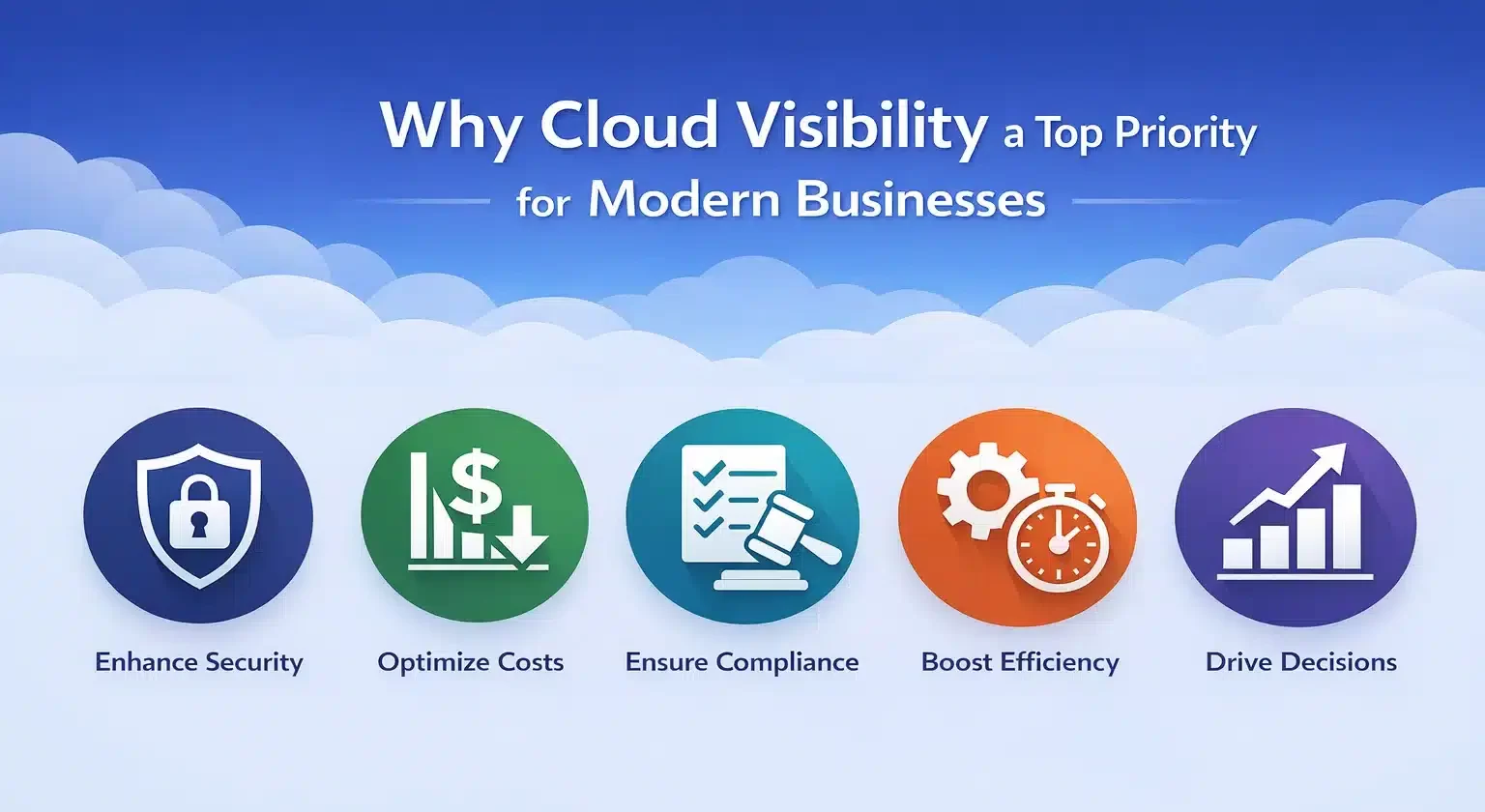
In the digital age, visibility is a fundamental pillar of a resilient and competitive business strategy. It empowers companies to operate with greater security, speed, and financial efficiency.
1. Enhancing security and mitigating risks
Visibility allows security teams to identify misconfigurations and unauthorized access before they escalate into costly breaches. It ensures consistent policy enforcement across the entire infrastructure to protect sensitive data effectively.
2. Optimizing cloud operational costs
Detailed insights into resource consumption help identify idle or underutilized assets to eliminate unnecessary waste. This clarity ensures that every dollar spent on the cloud delivers maximum value to your organization.
3. Ensuring compliance with regulations
A clear audit trail of where data is stored and who accesses it is essential for meeting complex regulatory requirements. It simplifies the reporting process and significantly reduces the risk of fines associated with non-compliance.
4. Driving operational efficiency and productivity
A shared understanding of the environment streamlines workflows and reduces operational bottlenecks for IT and DevOps teams. This accelerates troubleshooting processes and fosters a culture of faster innovation and deployment.
5. Supporting data-driven strategic decision-making
Access to real-time data on performance and cost empowers leaders to make informed strategic decisions confidently. It allows you to accurately assess ROI and align your technology strategy with business goals.
Key Challenges in Achieving Full Cloud Visibility
Achieving transparency is difficult because scalability introduces layers of complexity that create significant blind spots. A proactive strategy begins with recognizing these hurdles to regain control over your digital environment.
1. Complexity of multi-cloud and hybrid environments
Fragmentation across multiple providers creates data silos that make achieving a unified view nearly impossible. Navigating multi-cloud transitions with centralized management platforms helps consolidate these disparate data streams to prevent undetected security gaps.
2. The dynamic and ephemeral nature of cloud resources
The ephemeral nature of cloud assets means resources are constantly spun up and torn down in minutes. Automated tracking tools are necessary to maintain an accurate, up-to-date inventory despite this constant change.
3. The rise of Shadow IT and unmanaged resources
Unmanaged resources deployed without approval often lead to significant security gaps and unexpected cost overruns. Comprehensive discovery tools help governance teams detect and regulate these hidden assets effectively.
4. Limitations of native tools from cloud service providers
Native provider tools often lack the capability to provide a consolidated view across different cloud ecosystems. Third-party integration solutions solve this by bridging the gaps between various platforms and dashboards.
5. Lack of collaboration and persistent team silos
A lack of collaboration between IT, finance, and security teams prevents the sharing of critical context. Implementing cross-functional workflows ensures everyone operates from a single source of truth regarding the cloud.
The Future Trends of Cloud Visibility
Visionary leaders must stay informed about emerging trends to ensure their visibility strategies remain relevant and effective. Future innovations emphasize proactivity and deeper integration to redefine how we manage cloud environments.
- The role of Artificial Intelligence (AI) and Machine Learning technologies is to analyze vast datasets to automatically detect complex patterns and predict future issues before they occur. This allows systems to proactively identify security threats and recommend optimization actions.
- Convergence with FinOps for financial visibility. Visibility is converging with FinOps to provide deep financial context for every technical resource and activity. This ensures that cloud usage is always viewed through the lens of business value and cost accountability.
- Visibility as Code (VaC). Visibility as Code involves defining monitoring policies and configurations directly within the development code itself. This ensures that every new resource is automatically provisioned with the correct settings and logging.

Conclusion
As cloud environments grow more complex, maintaining clear visibility becomes increasingly difficult. When teams lack a complete view of their digital operations, decision-making slows, and actions are often based on incomplete information.
Limited visibility can increase operational costs, introduce security risks, and weaken alignment between technology and business goals. Relying on multiple platforms often creates blind spots that are hard to manage.
Cloud visibility helps restore control by providing clearer insights into systems and performance. With better visibility, organizations can respond faster and make more informed decisionoften starting with a free consultation to assess current challenges.
FAQ about Cloud Visibility
-
What are the three types of cloud visibility?
The three main types of cloud visibility are: performance visibility (monitoring application and infrastructure health), security visibility (detecting threats and misconfigurations), and cost visibility (tracking and optimizing cloud spending).
-
Why is visibility important in the cloud?
Visibility is crucial in the cloud because it allows organizations to manage costs, enhance security, ensure compliance, and optimize performance. Without it, businesses face risks of budget overruns, data breaches, and operational inefficiencies.
-
What are the key components of cloud visibility?
Key components include a comprehensive asset inventory, real-time monitoring of performance and security events, cost tracking and allocation, dependency mapping between resources, and automated reporting and analytics for all cloud activities.