













A factory in Shah Alam receives a large order but cannot run at full capacity because it is short of 30 operators. Supervisors reshuffle shifts, employees take more overtime, and production slows before the order is even completed.
According to the Department of Statistics Malaysia, Malaysia’s Labour Force Participation Rate reached 70.9% in Q3 2025, while labour demand stood at 9.16 million jobs. This shows why businesses need better workforce planning when dealing with shortage of manpower, labour shortage, or staff shortage.
This article explains the causes, business effects, and 10 practical strategies to manage manpower shortage in Malaysia through better human resource management practices.
Key Takeaways
|
Manpower gaps are easier to manage when attendance, payroll, scheduling, and workforce data are connected. HR software helps give teams clearer visibility before staffing issues disrupt daily operations.

What Is a Shortage of Manpower?
A shortage of manpower is the gap between the number of workers a business needs and the number of workers available to do the job. It is also known as manpower shortage, labour shortage, staff shortage, or workforce shortage Malaysia.
This gap can be quantitative, meaning there are not enough workers in the market, or qualitative, meaning workers are available but lack the required skills. In Malaysia, this issue often affects manufacturing, construction, plantation, F&B, and healthcare.
What Are the Main Causes of Manpower Shortage in Malaysia?

The causes of manpower shortage in Malaysia come from several issues at once, including demographic shifts, foreign worker dependency, skills mismatch, compensation gaps, and changing worker expectations.
- Ageing Workforce and Declining Labour Pool: Malaysia’s workforce is gradually ageing, while some industries are not attracting enough younger workers to replace retirees. This creates a wider workforce gap, especially in plantation and construction, where many roles are physically demanding.
- Over-Dependence on Foreign Workers: Many Malaysian businesses still rely on workers from Indonesia, Bangladesh, and Nepal. After the pandemic, some foreign workers returned home and did not come back at the same pace, creating pressure for employers. This makes JTKSM, or Jabatan Tenaga Kerja Semenanjung Malaysia, important for businesses managing workforce compliance.
- Skills Mismatch Between Education and Industry Needs:A key cause of labour shortage Malaysia is the gap between graduate skills and industry needs. Technical sectors need CNC machine operators, welders, electricians, and technicians, while HRDF training funds remain underused for upskilling.
- Unattractive Compensation and Working Conditions:Some sectors struggle when pay, benefits, or work conditions do not match expectations. Although Malaysia aligned the minimum wage at RM1,700 nationwide from 1 August 2025, younger workers may still avoid night shifts, hazardous sites, or physically demanding roles.
- Post-Pandemic Workforce Restructuring: The post-pandemic period changed how many Malaysians view work. Some moved from fixed-shift jobs to gig work such as Grab, Lalamove, or Shopee delivery for more flexibility. This makes staff shortage harder to solve through traditional recruitment alone.
How Does Manpower Shortage Affect Malaysian Businesses?
The effects of manpower shortage can be seen directly in daily operations, labour costs, and growth decisions. For Malaysian businesses, the issue is not only about having fewer workers, but also about losing capacity to deliver on time.
- Production Delays and Order Backlog: When a factory does not have enough operators, production lines slow down and delivery timelines become harder to meet. This can lead to customer churn, cancelled orders, or revenue loss. In construction, a workforce gap Malaysia issue can also delay project milestones and trigger penalty clauses.
- Rising Labour and Recruitment Costs: The impact of labour shortage often appears in higher overtime pay, faster salary adjustments, and stronger competition for skilled workers. Companies may also spend more on repeated recruitment when turnover remains high.
- Employee Burnout and Higher Turnover: When remaining staff carry heavier workloads for too long, employee burnout becomes more likely. This can increase absenteeism, reduce work quality, and push more employees to resign, creating a shortage cycle that becomes harder to fix.
- Stunted Business Growth and Missed Opportunities: A business with limited manpower may struggle to accept new contracts, open new branches, or launch new products. Even when market demand exists, growth can stall because the team does not have enough capacity to support expansion.

10 Proven Strategies to Overcome Shortage of Manpower
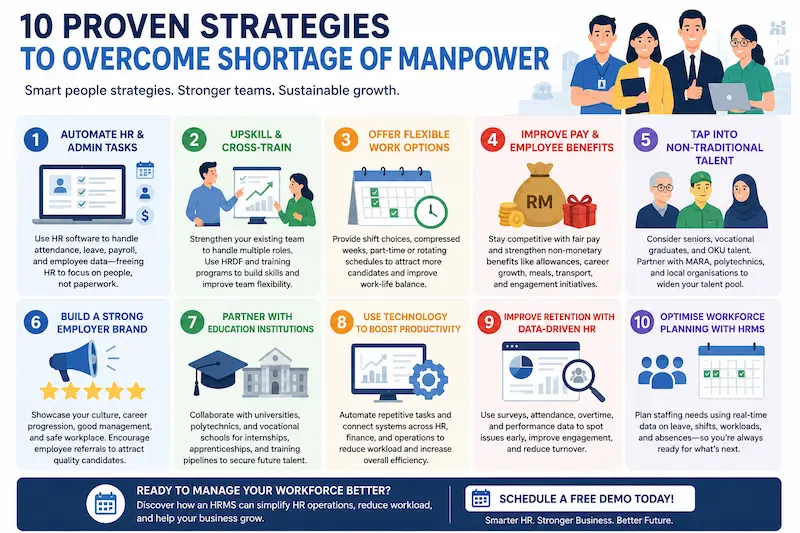
Automate Repetitive HR and Administrative Tasks
One practical way to solve manpower pressure is to reduce repetitive admin work first. HR teams can use HR management software Malaysia to automate attendance, leave requests, payroll, employee records, and scheduling in one system. This gives HR more time to focus on hiring, retention, and workforce planning instead of chasing manual updates. An integrated HRMS can connect multiple HR modules to help teams manage employee data and payroll management more efficiently.
1. Invest in Cross-Training and Upskilling
Companies should not rely only on new hiring when the labour market is tight. Cross-training existing employees helps teams cover more than one role when someone resigns, takes leave, or when demand suddenly increases. Malaysian employers can also use HRDF to support training programmes that improve technical, supervisory, and digital skills. This is especially useful for manufacturing, F&B, and service businesses that need flexible workers across shifts or departments.
2. Offer Flexible Working Arrangements
Not every role can be fully remote, but businesses can still offer flexibility through shift preferences, compressed workweeks, rotating schedules, or part-time arrangements. This helps attract workers who may avoid fixed or rigid working hours. For operations-heavy businesses, shift scheduling software can help managers assign shifts more fairly while still meeting manpower needs. Better scheduling also reduces last-minute absenteeism and employee fatigue.
3. Improve Compensation and Non-Monetary Benefits
Salary remains important, especially when workers compare similar roles across industries. Businesses should benchmark wages at least once a year to make sure pay remains competitive in the Malaysian market. Non-monetary benefits such as meal allowance, transport subsidy, clear promotion paths, and employee engagement programmes can also improve retention. These benefits are often more affordable than constantly replacing workers.
4. Tap Into Non-Traditional Talent Pools
Companies can reduce hiring pressure by looking beyond the usual candidate pool. Retired seniors may be suitable for part-time roles, while vocational and polytechnic graduates can fill technical or operational positions with the right training. Employers can also explore OKU employment opportunities, especially where roles can be adapted with proper workplace support. Institutions such as MARA and local polytechnics can become useful sources for entry-level and semi-skilled talent.
5. Build a Strong Employer Brand
Candidates often check a company’s reputation before applying. Reviews on platforms like Glassdoor, LinkedIn, and Google can influence whether job seekers trust the employer. Businesses should show clear career growth, fair management, safe working conditions, and conflict resolution in the workplace. Employee referral programmes can also help bring in better-fit candidates because existing staff understand both the company culture and job requirements.
6. Partner with Universities, Polytechnics, and Vocational Schools
A steady talent pipeline can reduce long-term manpower shortage. Companies can partner with universities, MARA institutions, UiTM, polytechnics, and vocational schools to offer internships, apprenticeships, or sponsored training programmes. This helps students understand real workplace expectations before graduation. For employers, it creates early access to future workers who already know the company’s processes.
7. Leverage Technology to Do More with Fewer People
Technology helps businesses reduce workload without forcing every task onto existing employees. Automation can handle repetitive HR, admin, approval, attendance, and reporting tasks so teams can focus on higher-value work. Integrated systems also reduce duplicated data entry between HR, finance, and operations. This helps businesses connect HR processes with other business functions when operations become more complex.
8. Improve Employee Retention with Data-Driven HR
Solving staff shortage is not only about hiring faster. Businesses also need to understand why employees leave, which teams are overloaded, and where disengagement starts. Pulse surveys, attendance trends, overtime data, and performance records can help HR identify early signs of quiet quitting before resignations increase. Transparent performance management also helps employees understand expectations, growth paths, and how their work is evaluated.
9. Optimise Workforce Planning with HRMS
Workforce planning helps businesses see manpower needs before they become urgent. An HRMS can show real-time data on leave, absences, overtime, shift gaps, and overloaded departments. Historical workforce data also helps managers plan hiring, training, and shift allocation before demand increases. With clearer workforce visibility, businesses can understand staff availability and employee workload before shortages disrupt daily operations.
See how an HRMS can help Malaysian businesses manage attendance, scheduling, payroll, and workforce planning more efficiently. Schedule a free demo today.
Conclusion
Shortage of manpower in Malaysia is a real business issue, and it rarely comes from one cause alone. Ageing workforce trends, foreign worker dependency, skills mismatch, high turnover, and changing employee expectations all contribute to manpower shortage Malaysia.
The impact is direct: slower production, rising overtime costs, employee burnout, and missed growth opportunities. Businesses need to respond with stronger people strategies, better retention, workforce planning, and HR management software that helps reduce manual workload.
Start by reviewing which teams are overloaded, which roles are hardest to fill, and which HR processes still depend on spreadsheets. A free demo can help you see how HRMS supports workforce planning, attendance, payroll, and employee data management with the resources you already have.

FAQ About Manpower Shortage in Malaysia
-
What is the main cause of manpower shortage in Malaysia?
The main causes of manpower shortage Malaysia include foreign worker dependency, skills mismatch, unattractive compensation, and an ageing workforce. Many employers still rely on foreign workers, so hiring disruptions can quickly affect operations. JTKSM is also relevant because companies must manage workforce compliance properly when hiring and managing labour.
-
Which industries in Malaysia are most affected by manpower shortage?
Manufacturing, construction, plantation, F&B, and healthcare are among the most affected industries. Manufacturing and construction need skilled and physical workers, while plantation work often struggles to attract younger talent. F&B faces high turnover and shift-based staffing pressure, while healthcare needs qualified workers with specific training and compliance requirements.
-
How can small businesses in Malaysia deal with staff shortage?
Small businesses should focus on retention first because replacing employees is often costly and time-consuming. Practical staff shortage solutions include cross-training employees, improving shift planning, offering flexible arrangements, and using affordable HRMS tools. This helps SMEs manage daily operations with leaner teams.
-
What is the difference between manpower shortage and skills shortage?
Manpower shortage is a quantitative issue, meaning there are not enough workers available to fill required roles. Skills shortage is a qualitative issue, meaning workers are available but do not have the right skills, experience, or technical ability. Malaysia faces both issues, especially in technical, manufacturing, construction, and service roles.
-
Can HR software help manage manpower shortage?
Yes, HR software workforce management can help businesses plan, track, and manage employees more clearly. It supports attendance tracking, shift scheduling, overtime monitoring, payroll automation, and workforce planning. With better real-time visibility, HR teams can spot staffing gaps earlier and reduce repetitive admin work.
-
What role does HRDF play in addressing manpower shortage in Malaysia?
HRDF Malaysia helps employers fund employee training through claimable programmes and registered training providers. It can support upskilling, reskilling, and cross-training for workers who need stronger technical or operational skills. Many Malaysian employers underuse HRDF, even though it can help reduce skills mismatch and strengthen internal talent pipelines.