











A furniture manufacturer in Selangor sends purchase orders to 40 suppliers every week. Each PO goes out as a PDF email. A clerk on the supplier side then re-keys every line into their own ERP. By the time the manufacturer chases confirmations, three orders already have the wrong quantity.
This kind of friction is common across transformation business in Malaysian. Procurement teams lose hours to data entry. Suppliers deal with mismatched POs. Finance teams chase invoice disputes that started with a typo.
Electronic Data Interchange (EDI) helps businesses automate document exchange and reduce manual errors through standardized digital transactions. For many Malaysian companies, integrating EDI with an ERP system improves the speed, accuracy, and efficiency of B2B operations. This guide explains how EDI works, its benefits, and the importance of ERP integration.
Key Takeaways
|
Improve business communication and operational efficiency with the right EDI solution. Discover how automated B2B integration helps businesses exchange data faster, reduce manual work, and maintain better accuracy across operations.

What is Electronic Data Interchange (EDI)?
Electronic Data Interchange (EDI) is the automated exchange of business documents between organizations using a standardized electronic format. Instead of sending PDFs or paper, the buyer’s ERP creates a purchase order. An EDI system converts it into a structured format such as EDIFACT. The supplier’s system receives the file, validates it, and posts it into their own ERP. No one re-keys the data.
The EDI meaning is easiest to grasp in a B2B context. EDI connects trading partners across the supply chain. These include buyers, suppliers, logistics providers, banks, and customs authorities. The shared standard format is what lets the two systems talk to each other reliably.
Going back to the Selangor furniture manufacturer, EDI replaces 40 separate email threads with a direct system-to-system link. Confirmation time drops from days to minutes. Quantity mismatches and delivery date errors are caught at the source.
How Does Electronic Data Interchange Work?
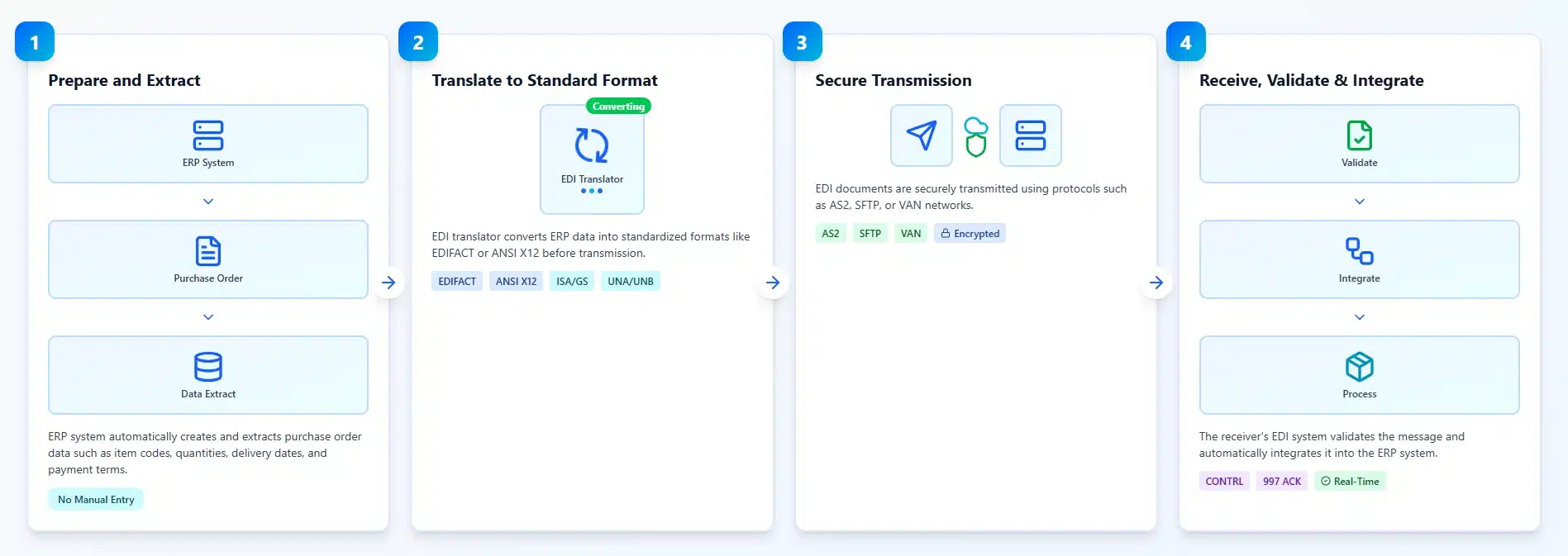
An EDI system handles Electronic Data Interchange through a four-stage process: document preparation, format translation, secure transmission, and automated integration at the receiving end. Each stage is automated end to end.
Step 1. Prepare and Extract
The process starts inside the sender’s business system. The Selangor manufacturer’s ERP creates a purchase order containing supplier code, item codes, quantities, delivery dates, and payment terms. The EDI system pulls these fields directly from the ERP database. If the ERP data is wrong, the EDI document carries the same error downstream.
Step 2. Translate to a Standard Format
The EDI translator converts the data into a recognized industry standard. The translator maps each ERP field to its equivalent segment in the standard. The data is then wrapped in an “envelope” that identifies the sender, receiver, and message type. The manufacturer’s system wraps the PO in an EDIFACT ORDERS message, ready for transmission.
Step 3. Transmit Via a Secure Protocol
Transmission uses secure protocols like AS2, which encrypts messages and applies digital signatures for direct EDI communication. Smaller businesses often use VAN services to manage connectivity, while larger enterprises prefer direct AS2 connections to reduce transaction costs.
Step 4. Receive, Validate, and Integrate
At the receiving end, the EDI system validates the message and automatically transfers the data into the partner’s ERP system. The supplier can instantly generate sales orders and send acknowledgments such as CONTRL or 997, allowing procurement teams to track supplier responses in real time.
The Types of EDI Documents
EDI covers dozens of standardized document types. A small set accounts for the majority of B2B transactions. Each document maps to a specific business event in the order-to-cash or procure-to-pay cycle.
- Purchase Orders (EDIFACT ORDERS / ANSI X12 850).
Sent from buyer to supplier to start fulfillment. Contains item codes, quantities, delivery dates, and ship-to information. Usually the first document a partnership exchanges via EDI. - Invoices (EDIFACT INVOIC / ANSI X12 810).
Issued by the supplier to bill the buyer. EDI invoices flow directly into the buyer’s accounts payable module, enabling automated invoice processing without manual data entry. - Advance Ship Notices (EDIFACT DESADV / ANSI X12 856).
Sent before a shipment arrives. The receiving warehouse uses the ASN to prepare dock space, allocate labour, and pre-stage put-away tasks. - Functional Acknowledgments (EDIFACT CONTRL / ANSI X12 997).
Confirms an EDI message was received and parsed successfully. Different from a business acceptance. It confirms transmission, not agreement to fulfill. - Remittance Advice (EDIFACT REMADV / ANSI X12 820).
Sent by the buyer alongside payment. Lists which invoices are being paid and any deductions applied. - Inventory Inquiry/Advice (ANSI X12 846).
Used in retail replenishment to share stock levels between supplier and retailer. Supports vendor-managed inventory.
Common EDI Standards
1. UN/EDIFACT
United Nations standard for Electronic Data Interchange. It is dominant across Europe, Asia, and most international trade lanes. EDIFACT messages are identified by descriptive names: ORDERS for purchase orders, INVOIC for invoices, DESADV for advance ship notices, and CONTRL for acknowledgments.
For Malaysian businesses trading with Singapore, Japan, Europe, or ASEAN logistics partners, EDIFACT is usually the preferred EDI standard. Companies in Malaysia generally use EDIFACT by default, while ANSI X12 is mainly adopted only when required by specific partners.
2. ANSI X12
Standard developed for use across North America. It uses numeric transaction codes such as 850 for purchase orders, 810 for invoices, and 856 for advance ship notices. X12 is mandated by US retailers like Walmart, Target, and Amazon, and by many large MNCs. Malaysian exporters supplying these buyers need X12 capability. EDI software in Malaysia commonly supports both EDIFACT and X12 in parallel.
3. RosettaNet
XML-based standard developed for the high-tech and electronics sectors. It defines Partner Interface Processes (PIPs) for tasks such as design changes, forecasting, and order management. RosettaNet is highly relevant to Penang’s electronics manufacturers. Tier-one customers like HP, Dell, and Intel often require it as a contractual standard.
Benefits of EDI for Malaysian Businesses
Electronic Data Interchange delivers six measurable benefits for Malaysian businesses operating in B2B supply chains. Each one ties directly to either cost, speed, or compliance.
1. Faster document processing
Businesses using EDI process documents 61% faster than manual methods. In Malaysian terms, this affects two pressure points. Customs clearance through Dagang Net moves to near real-time. Retail purchase order turnaround drops from days to hours. For manufacturers running daily replenishment with hypermarkets, this can decide whether an SKU is in stock.
2. Lower operational costs
EDI has a 35% reduction in transaction processing costs. The savings come from removing printing, postage, manual data entry, and error reconciliation. A clerk who once re-keyed 200 POs a day can be redeployed to vendor performance analysis and other higher-value work.
3. Fewer errors and disputes
EDI’s standardized format enforces validation rules before transmission. A PO with a missing delivery date or mistyped item code is rejected at the source. Re-keying errors, mismatched PO numbers, and quantity discrepancies are the most common causes of invoice disputes. EDI eliminates most of them.
4. Full audit trail for compliance
Every EDI transaction is timestamped and traceable end to end. This supports both RMCD audit documentation and LHDN tax record requirements. When an auditor asks for evidence of a specific shipment, the EDI log produces a complete history within seconds.
5. Scales without adding headcount
Once an EDI link is established with a partner, processing 10,000 POs per month requires no more staff than processing 100. This matters for fast-growing businesses expanding into regional supply chains where volume can grow tenfold in a single contract win.
6. Stronger supplier and buyer relationships
Faster PO confirmation means faster fulfillment and more predictable lead times. Major Malaysian retailers including Mydin, Aeon, and Lotus’s increasingly prefer EDI-capable suppliers. Some now require EDI as a condition of vendor onboarding. EDI capability is also becoming a clear differentiator in B2B lead generation, where large buyers shortlist EDI-ready suppliers first during RFP screening.
Common Challenges in EDI Implementation
EDI delivers measurable benefits, but it is not plug-and-play. Most failed projects share the same root causes. Malaysian businesses should weigh these against the upside before committing.
1. Setup and integration costs
The initial investment includes EDI software or middleware, mapping each document type to the partner’s specification, and end-to-end testing before go-live. EDI software pricing varies widely by deployment model: VAN-managed, on-premise, or bundled inside a modern cloud ERP. Model both capex and three-year opex when comparing direct AS2 against a VAN.
2. Trading partner onboarding
EDI is bilateral, only works if both sides support it. Large buyers like Tesco MY and Nestle Malaysia may mandate EDI from suppliers, creating onboarding pressure but also a clear business case. Smaller suppliers may not be EDI-ready and require patience and technical support. Most rollouts begin with the top 20% of partners by volume and expand outward over 12 to 24 months.
3. Legacy system compatibility
Older ERP and accounting systems often lack native EDI connectors and require custom middleware. The hidden cost is ongoing maintenance every time the ERP is upgraded or a partner changes their format. A modern ERP with built-in EDI support eliminates an entire layer of integration debt.
4. Standard variations between partners
Even within EDIFACT or X12, partners use customized variants with different mandatory fields and partner-specific code lists. Each new partner requires its own mapping and testing cycle. Plan for two to six weeks of onboarding per significant partner.
EDI in Malaysia: What Businesses Need to Know
Malaysia’s digital trade environment is evolving rapidly. Two regulatory requirements make EDI understanding essential for businesses operating in or exporting from Malaysia.
The MyInvois e-invoicing Mandate and EDI
LHDN is implementing mandatory e-invoicing in phases from 2024 to 2026 through the MyInvois system The platform uses structured XML and JSON formats based on UBL 2.1 standards for invoice submissior and validation.
Although Mylnvois is not the same as traditional EDI standards such as EDIFACT or ANSI X12, both approaches rely on structured, machine-readable business documents that can be exchanged and processed automatically. Businesses already using EDI-enabled ERP or accounting systems may find it easier to adapt because their transaction data is already organized for automated digital exchange.
RMCD Customs EDI for Import/Export Compliance
The Royal Malaysian Customs Department requires customs declarations to be submitted electronically through Dagang Net, Malaysia’s national single window platform. Businesses with ERP systems integrated into the customs gateway can automate declaration data such as HS codes, shipment details, and permit references directly from procurement or shipment records.
In Malaysia, EDI adoption is most common in manufacturing, retail, logistics, and F&B export industries. EDI to automate purchase orders, invoices, and shipment processes. Before implementing EDI, businesses should first evaluate their procurement, invoicing, and logistics workflows to avoid duplicated processes across departments.
How EDI Integrates with ERP Systems

An EDI system delivers the best results when fully integrated with an ERP system, which acts as the main source of business data. Purchase orders, invoices, and other documents can be automatically formatted, transmitted, validated, and recorded without manual input, spreadsheet exports, or PDF processing. Reliable ERP master data such as supplier and item codes also ensures accurate EDI mapping and transaction processing.
For example, when a Singaporean buyer confirms a shipment from a Selangor furniture manufacturer, the incoming EDI ASN automatically updates the ERP inventory system. The same information can instantly trigger warehouse picking activities and refresh customer delivery status dashboards, reducing tasks that previously took hours into a process completed within seconds.
Quick Comparison: EDI vs API
| Features | EDI | API |
|---|---|---|
| Best for | B2B document exchange (POs, invoices, ASNs) | Real-time app-to-app integrations |
| Format standard | EDIFACT, ANSI X12, RosettaNet | REST, JSON, GraphQL |
| Typical partners | Large enterprises, retailers, customs, logistics | SaaS platforms, fintechs, internal systems |
| Setup complexity | Higher, per-partner mapping required | Lower and developer-friendly |
| Adoption in Malaysia | Established in customs, retail, and manufacturing | Growing in fintech, e-commerce, and cloud SaaS |
EDI and APIs are complementary technologies in modern ERP systems. EDI is mainly used for standardized B2B document exchange between trading partners, while APIs support faster real-time integration between applications, cloud services, and internal systems. Sound ERP architecture planning treats them as complementary layers.
Choosing the Right ERP to Support EDI Integration
When selecting an ERP system for EDI integration in Malaysia, businesses should focus on features such as native EDI connectors, EDIFACT and ANSI X12 support, AS2 or VAN connectivity, real-time synchronization, and audit logging for compliance purposes. These capabilities help companies manage automated B2B transactions more efficiently while meeting RMCD and LHDN requirements.
Cloud-based ERP systems are often preferred because they provide built-in EDI support and automatic standards updates without requiring heavy infrastructure management. Compared to on-premise setups, cloud deployments are generally faster, more cost-effective, and easier for Malaysian. For a deeper comparison, see our overview of the best ERP software for Malaysian businesses.
Conclusion
Electronic Data Interchange has moved from an enterprise option to a regional baseline. Customs authorities require it. Major retailers prefer it. The MyInvois mandate makes structured B2B document exchange a regulatory reality. For Malaysian manufacturers, retailers, and exporters, the question is no longer whether to implement EDI but how quickly and on which architecture.
It is a modern ERP with EDI capability built in, supporting EDIFACT and X12, and integrated with MyInvois and RMCD from day one. Businesses that get this right reduce data-entry errors, shorten PO-to-fulfillment cycles, and stay ahead of compliance deadlines without scrambling. Try our free demo today and start the conversation.
FAQ about Electronic Data Interchange (EDI)
-
What is the difference between EDI and API?
EDI is a standardized format for exchanging structured business documents like purchase orders, invoices, and advance ship notices between organizations. It typically runs over secure protocols such as AS2 or via a VAN. APIs are real-time interfaces for connecting internal systems and cloud services using REST and JSON. EDI suits B2B partner workflows with audit and compliance needs. APIs suit fast app-to-app integrations. Most modern businesses use both in parallel rather than choosing one over the other.
-
How much does EDI cost to implement in Malaysia?
EDI implementation cost varies widely by deployment model. A VAN-based managed service can start from a few hundred ringgit per month for low-volume SMEs. Direct AS2 setup with a modern cloud ERP that includes native EDI is often bundled into the ERP licence at no extra cost. Custom middleware on legacy systems can run into six figures plus ongoing maintenance. A realistic budget should account for software, integration, partner mapping, testing, and the first year of operations.
-
Is EDI only suitable for large enterprises?
No. Many SMEs in Malaysia are also adopting EDI, especially those supplying large retailers, manufacturers, or export markets. Cloud-based EDI solutions now make implementation more affordable for smaller businesses without requiring large IT infrastructure investments.
-
Can EDI work with existing ERP or accounting systems?
Yes, but compatibility varies depending on the software being used. Modern ERP systems often include native EDI connectors or integration support, while older systems may require additional middleware or custom development. Businesses should evaluate whether their current ERP can support standards like EDIFACT or ANSI X12 before starting implementation.
-
What is the difference between cloud-based and on-premise EDI?
Cloud-based EDI solutions are managed by the vendor and usually include automatic updates, lower upfront costs, and faster deployment. On-premise EDI offers more direct control over infrastructure and configurations but requires businesses to manage servers, maintenance, security certificates, and system updates internally. Many Malaysian SMEs prefer cloud-based EDI because it reduces technical complexity and implementation costs.