











Malaysia’s supply chain and logistics sector is growing at a remarkable pace. According to the Malaysia Digital Economy Corporation (MDEC), the country’s digital economy is projected to contribute significantly to GDP as e-commerce and fulfillment operations continue to expand across the region. Meanwhile, data from the Department of Statistics Malaysia (DOSM) shows a steady year-on-year increase in domestic trade volume putting growing pressure on businesses to modernise their backend operations.
Despite this growth, many Malaysian businesses from small retailers in Petaling Jaya to large distributors in Port Klang still struggle with a fundamental decision: should they invest in a Warehouse Management System (WMS) or an Inventory Management System (IMS)?
These two systems are frequently confused or used interchangeably. However, they serve entirely different purposes within the supply chain. Choosing the wrong one can lead to wasted IT budgets, operational disruptions, and poor customer satisfaction. Therefore, understanding the distinction between WMS vs IMS is not just a technical question it is a strategic business decision.
In this guide, we break down exactly what each system does, when each one is the right fit, and how Malaysian businesses can integrate both for maximum supply chain efficiency.
Key Takeaways
|
Don’t wait for a bottleneck to happen before you decide to upgrade your tracking system. Explore our interactive WMS demo through the banner below to see how real-time data can transform your stock accuracy and team productivity today.

What Is an Inventory Management System (IMS)?
In simple terms Inventory Management System (IMS) help us to tracks the complete lifecycle of goods from the moment they are purchased from suppliers to the moment they are sold to end customers. As a result, it answers three fundamental business questions: What do we have? How many do we have? And when do we need to reorder?
Furthermore, an IMS provides a high-level view of inventory across multiple locations including retail stores, distribution centres, and third-party logistics (3PL) partners. This centralised visibility allows businesses to make smarter purchasing decisions, calculate the cost of goods sold (COGS), and prepare for seasonal demand shifts.
Importantly, an IMS is also deeply connected to a company’s financial health. It supports inventory valuation methods such as First-In First-Out (FIFO), Last-In First-Out (LIFO), and Weighted Average Cost (WAC) which are critical for accurate financial reporting and tax compliance in Malaysia.
Core Functions of an Inventory Management System (IMS)
To fully grasp the utility of an IMS, it is crucial to examine its standard feature set. While platforms vary, the foundational capabilities typically include:
- Real-Time Stock Monitoring: Tracks total quantity of each SKU across the entire enterprise network.
- Reorder Point Automation: Generates automated purchase orders when stock drops below a predefined threshold, factoring in supplier lead times and safety stock.
- Multi-Channel Syncing: Synchronises inventory levels across e-commerce platforms, POS systems, and wholesale portals to prevent overselling.
- Demand Forecasting: Uses historical sales data to predict future inventory needs, especially for peak seasons or promotional campaigns.
- Supplier Management: Tracks vendor performance, purchase histories, and supplier pricing for better procurement decisions.
In short, an IMS tells you what you own and how much it is worth, but it does not tell you where exactly a product sits on your warehouse shelf.
What Is a Warehouse Management System (WMS)?
While an IMS manages the big picture, a Warehouse Management System (WMS) is the micro-level tactician. Specifically, a WMS is designed to control and optimise every physical activity that takes place within a warehouse or distribution centre. It takes over the moment goods arrive at the receiving dock, and it manages every single movement until those goods are loaded onto an outbound delivery truck.
In addition to managing physical flow, a WMS also actively directs human behaviour on the warehouse floor. When a worker logs in via a handheld RF scanner, for instance, the WMS tells them exactly where to walk, what to scan, and where to place each item. This level of system-directed workflow is what separates a WMS from all other supply chain tools.
Core Functions of a WMS
- Directed Putaway: Automatically instructs workers on the optimal bin or rack location to store received goods, maximising space utilisation.
- Advanced Picking Strategies: Supports wave picking, batch picking, zone picking, and cluster picking to reduce order fulfillment time significantly.
- Labour Management: Tracks the productivity of individual warehouse workers through KPIs such as picks per hour, helping managers identify training needs.
- 3D Inventory Mapping: Maintains an exact digital map of the warehouse layout, pinpointing the precise aisle, rack, shelf, and bin location of every item.
- Shipping and Routing: Integrates with parcel carriers to generate shipping labels, calculate freight costs, and optimise outbound truck loading sequences.
WMS vs IMS: The Key Differences Explained
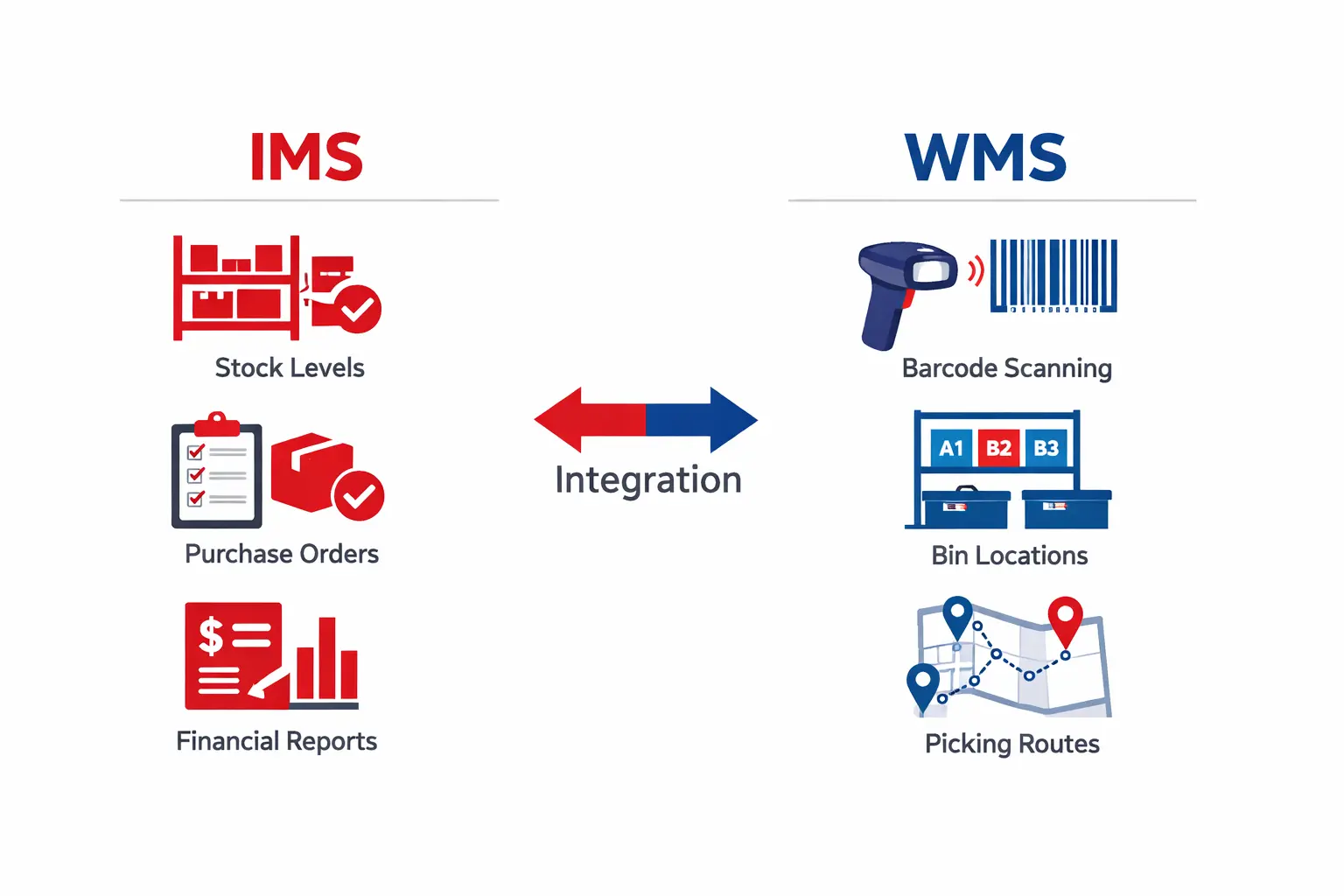
Now that we understand each system individually, let us compare them directly. Although both WMS and IMS deal with inventory, their scope, complexity, and primary users differ substantially.
| Aspect | IMS (Inventory Management System) | WMS (Warehouse Management System) |
|---|---|---|
| Operational Scope | Enterprise-wide (multi-location) | Within the four walls of one warehouse |
| Primary Focus | Stock value & supply flow | Physical movement & operational efficiency |
| Primary Users | Procurement managers, financial controllers | Warehouse operators, fulfillment managers |
| Automation Level | Reports, reorder alerts, channel sync | Real-time task directives via scanner/RFID |
| Location Management | Basic location field (name only) | Full 3D mapping aisle, rack, shelf, bin |
| Financial Compliance | FIFO, LIFO, COGS, inventory valuation | Not designed for financial accounting |
| Infrastructure Requirements | Low, accessible via desktop or browser | High, requires Wi-Fi, scanners, barcode labels |
| Best For | SMEs, retailers, dropshipping, 3PL models | Large warehouses, complex fulfillment operations |
As the table above clearly shows, neither system is universally superior. Instead, each one serves a specific operational purpose. Therefore, the right choice depends entirely on where your biggest bottlenecks currently exist.
When Is an IMS Sufficient for Your Business?
Not every business requires the granular control that a WMS provides. In fact, for many organisations, a standalone IMS is the most cost-effective and practical step toward supply chain maturity. Below are the scenarios where an IMS alone is the right solution.
- Small and Medium Enterprises (SMEs) with Simple Operations:
If your warehouse is small enough that staff can easily remember the layout, and picking an order simply involves walking to a known shelf, then the complex routing algorithms of a WMS would be overkill. In this case, an IMS gives you the stock visibility and financial accuracy you need without the high implementation cost. - Dropshipping and Third-Party Logistics (3PL) Models:
When a business outsources its physical storage and fulfillment to a 3PL provider, there is no warehouse to manage internally. Consequently, the business only needs to track stock levels at the supplier or 3PL, manage purchase orders, and sync inventory across sales channels. In this model, a WMS is unnecessary for the merchant an IMS is all that is required. - Businesses Where Financial Accuracy Is the Priority:
Some companies face challenges that are financial rather than operational. For example, if your main pain point involves calculating accurate profit margins, managing COGS across multiple channels, or generating compliant financial reports, then an IMS is the right tool. It supports all major inventory valuation methodologies and integrates directly with accounting systems for accurate reporting.
When Does Your Business Actually Need a WMS?
As your business scales, managing thousands of SKUs eventually outpaces any manual inventory workflow. Recognising this tipping point where a specialized warehouse management system in Malaysia becomes necessary marks a critical milestone to secure your growth journey.
- Rising Labour Costs with Falling Fulfillment Speed:
The clearest sign you need a WMS is when workers spend more time searching than picking products. This search time directly drains your operational efficiency. A WMS solves this by directing staff to exact bin locations. As your workforce grows, the system tracks KPIs like picks per hour to identify inefficiencies and boost productivity. - Advanced Fulfillment Strategies for E-Commerce:
Modern e-commerce in Malaysia, driven by Shopee and Lazada, demands fast and scalable fulfillment. Implementing strategies like wave or zone picking requires a WMS to group orders and route pickers efficiently. This ensures your team meets tight delivery windows without increasing headcount. - High Order Volume and Complex SKU Management:
Processing thousands of daily orders makes a WMS a survival necessity to prevent errors that damage your brand reputation. Automating these processes protects your bottom line and ensures your business remains LHDN MyInvois compliant during financial integrations.
The Power of Integration: WMS and IMS Working Together
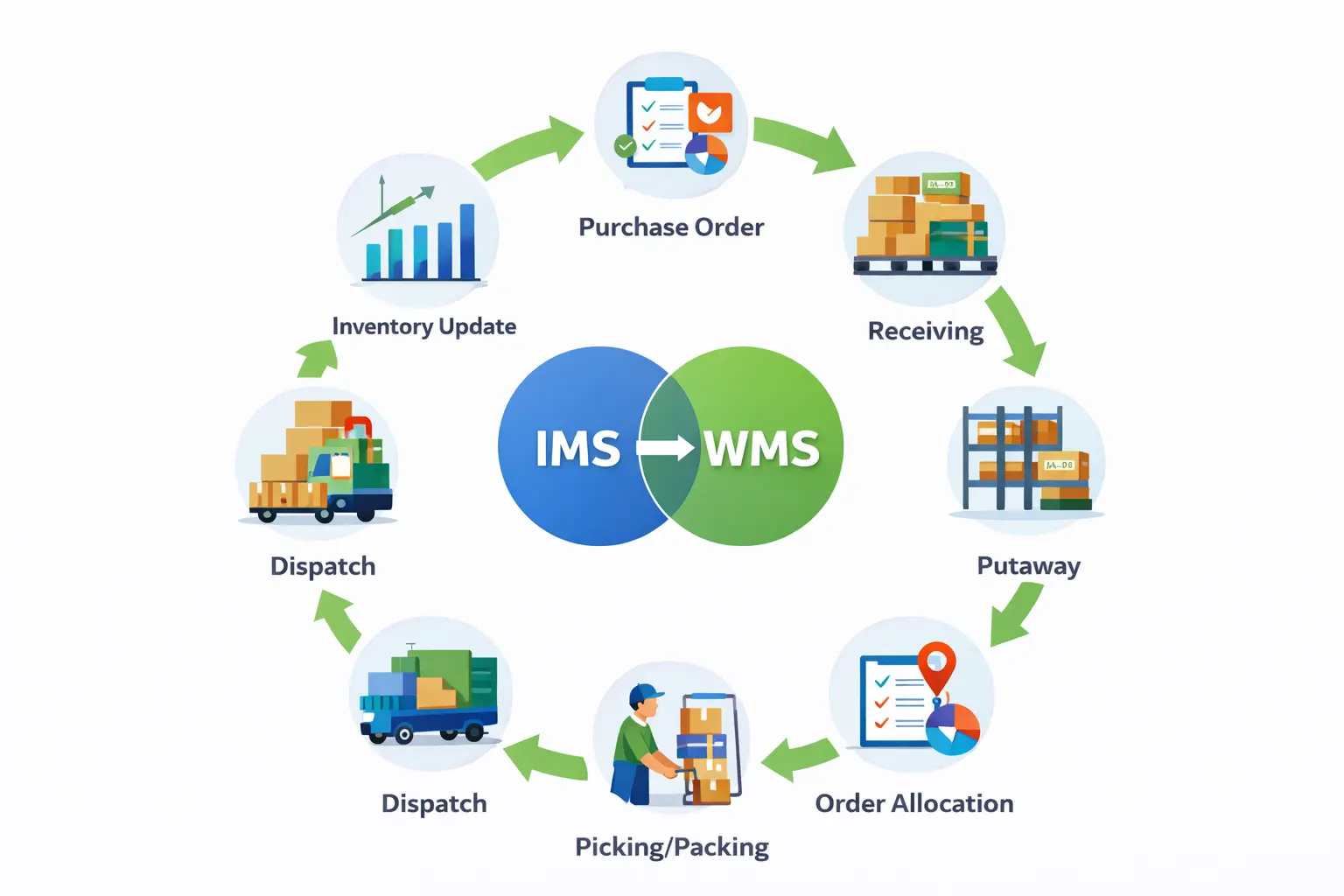
For mid-market and enterprise-level businesses in Malaysia, WMS and IMS are not mutually exclusive choices. On the contrary, the most optimised supply chains use both systems working in tandem, creating a seamless flow of data from strategic planning all the way down to physical execution.
Here is how the integrated workflow typically operates:
- IMS detects a stock drop → automatically generates a purchase order to the supplier.
- Goods arrive at the warehouse → WMS takes over, guiding receiving and putaway to the correct bin locations.
- WMS signals the IMS → global stock levels are updated and items become available for sale across all channels.
- Customer places an online order → IMS allocates the inventory and pushes the order to the WMS.
- WMS orchestrates picking, packing, and shipping → upon dispatch, it notifies the IMS to deduct items from the financial ledger and trigger a shipping confirmation to the customer.
This bidirectional data flow eliminates manual entry errors, prevents data silos, and ensures that your sales team never commits to inventory the warehouse cannot physically locate.
The Role of an Integrated ERP System
For many growing Malaysian businesses, the most practical resolution to the WMS vs IMS debate is implementing a comprehensive Enterprise Resource Planning (ERP) system. A well-designed ERP such as HashMicro combines inventory management, warehouse operations, financial accounting, and procurement modules within a single unified architecture.
As a result, businesses bypass the complexity and fragility of API integrations between separate software systems. Everything from stock levels to financial ledgers to warehouse bin locations lives within the same data base, giving executive leadership real-time visibility across the entire supply chain.
How to Choose Between WMS and IMS: A Practical Decision Guide
Choosing the right system requires an honest assessment of your current operations and a clear view of where your business is heading. To help you decide, use the diagnostic checklist below.
| Diagnostic Question | If Your Answer Is “Yes” → |
|---|---|
| Are popular items frequently out of stock, or are you holding too much dead stock? | Consider a stronger IMS |
| Are warehouse workers spending excessive time walking the floor to find items? | Consider implementing a WMS |
| Is your true profit margin difficult to calculate due to inaccurate COGS? | Consider a stronger IMS |
| Is your order accuracy rate declining, leading to more customer returns? | Consider implementing a WMS |
| Are you planning to open additional warehouses or distribution centres? | Consider an integrated ERP with both WMS + IMS |
| Are you selling across multiple online platforms simultaneously? | Consider a stronger IMS with multi-channel sync |
Implementation Steps to Follow
Once you have identified the right system, follow these structured steps to ensure a smooth deployment:
- Conduct a Needs Assessment: Map your current workflows and identify your most critical bottlenecks before evaluating vendors.
- Select a Vendor with Strong Integration Capabilities: Ensure the system connects seamlessly with your existing ERP, accounting software, and e-commerce platforms.
- Cleanse and Migrate Your Data: Standardise SKU data, unit-of-measure (UOM) conversions, and supplier pricing before migration. Remember: garbage in, garbage out.
- Roll Out in Phases: Start with a pilot in one warehouse or one product category. A phased approach significantly reduces implementation risk.
- Train Your Team Thoroughly: Whether it is procurement staff using the IMS dashboard or warehouse operators using RF scanners, comprehensive training is non-negotiable before go-live.
Conclusion: Aligning Your System Choice with Business Goals
Ultimately, selecting between WMS and IMS depends on your current business stage. An IMS provides strategic macro level visibility to optimize procurement and supply balance. Conversely, a WMS delivers precise operational control for physical fulfillment.
For Malaysian businesses scaling rapidly into new channels, manual processes are no longer sustainable. Flexible ERP platforms like HashMicro allow your team to start with core features and activate advanced warehouse capabilities as your operations evolve.
Securing your growth trajectory requires a system that adapts to your unique operational needs. Schedule a free demo to explore a comprehensive warehouse management solution in Malaysia designed to eliminate bottlenecks as your business expands.

FAQ About WMS vs IMS
-
What is the main difference between WMS and IMS?
A WMS manages the physical execution within your facility to optimize picking and shipping speed. An IMS tracks stock levels and financial valuation across all your business locations. To put it simply, your IMS tracks what you own while a warehouse management system in Malaysia tells you exactly where items are to maintain LHDN MyInvois compliance and peak operational efficiency.
-
Can a small business in Malaysia use a WMS?
It depends on the complexity of your operations. For most Malaysian SMEs operating from a single, simple stockroom, an IMS is sufficient. However, if your business handles a high volume of daily orders, manages thousands of SKUs, or requires advanced picking strategies, investing in a WMS or an integrated ERP with WMS capabilities will deliver a strong return on investment.
-
Do I need both a WMS and an IMS?
Not necessarily, it depends on your business size and operational complexity. Many growing businesses benefit from using both systems together, as they complement each other. The IMS manages macro-level stock visibility and financial accuracy, while the WMS handles micro-level warehouse execution. For businesses that want both in one platform, a unified ERP system like HashMicro is the most practical solution.
-
What happens if I use an IMS without a WMS in a large warehouse?
Without a WMS, your warehouse operations rely on manual processes, memory, or spreadsheets to locate and pick items. As order volume grows, this leads to increased picking errors, slower fulfillment speeds, rising labour costs, and declining order accuracy. These issues directly impact customer satisfaction and your overall operational efficiency.
-
Can a WMS help with FEFO compliance for food and pharmaceutical businesses in Malaysia?
Yes. A WMS tracks expiration dates and lot numbers at the bin level, ensuring workers always pick the oldest or soonest-expiring stock first in line with FEFO (First-Expired, First-Out) protocols. This is especially critical for food manufacturers, pharmaceutical distributors, and healthcare businesses in Malaysia that must comply with strict product traceability and safety regulations.