












Human resources has evolved from a basic administrative role into a core pillar of corporate strategy. Modern HR leaders now use advanced data methodologies to influence boardroom decisions and drive organizational growth. This shift relies on HR workforce analytics to replace traditional intuition with concrete, empirical evidence.
Malaysian businesses are adopting workforce analytics to address high employee turnover and support digital upskilling while meeting regional regulations. Insights from the workplace analysis market help companies track human capital metrics, better understand employee needs, and maintain a more stable workforce.
In today’s competitive market, leveraging talent data is the primary differentiator for successful global businesses. Workforce analytics allows leaders to uncover hidden patterns and predict future employment trends with high accuracy. By analyzing human capital systematically, companies can improve the employee experience while significantly boosting their bottom line.
Key Takeaways
|
To explore deeper insights and key trends shaping this space, check out the full workplace analysis market report through the banner below.
What is HR Workforce Analytics?
Understanding workforce analytics is essential to grasping data’s impact on human resources. This discipline applies mathematics and statistics to employee data to uncover meaningful patterns. It ultimately aligns HR initiatives with core business goals to optimize management.
Rather than viewing metrics in isolation, workforce analytics connects employee data to organizational performance. This process helps leaders solve complex challenges regarding productivity and operational efficiency. By transforming data into insights, companies drive more consistent business growth.
Key Differences Between Workforce Analytics Terms
In the realm of HR data, several terms are often used interchangeably, though they carry distinct nuances. Understanding these differences is crucial for establishing a clear analytical strategy:
- HR Analytics: Traditionally, this term refers specifically to the analysis of metrics generated within the HR department itself. It focuses on the efficiency of HR processes, such as time-to-hire, training costs, and benefits utilization.
- People Analytics: This is a broader, more holistic term that encompasses all aspects of the individuals within an organization. It often includes data outside of traditional HR systems, looking at organizational network analysis, employee sentiment, and behavioral data to understand the human element of work.
- Workforce Analytics: This term is the most comprehensive. It encompasses not only full-time internal employees but also part-time workers, contractors, contingent labor, and freelancers. By analyzing this broader spectrum, business leaders gain a macro-level view of the entire talent ecosystem, allowing for more agile and comprehensive strategic planning.
By leveraging HR workforce analytics, business leaders can shift their perspective from viewing employees merely as a cost center to recognizing them as a strategic asset whose value can be measured, optimized, and maximized over time.
The Evolution of Data in Human Resources
The journey of data within the human resources function has been a gradual evolution, mirroring the advancements in enterprise technology and the shifting expectations of corporate leadership. To appreciate the power of modern HR workforce analytics, it is helpful to examine the maturity model of HR data, which typically spans four distinct stages.
Stage 1: Operational Reporting
In the early days of digitized HR, the primary focus remained on basic operational reporting. This stage involved reactive, backward-looking data collection for headcount, payroll, and compliance. Because data lived in siloed systems, it required heavy manual effort and offered little strategic value.
Stage 2: Advanced Reporting and Benchmarking
As HR systems improved, organizations began proactively analyzing trends and benchmarking metrics against industry standards. Leaders used dashboards to visualize turnover rates and compensation distributions more effectively. While this provided a clearer view of the current workforce, the analysis remained descriptive rather than predictive.
Stage 3: Strategic Analytics
Strategic analytics marked a turning point by connecting HR metrics directly to core business outcomes. Instead of just tracking turnover, HR could finally analyze its specific impact on sales revenue or customer satisfaction. Statistical analysis now identifies root causes, allowing leaders to develop targeted interventions for workplace issues.
Stage 4: Predictive and Prescriptive Analytics
The final stage utilizes machine learning and AI to forecast future scenarios and talent trends. Predictive analytics identifies flight risks or high-potential candidates before critical shifts occur. Prescriptive analytics then recommends the best actions to mitigate these risks, making HR a truly proactive business partner.
Core Components of Effective Workforce Analytics

Building a successful HR workforce analytics capability requires more than just purchasing a new software tool; it requires a comprehensive framework built upon several core components. Without a solid foundation, analytical efforts will likely yield inaccurate or unactionable results.
1. Data Infrastructure and Quality
The most critical component of any analytics initiative is the data itself. Organizations must establish a robust infrastructure to store and process employee information securely. Rigorous data governance ensures consistency and prevents the “garbage in, garbage out” phenomenon.
2. System Integration
HR data often resides in separate platforms like payroll software, Applicant Tracking Systems (ATS), and performance systems. To drive results, businesses must integrate these metrics with external ERP or CRM systems. Evaluating the workforce management system helps centralize information and eliminate data silos.
3. Analytical Capabilities and Data Science
Clean data requires strong analytical capabilities to generate meaningful business insights. This process involves a blend of HR expertise and advanced data science techniques. Whether using internal teams or sophisticated software, rigorous analysis remains a foundational pillar.
4. Data Visualization and Storytelling
Profound insights are only valuable if communicated effectively to leadership. Data visualization tools translate complex findings into intuitive charts and interactive dashboards. HR professionals must also master data storytelling to highlight business impacts and guide strategic decisions.
Key Metrics Monitored in HR Workforce Analytics
While the specific metrics an organization tracks will depend on its unique goals and industry, there are several fundamental categories of metrics that form the backbone of HR workforce analytics. To effectively measure these areas, HR professionals must establish clear key performance indicators (KPI) that align with broader organizational goals.
Recruitment and Talent Acquisition Metrics
Attracting the right talent is the first step in building a high-performing workforce. Analytics in this area focus on optimizing the recruitment funnel and ensuring a strong return on investment for hiring efforts. Key metrics include:
- Time-to-Fill and Time-to-Hire: Measuring the efficiency of the recruitment process from the moment a requisition is opened to the moment an offer is accepted.
- Cost-per-Hire: Calculating the total financial investment required to bring a new employee on board, including advertising, agency fees, and internal recruiter time.
- Quality of Hire: A more complex metric that evaluates the long-term value a new hire brings to the organization, often measured by their performance ratings and retention after their first year.
- Source of Hire Effectiveness: Analyzing which recruiting channels (e.g., job boards, employee referrals, university partnerships) yield the highest quality candidates and the best retention rates.
Retention and Turnover Metrics
Employee turnover is incredibly costly, making retention a primary focus for workforce analytics. By understanding who is leaving and why, organizations can take proactive steps to retain their top performers.
- Voluntary vs. Involuntary Turnover: Distinguishing between employees who choose to leave and those who are terminated provides critical context for retention strategies.
- First-Year Turnover Rate: High turnover within the first year often indicates issues with the recruitment process, onboarding experience, or a misalignment of job expectations.
- Flight Risk Indicators: Using predictive analytics to identify behavioral patterns—such as decreased engagement, sudden changes in attendance, or stagnant compensation—that suggest an employee is likely to resign.
Performance and Productivity Metrics
Understanding how employees contribute to the organization’s success is essential for maximizing workforce value. Analytics helps identify top performers and areas where intervention is needed.
- Revenue per Employee: A high-level indicator of overall workforce productivity, calculated by dividing total revenue by the total number of employees.
- Goal Attainment Rates: Tracking the percentage of employees who consistently meet or exceed their performance objectives.
- Training ROI: Measuring the impact of learning and development initiatives on employee performance and business outcomes.
Diversity, Equity, and Inclusion (DEI) Metrics
Modern organizations recognize that diverse and inclusive workforces are more innovative and resilient. Workforce analytics provides the transparency needed to track DEI progress.
- Demographic Representation: Monitoring the diversity of the workforce across different levels of the organization, from entry-level to executive leadership.
- Pay Equity Analysis: Identifying and addressing unexplained wage gaps between different demographic groups performing similar work.
- Promotion Rates by Demographic: Ensuring that all employees have equitable access to career advancement opportunities.
| Category | Key Metrics | Primary Focus |
|---|---|---|
| Recruitment & Talent Acquisition | Time-to-Fill, Cost-per-Hire, Quality of Hire, Source Effectiveness | Hiring efficiency and ROI |
| Retention & Turnover | Voluntary vs. Involuntary Turnover, First-Year Turnover, Flight Risk | Retaining top talent |
| Performance & Productivity | Revenue per Employee, Goal Attainment, Training ROI | Improving workforce performance |
| Diversity, Equity & Inclusion | Demographic Representation, Pay Equity, Promotion by Demographic | Building an inclusive workplace |
How Workforce Analytics Drives Strategic Decision Making
The true power of HR workforce analytics lies in its ability to inform and elevate strategic decision-making across the entire employee lifecycle. When leaders have access to accurate, predictive insights, they can move away from reactive problem-solving and begin designing proactive strategies that shape the future of the organization.
Optimizing Talent Acquisition Strategies
Recruitment represents one of the largest expenses within an average HR budget. Workforce analytics optimizes this spend by identifying which sourcing channels produce the highest-performing and longest-tenured employees. High-level insights allow leadership to reallocate marketing budgets strategically, improving hire quality while reducing overall costs.
Enhancing Employee Engagement and Experience
Employee engagement directly impacts productivity, customer satisfaction, and overall profitability. Analytics synthesizes data from engagement surveys and collaboration tools to create a comprehensive picture of staff sentiment. By identifying specific engagement drivers, HR can tailor initiatives to meet the unique needs of different employee segments..
Proactive Talent Retention and Reducing Turnover
Losing key employees disrupts projects, lowers team morale, and incurs significant replacement costs. Predictive models analyze historical turnover and current employee metrics to flag individuals or departments at high risk of leaving. This allows management to intervene proactively with adjusted compensation or workload redistribution before talent begins looking elsewhere.
Strategic Workforce Planning
Organizations must ensure they have the right skills in the right places at the right time. Workforce analytics facilitates planning by forecasting future talent needs based on growth projections and industry trends. By conducting a gap analysis, HR can develop targeted strategies for upskilling current staff and succession planning for critical roles.
Practical Benefits for Modern Organizations
The implementation of a robust HR workforce analytics program requires significant investment in technology, talent, and change management. However, organizations that successfully navigate this transition reap substantial, tangible benefits that provide a significant competitive advantage.
1. Significant Cost Reduction and Efficiency Gains
Workforce analytics helps businesses identify operational gaps and immediate cost-saving opportunities. By optimizing recruitment and reducing turnover, organizations can save millions in annual expenses. Analyzing attendance data system also reveals burnout patterns, allowing for interventions that lower absenteeism and healthcare costs.
2. Improved Productivity and Performance
Data allows organizations to identify the specific traits and behaviors of their top performers. HR teams use these insights to refine hiring criteria and select candidates with the highest success potential. Additionally, analytics pinpoints workflow bottlenecks, ensuring employees receive the training and resources needed to work effectively.
3. Enhanced Employee Well-being and Satisfaction
Analytics is a powerful tool for improving the daily human experience at work. By monitoring sentiment and workload, companies can detect burnout signs before they lead to health issues or resignations. Data-driven teams then design targeted wellness programs and flexible policies that prioritize the actual needs of their workforce.
4. Agility in a Dynamic Business Environment
Modern organizations must pivot quickly in response to economic shifts or technological disruptions. Workforce analytics provides real-time insights to help leaders navigate these complex challenges confidently. Whether managing remote work shifts or restructuring teams, data ensures human capital decisions remain swift and informed.
Best Practices for Building a Data-Driven HR Culture
Transforming an organization’s approach to human capital management does not happen overnight. It requires a strategic, phased approach and a commitment to fostering a culture that values empirical evidence. Here are the best practices for successfully implementing HR workforce analytics.
1. Start with Clear Business Questions
Many organizations fail by gathering massive amounts of data without a clear direction or purpose. Successful initiatives begin with specific, high-priority questions rather than simply searching for random insights. Focusing on defined problems, such as specific turnover causes, ensures analytical efforts stay relevant to core business outcomes.
2. Focus on Data Quality from Day One
Before investing in advanced predictive models, organizations must ensure their foundational data is accurate and reliable. This involves conducting comprehensive data audits, standardizing data entry procedures, and implementing automated validation checks. Establishing a cross-functional data governance committee can help maintain data integrity across the organization.
3. Invest in the Right Technology Infrastructure
Building a robust analytics capability requires scalable technology solutions that can handle large datasets while ensuring security and accessibility for all stakeholders.
Step-by-Step Implementation Steps for Workforce Analytics
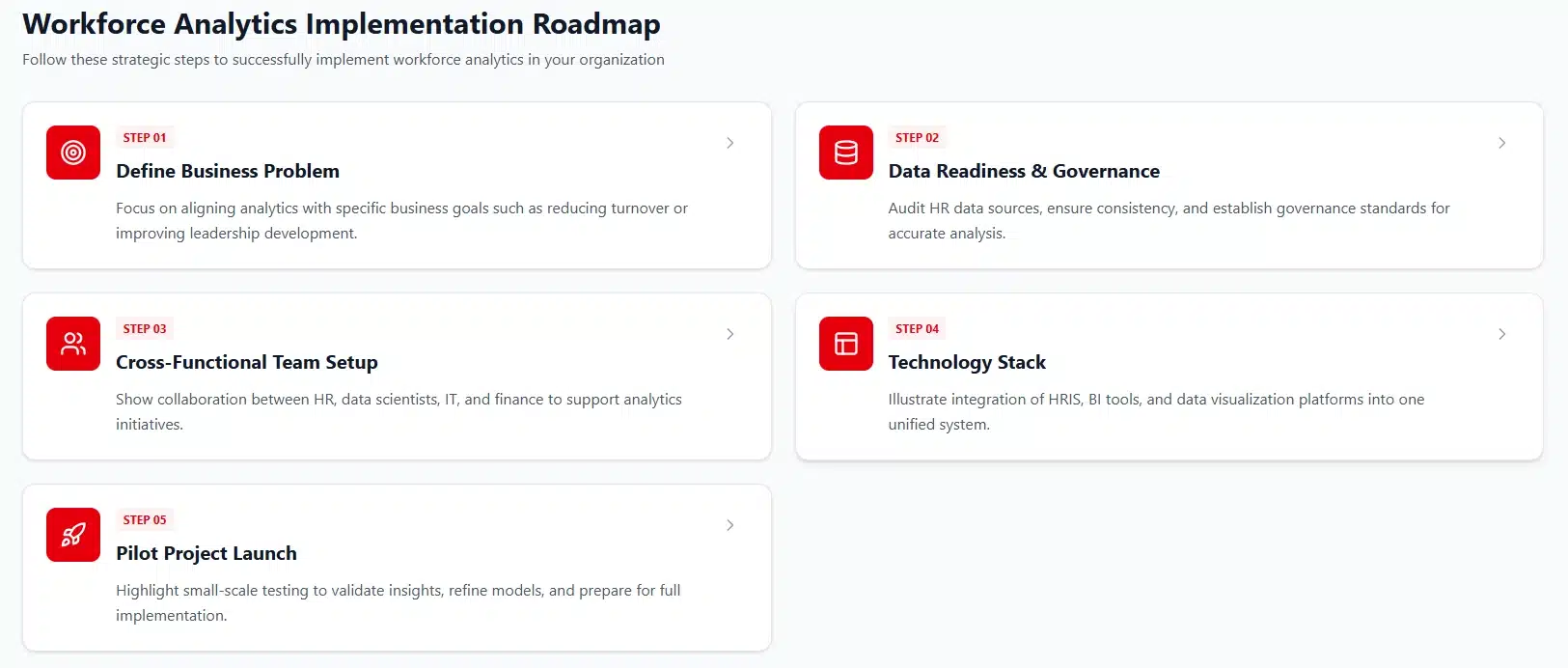
Transitioning from basic HR reporting to advanced workforce analytics is a journey that requires careful planning, cross-functional collaboration, and a robust technological infrastructure. Organizations looking to build a successful analytics capability should follow a structured implementation roadmap.
1. Define the Business Problem First
The most common mistake organizations make is starting with data rather than a specific business question. Effective workforce analytics must always align with overarching organizational goals and measurable objectives. Instead of searching for random insights, leaders should focus on solving specific challenges like reducing turnover or accelerating leadership development.
2. Assess Data Readiness and Establish Governance
Before deploying complex algorithms, an organization must ensure its underlying data foundation is reliable. This phase involves conducting thorough audits to assess the accuracy and consistency of existing HR sources. Establishing a strong governance framework is critical to standardizing entry protocols and ensuring historical data remains clean for analysis.
3. Assemble a Cross-Functional Analytics Team
Workforce analytics requires a multidisciplinary team rather than just the HR department working in isolation. While HR professionals provide necessary context, data scientists are needed to build and interpret complex statistical models. Collaboration with IT and finance partners ensures that systems remain secure and the financial impact of every initiative is quantified.
4. Invest in the Right Technology Stack
Modern analytics relies on a sophisticated technology stack beyond foundational HRIS platforms. Organizations should invest in advanced business intelligence tools and data visualization platforms to manage information effectively. These tools must aggregate data from various sources, such as financial databases and performance software, into a unified system for easier querying.
5. Launch Pilot Projects Before Scaling
Rather than attempting a massive, enterprise-wide rollout, organizations should begin with a focused pilot project. Select a specific department or a singular business problem to test the analytics models. A successful pilot demonstrates quick wins, builds executive buy-in, and allows the analytics team to refine their methodologies and data pipelines before scaling the program across the entire organization.
Common Mistakes and How to Avoid Them
- Siloed Data Systems: When HR data is kept isolated from operational and financial data, the resulting insights are limited. True workforce analytics requires integrating HR metrics with broader business KPIs to show how human capital impacts the bottom line.
- Analysis Paralysis: It is easy to become overwhelmed by the sheer volume of available data. Organizations often fall into the trap of creating endlessly complex dashboards that offer no clear directives. Analytics must always lead to actionable interventions; if a metric does not inform a decision, it is merely a vanity metric.
- Ignoring Privacy and Ethics: As organizations collect increasingly granular data on employee behavior, ethical concerns and privacy regulations (such as GDPR or CCPA) become paramount. HR leaders must be transparent about what data is being collected and how it will be used, ensuring that analytics initiatives do not foster a culture of surveillance or erode employee trust.
- Lack of HR Data Literacy: Even the most advanced predictive models are useless if HR business partners cannot interpret the findings. Organizations must invest in data literacy training for their HR staff, empowering them to translate analytical outputs into strategic human-centric conversations.
Advanced Practices Shaping the Future of Workforce Analytics
Organizational Network Analysis (ONA)
Traditional charts show formal structures, but Organizational Network Analysis (ONA) maps the informal networks that truly drive a business. By analyzing anonymized communication data, this method identifies key influencers and collaboration bottlenecks within a team. These insights provide visibility into organizational agility and help flag employees who may feel isolated.
Natural Language Processing (NLP) for Employee Sentiment
Annual surveys are evolving into continuous listening strategies powered by Natural Language Processing. Natural Language Processing (NLP) algorithms analyze unstructured text from feedback forms and chat channels to gauge real-time employee sentiment. This allows HR leaders to detect shifts in morale and address cultural issues before they lead to turnover.
AI-Driven Prescriptive Analytics
The next frontier is prescriptive analytics, where Artificial Intelligence (AI) and Machine Learning (ML) not only predict future outcomes but recommend specific courses of action. For example, if an AI model predicts a high flight risk for a top-performing software engineer, a prescriptive analytics engine might automatically suggest a tailored retention strategy based on historical success patterns.
Conclusion
HR workforce analytics has transitioned from a futuristic luxury to a fundamental necessity for organizations in the modern economy. By systematically leveraging data to support and optimize human capital, businesses foster a more engaged and productive workforce. This data-driven approach ultimately secures a sustainable competitive advantage and drives operational excellence in the global marketplace.
The journey toward data-driven optimization requires a strategic vision, significant investment, and strong cultural alignment. While moving away from intuition-based HR takes effort, the return on investment for both human potential and financial performance is undeniably profound. Organizations that embrace this transformation successfully position themselves for long-term stability and measurable growth.
FAQ about Workforce Analytics
-
What is the primary goal of HR workforce analytics?
The primary goal is to apply statistical models to HR data to discover insights that optimize workforce management and align human capital with business goals.
-
How does workforce analytics differ from traditional HR reporting?
Traditional HR reporting is reactive and backward-looking, whereas workforce analytics is proactive, using predictive models to forecast future trends and business outcomes.
-
What types of data are typically used in workforce analytics?
Common types of data used in workforce analytics include employee demographics, performance metrics, attendance records, engagement surveys, and training and development information.