









Moving goods across borders sounds simple on paper. In practice, it involves a complex web of ports, trucks, warehouses, schedules, and regulations, one wrong decision can cost you days of delay and thousands in extra fees.
According to the UNCTAD Review of Maritime Transport 2024, over 80% of global trade by volume is carried by sea and ports that have adopted digital technologies for transshipment report measurably reduced waiting times, better cargo tracking, and more efficient operations. Yet for most businesses, the mechanics of how that cargo actually moves between vessels and hubs remains poorly understood.
This comprehensive guide breaks down every dimension of what transshipment is, how it works step by step, what it really costs, how to choose the right hub, what compliance requires, and how the right technology makes the difference between a supply chain that runs smoothly and one that does not.
Key Takeaways
|
What Is Transshipment?
Transshipment is the process of moving cargo from one transport vehicle, carrier, or vessel to another during its journey, at a midpoint location, before it reaches its final destination.
Instead of traveling on a single carrier all the way through, goods stop at an intermediate hub a port, freight depot, or warehouse, where they are unloaded, sorted, and reloaded onto a different vehicle before continuing onward.
No matter the industry or transport mode, the principle is the same: move goods efficiently through a network of hubs and routes, rather than trying to connect every point directly.
How the Transshipment Process Works
Understanding the transshipment process in detail requires following the journey of a shipment from arrival at the transshipment hub to its departure for the final destination.
Step 1: Arrival and Receiving
Cargo arrives at the transshipment facility. The facility immediately logs every shipment into the management system using barcodes, RFID tags, or physical shipping documents. Key data recorded: origin, contents, weight, dimensions, and intended destination. Accurate data capture here is what makes every downstream step possible errors at this stage cause sorting mistakes, customs issues, and misdirected cargo.
Step 2: Unloading and Sorting
Workers unload the cargo from the incoming vehicle using conveyor systems, forklifts, and at large facilities robotic sorting equipment. The system sorts each item by destination. Staff group together all goods heading to the same region. This is the most critical step: a single sorting error cascades downstream into misdeliveries, delays, and costly corrections.
Step 3: Consolidation or Deconsolidation
Consolidation combines smaller shipments from multiple origins into one larger load heading in the same direction, this is where a large portion of transshipment’s cost savings come from. Deconsolidation breaks apart one large shipment into smaller parcels, each heading to a different end recipient.
Step 4: Temporary Storage (If Required)
If there is a gap between cargo arriving and the next outbound vehicle departing, goods are held in a staging area. The operative word is temporary a well-run facility treats storage as a last resort, not a default. Minimizing this dwell time is one of the primary drivers of cost efficiency in transshipment.
Step 5: Loading and Dispatch
Sorted, consolidated cargo is loaded onto the outbound vehicle and dispatched. The system generates new shipping documents, the system is updated to reflect the carrier handover, and goods continue their journey either to the final destination or to the next transshipment hub in more complex networks.
Understanding these inbound and outbound flows is essential for any logistics professional.
Transshipment vs Cross-Docking: Understanding the Difference
These two terms are used interchangeably so often that the distinction has become blurred even among logistics professionals. Understanding the difference matters for anyone designing or managing these kinds of operations.
Transshipment is the broader category. It describes any situation where goods are transferred between carriers or transport modes at an intermediate point and may include a brief storage period while awaiting the next outbound vehicle.
Cross-docking is a specific type of transshipment. The key difference: in a true cross-docking operation, goods move directly from the inbound dock to the outbound dock often within the same shift or hour with minimal or zero storage time.
| Aspect | Transshipment | Cross-Docking |
| Scope | Broad, any carrier or mode transfer at a midpoint | Specific subset of transshipment |
| Storage Time | May include brief temporary storage | Zero or near-zero |
| Additional Activities | Sorting, consolidation, deconsolidation, value-added services | Very limited, speed is the priority |
| Schedule Dependency | Moderate more flexible in timing | Very high, requires precise synchronization |
| Common Users | Ports, freight depots, intermodal terminals | Large retailers, food distributors, express carriers |
| Best For | Flexible networks, varied cargo types | Predictable, high-frequency freight flows |
The Key Benefits of Transshipment for Modern Logistics
Transshipment has become a cornerstone of global logistics not simply because it is convenient, but because it delivers measurable, significant advantages across multiple dimensions of supply chain performance. Here is a detailed examination of the core benefits.
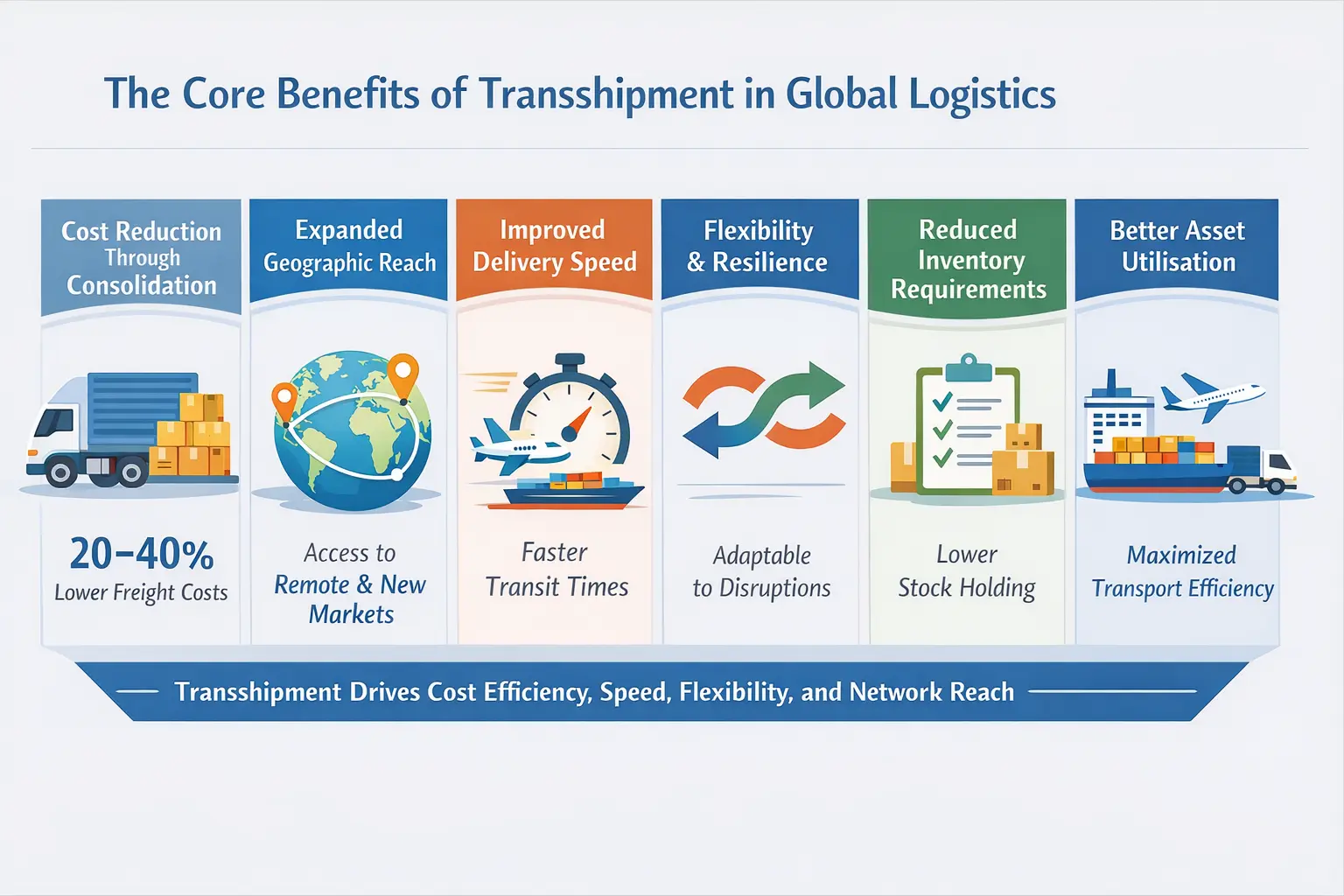
These benefits directly connect to how efficiently warehouse logistics are managed overall. If you want to see how transshipment fits within the wider picture of warehouse and distribution operations, our detailed resource on warehouse logistics covers the full scope of logistical activities within and around warehouse environments.
Challenges in Transshipment Operations
Even when planned correctly, transshipment introduces operational variables that can undermine its benefits. Understanding these challenges is the first step to managing them proactively.
| Challenge | What Cause it | How to Mitigate it |
| Port Congestion | Too many vessels, insufficient berths, limited handling capacity | Choose hubs with strong operational track records and multiple berth options |
| Schedule Synchronization | Inbound cargo missing outbound connections across multiple time zones | TMS-enabled dock scheduling and real-time arrival tracking |
| Cargo Damage and Loss | Multiple handling events across different equipment and facilities | Strict packing standards, carrier SLAs, IoT condition monitoring |
| Customs Documentation Errors | Incorrect fields triggering customs holds across multiple jurisdictions | Experienced customs brokers; WMS-generated documentation |
| Data Visibility Gap | Disconnected carrier and facility tracking systems | Real-time visibility platforms aggregating multi-carrier data |
| Environmental Impact | Extra handling events and potential routing detours | Multimodal routing, hub selection optimizing for load consolidation |
The Role of a Transshipment Warehouse
A transshipment warehouse is a specialised logistics facility designed specifically to support the transshipment process. Unlike a conventional storage warehouse, which is built to hold inventory for extended periods, Operators optimise a transshipment warehouse for speed, throughput, and efficient cargo handling. Understanding its design, function, and strategic role in the supply chain is essential for anyone involved in distribution logistics.
- Physical Layout and Design
Transshipment warehouses are typically large, single-storey buildings with loading docks on both sides, one side for inbound vehicles, the other for outbound. The interior features wide aisles and minimal racking, allowing forklifts and conveyor systems to move cargo quickly from one end to the other. Some facilities include tilt-tray sorters and automated scanning systems capable of processing thousands of packages per hour.
The design principle is simple: the shortest possible path from inbound dock to outbound dock. Every unnecessary meter of movement adds time and cost.
- Strategic Location
Location is the most critical design decision for a transshipment warehouse. Businesses should position these facilities at the intersection of major transport routes near motorway junctions, port terminals, rail yards, or airports. A poorly located hub adds travel distance for every vehicle moving through it, eroding the cost and time advantages that transshipment is meant to deliver.
- Value-Added Services
Many transshipment warehouses offer services beyond simple cargo transfer: repackaging, relabelling, quality inspection, kitting, and light assembly. These services allow businesses to complete last-minute customizations or compliance activities before goods are dispatched transforming the hub from a simple relay point into a genuine value creation node in the supply chain.
- The Blurring Line with E-Commerce Fulfilment
In the e-commerce era, the boundary between transshipment and fulfilment has become increasingly indistinct. Some modern logistics facilities now function simultaneously as transshipment hubs and order fulfilment centers receiving bulk inventory, picking and packing individual orders, and dispatching them to end customers within the same operation.
- Relationship to Fulfilment Operations
In the e-commerce era, the boundary between transshipment and fulfilment has become increasingly blurred. Some modern logistics facilities function simultaneously as transshipment hubs and order fulfilment centres, receiving bulk inventory, picking and packing individual orders, and dispatching them to end customers all within the same operation.
Understanding the differences and intersections between these two models is important for businesses designing their logistics networks. For a detailed explanation of how fulfilment warehouses operate, our article on fulfilment warehouse operations provides a comprehensive comparison with other warehouse types.
How Technology Transforms Transshipment Operations
This is the dimension that most transshipment guides skip entirely. The difference between a transshipment operation that works and one that consistently underperforms often comes down to the technology stack running behind it.
Warehouse Management System (WMS)
A WMS is the operational brain of a transshipment facility. It manages real-time information about every piece of cargo arriving and departing, directs workers and automated equipment through task assignments, maintains live inventory visibility, and generates the customs and handover documentation required at each stage.
Transport Management System (TMS)
A TMS manages the vehicles moving to and from the transshipment facility carrier selection, route optimization, dock scheduling, and freight cost management. When a TMS and WMS are integrated, the facility can automatically adjust dock assignments and staging areas in response to real-time vehicle arrival data, minimizing dwell time without manual intervention.
RFID and Automated Scanning
Barcode scanning has been the logistics standard for decades, but RFID (Radio Frequency Identification) is increasingly being adopted in high-volume environments. RFID allows multiple items to be scanned simultaneously without direct line-of-sight contact dramatically accelerating receiving and sorting while reducing human error.
Automated Sorting Systems
For parcel and small-freight transshipment at scale, automated sorting systems are essential. Tilt-tray sorters, cross-belt sorters, and roller conveyor systems can process thousands of items per hour with high accuracy, routing each item automatically to the correct outbound lane based on real-time WMS data.
Real-Time Visibility Platforms
Real-time visibility platforms aggregate tracking data from multiple carriers, facilities, and transport modes into a single dashboard. The best platforms now use machine learning to predict disruptions before they occur alerting logistics teams to potential delays while there is still time to act proactively.
IoT Sensors for Condition Monitoring
For temperature-sensitive or fragile cargo, IoT sensors embedded in containers or packaging continuously monitor conditions like temperature, humidity, shock, and tilt throughout the transshipment journey. This data provides verifiable evidence that goods were handled correctly valuable for compliance, insurance claims, and quality assurance.
Transshipment in Malaysia’s Logistics Landscape
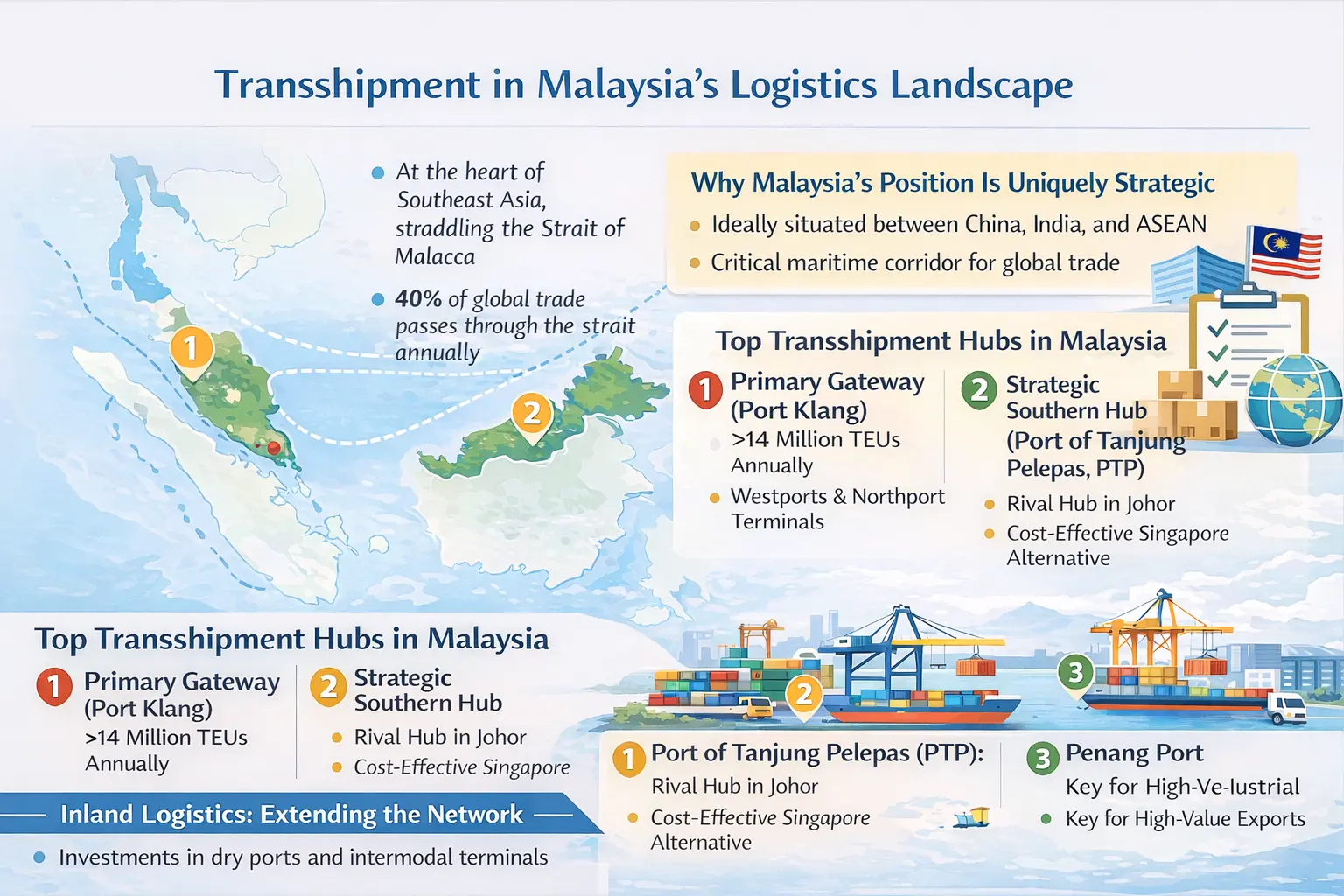
Malaysia occupies a uniquely advantageous position in the global transshipment landscape. Situated at the heart of Southeast Asia, with coastlines on the Strait of Malacca one of the world’s busiest and most strategically important shipping lanes Malaysia has grown into a significant regional logistics and transshipment hub over the past several decades.
Malaysia sits at the heart of Southeast Asia, with coastlines along both the Strait of Malacca and the South China Sea. Approximately 40% of global trade by value passes through the Strait of Malacca annually making it one of the world’s most critical maritime corridors. This geography gives Malaysia natural transshipment advantages that cannot be replicated by landlocked competitors.
Port Klang: Malaysia’s Primary Transshipment Gateway
Port Klang is Malaysia’s largest and busiest container port, cPort Klang consistently ranks among the top 15″ container ports in the world by volume. Handling more than 14 million TEUs in recent years with a substantial share being transshipment cargo Port Klang connects routes between East Asia, South Asia, the Middle East, Europe, and beyond.
Port of Tanjung Pelepas (PTP): The Rising Alternative
Located in Johor, just across the strait from Singapore, PTP has grown into one of the top transshipment hubs in Southeast Asia, attracting major global shipping alliances. For businesses sourcing or manufacturing in Johor or the southern peninsula, PTP often offers a more cost-effective transshipment gateway than routing cargo north to Port Klang or across to Singapore.
Penang Port: The Northern Node
Penang Port serves as the transshipment gateway for Malaysia’s northern manufacturing corridor including the semiconductor and electronics clusters in Penang state and northern Perak. These industries drive a significant portion of Malaysia’s export value, and Penang Port provides their most direct connection to global shipping lanes.
Conclusion
Transshipment is not a logistics complexity to be managed, it is a strategic tool to be leveraged. When understood and operated well, it cuts costs, expands reach, speeds up deliveries, and builds supply chain resilience that rigid direct-shipping networks simply cannot match.
But that potential is not automatic. It requires the right hub selection, a clear understanding of what compliance demands, a well-designed warehouse operation, and a technology foundation that keeps every moving part synchronized and visible in real time.
Businesses that treat transshipment as a commodity picking the cheapest option without understanding the full cost structure will consistently underperform. Those that approach it as a strategic decision, informed by operational and analytical depth, will find it one of the most powerful levers available in their supply chain.
FAQ About Transshipment
-
What is the main difference between transshipment and direct shipping?
Direct shipping uses a single carrier from the point of origin all the way to the final destination, with no intermediate stops. Transshipment involves at least one midpoint stop where cargo is transferred to a different carrier or transport mode before continuing its journey. While direct shipping sounds simpler, transshipment is often more cost-effective and even faster for certain destinations because it allows consolidation and more efficient use of primary routes.
-
Does transshipment cargo get taxed at customs in transit countries?
In most cases, no. Transshipment cargo is generally allowed to pass through transit countries without paying import duties, as long as it stays within an approved bonded area and is not sold or consumed locally. However, strict documentation requirements apply, and rules vary from country to country. Working with an experienced freight forwarder or customs broker familiar with regulations in each transit country is strongly recommended.
-
What is dwell time in transshipment, and why does it matter?
Dwell time is the amount of time cargo spends at a transshipment facility between arriving and departing. Keeping dwell time short is a top priority in transshipment operations extended waiting increases storage costs, risks missing outbound connections, and can slow down the entire supply chain.