








Logistics can quietly drain a business, not just in money, but also in service levels and missed sales when shipments slip or costs spike without warning. In fact, the latest State of Logistics Report estimates U.S. business logistics costs at US$2.3 trillion, around 8.7% of GDP, showing how big the “freight and logistics” line can get when it isn’t tightly managed.
That’s where freight management helps. It’s the discipline of planning, coordinating, and monitoring the movement of goods so you can control spend, hit delivery targets, and see what’s happening across carriers, lanes, and shipments before issues turn into escalations.
You’ll see how freight management works in practice, what the typical workflow looks like from planning to delivery, and what improves when it’s supported by the right system, especially visibility, cost control, and decision-making speed across your supply chain.
Key Takeaways
|
Freight Management and Freight Management System (FMS)
Freight management is how a business plans, coordinates, and controls shipments so goods arrive on time and costs stay under control. It includes choosing carriers, setting delivery schedules, optimizing routes, tracking progress, and handling compliance.
A Freight Management System (FMS) is the software that helps teams run that process in a more consistent way. It brings planning, rate comparisons, scheduling, tracking, and cost reporting into one place.
For most businesses, the benefit is practical. Less manual follow-up, fewer shipping mistakes, clearer visibility, and faster decisions when something changes in transit.
Why is Freight Management Important For Your Business?

Efficient freight management is no longer a nice to have, it has become a strategic necessity for businesses looking to stay competitive in a rapidly evolving supply chain landscape.
By adopting a structured approach to managing freight operations, companies can unlock significant cost savings, improve customer satisfaction, and gain the agility needed to respond to market demands. Here are the key reasons why freight management matters for your business:
- Cost Efficiency: Freight management helps businesses reduce transportation costs through better route planning, carrier negotiations, and load optimization, leading to significant savings over time.
- Improved Delivery Performance: With real-time tracking and optimized scheduling, companies can ensure timely deliveries, minimize delays, and build stronger customer relationships.
- Enhanced Visibility and Control: Centralized freight data gives managers end-to-end visibility, enabling quick decision-making and proactive issue resolution.
- Risk Mitigation: Automated compliance checks and proactive monitoring reduce risks related to damaged goods, regulatory fines, and delivery disruptions.
- Scalability for Business Growth: A well-structured freight management system adapts as shipment volumes and operational complexity increase, supporting long-term growth without added inefficiencies.
Key Module of FMS
To maximize the value of a Freight Management System (FMS), businesses need to understand the core modules that drive operational efficiency and cost savings.
Each module is critical in streamlining logistics processes and creating a more connected, data-driven supply chain. Below are the key modules and their business impact:
- Automated Workflow Management: Centralizes all freight-related processes, from shipment booking to final billing, ensuring operational consistency and reducing manual errors across departments.
- Carrier Management: Provides a unified platform for evaluating and selecting carriers, maintaining relationships, and tracking shipments in real time to improve service quality and accountability.
- Rate Management: Consolidates rates from multiple carriers, enabling easy comparison and selection of the most cost-effective options. Many FMS solutions integrate directly with ERP systems for seamless financial management.
- Route Optimization: Uses advanced algorithms to calculate the most efficient routes, considering fuel costs, traffic patterns, and regulatory constraints to reduce delivery times and expenses.
- Real-Time Tracking and Visibility: This service offers GPS-enabled tracking and real-time updates, allowing businesses to make proactive decisions and respond quickly to potential delivery disruptions.
- Inventory Management: Synchronizes freight activities with warehouse systems to provide a unified view of inventory, minimizing the risk of stockouts or overstock situations.
- Billing and Invoice Management: This system automates invoicing from creation to settlement, ensuring accuracy and faster payments while tracking sea freight cost.
Wondering what a system like this would cost for your operation? Click the banner below to get a quick estimate based on your needs
Modern Freight Management That Fits Malaysia’s Reality
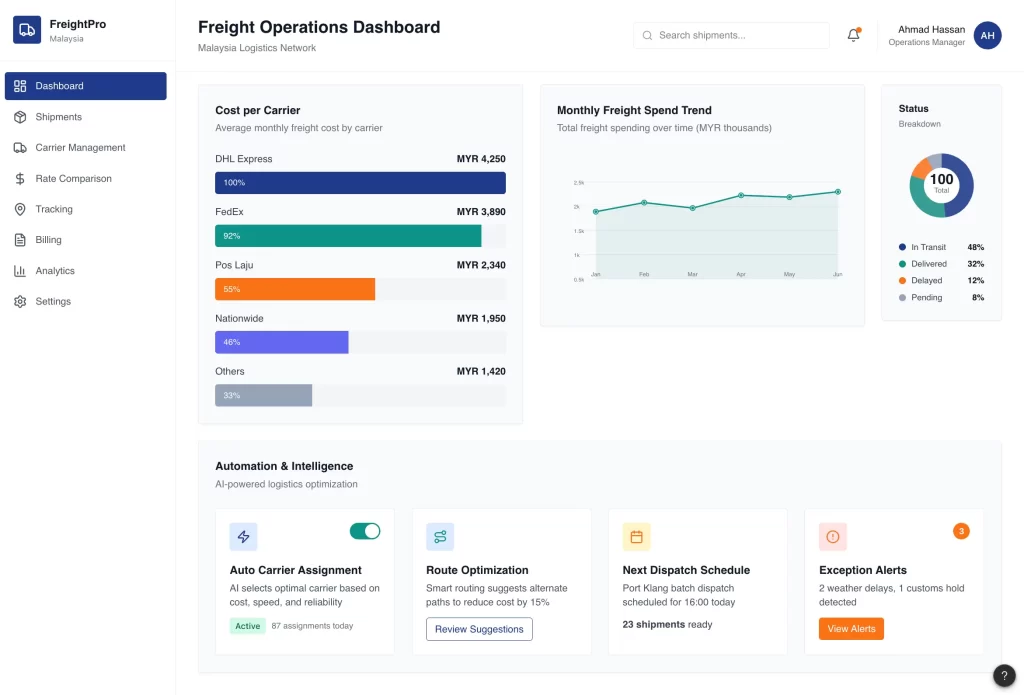 In Malaysia, freight teams often deal with real operational friction, from congestion around key industrial areas to longer lead times for East Malaysia lanes. When shipment planning, carrier coordination, tracking, and billing sit in different tools, small disruptions can quickly turn into delays, higher costs, and messy customer updates.
A modern freight setup helps by bringing those workflows into one process, so your team isn’t chasing information across spreadsheets, chat threads, and separate systems. The goal is practical: fewer surprises, faster coordination, and better control over service levels and transportation spend.
Capabilities that usually matter most for Malaysian operators:
- Automated Shipment Planning: Plans shipments and assigns carriers automatically to save time and improve delivery efficiency.
- Carrier and Rate Management: Centralizes carrier data and rates, enabling quick comparisons and cost-effective decisions.
- Real-Time Tracking: Provides full shipment visibility with GPS tracking and instant status updates.
- Integrated Billing: Automates invoicing and payment processes to reduce errors and speed up financial workflows.
- Advanced Analytics: Delivers real-time dashboards for cost analysis, performance monitoring, and data-driven decisions.
- ERP Integration: Connects seamlessly with ERP and inventory systems for consistent, accurate data across operations.
Conclusion
Effective freight management is no longer just a logistics function; it has become a strategic driver for business growth. By improving shipment planning, increasing visibility, and controlling operational costs, companies can build a supply chain that is more resilient and easier to scale.
In practice, this usually comes down to having a clear, consistent way to manage carrier selection, tracking, exceptions, and freight spend in one workflow. When these processes are supported by the right system, teams spend less time chasing updates, reduce avoidable shipping errors, and make faster decisions based on reliable data.
If freight delays, cost variance, or limited shipment visibility are recurring issues, it’s worth reviewing your current process and tools. Identify where bottlenecks happen most often, then evaluate solutions that can automate routine tasks and provide real-time reporting to help improve performance over time.

FAQ Freight Management
-
What are the four types of freight?
There are four major types of freight transportation available for shippers to use in the world of freight shipping. The primary ones are by ground (road), rail, ocean, and air.
-
What is freight vs shipping?
Unlike standard shipping, which focuses on smaller individual packages, freight involves the transportation of goods in larger volumes or sizes, typically using pallets, crates, or shipping containers. Moving large quantities of inventory from manufacturers to warehouses or distribution centers.
-
What is 5PL logistics?
The term 5PL or Fifth Party Logistics is still a new logistics term. A 5PL operator combines the transport and logistics services of a 3PL provider with the supply chain optimalisation of a 4PL provider. The 5PL operator takes this one step further and manages an entire network of supply chains for the client.