







The Tax Reform for Acceleration and Inclusion (TRAIN) Act, or Republic Act No. 10963, is a major milestone in the evolution of the Philippine tax system. Enacted in 2017, the TRAIN law was designed to streamline taxation and improve fairness.
For business owners and decision-makers, the TRAIN Law goes beyond regulatory compliance. It directly influences payroll structures, pricing strategies, cash flow management, and overall financial planning.
Understanding the TRAIN Law in the context of 2026 is essential for maintaining operational efficiency and financial resilience. By clearly grasping its key provisions and business implications, companies can better align their strategies with current tax regulations.
Table of Contents
Key Takeaways
|
The Core Objectives Behind the TRAIN Law (RA 10963)
The implementation of the TRAIN Law was driven by a clear set of national objectives aimed at fostering economic growth and improving public services. It was not merely a revision of tax rates but a foundational part of the government’s broader socioeconomic agenda.
The reform was designed to generate revenue to fund the nation’s ambitious infrastructure projects under the “Build, Build, Build” program and to increase the budget for essential services like education and healthcare.
By restructuring the tax system, the government also aimed to unburden the majority of taxpayers, particularly low-income earners, thereby increasing their disposable income and stimulating domestic consumption.
For businesses, these objectives signal a long-term shift in the country’s economic priorities and regulatory environment. Understanding the reason behind the law is the first step in navigating its complexities and aligning your business strategy accordingly.
The following sections will delve deeper into the specific goals that shaped this landmark legislation and what they mean for the future of commerce in the Philippines, helping you understand the strategic context of these significant fiscal changes.
A. To create a simpler and fairer tax system
The previous tax code was often criticized for being overly complex, inefficient, and inequitable, placing a heavy burden on middle-class taxpayers while offering numerous loopholes.
The TRAIN Law aimed to correct this by simplifying tax brackets, reducing personal income tax rates for the majority of the partial period compensation employees, and shifting the revenue focus towards consumption-based taxes.
This restructuring was intended to make tax compliance easier for individuals and businesses alike, fostering a more transparent and predictable fiscal environment that encourages investment and formal economic participation.
B. To generate revenue for public infrastructure and services
A primary driver for the TRAIN Law was the urgent need to fund the Philippine government’s ambitious “Build, Build, Build” infrastructure program and enhance social services.
The reform was projected to generate substantial additional revenue by expanding the Value-Added Tax (VAT) base and introducing new excise taxes on items like sweetened beverages, petroleum products, and automobiles.
This revenue is earmarked for critical projects such as roads, bridges, airports, and public transportation, which are essential for reducing traffic congestion, improving connectivity, and lowering the cost of doing business across the archipelago.
Furthermore, a portion of the revenue is allocated to social welfare programs, including education, healthcare, and targeted support for the most vulnerable sectors affected by the tax changes.
Key Features of the TRAIN Law Affecting Businesses
The TRAIN Law introduced major changes that reshaped how businesses operate in the Philippines. Beyond personal income tax cuts, updates to VAT, new excise taxes, and simplified estate and donor taxes have had a direct impact on corporate finances.
Understanding these changes is essential for effective business management. Failure to adjust to new VAT thresholds or excise taxes can lead to compliance risks, reduced margins, and inaccurate pricing.
According to the official text of the law, these provisions were designed to work together to support the government’s fiscal objectives. The following overview highlights the most important changes and their immediate implications for businesses.
A. Overhaul of the Personal Income Tax (PIT) System
One of the key features of the TRAIN Law is the restructuring of personal income tax brackets, which directly affects employees’ take-home pay. Individuals earning up to ₱250,000 annually are now exempt from income tax, providing broad relief to workers.
For higher income levels, the law introduced simpler and generally lower tax rates. This requires HR and payroll teams to update withholding calculations and adjust compensation and benefits strategies accordingly.
B. Updates to the Value-Added Tax (VAT) System
The TRAIN Law introduced major updates to the VAT system, including raising the VAT exemption threshold from ₱1,919,500 to ₱3,000,000 in annual gross sales or receipts. This change benefited many SMEs by reducing the need to register for and manage VAT compliance.
At the same time, the law removed VAT exemptions from several sectors and goods. As a result, businesses must reassess their VAT status, evaluate potential new tax costs in their supply chains, and ensure their accounting systems support accurate compliance.
C. Introduction of New and Increased Excise Taxes
A major revenue-generating component of the TRAIN Law was the imposition of new and increased excise taxes on specific goods, which has had a ripple effect across various industries.
The TRAIN Law introduced excise taxes on sugar-sweetened beverages, affecting food and beverage manufacturers, goods suppliers, and retailers. It also raised excise taxes on petroleum products, increasing costs for logistics, transportation, and manufacturing.
D. Simplification of Estate Tax and Donor’s Tax
To simplify and encourage compliance in wealth transfer, the TRAIN Law streamlined both estate tax and donor’s tax. It replaced the complex, tiered tax structures with a single, flat rate of 6% for both.
For estate tax, this rate is applied to the net estate value exceeding ₱5 million, with increased standard deductions. For donor’s tax, the 6% rate applies to net donations exceeding ₱250,000 annually.
This simplification makes estate planning and wealth transfer more straightforward for business owners and high-net-worth individuals, reducing the administrative burden and potentially encouraging the legal declaration of assets.
The Strategic Impact of TRAIN Law on Your Business Operations
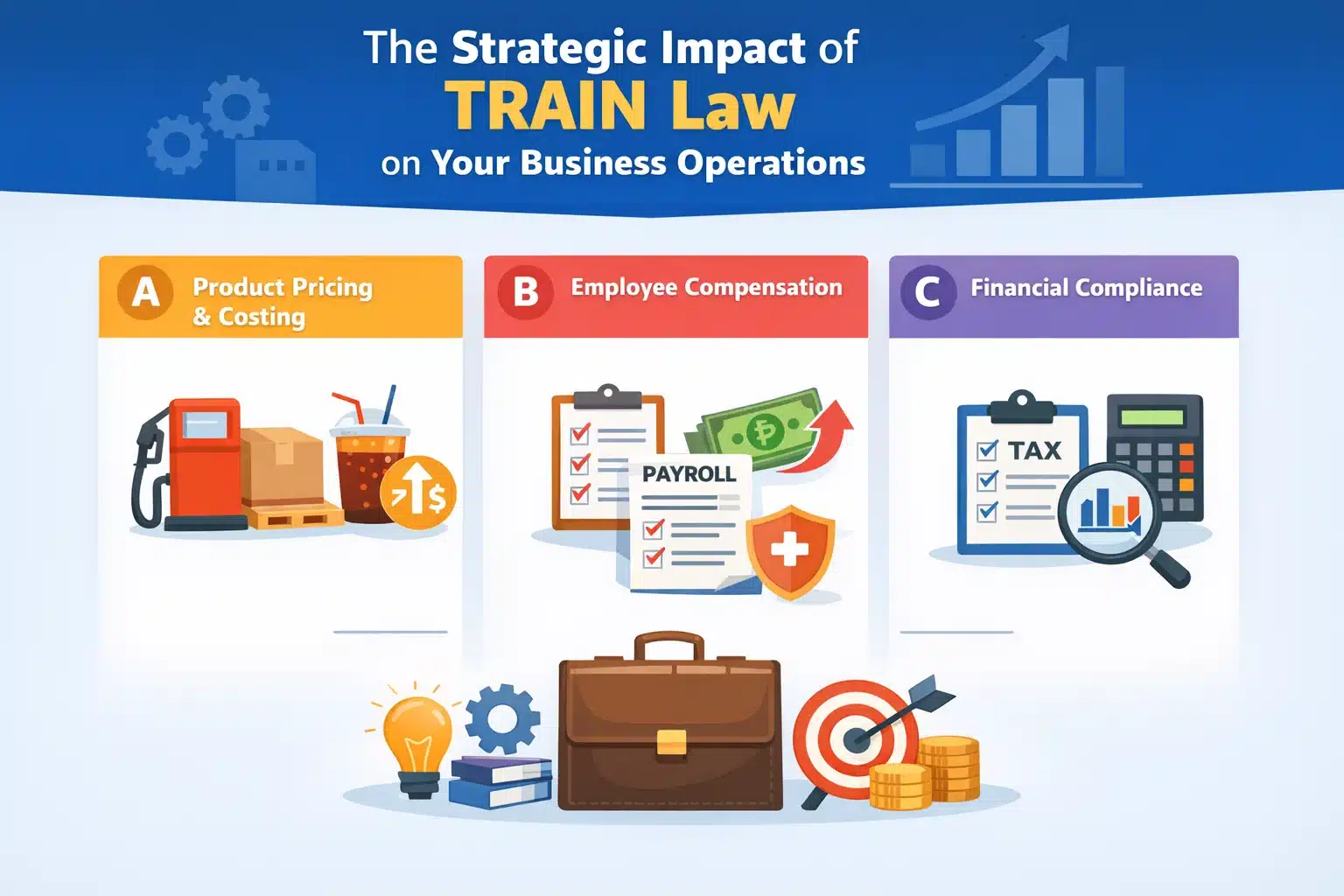
The TRAIN Law goes beyond compliance and directly influences pricing, budgeting, HR, and investment decisions. Adapting to these changes requires a holistic review of business processes to reduce risks and capture new opportunities.
From adjusting prices due to excise taxes to restructuring compensation after income tax reforms, businesses must take a forward-looking approach. The higher VAT threshold also gives SMEs a chance to streamline operations and improve cash flow.
A. Impact on product pricing and overall costing
The new excise taxes on fuel, sweetened beverages, and other goods have a direct impact on the cost of production and distribution, forcing many businesses to re-evaluate their pricing strategies.
Higher fuel costs affect logistics, manufacturing, and retail across the entire supply chain, from sourcing to delivery. Meanwhile, taxes on sweetened beverages force F&B businesses to absorb costs or raise prices, potentially impacting demand.
B. Changes in employee compensation and payroll management
The personal income tax overhaul increases employees’ take-home pay, which can improve morale and productivity, but it also requires updated payroll calculations under the new income tax rate table Philippines. It allows businesses to review compensation and optimize allowances.
C. Navigating new financial compliance and reporting standards
The TRAIN Law has intensified the need for meticulous record-keeping and accurate financial reporting to ensure compliance with the Bureau of Internal Revenue (BIR). With changes in VAT thresholds, the risk of errors and penalties has increased.
This environment underscores the importance of robust financial systems that can handle complex calculations and generate precise reports. Businesses must ensure their accounting teams are well-versed in the new regulations and that their processes.
How to Ensure Your Business is Compliant and Competitive Post-TRAIN
Adapting to the TRAIN Law is an ongoing process that goes beyond basic compliance. Businesses must integrate tax changes into core operations to stay efficient and competitive.
This shift has exposed the limits of manual and outdated processes. Using the right tools and strategies helps automate compliance, improve accuracy, and gain clearer financial visibility.
A. Conduct a comprehensive review of your financial processes
The first step to compliance is auditing financial processes affected by the TRAIN Law, including supply chain costs, pricing, and billing adjustments. This helps businesses understand the law’s financial impact, address gaps quickly, and prepare for regulatory audits.
B. Modernize your payroll and accounting systems
Manual payroll and accounting processes are highly susceptible to errors, a risk that is magnified by the complexities of the TRAIN Law. Modernizing these systems is no longer a luxury but a necessity for accurate and efficient compliance.
An automated payroll system can ensure correct withholding tax deductions based on the latest income tax tables, while the sophisticated accounting software can streamline the tracking and reporting of VAT and excise taxes.
C. Leverage technology for automated and accurate tax management
The complexity introduced by the TRAIN Law makes technology an indispensable ally for modern businesses. An integrated accounting system or Enterprise Resource Planning (ERP) software is designed to handle such complexities with ease.
For example, HashMicro’s Accounting Software automates tax calculations, including VAT and withholding taxes, directly within your financial digital workflow management, ensuring every transaction is recorded accurately according to current BIR regulations.
This technology provides a centralized platform for managing all financial data, from payables and receivables to general ledger management, generating compliant reports automatically, and simplifying the entire record-to-report process.

Conclusion
The TRAIN Law has reshaped the Philippine business environment by affecting taxation, costs, pricing, payroll, and financial compliance. For businesses, understanding the core provisions is essential to managing risk and making informed strategic decisions.
Adapting to the TRAIN Law requires a proactive approach that goes beyond meeting minimum compliance requirements. By aligning financial processes and payroll management with updated tax regulations, companies can improve efficiency while maintaining competitiveness.
To navigate these changes effectively, businesses should leverage modern financial tools that improve accuracy and control. Seeking expert guidance through a free consultation can also help organizations assess readiness and strengthen long-term financial resilience.
Frequently Asked Questions
-
What is the main goal of the TRAIN Law?
The primary goal of the TRAIN Law is to create a simpler, fairer, and more efficient tax system in the Philippines. It aims to generate revenue for government infrastructure and social services while providing tax relief to most Filipino taxpayers to boost their purchasing power.
-
Who benefits most from the TRAIN Law’s income tax changes?
Individuals earning an annual taxable income of ₱250,000 or less benefit the most, as they are now fully exempt from personal income tax. Middle-income earners also generally see higher take-home pay due to the restructured, lower tax rates.
-
How does the TRAIN Law affect freelancers and self-employed individuals?
Freelancers and self-employed individuals with gross sales under the ₱3 million VAT threshold can opt for a simplified 8% tax on gross earnings. This is in lieu of the graduated personal income tax rates and percentage tax, simplifying compliance for many small entrepreneurs.
-
Is the TRAIN Law still in effect today?
Yes, the TRAIN Law (RA 10963) is still in effect in 2026. It was designed with staggered implementation for certain components, like fuel excise taxes, and it continues to be the foundational tax code for personal income, VAT, and various excise taxes in the Philippines.