







Question. Which is more damaging for your construction site?
A) A packed storage, or
B) A crew sitting idle because there’s no supply onsite
That’s a common problem in the construction industry. A site manager must choose between sacrificing limited storage space or wasting the project’s budget. Both interrupt workflows, so it’s important that you understand site logistics.
Good site logistics make or break a project. To run a construction site smoothly, you must plan it thoroughly. In this article, we will explore site logistics and how to use it against worksite problems.
Key Takeaways
|
What is Site Logistics?
Site logistics is the resource planning side of project management. It deals with the handling of resources, such as goods and transportation, within a worksite. When handled with care, you are ensuring that your project is both on schedule and under budget.
No two sites are the same. They are influenced by the client, contractors, and the project itself. In order for a construction site to run smoothly, you must understand the basics of site logistics. A site logistics plan might work on a residential complex, but it won’t work on a high-rise apartment.
How to Mitigate Worksite Problems Using Site Logistics
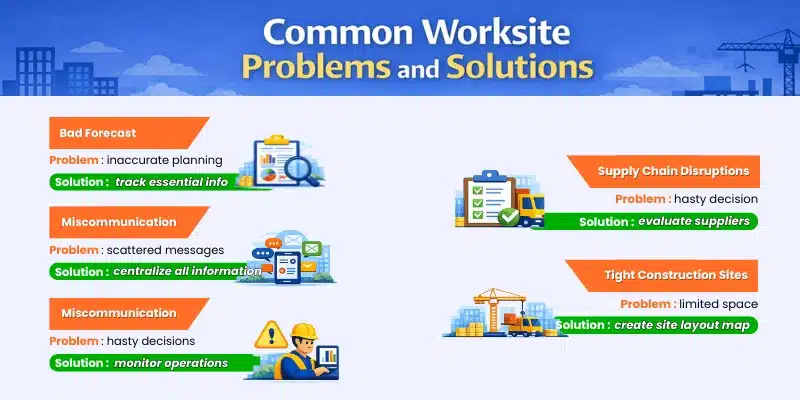
As stated above, site logistics are important in running a business. Even with the most thought-out plan, they are still vulnerable against a wide range of issues. Below are some ways site logistics lessen their effects, grouped by common worksite problems:
Bad Forecasts
Bad forecasts can catch people off guard. A single miscalculation could hurt your business’ reputation. Through site logistics, you can anticipate potential problems by tracking essential information. It lets you adjust the budget and schedule to mitigate worksite problems.
Miscommunication
Miscommunication causes conflict on worksites. It triggers workplace relationship problems and low morale. By using site logistics, you can improve communications and prevent miscommunications. A centralized communication channel helps you establish communication protocols and a chain of command.
Rash Decisions
Rash decisions put both projects and the people involved at risk. It compromises the safety of your workers and limits your business’s ability to change when needed. You can avoid this by using site logistics. A thought-out logistics plan helps you predict future demands, giving your company time to prepare.
Supply Chain Disruptions
Sudden supply shortages can shut down a project. As goods stop coming to the site, construction works are delayed and substandard materials are used instead. Site logistics give you early warnings about your suppliers. Through evaluating supplier’s performances, you can have a reliable supplier and backup inventory.
Tight Construction Sites
Urban construction sites must deal with the limited space given to them. In order to increase efficiency, you must organize the area properly. Site logistics help you manage resources by guiding you in creating a site layout plan. It reduces congestion and increases productivity through designating areas based on their purpose.
How Site Logistics Help with Regulatory Compliance
One overlooked benefit of site logistics is that it helps with following the rules. In the Philippines, the Construction Industry Authority of the Philippines oversees the construction industry through specialized boards, such as the Philippine Contractors Accreditation Board. They set the standard for construction work in that area. Below are some ways site logistics help with complying to the rules:
Resource Management
Presidential Decree No. 1096, also known as the National Building Code of the Philippines (NBCP) requires the use of quality materials in construction projects. It mandates that the quality of materials must comply with previously established regulations. If someone violates this law, the Building Official of that area will take action.
You can comply with these regulations with the help of a site logistics plan. Resource management helps you select the best supplier. Your material will meet quality standards and prior regulations if you use it to evaluate suppliers.
Safety Compliance
Republic Act No. 11058, An Act of Strengthening Compliance with Occupational Safety and Health Standards and Providing Penalties of Violations Thereof enforce safety in the industry. It requires businesses to make their jobsites safe. Contractors must implement a safety and health program, which includes an emergency preparedness and response plan.
You can ensure worker safety through implementing a site logistics plan. It helps with implementing safety measures such as establishing emergency response plans and evacuation routes to mitigate workplace risks. This way, you mitigate workplace hazards and risks.
Traffic Management
DPWH Department Order No. 135, Series 2015 demands compliance with the Road Safety & Traffic Management and Construction Safety and Health requirements. Contractors must set up warning signs and barricades while they work. They also have to minimize public inconveniences during construction.
By using a site logistics plan, you can comply with laws similar to the above. Traffic management keeps workers and pedestrians safe by coordinating traffic going in and out of the area. It ensures road safety by enforcing safety requirements.
Waste Management
Republic Act No. 9: Ecological Solid Waste Management Act of 2000 requires companies to reuse and recycle waste before disposal. It mandates that businesses implement a waste management program for categorizing and processing trash. It also prohibits businesses from open dumping and making open dumpsites.
Through site logistics, you can ensure compliance with waste management laws like this one. It helps you handle waste materials and reduce environmental damage caused by construction work. This means properly sorting and disposing of trash, which reduces recycling contamination.
How to Implement Technology in a Site Logistics Plan

Even if the above text didn’t mention it, you should incorporate technology into your site logistics plan. Advancements in technology have pushed the construction industry forward. Below are the steps to implement technology in site logistics, divided into three phases:
Pre-project
In the first phase, use technology to create your site logistics plan. You can use Construction Management Software to keep all information in one place. This helps planning and scheduling by providing real-time data. You can also use Building Information Modeling (BIM) to visualize your project’s design.
Project
After the pre-project phase, use technology to run the site smoothly. Management software, like Asset Management Software and Transportation Management System helps manage resources. Real-time communication tools facilitate communication between workers and prevent miscommunication.
Post-project
At the final phase, use logistics software in the demobilization process. Reverse Logistics Software helps you plan and coordinate the removal of resources from the jobsite. Document Management Software allows you to easily transfer documents to the client. All previously mentioned tools can also be used to make the process easier.
What Happens If You Don’t Implement Site Logistics?
Failing to implement a site logistics plan is a key to disaster. Your company won’t be able to adapt without a plan, leading to a domino effect. In order to illustrate this, imagine yourself as a general contractor who ignored site logistics and whose supplier just went bankrupt:
Delays
The first effect you’ll experience is constant delays. Your project can’t handle supply chain disruptions without a plan. When resources run out, your workers will have to wait for the next delivery. This could have been avoided if you had a backup supplier.
Cost Overrun
If you can’t find a new supplier and delays keep happening, you will go over budget. You’ll be forced to compromise on quality to meet the deadline. However, cutting corners can cause your client to panic and your workers to burn out, slowing down work.
Safety Hazard
When you cut corners, you put your workers at risk. They will be forced to work with poorly maintained equipment. They will also be forced to move around material as your storage is overfilled. This decreases productivity and workers’ morale.
Site Shutdown
After months of delays, you have to shut down your site. Your project is losing money because of it, but you couldn’t fix it quickly because you don’t have all the information needed. This forces you to use your small budget to fix it.
Reputational Damage
All these problems damage people’s perception of you. Nobody wants to work with someone who consistently misses the deadline and overspends, they want someone who is reliable. If this continues, your company won’t be able to secure new projects and could go bankrupt.
Conclusion
Site logistics play an important role in ensuring efficient work processes. By carefully planning workflows, they help minimize damages caused by worksite problems. You can boost workers’ productivity through a thought-out site layout.
You need to understand site logistics to address problems strategically. Construction managers and supervisors must take a proactive approach in managing the site to minimize losses once they occur.
FAQ About Site Logistics
-
How do I Make a Site Logistics Plan?
First, you need to define your project’s scope. Next, you evaluate the jobsite and available resources within it. After you gather this information, use it to make a logistics plan for your site. This plan should include designated areas and traffic control.
-
How do I Implement Site Logistics on a Construction Site?
You need to develop an initial plan for moving resources to their designated areas in the construction sites. After that, you start the new schedule and communication channels.
-
How do I Evaluate a Site Logistics Plan?
You use Key Performance Indicators (KPIs) to evaluate your site logistics plan. There are four types of industry-specific KPIs that you can use: cost-related KPIs, quality-related KPIs, safety-related KPIs, and time-related KPIs.