







Receiving a payslip can be disappointing. A gross salary promised in an employment contract often looks vastly different from the net amount deposited. This is called salary deduction, a reduction of any money from an employee’s gross pay before the final net pay is calculated and disbursed.
It serves as an important component of payroll management. Employees trying to manage their personal finances, HR professionals, and business owners who have to adhere to labor laws and tax regulations have to understand the concept.
Table of Contents
Key Takeaways
|
Understanding the Mechanics of Payroll Withholdings
To really understand salary deductions, it helps to first look at how a typical paycheck is structured. Payroll is essentially a step-by-step calculation that turns the salary or wages promised in an employment contract into the actual amount an employee takes home. Along the way, the process moves through several clear stages, and each stage involves its own types of earnings and deductions.
Gross Pay: The Starting Point
Gross pay is the full amount an employee earns during a pay period before any deductions are taken out. For salaried employees, it is usually figured out by dividing the annual salary by the number of pay periods in a year, such as 12 for monthly pay, 24 for semi-monthly pay, or 26 for bi-weekly pay.
For hourly workers, gross pay is calculated by multiplying the hours worked by the hourly rate. Even so, gross pay usually includes more than just a salary or hourly wages. It can also include several other types of earnings, such as:
- Overtime Pay: Compensation for hours worked beyond the standard workweek, often paid at a premium rate.
- Bonuses and Commissions: Performance-based incentives, sales commissions, or annual company bonuses.
- Allowances: Non-wage compensations provided for specific purposes, such as housing, transportation, or meal allowances.
- Paid Time Off (PTO): Compensation for vacation days, sick leave, or public holidays.
The Deduction Phase
After gross pay has been determined, the deduction stage begins. This is where payroll can become much more complicated. Deductions are not taken out all at once. Instead, they are applied in a certain order depending on how they affect taxes.
Some deductions come out before taxes are calculated (pre-tax), while others are taken out after taxes (post-tax). This difference matters because it has a direct impact on an employee’s taxable income and, in turn, the amount of tax they owe.
Net Pay: The Final Disbursement
After all required taxes, voluntary deductions, and any wage garnishments have been taken out of gross pay, what is left is the net pay. This is the employee’s take-home pay, meaning the actual amount deposited into their bank account or paid by check.
The main purpose of payroll administration is to calculate this amount correctly while making sure every deduction along the way is properly withheld, reported, and sent to the correct third parties, such as tax agencies, insurance companies, or retirement plan providers, on time and in compliance with the law.
Categorizing Types of Salary Deductions

Salary deductions usually fall into three main categories, based on where they come from and whether they are legally required: mandatory or statutory deductions, voluntary deductions, and involuntary deductions such as disciplinary or court-ordered payments. Understanding these categories is important for HR professionals so they can stay compliant, and it also helps employees better understand their financial responsibilities.
Mandatory or Statutory Deductions
Mandatory deductions are those required by federal, state, or local laws. Employers are legally obligated to calculate, deduct, and remit these amounts on behalf of their employees. Failure to comply with statutory deduction laws can result in severe financial penalties, audits, and legal action against the employer.
- Income Tax Withholdings: For most employees, income tax is one of the biggest mandatory deductions from their pay. Employers withhold part of an employee’s earnings on behalf of the government, based on factors such as income level, marital status, and the number of dependents claimed. This allows employees to pay their taxes gradually throughout the year instead of having to deal with a large tax bill at the end of the tax year.
- Social Security Contributions: In many countries, employees contribute to a national social insurance system that helps fund benefits such as retirement, disability, and survivor support. In the United States, this falls under FICA, or the Federal Insurance Contributions Act, where both the employer and the employee pay a fixed percentage of the employee’s earnings up to a certain wage limit. Similar programs exist in other countries as well, including National Insurance in the UK and the Employees Provident Fund in several Asian nations.
- Medicare or National Health Insurance: Alongside retirement benefits, statutory deductions often include contributions to national healthcare systems. These funds subsidize healthcare costs for the elderly, disabled, or the general population, depending on the country’s social infrastructure.
- State and Local Taxes: Depending on the geographical location of the employee and the business, there may be additional mandatory taxes levied by state, provincial, or municipal governments. These can include state income taxes, local city taxes, or specific state-mandated disability or unemployment insurance contributions.
Voluntary Deductions
Voluntary deductions require the explicit consent of the employee. These are typically associated with employer-sponsored benefit programs or personal financial initiatives. Because they are optional, employees can usually choose to opt-in, opt-out, or modify these deductions during specific enrollment periods or qualifying life events.
- Health and Welfare Premiums: Employees are frequently required to pay a portion of the health premiums, despite employers often subsidizing the cost. This employee’s share is deducted directly from their paycheck. These deductions are often made on a pre-tax basis, lowering the employee’s taxable income.
- Retirement Plan Contributions: Employees can choose to set aside part of their salary in a retirement savings plan, such as a 401(k) in the US, or the SSS and related retirement savings contributions in the Philippines. Employers often match a percentage of these contributions. Like health premiums, traditional retirement contributions are usually pre-tax, though options like Roth contributions are made post-tax.
- Flexible Spending Accounts (FSAs) and Health Savings Accounts (HSAs): Let employees set aside pre-tax dollars to cover eligible out-of-pocket medical expenses or dependent care costs.
- Life and Disability Insurance: Employees may opt to purchase additional life insurance or short/long-term disability coverage beyond what the employer provides as a baseline benefit. The premiums for these supplemental policies are deducted from their salary.
- Union Dues: In unionized workplaces, employees who are members of the labor union agree to have their union dues automatically deducted from their paychecks and remitted to the union organization.
- Commuter Benefits: Some companies offer programs where employees can pay for public transit passes or parking fees using pre-tax payroll deductions.
- Charitable Contributions: Employers may facilitate charitable giving by allowing employees to elect a specific amount to be deducted per pay period and donated to a designated charity or non-profit organization.
Involuntary and Court-Ordered Deductions
Involuntary deductions, often referred to as wage garnishments, are mandated by a court or government agency. Unlike statutory taxes, these apply only to specific individuals who have outstanding debts or legal obligations. Employers are legally bound to enforce these orders, and failure to do so can result in the employer becoming liable for the employee’s debt.
- Child Support and Alimony: The most common type of wage garnishment is for unpaid child support or spousal maintenance. Family courts issue orders directing the employer to withhold a specific amount from the employee’s disposable earnings to satisfy these domestic obligations.
- Tax Levies: If an employee owes back taxes to a federal or state government, the tax authority can issue a levy against their wages. The employer must deduct a significant portion of the employee’s pay until the tax debt is fully resolved.
- Creditor Garnishments: If an employee defaults on a consumer debt (such as a credit card, personal loan, or medical bill) and the creditor wins a judgment in court, the court can order the employer to garnish the employee’s wages to repay the creditor.
- Student Loan Default: Government agencies can garnish wages without a court order if an employee defaults on federal student loans.
- Bankruptcy Orders: If an employee files for Chapter 13 bankruptcy, a court may order the employer to deduct a specific amount from their paycheck to fund the bankruptcy repayment plan.
The Legal Framework Governing Payroll Deductions

The administration of a salary deduction is not a free-for-all; it is heavily regulated by labor laws designed to protect employees from exploitation and ensure fair compensation. HR departments must navigate a myriad of federal, state, and local regulations to maintain compliance.
The Principle of Written Consent
Payroll law is a foundational principle that exists in almost every jurisdiction. An employer cannot arbitrarily deduct money from an employee’s paycheck for the employer’s benefit without explicit, prior written consent. This rule is designed to prevent employers from unfairly passing the costs of doing business onto their workforce.
For example, if an employee accidentally breaks a piece of company equipment, the employer generally cannot deduct the cost of these losses from the employee’s wages unless the employee has signed a specific agreement acknowledging liability and authorizing the deduction. Even with an agreement, many jurisdictions strictly limit or entirely prohibit these types of deductions, viewing them as an inherent risk of running a business.
Minimum Wage Protections
Many countries have a minimum wage, like the USA under the Fair Labor Standards Act (FLSA). This is a critical legal boundary that prohibits certain types of deductions to reduce an employee’s net pay below the statutory minimum wage or cut into their required overtime premium.
For instance, if an employer requires employees to wear a specific uniform and deducts the cost of that uniform from their paycheck, that deduction is illegal if it causes the employee’s hourly rate for that pay period to drop below the minimum wage. This protection ensures that low-wage workers are not impoverished by mandatory employment costs.
The Rule of Non-Diminution of Benefits
Many labor frameworks recognize the principle of non-diminution of benefits. Under this rule, employers cannot unilaterally remove or reduce a benefit, allowance, or favorable practice once it has become an established employee right. For example, if a company has consistently provided a specific allowance on top of base salary, it cannot later reclassify that allowance as a salary deduction without risking legal disputes or even claims of constructive dismissal.
Garnishment Limits
When it comes to involuntary deductions, the law sets clear limits to protect employees from losing too much of their income. In the US, the Consumer Credit Protection Act (CCPA) caps how much an employer can garnish from an employee’s pay in a single week.
For ordinary creditor garnishments, employers can usually withhold up to 25% of disposable earnings, which means gross pay after legally required deductions. For child support or alimony, the limit can rise to 50% or 60% of disposable earnings, depending on the employee’s situation.
Step-by-Step Guide to Calculating Salary Deductions
Accuracy in payroll processing is paramount. A single miscalculation can trigger compliance issues, tax penalties, and employee dissatisfaction. The process of calculating a salary deduction follows a strict chronological order to ensure tax liabilities are assessed correctly.
Step 1: Calculate Total Gross Income
The first step is aggregating all forms of compensation earned during the pay period. This includes the base salary or hourly wages, overtime pay, shift differentials, bonuses, commissions, and taxable fringe benefits. The sum of these components is the Total Gross Income.
Step 2: Subtract Pre-Tax Deductions
Before any income taxes are calculated, pre-tax deductions must be subtracted from the Total Gross Income. Pre-tax deductions are highly beneficial to employees because they lower the individual’s taxable income, thereby reducing the amount of income tax they owe.
Common pre-tax deductions include:
- Traditional retirement contributions (e.g., 401(k), 403(b))
- Health, dental, and vision insurance premiums
- Contributions to Flexible Spending Accounts (FSAs) or Health Savings Accounts (HSAs)
- Commuter and transit benefits

Step 3: Calculate and Withhold Statutory Taxes
Once the taxable income is established, the employer must calculate the mandatory tax withholdings. This is often the most complex step, as tax rates are frequently progressive (meaning the rate increases as income increases) and depend on the employee’s personal tax profile (filing status, number of dependents, etc.).
The employer must calculate:
- Federal/National Income Tax based on current tax brackets.
- Social Security and Medicare (or equivalent national insurance programs). Note that some of these taxes may be calculated on the Total Gross Income rather than the Adjusted Gross Income, depending on specific national tax laws.
- State, provincial, or local income taxes.
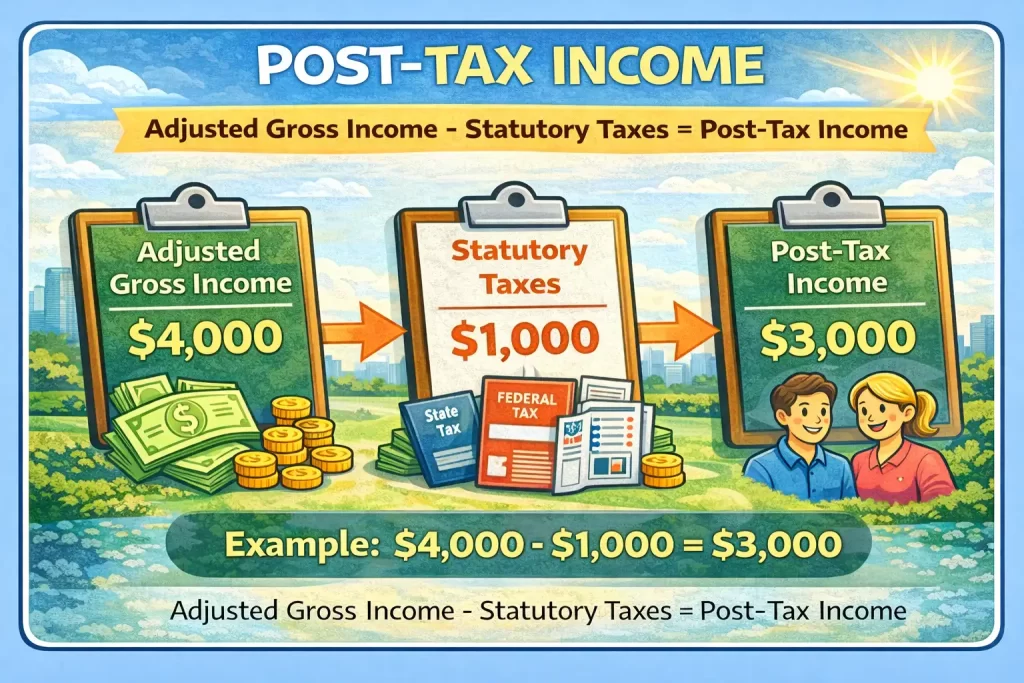
Step 4: Subtract Post-Tax Deductions
After all taxes have been withheld, the employer subtracts post-tax deductions. These deductions do not affect the employee’s taxable income; they are simply subtracted from the remaining balance.
Common post-tax deductions include:
- Roth retirement contributions (which are taxed upfront but grow tax-free).
- Union dues.
- Charitable contributions.
- Life insurance premiums (if not structured as pre-tax).
- Wage garnishments (child support, tax levies, creditor judgments).
Step 5: Arrive at Net Pay
The final result after all pre-tax deductions, statutory taxes, and post-tax deductions have been subtracted is the Net Pay. This is the amount that will be processed for direct deposit or printed on a physical paycheck.
Common Mistakes in Processing Salary Deductions

Payroll is an unforgiving discipline. The sheer volume of variables involved in calculating a salary deduction creates numerous opportunities for error. Identifying and avoiding these common pitfalls is essential for maintaining a healthy HR operation.
- Misclassifying pre-tax and post-tax deductions: Mixing up deduction types can cause tax errors. If a post-tax deduction is taken before tax, the employer may underpay taxes and face penalties. If a pre-tax deduction is treated as post-tax, the employee pays more tax than necessary.
- Failing to monitor garnishment limits and end dates: Employers need to track both legal garnishment caps and when the debt has been fully paid. Deducting too much, or continuing deductions after the balance is cleared, can create serious legal problems.
- Ignoring regional and local tax rules: Payroll should follow the tax laws where the employee actually works, not just where the company is based. This becomes more important with remote teams spread across different regions or countries.
- Lack of proper documentation and consent: Employers cannot make certain deductions, such as for damages, uniforms, or loan repayments, without clear written approval. Relying on verbal consent or vague policy language can lead to disputes and reimbursement claims.
The Impact of Deductions on Employee Experience
While HR and finance departments view a salary deduction as a mathematical and legal necessity, employees view it through a deeply personal and emotional lens. The way deductions are communicated and managed has a profound impact on the overall employee experience, financial wellness, and organizational trust.
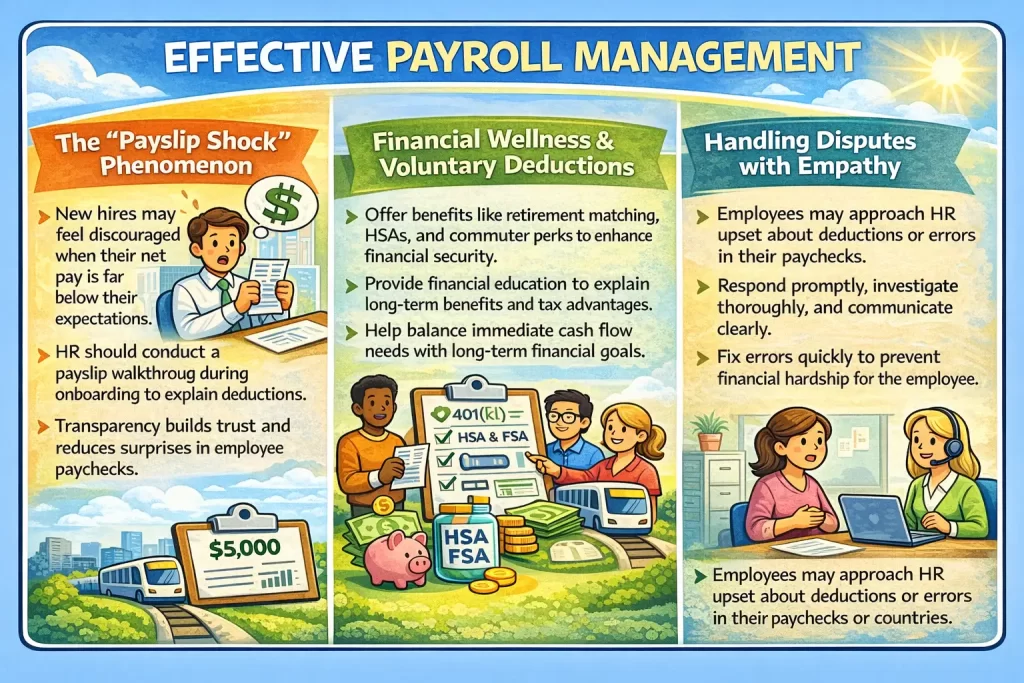
By applying these management methods, you will be able to deduct employee salaries without breaking their morale.
Best Practices for Employers Managing Payroll
To navigate the complexities of payroll withholdings successfully, organizations must adopt robust best practices that prioritize accuracy, compliance, and efficiency.
Conduct Regular Payroll Audits
A payroll audit is a comprehensive review of the company’s payroll processes to ensure accuracy and compliance. Audits should be conducted at least annually, or biannually for larger organizations. During an audit, HR and finance teams should:
- Reconcile the payroll register with the general ledger to ensure all funds are accounted for.
- Verify that all active employees are correctly classified (e.g., exempt vs. non-exempt, employee vs. independent contractor).
- Cross-reference benefit enrollment records with payroll deduction reports to ensure the amounts being withheld match the employee’s elected coverage levels.
- Review all active garnishment orders to ensure balances are accurate and limits are being respected.
- Ensure that written consent forms are on file for all voluntary and non-statutory deductions.
Establish Clear Company Policies
Ambiguity is the enemy of compliance. Organizations must have a comprehensive payroll policy documented in the employee handbook. This policy should clearly outline:
- The company’s pay schedule (when and how employees are paid).
- The procedures for reporting payroll errors.
- The company’s stance on advances, loans, and the subsequent recovery of those funds via payroll deductions.
- The process for returning company property upon termination and the legal limitations regarding deductions for unreturned items.
Leverage Advanced Technology
Using advanced Human Resource Management (HRM) systems can streamline the entire payroll process. These platforms automate the complex calculations required for both pre-tax and post-tax deductions, dynamically adjust to shifting tax brackets, and maintain meticulous digital records of employee consent forms. By centralizing employee data, time and attendance tracking, and benefits administration into a single ecosystem, automation drastically reduces the margin for human error.
Industry-Specific Use Cases for Salary Deductions

While standard tax withholdings apply universally across most sectors, various industries encounter highly specialized salary deduction scenarios tailored to their operational realities. Understanding these unique applications helps HR professionals maintain compliance within their specific niches.
Retail and Hospitality
In the retail and hospitality sectors, salary deductions often revolve around company property and operational shortages. Common withholdings include costs for mandatory uniforms, name tags, or specific safety gear. Employers must be careful with deducting an employee’s salary for the cost of uniforms or register shortages.
If the employee’s net pay gets below the statutory minimum wage, then there could be legal repercussions. Many retail chains instead utilize voluntary deduction agreements for employee purchase programs, allowing staff to buy merchandise at a discount and pay via structured payroll deductions.
Healthcare and Medical Services
The healthcare industry often handles complex voluntary deductions tied to professional requirements. Hospitals and clinics regularly deduct malpractice insurance premiums, continuing medical education (CME) contributions, and specialized credentialing fees through payroll. In addition, large healthcare networks often work with local transit providers to offer pre-tax commuter benefits, allowing them to deduct transit passes or parking fees directly from an employee’s gross pay before taxes are calculated.
Construction and Manufacturing
In the construction sector, payroll teams frequently deal with union dues, which require precise calculation based on collective bargaining agreements. Furthermore, employers may offer tools or equipment advances to new hires, recouping the costs through legally compliant installment deductions over several pay periods. Multi-state tax deductions are also common here, as crews often cross state lines for different projects, necessitating complex tax withholding allocations based on where the labor was physically performed.
Implementation Steps for a Compliant Deduction Strategy
Establishing a robust system for managing a salary deduction requires meticulous planning and execution. Organizations can follow these foundational steps to ensure accuracy, transparency, and legal compliance:
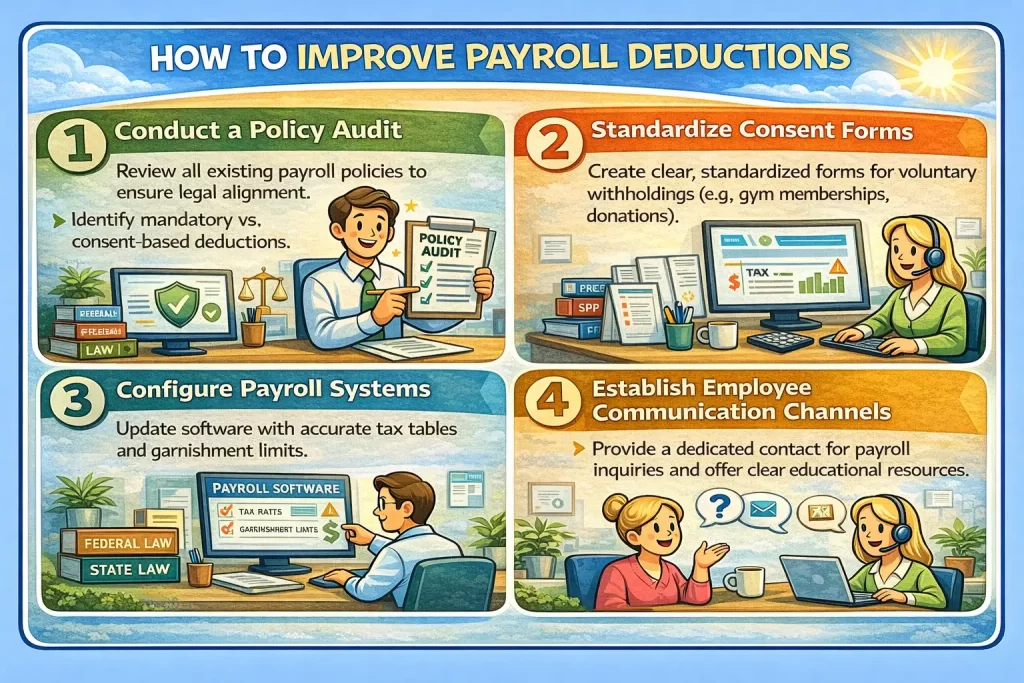
Advanced Practices in Payroll Deduction Management
As organizations grow, manual payroll processing starts creating more risk than value. Many companies now connect their HRIS with accounting and benefits platforms through APIs, so updates to health plans or retirement funds flow directly into payroll. This automation reduces manual entry, cuts delays, and helps HR teams avoid deduction errors that can lead to compliance issues.
Self-service employee portals also improve how companies manage deductions. Through secure dashboards, employees can update tax withholdings, adjust retirement contributions, or enroll in voluntary programs without waiting for HR to process every request manually. This gives employees more control over their net pay while reducing routine administrative work and making payroll processes feel more transparent.
Companies are also using salary deductions to support financial wellness. Some offer automatic emergency savings transfers, while others match employee payments for student loans or similar obligations. This approach changes the way employees view deductions. Instead of seeing them only as money taken away, they begin to see them as tools that support long-term stability, confidence, and retention.
Conclusion
Salary deduction is an integral part of payroll management. It is used when a business needs to deduct an employee’s gross salary for a multitude of reasons, some are decided by the employee themselves, others are decided by either the business or another third-party, like the government or union.
Salary deduction can bring both benefits and costs if a business is not cautious with how the apply salary deduction. From breaking labor law, miscalculating taxes, to demoralizing employees. A business must be cautious and be mindful of how they implement salary deduction with the help of advanced technology like HRIS software that can reduce human errors.
FAQ for Salary Deduction
-
Is 18,000 pesos salary taxable?
In most cases, no withholding income tax applies if an employee earns ₱18,000 per month from one employer and has no other taxable compensation that pushes annual taxable income above ₱250,000. However, the salary may still be subject to mandatory deductions such as SSS, PhilHealth, and Pag-IBIG contributions.
-
When can you deduct from salary?
Employers can deduct from salary only when the deduction is allowed by law or properly authorized under labor rules. Common examples include mandatory government contributions, withholding tax when applicable, union dues under valid authorization, and other deductions with the employee’s written consent where the employer does not benefit from the transaction.
-
Is deduction a refund?
No, a deduction is not a refund. A deduction is an amount taken from salary before the employee receives their pay, while a refund is money returned later, such as when too much tax was withheld.
-
Which deductions are allowed from salary?
Allowed salary deductions usually include withholding tax when applicable, employee contributions to SSS, PhilHealth, and Pag-IBIG, union dues under proper authorization, insurance premiums with the employee’s consent, and other deductions that the law or labor rules specifically allow.