






Table of Contents
Most organizations have felt the pain of a bad purchase unnecessary equipment, vendors chosen without budget checks, or duplicate orders. These mistakes usually don’t happen because employees are careless, but because there’s no clear checkpoint between “I need this” and “we’ve paid for it.” That checkpoint is the purchase requisition, and understanding it is essential for effective procurement and finance control.
This article breaks down what a purchase requisition actually is, why it matters far more than most organizations give it credit for, and how to build a process around it that genuinely helps rather than creates bureaucratic headaches whether you’re establishing the process for the first time or trying to fix one that’s already causing frustration.
Key Takeaways
|
The Real Purpose of This Form
 A purchase requisition is an internal request for approval before a purchase is made. It records what is needed, why it’s needed, the estimated cost, and who is requesting it, then moves through an approval process before any money is spent.
Although it seems simple, many organizations skip or rush this step because urgent needs make approvals feel like a delay. But bypassing the process is often when costly purchasing mistakes happen.
The real value of a purchase requisition isn’t the form itself, it’s the pause it creates. It forces employees to justify the need, link it to a budget, and get a second opinion. That moment of review helps prevent unnecessary spending, duplicate orders, and poorly timed purchases.
The Real Difference Between a Request and an Order
It’s worth being precise about terminology here because confusion between a purchase requisition and a purchase order is one of the most common sources of process breakdowns.
- Purchase requisition
is an internal document. It stays inside the organization. No vendor ever sees it. It is a request made by someone within the company to the procurement or finance team, asking for permission to make a purchase. The requisition does not commit the company to any spending. It is a proposal waiting for approval.
- Purchase order
Once a requisition is approved, the procurement team creates a purchase order and sends it to the selected vendor. The purchase order is a legally binding commitment when the vendor accepts it, both parties are obligated to follow through. The purchase order includes final pricing, delivery terms, and specific product or service details.
The sequence matters: requisition first, then approval, then purchase order. Organizations that skip or collapse these steps often find that spending happens before it’s been properly authorized, which makes financial reporting unreliable, budget control nearly impossible, and audits uncomfortable.
Who’s Involved and What Each Role Actually Decides
A purchase requisition typically involves several people, each with a distinct responsibility. Understanding who does what eliminates a lot of the confusion that causes delays in the process.
- The Requester
Is the employee or department manager who identifies a need. Their job is to provide enough detail for the approver to make an informed decision. This means specifying what they need, why they need it, when they need it by, and what they expect it to cost. Vague requests create back-and-forth that wastes everyone’s time.
- The Budget Owner or Department Head
Is usually the first approver. They check whether the request fits within the team’s allocated budget and whether it aligns with departmental priorities. In smaller organizations, this step might be handled by a single manager. In larger ones, there may be multiple levels of approval depending on the purchase amount.
- The Procurement Team
Takes over once a requisition is approved internally. Their role is to translate the approved request into an actual purchase finding the right vendor, negotiating terms if applicable, and generating the purchase order. In many organizations, procurement also plays a gatekeeping role, reviewing requisitions for compliance with company policies before they reach final approval.
- Finance or Accounts Payable
May be involved at the approval stage for larger purchases, particularly when the spend requires budget reallocation or has implications for cash flow. They’re also involved at the back end, matching the purchase order and the eventual invoice to ensure payment accuracy.
The clarity of these roles is what makes the process functional. When everyone knows what decision they’re responsible for and what decisions belong to someone else the process moves faster and produces better outcomes.
Not All Purchases Need the Same Approval
One common mistake companies make is treating every purchase the same way. Asking for the same paperwork and approvals for a $50 office supply order as for a $50,000 software contract doesn’t make the process safer it just makes it slower. Employees get frustrated, approvers get overwhelmed, and the process starts to feel like pointless bureaucracy instead of a helpful control.
A better approach is to use different levels of review. Small, routine purchases should be quick and simple to approve, while expensive or risky purchases should go through more careful checks. This keeps everyday buying fast and easy, while still protecting the company when the stakes are higher.
Setting Smart Limits So Small Purchases Don’t Get Stuck
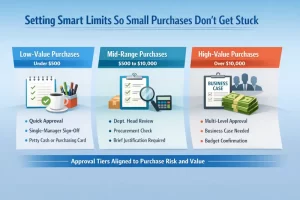 Spend limits are the basis of a tiered approval system. The exact amounts will differ by company based on its size, industry, and budget, but the idea is the same: small purchases should be approved quickly with very little review, while larger purchases should trigger more detailed checks and higher-level approval.
A common framework looks something like this:
- Low-value purchases (e.g., under $500):
A simple notification or single-manager approval is sufficient. These are typically routine items office supplies, minor tools, software subscriptions at the individual level. The risk of a bad decision is low, and the cost of a slow process is high. In some organizations, recurring low value purchases from pre-approved vendors are handled through a petty cash or purchasing card system entirely, bypassing the requisition process.
- Mid-range purchases (e.g., $500 to $10,000):
These warrant department head approval and a review by procurement for vendor selection. There should be some documentation of why this purchase is needed and some confirmation that it fits within the budget. A brief justification note alongside the requisition form is usually enough.
- High-value purchases (e.g., above $10,000):
These require multilevel approval typically department head, finance, and possibly a senior executive or committee depending on the company’s governance structure. There should be a formal business case, at least a preliminary comparison of vendor options, and explicit budget confirmation before anyone proceeds.
Setting these limits requires a conversation between procurement, finance, and leadership. They should reflect actual risk tolerance, not just convenience. And they should be reviewed periodically thresholds that made sense three years ago may be too tight or too loose given where the organization is today.
When a Quick Approval Is Enough vs When You Need the Full Process
Beyond spend limits, the type of purchase also determines how much review is needed. Some categories carry higher risk and deserve closer scrutiny regardless of cost. For example, IT purchases may require security or compliance review because even inexpensive software can create data or integration risks.
At the same time, low risk, recurring purchases can move faster. Standard supplies, subscriptions under existing agreements, and purchases from approved vendors can follow simplified paths without losing control.
The aim isn’t to make approvals stricter or looser overall, but to apply scrutiny where it prevents real problems and reduce it where it only adds friction.
How the Process Works (Without the Corporate Jargon)
Understanding the purchase requisition process in the abstract is one thing. Seeing it in motion is more useful. Here is a clear walkthrough of how the process should work from start to finish, without the corporate jargon that usually makes these descriptions impenetrable.
From “We Need This” to a Signed-Off Order
- Step 1: The need is identified
An employee recognizes that something is required a piece of equipment, a service, a subscription, materials. This might come from a project requirement, an inventory shortfall, or simply a team deciding they need a new tool to do their job better.
- Step 2: The requisition is submitted
The employee fills out a purchase requisition form. Good forms ask for: a description of what’s needed, the quantity, the estimated cost, the business justification, the required delivery date, and the budget or cost center to be charged. Some organizations also ask for vendor preferences or recommendations at this stage.
- Step 3: Initial review by the department manager
The manager reviews the request for legitimacy and fit within the team’s budget. They’re not evaluating vendor selection at this point that’s procurement’s job. They’re asking: Is this a real need? Is the timing right? Do we have the budget for it? Do I have the authority to approve this, or does it need to go higher?
- Step 4: Procurement review
Once internally approved, the requisition moves to procurement. The procurement team confirms that the request is complete and compliant with purchasing policies. They check whether an existing vendor relationship applies, whether competitive quotes are needed, and whether the request triggers any additional review requirements (e.g., IT security for software, legal for service contracts).
- Step 5: Finance or senior approval (if required)
For purchases above certain thresholds, finance reviews the request against budget availability and cash flow considerations. Senior leadership may approve large or strategically significant expenditures.
- Step 6: Purchase order creation
Once fully approved, procurement converts the requisition into a purchase order and sends it to the selected vendor. The purchase order is the formal commitment it specifies exactly what is being ordered, at what price, with what delivery expectations, and under what payment terms.
- Step 7: Receipt and matching
When the goods or services are delivered, the receiving party confirms receipt. Finance then performs a three way match comparing the original purchase order, the supplier’s invoice, and the receiving record before authorizing payment. Any discrepancies trigger a resolution process before payment is released.
This entire sequence, when it works well, provides a complete audit trail from the original need to the final payment. Every decision is documented, every authorization is traceable, and every invoice can be connected back to an approved business need.
Adapting the Process as Your Company Scales
The purchase requisition process that works for a 20vperson startup will not work for a 500 person company. And the one that works at 500 will need to evolve again as the organization grows further. Treating the process as a static set of rules rather than a living system is one of the most common reasons procurement workflows become dysfunctional as companies scale.
What Works for a 20 Person Team Won’t Work at 500
In a 20-person company, purchasing is simple. Everyone knows the budget, a founder or senior manager approves most requests, and a quick message is often enough to move forward.
As the company grows, that system breaks. Leaders can’t approve everything, managers spend without seeing what other teams are buying, and there’s no clear record of what’s already been committed.
By a few hundred employees, structure is no longer optional. Clear rules, defined approval levels, and a formal purchase requisition process become essential to keep spending visible and under control.
Deciding When It’s Time to Automate
Many organizations rely on email, spreadsheets, and paper forms for purchase requisitions longer than they should. This works at low volume, but as requests increase, problems appear: forms get lost, approvals are missed, there’s no clear view of request status, and reporting depends on manual data collection from multiple sources.
The decision to automate to move to a dedicated procurement or ERP system with built in workflow management should be based on a few clear signals:
- Volume
If the team is processing dozens of requisitions per week and manually tracking status, automation will pay for itself quickly in time saved and errors avoided.
- Visibility
If managers and finance teams regularly don’t know what’s been committed against their budgets, or if auditors struggle to trace spending decisions, the manual process has already become a liability.
- Bottlenecks
If approval delays are consistently causing project delays or forcing employees into workarounds, the process needs structural improvement that manual systems can’t provide.
- Growth rate
If the organization is growing rapidly, getting ahead of the automation need is far less disruptive than trying to implement it mid crisis. A company that automates its purchase requisition process at 150 employees will have a much smoother experience than one that waits until 400 employees are using a broken manual system.
Conclusion
A purchase requisition isn’t just paperwork. It’s the point where spending slows down long enough for someone to ask, “Do we really need this, and can we afford it?” When it works well, it helps avoid budget surprises, duplicate purchases, and rushed decisions, without getting in the way of everyday work.
The key is matching the process to the size of the company. What works for a small team won’t hold up as the organization grows. Clear rules, different approval levels, and eventually automation help keep spending visible and under control. The goal isn’t to add red tape, but to keep buying simple while protecting the company’s money.
FAQ About Purchase Requisitions
-
What is a purchase requisition and why is it important?
A purchase requisition is an internal document submitted by an employee or department to formally request approval before making a purchase. It captures what is needed, why it is needed, the estimated cost, and who is requesting it. It is important because it creates a structured checkpoint between identifying a need and spending company funds, preventing unauthorized purchases, duplicate orders, and budget overruns.
-
What is the difference between a purchase requisition and a purchase order?
A purchase requisition is an internal document that stays within the organization — no vendor ever sees it. It is a request for approval to make a purchase. A purchase order is an external document sent to a vendor after the requisition has been approved. The purchase order represents a legally binding commitment to buy specific goods or services at agreed terms. The correct sequence is: requisition first, then approval, then purchase order.
-
Who typically approves a purchase requisition?
Approval typically involves the requester’s department manager or budget owner as the first reviewer, followed by the procurement team who handles vendor compliance and policy checks, and finance or senior leadership for high-value purchases. The specific approval chain depends on the purchase amount, category, and the organization’s governance structure.
-
How long should a purchase requisition approval take?
For routine, low-value purchases, approval should ideally happen within one business day. Mid-range purchases may take two to three business days when additional review is needed. High-value or complex purchases requiring multi-level approval may take longer, but organizations should set clear service level agreements for each tier so requesters know what to expect and approvers are held accountable for timely decisions.
-
What happens if a purchase requisition is rejected?
A rejected purchase requisition should always come with a clear explanation from the approver — whether the budget is unavailable, the timing is wrong, the justification is insufficient, or the need can be addressed another way. Rejection should not be a dead end. It should either lead to a revised resubmission, a deferral to a future period, or a redirect to an existing resource that already covers the need.
-
Do all purchases require a formal purchase requisition?
Not necessarily. Most organizations establish spend thresholds and category rules that determine when a formal requisition is required. Very low-value or routine purchases from pre-approved vendors may be handled through a petty cash system or purchasing card without a formal requisition. The key is to define these exceptions clearly in policy so employees know exactly when the formal process applies.
-
When should a company automate its purchase requisition process?
Automation becomes worthwhile when the volume of requisitions is high enough that manual tracking creates errors or delays, when budget visibility is poor because commitments aren’t being captured in real time, when approval bottlenecks are regularly causing project delays, or when the organization is growing rapidly and manual processes cannot scale.
-
How can companies get employees to consistently follow the purchase requisition process?
The most effective approach is to make compliance easier than non-compliance. This means designing simple, intuitive forms that don’t take excessive time to complete, publishing clear guidelines on when a requisition is required, committing to fast approval turnaround times, and enforcing consistent consequences for unauthorized purchases. Training and communication also play a critical role, especially for new employees who may not be aware of the process.