






Product development rarely runs as smoothly as it looks on paper. You update a design file and assume the whole floor will follow. Then you notice production still uses the previous version, and procurement already confirmed materials based on last week’s specs. Nobody “messes up,” but progress still slows because your team keeps fixing small mismatches instead of pushing the build forward.
If you operate in fast moving manufacturing corridors around Metro Manila and CALABARZON, you feel this problem quicker. Volume magnifies everything. A small revision gap that used to cost you one meeting can now cost you a delayed run, excess materials, and a quality hold that nobody planned for.
When this happens repeatedly, the real issue usually is not capability. It is coordination. You can have strong engineers and disciplined supervisors, but if product data lives in scattered folders and spreadsheets, you end up chasing the “latest” version all week.
Key Takeaways
|
Table of Contents
How PLM Supports End-to-End Product Management
Managing a product from planning to discontinuation means you live with change. Specs evolve, components get substituted, cost assumptions shift, and documentation requirements tighten. If you run that flow manually, every update adds risk, because someone will eventually work from the wrong reference.
Product Lifecycle Management, or PLM, keeps specifications, bills of materials, revision history, and supporting records connected in one controlled flow. When you approve a change, you lock the reference and route it to the teams that need it. You stop relying on memory and messaging apps to keep everyone aligned.
This control matters even more if your products fall under regulated categories. Local FDA guidance requires certain establishments handling health products to secure a License to Operate, and your documentation discipline often shapes how smoothly licensing, audits, and verification run.
Here is the simplest test. If a customer asks why a component changed, can you explain what changed, when it changed, and who approved it without digging through a long email chain?
1. The Scope of Product Lifecycle Management
PLM covers everything tied to your product, from development to phase out, but you feel the biggest impact at the handoffs. Engineering revises a drawing, procurement already ordered materials, production already planned the run. If you cannot control that handoff, you create confusion even when everyone works hard.
This is also where local reality matters. MSMEs make up the vast majority of establishments, so most manufacturing teams run lean, with people wearing multiple hats. That setup works until the workload spikes and coordination turns into constant follow ups.
With a centralized lifecycle flow, you reduce the amount of manual chasing your team needs to do just to stay aligned. You protect focus. You protect time. You also protect your ability to scale without turning every revision into a fire drill.
2. Distinguishing PLM from the Product Life Cycle Model
The Product Life Cycle model tells you what happens to a product in the market, introduction, growth, maturity, decline. PLM focuses on what happens inside your operation. It governs how you design, revise, document, and produce consistently.
PLC helps you decide how to respond to market conditions. PLM helps you keep internal decisions stable while you respond. That difference matters when you increase SKU count, take on stricter customer requirements, or push into channels that demand stronger documentation.
3. The Role of PLM in Maintaining Operational Consistency
Most lifecycle problems do not arrive as one big failure. They show up as friction. Approvals slow down because nobody feels sure the document is final. Production pauses to reconfirm drawings. Procurement rechecks specs because they do not want to buy the wrong thing.
PLM reduces that friction because you record change once, define who approves it, and keep everyone on the same reference. You do not need constant manual confirmation.
This also supports standards and compliance work. Local marking and labeling requirements connect to national standards, and the Bureau of Philippine Standards under DTI sits at the center of standards development and implementation. For certain products, you deal with mandatory certification requirements, so controlled documentation and traceable change history help you avoid unnecessary compliance delays.
You also cannot ignore practical constraints. Digital readiness varies across sites, and connectivity challenges outside major business centers can make manual coordination slower and more error prone. A controlled system helps because you spend less effort reconciling versions across teams and locations.
Four Core Phases in Product Lifecycle Management

Every product goes through phases that shape how you design, manufacture, maintain, and discontinue it. The biggest risk is not the phase itself. The risk sits between phases, when information moves and versions diverge. PLM helps you keep decisions connected so those transitions stay clean.
1. Introduction – Concept and Development
In the early phase, you define specifications, choose materials, build prototypes, and revise quickly. This stage feels flexible, but it quietly sets the rules production will live with later.
If you do not document revisions properly now, you will pay for it during scale up. A quick check helps. Can you point to the approved BOM and the latest drawing without asking three people and opening five folders? If not, your lifecycle visibility already leaks.
2. Growth – Production and Market Expansion
As demand grows, volume magnifies mistakes. A small mismatch that used to cost you a short delay can now cost you material waste, overtime, and missed delivery dates.
Growth is also when you feel the gap between “engineering updated it” and “operations absorbed it.” If procurement and production planning do not adjust with design changes, you start seeing rushed revisions and last minute schedule reshuffles.
If you already run manufacturing ERP software that connects purchasing, production, inventory, and costing, you can align lifecycle approval with operational execution more easily because your teams do not rebuild plans from scratch every time. Manufacturing ERP software for production planning.
3. Maturity – Efficiency and Refinement
In maturity, you focus on efficiency. You care about stable yields, predictable costs, lower scrap, and fewer reworks. This is where PLM helps you build a credible ROI story, not a vague promise.
A practical way to estimate value is to quantify what you currently lose to lifecycle friction. You can measure the hours engineering spends validating versions, the number of rework cycles per month, the scrap tied to spec mismatches, and the time QA spends reconstructing traceability during checks. When those numbers fall, your ROI becomes real.
As a rule of thumb, most teams see clear operational stabilization within 12 to 24 months, depending on data cleanliness, training readiness, and whether you integrate lifecycle control with execution systems. Treat this as a planning range, not a guarantee, because your starting point drives the timeline.
4. Decline – Controlled Phase Out
When demand declines, discipline still matters. You manage inventory carefully, maintain documentation, and preserve traceability for support and warranty needs.
Clean lifecycle records help you avoid overbuying materials and losing track of which revision went into which batch. Even in phase out, good control protects margin and keeps operations calm.
Operational Breakdown Without Structured Lifecycle Control
When lifecycle control weakens, coordination breaks in predictable ways. Engineering updates a file, production follows an earlier document, procurement orders based on outdated specs. The issue is not missing information. The issue is misaligned information.
When Product Data Becomes a Business Risk
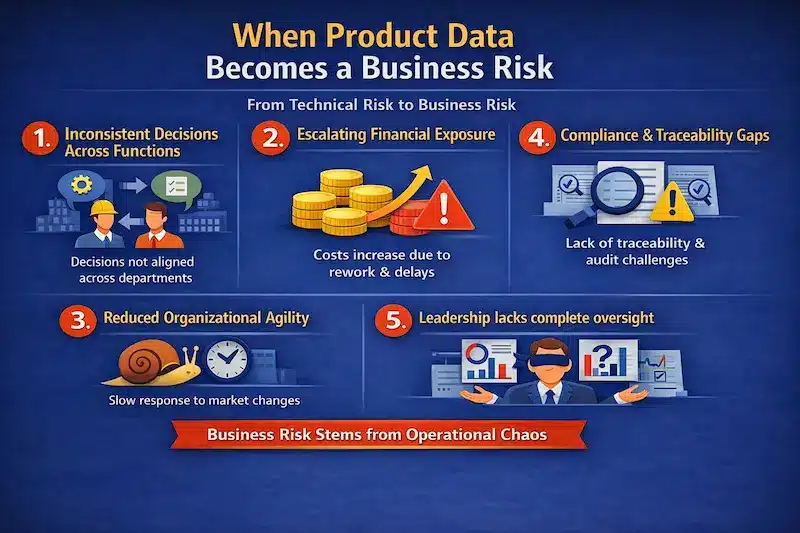
When product data fragments, the risk stops being technical. It becomes commercial. You lose cost stability because rework creeps in. You lose agility because every update triggers manual coordination. You lose confidence in reporting because your numbers do not reflect the latest technical reality.
Cost is where leaders usually pause, so let’s keep it practical. A realistic implementation budget often breaks into three parts: the system and setup, master data cleanup for items, BOMs, and revision rules, and training plus change management. In PHP terms, many mid-sized manufacturing rollouts land somewhere between PHP 800,000 and PHP 2,500,000 depending on scope, number of users, and integration of Dell park for planning, because data readiness creates the biggest swing.
ROI usually comes faster from operational savings than from anything else. The quickest wins tend to be fewer reworks, fewer procurement mistakes, and shorter approval cycles. If you reduce scrap even slightly and cut repeated clarification loops, the savings add up quietly and consistently.
1. Inconsistent Decisions Across Functions
When each function works from a different reference, decisions stop lining up. You approve a change in engineering, but your production schedule still runs on the old version. Procurement locks supplier commitments based on outdated specifications. QA checks the wrong revision. You then spend time fixing decisions that never should have diverged in the first place. PLM helps you turn “approved” into a shared operational truth, not just a technical status.
2. Escalating Financial Exposure
Financial exposure rarely appears as one dramatic incident. It shows up as repeated small corrections: rework labor, scrap material, expedited shipping, retesting, and schedule changes.
If you want a fast diagnostic, ask yourself five questions in one sitting. Can you trace every revision quickly? Does procurement see approved changes immediately? Can you produce audit ready records without compiling from multiple sources? Do production and engineering share the same BOM structure? Can you tie each revision to affected batches? If you struggle with more than two, your lifecycle control still relies heavily on manual effort.
3. Reduced Organizational Agility
Agility is not about moving fast once. It is about moving fast repeatedly without breaking alignment.
If every adjustment requires manual coordination, response time slows. This challenge feels sharper when your workforce shows uneven digital familiarity and you operate across sites with different levels of infrastructure. National and development programs have highlighted connectivity gaps and the need to strengthen digital capability, especially for smaller businesses.
A structured lifecycle flow helps because you reduce dependencies on ad hoc coordination, not because you add more steps.
4. Compliance and Traceability Gaps
If your product category requires registration or mandatory certification, traceability gaps create avoidable risk.
Local standards and labeling requirements tie back to national standards, and DTI related certification and marking frameworks depend on clear documentation and controlled product records.
For regulated health products, FDA requirements for a License to Operate raise the bar for documentation discipline. When you keep a clean change history, you reduce friction during audits and verification.
5. Leadership Without Full Visibility
You can review output and sales figures and still miss the technical shifts behind them. If data does not connect, you make strategic decisions in partial context. Better lifecycle visibility does not replace judgment, but it gives your judgment stronger ground.
Aligning Product Development and Operations Through ERP
PLM governs design truth. ERP governs execution truth. When those truths drift apart, you pay for it through duplicated work and mismatched references.
If you compare three approaches, the trade offs become clear. Manual lifecycle management can work when product complexity stays low and revisions remain rare, but it breaks once changes become frequent. Standalone PLM tightens engineering control, but operations can still lag if execution systems do not absorb updates quickly. PLM aligned with ERP reduces duplicate data entry and cuts the risk of two competing sources of truth.
If you need another natural internal link, you can reference this once where it fits your sentence flow. Integrated ERP system for manufacturing operations.
Building a Connected Digital Foundation for Product Governance
A realistic implementation timeline often looks like this. You start by mapping workflows and defining revision rules. Next, you clean core master data and set roles and approvals. Then you pilot on one product line and train users using real scenarios, not generic demos. Finally, you stabilize, fix gaps, and decide whether to deepen integration with ERP.
Most teams can complete a disciplined rollout in about 8 to 12 weeks, but only if they protect time for data cleanup and training.
Three mistakes usually trigger early failure. You roll out without training the people who run the daily process. You migrate messy data as is and blame the system when outputs look wrong. You skip integration planning and end up maintaining two sources of truth.
One more local consideration helps you make the decision feel grounded. BOI publishes investment priority frameworks that identify activities that may qualify for incentives, so many manufacturers naturally link tech adoption plans to broader investment planning. You do not need to chase incentives to justify governance, but it helps to recognize how factories plan capex in the real world.
If you want a final internal link that supports deeper reading without forcing SEO language, this anchor usually blends well inside a paragraph about learning and alignment. Product lifecycle management guide for manufacturers.
Conclusion
Product lifecycle management does not end when development wraps up. Your real stability shows up in how you control data, changes, and handoffs across teams. When information lives in scattered folders and disconnected files, small technical slips start turning into business risk, slower runs, higher costs, and messy decisions.
A structured lifecycle flow keeps development and execution on the same reference, so planning stays accurate and your team stops spending hours reconciling versions. It also helps you stay ready when standards and verification come up, especially when documentation discipline matters for DTI related certification and marking, or when FDA requirements raise the bar for records and change history.
Frequently Asked Questions
-
What is the first step to start a PLM implementation?
PLM is how you keep product data and change decisions connected from idea to production and eventual phase out, so your team stops guessing which file is “final.” You use it to keep specs, BOM, revisions, and approvals on one reference, especially when changes keep coming.
-
What is the difference between PLM and the product life cycle (PLC)?
PLC describes what happens to a product in the market: introduction, growth, maturity, and decline. PLM focuses on what happens inside your operation: how you design, revise, document, and produce consistently while the market keeps moving.
-
Why do small version gaps turn into business risk so quickly?
Because the risk stops being “just technical” once rework creeps in. You start losing cost stability, agility, and confidence in reporting when every update triggers manual coordination and fixes.
{
“@context”: “https://schema.org”,
“@type”: “FAQPage”,
“mainEntity”: [{
“@type”: “Question”,
“name”: “What is the first step to start a PLM implementation?”,
“acceptedAnswer”: {
“@type”: “Answer”,
“text”: “The first step is to conduct a thorough internal assessment of your current product development processes. This analysis helps identify weaknesses and define specific goals you want to achieve with PLM.”
}
},{
“@type”: “Question”,
“name”: “Is PLM only suitable for large manufacturing companies?”,
“acceptedAnswer”: {
“@type”: “Answer”,
“text”: “No. While initially adopted by large corporations, modern cloud-based PLM solutions are now affordable and scalable for small and medium-sized businesses (SMBs), helping them compete effectively.”
}
},{
“@type”: “Question”,
“name”: “Which industries benefit most from PLM?”,
“acceptedAnswer”: {
“@type”: “Answer”,
“text”: “Nearly any industry that develops physical products benefits from PLM. Key industries include automotive, aerospace, electronics, consumer goods, medical devices, pharmaceuticals, and increasingly, fashion and retail.”
}
},{
“@type”: “Question”,
“name”: “How can PLM support sustainability initiatives?”,
“acceptedAnswer”: {
“@type”: “Answer”,
“text”: “PLM supports sustainability by tracking material usage, ensuring compliance with environmental regulations like RoHS, and analyzing a product’s carbon footprint. This enables companies to design eco-friendly products and plan for end-of-life recycling.”
}
},{
“@type”: “Question”,
“name”: “How long does a PLM system implementation take?”,
“acceptedAnswer”: {
“@type”: “Answer”,
“text”: “The duration varies based on business complexity and the scope of implementation. It can range from a few months for a basic, single-department setup to over a year for a full-scale, multi-department enterprise implementation.”
}
}]
}