







Philippine businesses in 2026 now are under mounting financial pressure from inflation, peso volatility, and rising logistics costs across the archipelago. As a result, operational cost reduction has shifted into a core discipline that can determines which companies grow and which ones stall.
For most Philippine business owners, the electricity bill was always just another fixed line item. That changed when rolling brownouts returned across Luzon, Visayas, and Mindanao, and power rates began climbing to some of the highest levels in Southeast Asia. Suddenly, it became a live operational risk. The energy crisis did not just raise one number on a spreadsheet. It triggered a chain reaction across every major cost category in the business.
This article breaks down which cost categories are most exposed to energy-related pressure in the Philippines, how to track those costs before they become a crisis, and the specific role accounting software plays in giving finance teams the speed and clarity they need to respond.
Key Takeaways
|
Table of Contents

Why the Energy Crisis Directly Raises Operational Costs

The Philippines has long carried some of the highest electricity rates in Asia, driven by the country’s heavy dependence on imported fossil fuels and the structural inefficiencies of distributing power across more than 7,000 islands. When global oil prices spike or domestic supply constraints tighten, the cost impact lands directly and immediately on Philippine businesses through higher per-kilowatt-hour rates, demand surcharges, and power interruptions that force companies to run expensive diesel generators as backup.
What makes this particularly damaging is the compounding effect. A manufacturer running generators during a brownout is not just paying more for electricity, it is paying overtime to workers who cannot complete their shifts on schedule, absorbing spoilage costs from interrupted cold chain processes, and potentially missing delivery commitments that trigger penalty clauses with buyers.
Cost Categories Most Impacted by the Energy Crisis in the Philippines
| Cost Category | Impact of the Energy Crisis in the Philippines |
| Utilities and Facility Overhead | Rising electricity rates, especially in areas like Meralco’s territory, can drive power costs to 25% of total overhead. Unreliable supply also adds unexpected generator fuel expenses. |
| Logistics and Cold Chain | Fluctuating global oil prices increase last-mile delivery costs. For food and pharma businesses, even brief power interruptions can cause inventory spoilage and disposal fees. |
| Manufacturing and Labor Efficiency | Brownouts create idle labor costs when workers remain on the clock without output. Recovering lost production often leads to overtime expenses and expedited shipping penalties. |
| IT and Data Operations | Maintaining uptime during outages requires costly UPS and backup systems. On-premise businesses risk data blackouts, while cloud-based firms can maintain access despite local power disruptions. |
| Remote Work Infrastructure | Shifting to hybrid work to reduce office utility costs introduces hidden expenses, including subsidies for home internet, mobile data, and hardware provisions for staff. |
How to Track Energy-Related Costs in Real Time
The core problem for most Philippine businesses is not that energy costs are rising, it is that the full financial impact only becomes visible weeks after the fact when reviewed. By then, the opportunity to intervene has passed. Real-time cost tracking changes this by giving operations and finance teams a live view of where money is going, as it happens.
-
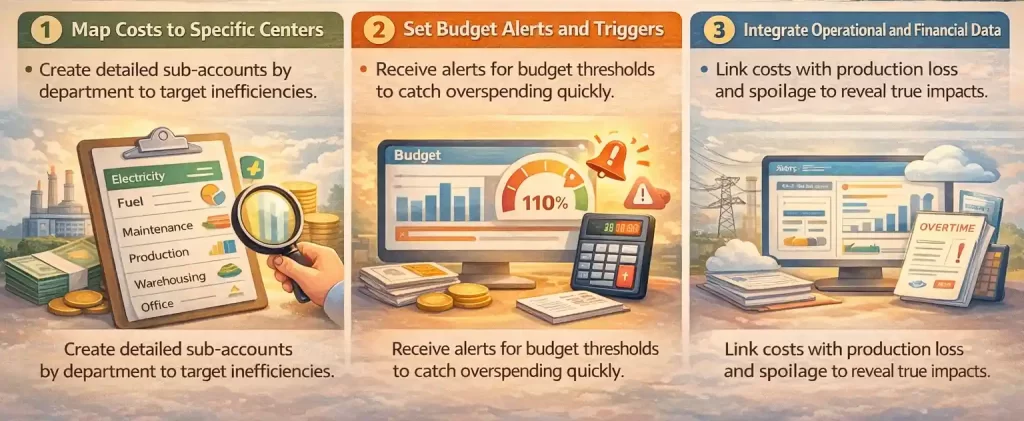
Map Costs to Specific Centers: Move beyond a generic “utilities” bucket. Create sub-accounts for electricity, fuel, and maintenance per department or production line. This granularity identifies which specific areas need urgent efficiency upgrades or solar investment.
-
Set Budget Alerts and Triggers: Use automated alerts that trigger when spending hits a threshold (e.g., 110% of budget). This allows for immediate intervention during the month rather than waiting for a post-mortem report when it’s too late to save costs.
-
Integrate Operational and Financial Data: Link utility bills with data on production losses, overtime, and spoilage. A unified platform calculates the “true total cost” of energy disruptions, providing the evidence needed for long-term investments like backup power or process redesign.
The Role of Accounting Software in Managing Energy-Driven Cost Pressure

When energy costs are volatile and operational impacts are spreading across multiple departments simultaneously, the finance team’s ability to respond depends entirely on the quality and speed of the data they are working with. This is where the right accounting software shifts from a back-office convenience to a genuine operational advantage.
-
Real-Time Financial Dashboards: Provides a live view of budget variances and cash positions. This allows leaders to detect cost spikes like excessive generator fuel spend by mid-month and take corrective action before the damage accumulates.
-
Automated Expense Categorization: Automatically assigns new energy-related costs (fuel, subsidies, maintenance) to the correct departments. This eliminates manual errors and ensures clean, auditable records for both internal decisions and tax compliance.
-
Scenario Planning and Forecasting: Enables businesses to model the financial impact of potential risks, such as a 10% rate hike or typhoon-season outages. Proactive modeling turns unplanned shocks into manageable budget contingencies.
-
Multi-Branch Consolidation: Centralizes financial data from different locations in real time. This helps head offices identify which specific branches are most exposed to local power issues and compare energy efficiency across the entire organization.
Practical Steps for Philippine Businesses to Take Now
The energy situation in the Philippines is unlikely to resolve quickly. Rate increases, supply volatility, and the ongoing challenge of grid stability across the archipelago mean that energy-related operational cost pressure is a structural feature of doing business locally. The businesses that manage this well in 2026 and beyond will be those that treat energy cost management as a continuous operational discipline, not an emergency response.
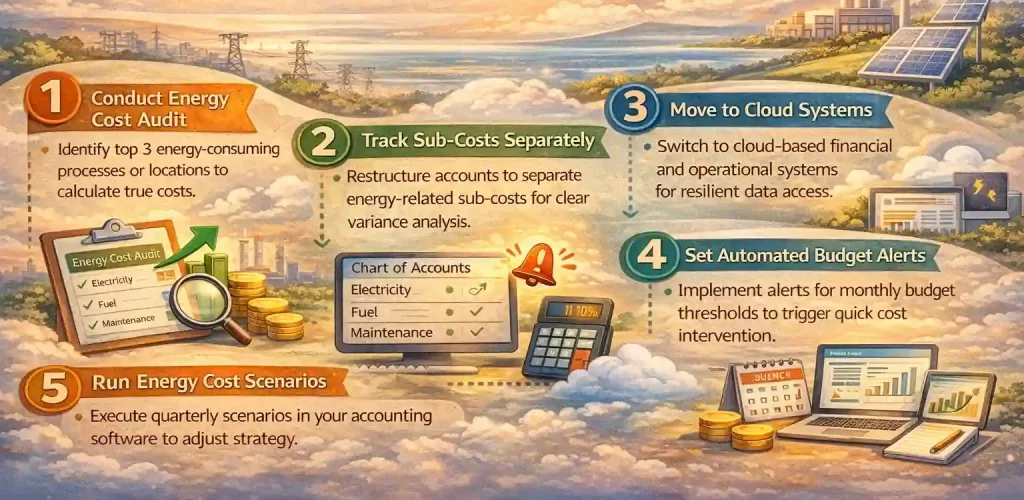
- Conduct an energy cost audit across all facilities by identifying your top three energy-consuming processes or locations and calculate their true total cost, including secondary impacts like overtime and spoilage.
- Restructure your chart of accounts to track energy-related sub-costs separately, so variance analysis is actionable rather than averaged into a broad utility category.
- Move to cloud-based financial and operational systems to eliminate the vulnerability of on-premise data access during power interruptions.
- Set monthly budget thresholds with automated alerts so your finance team can intervene mid-month rather than reporting on damage at month-end.
- Run quarterly energy cost scenarios in your accounting software to build reserve provisions and adjust pricing or procurement plans before rate increases compress margins.
Conclusion
The Philippines energy crisis has made one thing clear: operational cost management can no longer rely on monthly reports and annual budget reviews. The speed of cost escalation spreading from utility bills through logistics, labor, and IT in a matter of days requires real-time visibility and a finance function equipped to act on that data immediately. Accounting software is not the only answer, but for most Philippine businesses, it is the most accessible starting point for building that capability.
Businesses that take energy cost pressure seriously will carry a structural cost advantage over competitors still managing their finances through spreadsheets and monthly closes. For a broader view of the tools available to support this, it is worth exploring what the best accounting software options in the Philippines offer for real-time cost management, multi-branch consolidation, and BIR compliance in 2026.
Frequently Asked Questions Around Operational Cost Reduction
-
What is operational cost reduction in business?
Operational cost reduction is the process of lowering day-to-day business expenses without hurting output, quality, or customer service. For Philippine businesses, this often means improving how teams manage labor, utilities, inventory, transport, and manual admin work.
-
Why is reducing operational costs important for growing companies?
Reducing operational costs helps businesses protect margins when expenses like electricity, fuel, rent, and wages become harder to control. It also gives management more room to invest in expansion, better systems, and stronger service delivery.
-
Can automation help reduce operational costs for Philippine businesses?
Yes, automation can lower costs by reducing manual errors, cutting processing time, and helping teams work more efficiently across departments. This is especially useful for businesses that deal with frequent transactions, recurring paperwork, or operational delays that slowly increase monthly expenses.
-
How can businesses improve operational efficiency and reduce costs at the same time?
Companies can do this by removing duplicate tasks, automating routine processes, and using real-time data to make faster decisions. In practice, this may include better inventory tracking, digital approvals, automated reporting, and tighter control over overhead spending.