







What keeps your cash flow healthy while also maintaining strong customer relationships? Have you ever thought about how much your billing process affects both revenue collection and customer satisfaction? When billing is slow, confusing, or error-prone, it doesn’t just delay payments, it can weaken trust and damage the relationships you’ve worked hard to build.
Well, the answer lies in what’s called the customer billing cycle. This is the structured process businesses use to calculate charges, issue invoices, and collect payments within a set time frame. When managed properly, it ensures timely revenue, smoother operations, and a transparent experience for customers.
In this article, you’ll learn everything you need to know about the customer billing cycle, from its basic definition and common types to how automation can help you streamline billing and drive sustainable business growth.
Key Takeaways
|
Table of Contents
What is a Customer Billing Cycle?
A customer billing cycle is the recurring time frame in which a business calculates charges, issues invoices, and sets payment deadlines for its customers. It defines how often customers are billed such as monthly, quarterly, or annually and ensures revenue is collected in a predictable and organized way.
More than just sending bills, an effective billing cycle includes key dates like the billing period, invoice date, and due date. When managed clearly and consistently, it prevents confusion, speeds up payments, and supports healthy cash flow and strong customer relationships.
Core Components of a Billing Cycle
To run a billing cycle effectively, it’s essential to understand each component that makes it up. Every element plays a specific role in ensuring the process runs smoothly, from recording transactions to receiving payments. By breaking down the cycle into its smaller parts, you can identify which areas require more attention and have the potential for optimization.
The following are the core components that are mandatory in every customer billing cycle and need to be managed carefully. Understanding the function of each will help you design a billing workflow that is not only efficient for your internal team but also easy for your customers to understand.
1. Billing period
The billing period is the specific duration in which transactions, service usage, or product purchases are recorded before an invoice is created. This time frame can vary, for example, from the 1st to the 30th of each month for a monthly cycle. Establishing a clear and consistent period is crucial as it forms the basis for all calculations that will appear on the customer’s invoice. Without a well-defined period, it becomes difficult to track usage and ensure billing accuracy, which can lead to disputes with customers.
2. Statement date
The statement date, also often called the invoice date, is the day the bill is officially generated and sent to the customer. This date usually falls a few days after the billing period ends to give the system time to process all the collected transaction data. The speed and accuracy in issuing the statement greatly influence the customer’s perception of your company’s professionalism and give them enough time to review the bill before the due date.
3. Payment due date
The payment due date is the final deadline for the customer to make a payment without incurring late fees or interest. The interval between the statement date and the due date should be reasonable, typically between 15 to 30 days, to provide flexibility to the customer. Setting a clear due date and communicating it firmly on every invoice is a crucial practice for accelerating cash receipts and managing payment expectations.
4. Grace period
A grace period is an additional period after the due date during which a customer can still make a payment without penalty. Although not all businesses offer one, providing a short grace period (e.g., 3-5 days) can be a good policy for maintaining relationships with customers who may experience a slight delay. However, this policy must be clearly stated in the terms and conditions of service to prevent abuse and ensure fairness for all customers.
Why Optimizing the Billing Cycle is Crucial for Your Business
Many businesses view the billing cycle as a routine administrative task, but its role is far more strategic. How you manage your billing cycle has a direct impact on your financial health, operational efficiency, and customer loyalty. Optimizing this process is no longer an option but a necessity to compete and grow in a fast-changing market dynamic.
By designing a structured and efficient billing cycle, a company can unlock various strategic benefits. From strengthening its financial foundation to building more solid customer relationships, every improvement in this process will have a significant positive impact. Here are the main reasons why you should prioritize optimizing your customer billing cycle.
1. Enhances cash flow predictability
A consistent and well-managed billing cycle allows a company to predict when revenue will be received more accurately. This predictability is crucial for budget planning, expense management, and strategic investment decisions. According to a report by McKinsey, proactive cash-flow management is a key differentiator for resilient companies. When you know when money is coming in, you can manage obligations like employee salaries, vendor payments, and other operational costs with more confidence, avoiding unexpected cash shortages.
2. Improves customer experience and retention
Clear, accurate, and timely bills create a positive and transparent experience for customers. When customers don’t have to spend time clarifying confusing or incorrect bills, their trust in your company increases. A smooth and professional billing experience is a key, often overlooked, factor in building loyalty and driving long-term customer retention. A positive experience reduces churn and encourages customers to continue using your services.
3. Reduces administrative workload and human error
Manual billing processes are highly susceptible to human error, such as incorrect data entry, calculation mistakes, or delayed invoice delivery. These errors are not only financially detrimental but also require valuable time to correct. By optimizing and automating the billing cycle, you can drastically reduce the administrative team’s workload, minimize the risk of human error, and free them up to focus on more strategic tasks that add greater value to the business.
4. Supports accurate financial reporting
The data generated from a structured billing cycle is a vital source of information for financial reporting. This process ensures that revenue is recognized in the correct period, in line with applicable accounting standards. Accurate reporting is essential for business performance analysis, financial compliance, and providing a clear picture of the company’s financial health to stakeholders, such as investors and the board of directors, which builds trust and facilitates better decision-making.
Common Types of Customer Billing Cycles Used
Not all business models are suited for a single type of billing cycle. The right choice of cycle depends heavily on the nature of the products or services you offer, customer behavior, and the company’s cash flow needs. Understanding the different types of billing cycles will help you choose the most appropriate approach to maximize revenue and efficiency.
Each type of cycle has its own advantages and disadvantages and is better suited for certain industries or business models. A careful analysis of these options is an important step in designing an effective billing strategy. Here are some of the most common types of customer billing cycles used by various companies.
1. Monthly billing
This is the most common type of cycle, where customers are billed once every month on the same date. This model is very popular for subscription-based services such as SaaS, gym memberships, or streaming services because it provides high predictability for both the company and the customer. The advantage is a stable and easily manageable cash flow, but it may be less flexible for services with highly fluctuating usage.
2. Quarterly billing
In this cycle, customers are billed once every three months. This model is often used by B2B companies or professional service providers who want to reduce the frequency of transactions and administrative burden. The advantage is receiving cash in larger amounts at one time, which can help fund large projects, but on the other hand, the cash flow becomes less even throughout the year.
3. Annual billing
Customers are billed once a year for access to services for the next 12 months. This model is very beneficial for companies as it secures revenue upfront and significantly improves short-term cash flow. Companies usually offer attractive discounts to encourage customers to choose the annual payment option, which also helps to increase customer retention and reduce administrative overhead.
4. Usage-based/Metered billing
This model bills customers based on the amount of service or product they consume during a certain period. It is very commonly used by utility companies (electricity, water), cloud service providers (e.g., cost per GB of storage), or telecommunication services (cost per minute of call). Its advantage is fairness, as customers only pay for what they use, but the challenge is the complexity of accurately tracking usage and the less predictable revenue stream.
5. Milestone billing
This cycle is used in long-term projects, such as construction, software development, or consulting services. Payments are billed in stages after achieving certain milestones agreed upon in the contract. This model ensures that the company’s cash flow aligns with work progress, reduces financial risk for the service provider, and provides progress transparency to the client. This approach helps maintain a healthy financial state throughout the project lifecycle.
How to Choose the Right Billing Cycle for Your Business Model
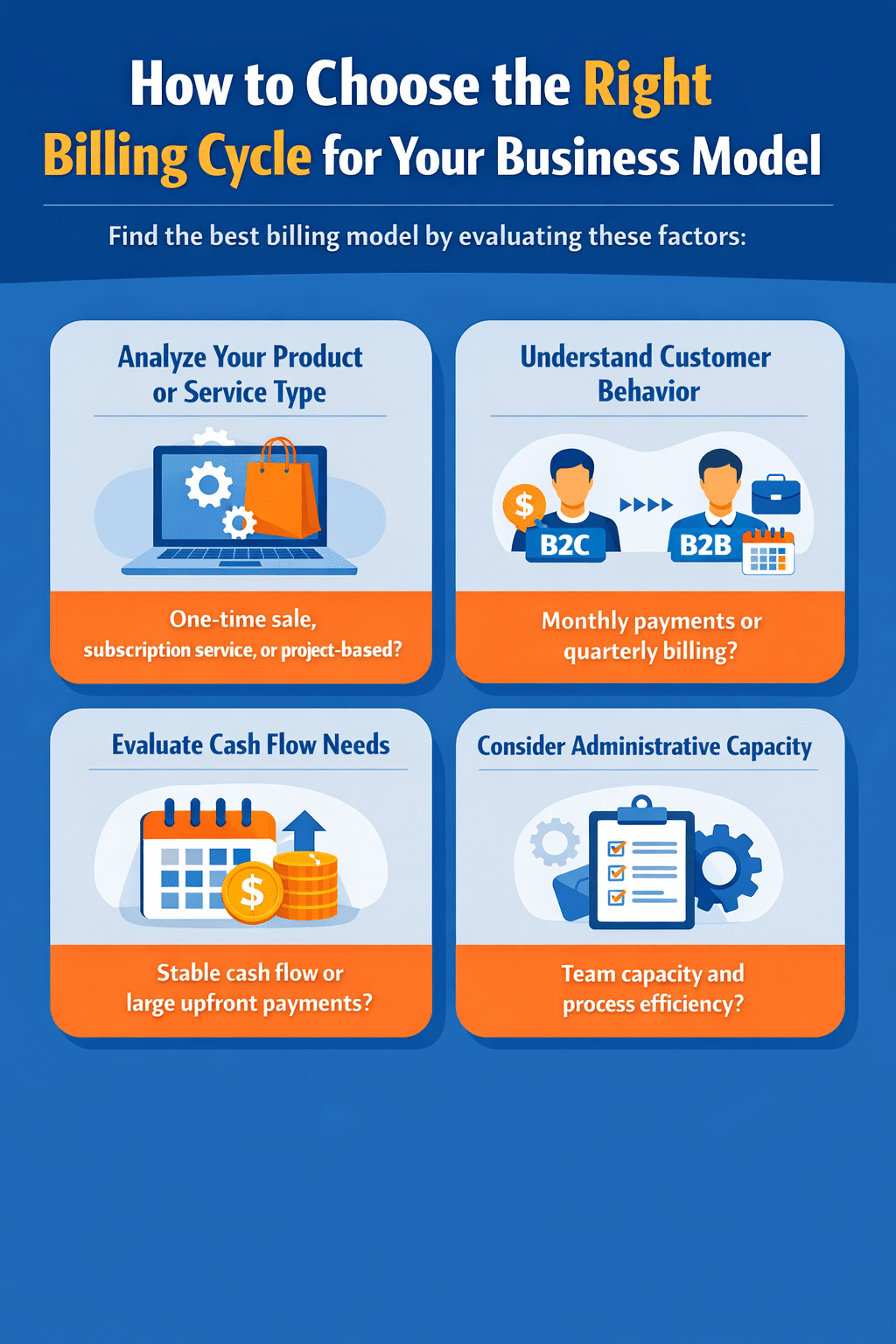
Choosing the right billing cycle is a strategic decision that can affect your financial health and customer relationships. There is no one-size-fits-all solution; the best choice depends on a careful analysis of several key factors in your business operations. This decision should be based on data and a deep understanding of your products, customers, and internal capacity.
This selection process requires careful consideration so that the implemented cycle can be effective and sustainable. By evaluating the following factors, you can determine the billing model that is most suitable to support your business growth and maintain customer satisfaction.
1. Analyze your product or service type
Do you sell one-time products, subscription-based services, or long-duration projects? Subscription services like software are well-suited for monthly or annual billing. In contrast, construction or consulting projects are better suited for milestone-based billing that aligns with work progress. The nature of your offering is the first and most important determinant of your billing strategy.
2. Understand customer behavior and preferences
Conduct research to understand how your target market prefers to pay. B2C customers might be more accustomed to smaller, monthly payments, while corporate clients (B2B) might prefer less frequent billing cycles like quarterly or annually to simplify their administrative processes. Aligning with customer expectations can reduce friction and improve payment timeliness.
3. Evaluate your company’s cash flow needs
If your business requires a stable and predictable cash flow each month to cover routine operational costs, a monthly billing cycle is a safe choice. However, if you need a large upfront cash injection for investment or working capital, offering discounts for annual payments can be a very effective strategy. Your financial strategy should directly inform your billing cycle choice.
4. Consider your administrative capacity
How prepared is your team to manage the billing process? A more frequent billing cycle like monthly requires more intensive administrative processes compared to an annual cycle. If you are still relying on manual processes, opting for a less frequent cycle can reduce the workload and the risk of errors, making operations smoother and more manageable for your team.
Common Challenges in Manual Billing Cycle Management
Although it may seem straightforward, managing a billing cycle manually using spreadsheets or other traditional methods can become a significant source of problems as a business grows. Manual processes are not only time-consuming but also open up a wide range of errors that can be detrimental to the company. Identifying these challenges is the first step toward realizing the need to switch to a more modern and efficient system.
Dependence on manual processes can hinder scalability and operational efficiency. The administrative burden grows exponentially with your customer base, creating bottlenecks that can stifle growth. The following are some of the most common challenges that companies face when managing the billing cycle without adequate technological assistance.
1. Human error in data entry and calculations
Manual data entry is one of the biggest sources of error in the billing process. A typo in the invoice amount, date, or customer details can lead to inaccurate invoices, which require time to correct and can damage customer trust. Manual calculations for discounts, taxes, or usage-based fees are also highly prone to mistakes, leading to financial losses and customer disputes that could have been easily avoided with automation.
2. Delays in invoice creation and delivery
Manual processes often cause delays in sending out invoices after the billing period ends. Every day of delay in sending an invoice means a day’s delay in receiving payment. These delays directly and negatively impact the company’s cash cycle and can accumulate into serious cash flow problems, affecting your ability to meet financial obligations and invest in growth opportunities.
3. Difficulty in tracking payments and aging receivables
Without a centralized system, tracking the payment status of hundreds or thousands of customers becomes an incredibly complex task. The finance team will struggle to identify which invoices are overdue and need follow-up. This makes the management of receivable aging ineffective and increases the risk of bad debt, ultimately impacting the company’s bottom line.
4. Lack of scalability as the business grows
Manual methods might be manageable when you only have a few customers. However, as the number of customers grows, the volume of transactions increases exponentially, and manual processes become unsustainable. This lack of scalability becomes a major obstacle to your business’s growth, preventing you from efficiently serving a larger customer base and capitalizing on new market opportunities.
Conclusion
The customer billing cycle is more than just sending bills; it is a vital driver of cash flow, operational efficiency, and customer relationships. By understanding its components, choosing the right cycle type, and addressing the limits of manual processes, businesses can take meaningful steps toward improvement.
In today’s digital age, relying on manual methods is no longer a smart choice. Adopting an automated accounting system improves accuracy, efficiency, and scalability. If you want to strengthen your billing process and build a solid financial foundation, schedule a free consultation today and start preparing your business for long-term growth.
Frequently Asked Question
The most common billing cycle is monthly, where customers are billed once every month on a consistent date. This model is widely used for subscription services, utilities, and credit cards because it provides a predictable and steady cash flow for businesses and is easy for customers to manage.
A business can improve its billing cycle by automating invoice creation and delivery, offering multiple payment options, sending timely reminders for due dates, and providing clear, detailed invoices. Using an integrated accounting system is the most effective way to streamline the entire process.
The billing cycle is the recurring period during which charges are accumulated (e.g., a 30-day period). The payment due date is the specific deadline within that cycle by which the customer must pay the invoice for that period to avoid penalties.