







Today’s consumers demand quick shopping experiences. They no longer want to wait in line for their morning coffee; they want to be able to order online and collect immediately without even leaving their cars. This is where curbside picking comes in. Originally used for grocery shoppers and fast-casual dining patrons, this fulfillment method has now grown and is used in other industries to make things more convenient. In this comprehensive guide, we will explore the intricate mechanics, technological requirements, consumer psychology, and implementation methods surrounding curbside fulfillment.
Table of Contents
Key Takeaways
|

What is Curbside Pickup? The Evolution of Modern Retail
Curbside pickup, also known as Buy Online, Pick Up In-Store (BOPIS) or Click-and-Collect, allows customers to order online and collect their goods without leaving their vehicles. Unlike traditional BOPIS, curbside pickup eliminates the need to enter the store. Store associates prepare and deliver the order directly to the customer’s car. This model gained significant popularity in the 2010s, with COVID-19 further accelerating its adoption.
Curbside pickup has now evolved into a permanent consumer preference, blending convenience, safety, and speed. A key component of omnichannel retail is its integration of the digital and physical shopping experiences. Its usage of seamless technology for inventory, pricing, and promotions management ensures that every element is aligned, from the stocks to the price. Now consumers can order while on lunch break or during the commute home.
The Mechanics Behind Curbside Pickup Operations
Curbside pickup operation is layered behind a complex, multi-step operational workflow that must be executed with precision. Any breakdown in this chain can result in extended wait times, incorrect orders, and significant customer dissatisfaction. Understanding the mechanics of this workflow is essential for identifying areas of optimization.
Step 1: Order Ingestion and Routing
The process starts when a customer clicks “checkout.” The order is instantly routed to the correct store based on real-time inventory data. If items are unavailable at the selected location, the system offers an alternative pickup location, suggests a substitution, or triggers a quick transfer from a nearby warehouse to the store, ensuring timely fulfillment for pickup.
Step 2: Picking and Packing (The Fulfillment Phase)
After routing, the order enters the fulfillment queue. Store associates, or “pickers,” use mobile devices to efficiently pick items, organized by the store layout. Packing ensures heavy items are at the bottom and fragile goods are protected. Once packed, items are placed in a staging area with proper equipment to maintain product integrity until customer pickup.
Step 3: Arrival Notification and Geofencing
Curbside operations face delays when the store is unaware of the customer’s arrival. To solve this, retailers use geofencing technology and mobile apps. When a customer enters a geofence, an alert notifies staff, allowing them to prepare the order in advance. By the time the customer arrives, the order is ready for a quick handoff.
Step 4: Verification and Handoff
The associate verifies the customer’s identity through a quick check (order number, barcode scan, or name confirmation) and loads the items into the vehicle. This step ensures speed, accuracy, and courtesy. Afterward, the associate marks the order as “Completed” on their device, updating the system, finalizing payment, and triggering a digital receipt and survey email to the customer.
The Role of POS Systems in Seamless Curbside Execution
While e-commerce platforms handle the front-end customer interaction, the Point of Sale (POS) system is the central nervous system of any retail operation. The POS cannot merely be a glorified cash register; it must be an integrated, cloud-based hub that connects sales, inventory, customer data, and fulfillment logistics in real-time.
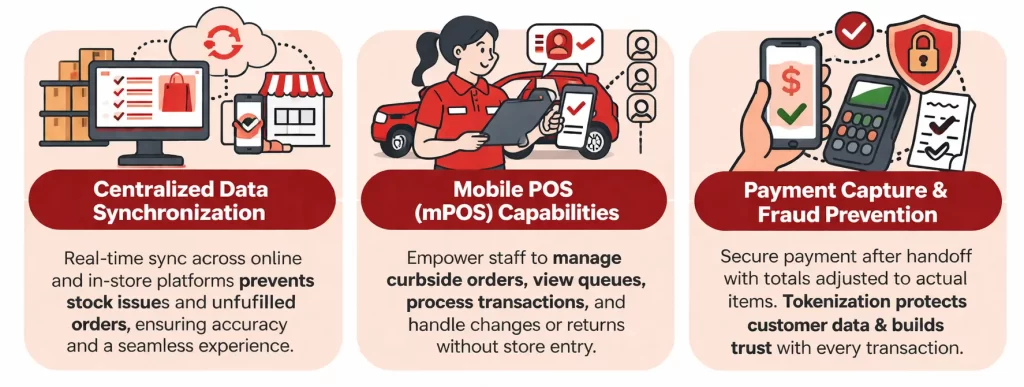
These features are needed in a POS system for curbside pickup to be fulfilled efficiently.
Why Shoppers Prefer Curbside Services
The appeal of curbside pickup is rooted in several deeply ingrained consumer desires: the need for control, the valuation of time, the aversion to friction, and the demand for instant gratification.
- Time-saving convenience: Curbside pickup alleviates “time poverty” by allowing customers to skip long aisles and checkout lines, reclaiming precious time. It offers easy access for parents, those with mobility issues, and busy professionals, enhancing daily life with minimal effort.
- Instant gratification with convenience: Unlike delivery, curbside pickup satisfies the need for immediacy, offering quick product acquisition without shipping fees or delivery windows. It gives customers control over timing, eliminating frustrations like waiting for deliveries or dealing with package theft.
- Comfort in personal space: Curbside pickup allows customers to remain in the comfort of their vehicle, maintaining privacy and control. The seamless, stress-free experience reduces anxiety, creating a positive emotional bond with brands offering this service.
Understanding the motivations behind using curbside services will help you exploit their benefits.
Essential Infrastructure for Effective Curbside Fulfillment

The success of a curbside program is heavily dependent on the physical environment in which it operates. Retailers cannot simply place a sandwich board in the parking lot and expect a smooth workflow. Dedicated infrastructure must be meticulously planned and implemented both outside and inside the facility.
External Infrastructure: Parking and Wayfinding
The customer’s physical journey begins the moment they enter the parking lot. The infrastructure must guide them intuitively to the correct location without requiring them to search or ask for directions.
- Dedicated Parking Zones: Retailers must allocate prime real estate for curbside parking. These spots should ideally be located as close to the designated fulfillment exit as possible to minimize the associate’s walking distance, thereby reducing turnaround times. The number of spots must scale with order volume; a small boutique might need two spots, while a large big-box retailer might require twenty.
- High-Visibility Signage: Clear, bold, and highly visible signage is critical. Signs should direct traffic flow from the street entrance all the way to the specific parking bays. Each parking spot must be clearly numbered or lettered so the customer can easily communicate their exact location to the store via the app.
- Weather Protection: Depending on the geographic location, weather can severely impact the curbside experience. Installing protective canopies or awnings over the pickup spots protects both the customer’s vehicle and the store associates from heavy rain, snow, or blistering sun during the handoff process.
- Lighting and Safety: For operations extending into the evening, the pickup zone must be brilliantly illuminated. This is crucial for the physical safety of the staff navigating the parking lot, the security of the transaction, and the customer’s peace of mind.
Internal Infrastructure: Staging and Storage
Inside the store, the physical layout must be adapted to handle the volume of staged orders without disrupting the experience of traditional walk-in shoppers.
- Dedicated Fulfillment Centers (Dark Stores): High-volume retailers often convert a portion of their backroom—or even an entire adjacent retail space—into a “dark store.” This area is closed to the public and laid out purely for the efficiency of the picking staff, resembling a micro-warehouse rather than a showroom.
- Temperature-Controlled Staging: For grocery and food-service operations, maintaining the cold chain is non-negotiable. Staging areas must include industrial refrigerators for dairy and produce, freezers for frozen goods, and heated cabinets for hot prepared foods.
- Organizational Bin Systems: Staged orders must be categorized using highly logical, easily scannable bin systems. Associates must be able to locate “Order #4892” within seconds. Utilizing color-coded bins or dynamic shelving equipped with pick-to-light technology can drastically reduce search times.
The Role of Inventory Management in Curbside Pickup
The Achilles’ heel of any omnichannel fulfillment strategy is poor inventory management. If a retailer fails to maintain absolute accuracy over their stock levels, the entire curbside model collapses. The promise of curbside pickup is predicated on trust: the customer trusts that the item they purchased online is actually waiting for them at the store. Breaking this trust through stockouts or canceled orders leads to severe brand damage.
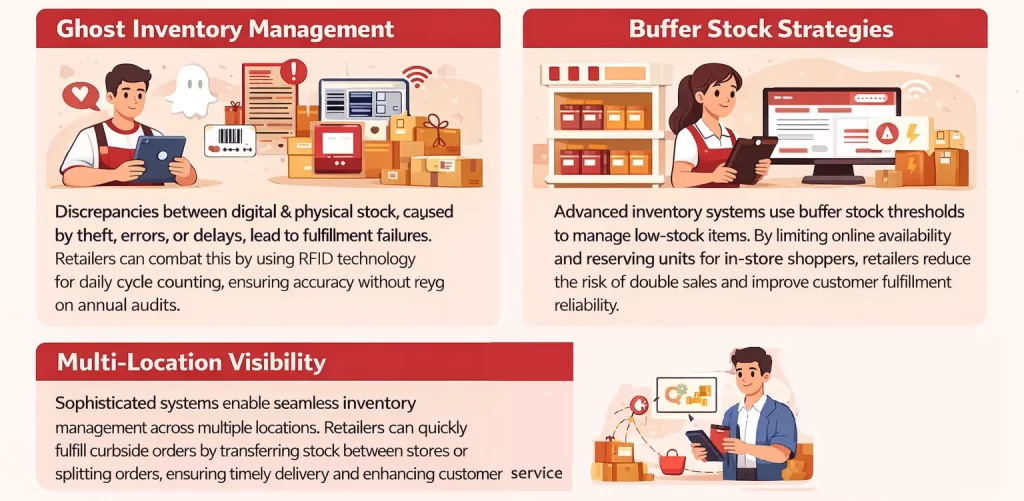
Using these inventory management solutions would ensure that your inventory will be optimal and won’t ruin the customer’s experience.
How to Implement Curbside Picking
Implementing curbside pickup requires more than adding a pickup option at checkout. Retailers need to align their digital systems, store layout, and staff workflows to deliver fast and accurate service. To launch or improve curbside operations, follow these key steps.
1. Synchronize Digital Infrastructure
Real-time inventory visibility is the foundation of curbside pickup. Retailers should connect their e-commerce platform with their POS and ERP systems so online stock levels match what is actually available in each store. This reduces order errors and helps prevent customers from paying for items that are already out of stock.
2. Optimize Physical Layout and Signage
The pickup process should feel as smooth as the online purchase. Store managers should assign curbside parking spaces near the staging area and mark them with clear, weather-resistant signs. Each sign should also explain exactly how customers can announce their arrival, whether through text, app notification, or phone call.
3. Establish Standard Operating Procedures (SOPs)
Clear SOPs help teams handle curbside orders consistently. Retailers should define each step, from item picking and order staging to customer verification and final handoff. They should also train staff to follow a standard process so they can maintain speed, accuracy, and service quality during busy periods.
4. Train Staff for Speed, Accuracy, and Service
Well-trained staff play a major role in curbside success. Retailers should assign dedicated fulfillment staff whenever possible so they can focus on picking, handoff, and issue resolution without dividing their attention. Training should cover customer verification, proper vehicle loading, safe handling of fragile or bulky items, and quick responses to order issues. Teams should also follow parking lot safety protocols to protect both employees and customers during every pickup.
Overcoming Common Logistical Challenges
Despite the best planning and technology, curbside operations are inherently complex and subject to real-world disruptions. Retailers must be prepared to navigate and mitigate a variety of logistical challenges to maintain operational excellence.
- Ghost Inventory: When digital systems show an item in stock that is actually missing, stolen, or damaged on the floor, it leads to canceled orders and deeply frustrated buyers. Combat this by implementing a safety stock threshold. For example, if only two units of a popular item remain, the system should automatically remove it from the curbside availability pool to account for in-store shoppers.
- Communication Breakdowns: If a customer arrives and the store is unaware, wait times skyrocket, completely negating the convenience of the service. Ensure your notification system has redundancies, such as automated audio alerts on staff mobile devices combined with a dedicated, flashing dashboard tablet at the fulfillment station.
- Peak Hour Bottlenecks: Offering unlimited pickup slots can easily overwhelm staff during rush hours, leading to massive queues in the parking lot. Implement dynamic slotting software that limits the number of orders scheduled for pickup per 15-minute window based on current staffing levels and average prep times.
- Managing Peak Hour Bottlenecks: Curbside demand is rarely distributed evenly throughout the day. It typically follows distinct peaks, such as the post-work commute.

Industry-Specific Use Cases for Curbside Pickup
While grocery stores were the early pioneers, curbside pickup has proven its incredible versatility across a multitude of retail sectors. Each industry faces unique logistical challenges and customer expectations that fundamentally shape their specific approach to curbside fulfillment.
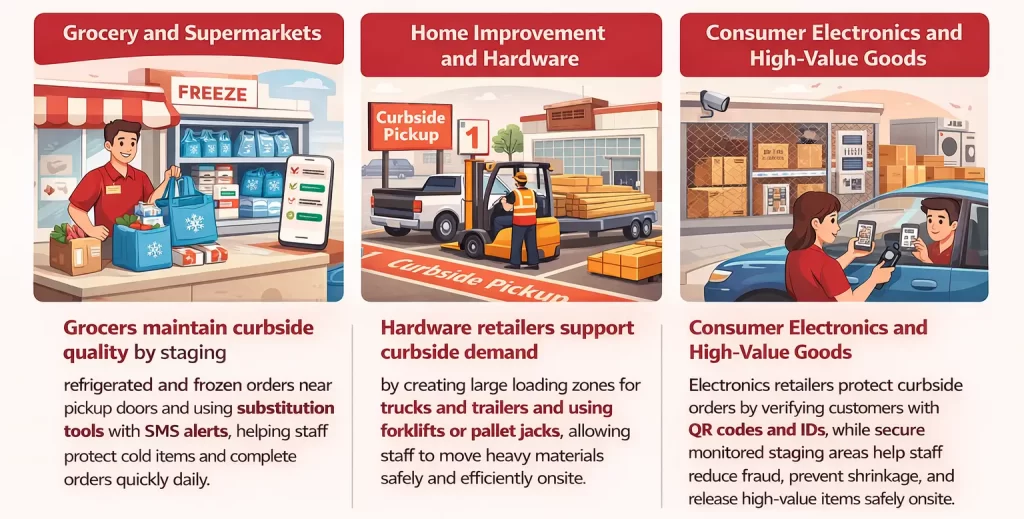
Knowing the differences will help you adapt to curbside pickup in the industry you are operating in. Retailers must address and reduce logistical challenges to maintain operational excellence.
Conclusion
Curbside pickup gives retailers a practical way to meet rising demand for speed, convenience, and control. Connecting your POS, inventory, and staff workflows with pickup operations will reduce fulfillment errors, improve order accuracy, and deliver a smoother shopping experience that keeps customers coming back.
Finding the right POS system is an important step in making it work. However, retailers need more than digital tools alone. They must build clear SOPs, train staff well, manage inventory accurately, and prepare for operational disruptions. With the right execution, curbside service can strengthen efficiency, protect customer trust, and support long-term retail growth.
FAQ for Curbside Pickup
Is curbside pickup free in the Philippines?
Many retailers offer curbside pickup for free, but some may apply service conditions or limit it to certain order types. Customers should always check checkout details before confirming the order.
What payment methods can customers use for curbside pickup?
Retailers usually accept credit or debit cards, while some also support e-wallets such as GCash. Payment options vary by store, so customers should review the available methods before placing a curbside order.
How long do customers have to pick up a curbside order?
Pickup windows vary by retailer. Some stores hold orders for only a few days, while others allow longer collection periods. If customers miss the deadline, the store may cancel the order automatically.
Can someone else pick up a curbside order on the customer’s behalf?
Many retailers allow another person to collect the order, but they usually require an authorization letter, order confirmation, and valid IDs. Customers should prepare these documents to avoid delays during pickup.