






Have you ever reviewed your financial report and noticed expenses or revenue figures that did not align with your original plan? These gaps often signal deeper issues in cost control or forecasting. Budget variance analysis helps businesses identify and understand these discrepancies early.
A 2023 study by RSI International found that organizations experience an average budget variance of nearly 10%, highlighting how often forecasts miss actual results. Budget variance analysis helps identify inefficiencies, unexpected trends, and cost drivers. This insight supports more accurate planning and corrective action.
To manage budget variances more effectively, businesses increasingly rely on automated financial tools for real-time visibility. HashMicro’s accounting software helps track performance accurately and reduce manual errors. Book a free demo to see how HashMicro supports smarter business control.
Table of Contents

Key Takeaways
|
What Is Budget Variance?
Budget variance is the difference between budgeted and actual revenue or expense over a period. It shows financial performance versus targets. When actual results are better than budgeted, it’s a favorable variance; however, when they are worse, it’s an unfavorable variance.
Budget variance analysis goes beyond operational costs; it also applies to sales, production, and project budgets. By understanding it, management can spot where performance exceeds or falls short of expectations, then investigate further and take corrective action as needed.
The Importance of Budget Variance Analysis for Business Health

Understanding budget variance is not just an accounting task; instead, it is a vital part of proactive strategic management. Regular variance analysis helps leaders anticipate problems, make smarter decisions, allocate resources efficiently, and support long-term financial stability.
This analysis turns raw data into actionable insights. Without it, a company operates in the dark, missing inefficiencies or standout team performance. By tracking variances, you can reward cost-saving teams and, meanwhile, support those struggling to meet budget goals, keeping everyone aligned.
1. As a financial control tool
Budget variance is the gap between budgeted and actual results. It signals performance versus targets. When results beat the budget, the variance is favorable; however, when they fall short, it is unfavorable, prompting managers to investigate and adjust plans accordingly.
2. For evaluating department and manager performance
Budget variance is an objective way to assess how well managers use resources. Consistently favorable variance suggests efficient, innovative management, while unfavorable variance may reveal issues. Consequently, it builds accountability and links each team’s actions to the company’s bottom line.
3. Improving the accuracy of future planning and forecasting
By analyzing past variance trends, a company can create more accurate future budgets. If a department consistently exceeds its budget for valid reasons, its budget may need adjustment; conversely, if revenue keeps beating targets, you can confidently set more ambitious goals.
To apply these budget variance analysis benefits more effectively, many businesses turn to automated financial systems. Exploring HashMicro’s pricing can help you understand how its budgeting tools support real-time control and smarter financial decisions.

How to Calculate Budget Variance: Formula and Interpretation
Calculating budget variance is fundamentally simple, but interpreting the results is crucial for valuable insights. The process compares planned figures with what actually occurred. Understanding how to calculate and categorize results helps you see the good news and the bad news in your financial reports.
It is important to remember that not all variances are equal. A small difference may be negligible, but a large one needs quick attention. Therefore, many companies set a threshold that triggers investigation so management can focus on variances with the greatest business impact.
A. The basic budget variance formula
The basic formula for budget variance is to subtract the budgeted amount from the actual amount. This applies to both costs and revenues, although their meanings differ. By using this formula consistently, you build reliable trend data that supports long‑term strategic planning.
Budget Variance = Actual Amount - Budgeted Amount
B. Understanding favorable variance (F)
A favorable variance (F) occurs when the actual result is better than budgeted. For costs, this means spending is lower than the budget. For revenue, it means income is higher. Although it seems positive, it still needs analysis to see if it comes from real efficiency or from missed activities that may slow growth.
C. Understanding unfavorable variance (U)
An unfavorable variance (U), or adverse variance, occurs when the actual result is worse than budgeted. For costs, this means spending is higher than the budget. For revenue, it means income is lower than targeted. Therefore, unfavorable variances are red flags that require quick investigation.
Key Factors Causing Budget Variance
Budget variance rarely occurs without a reason. Deviations between plan and reality can come from many internal and external factors. Therefore, finding the root causes is crucial so you can fix problems at their source and avoid repeating the same mistakes later.
By categorizing the causes of variance, you can create more targeted mitigation strategies. For example, a variance from external factors may require changes in procurement, while one from internal inefficiencies may call for process improvements or employee training.
1. Errors in the planning or estimation process
This is one of the most common causes, where the initial budget relies on inaccurate assumptions, incomplete data, or overly optimistic estimates. These errors often stem from weak research, failure to factor in inflation, or limited budgeting experience, and they almost guarantee significant variance later.
2. Changes in external market conditions
Factors beyond the company’s control are often key triggers for variance. For example, sudden jumps in raw material prices, new regulations that raise compliance costs, or currency swings that affect imports. Although these cannot be controlled, they can be anticipated and reduced with strong risk management and flexible budgeting.
3. Internal operational inefficiencies
An unfavorable cost variance often reflects internal problems. For example, it may come from material waste, low labor productivity, or inefficient equipment use. These variances are highly actionable because process improvements can quickly reduce costs and increase profitability.
4. Scope creep or changes in project scope
In project management, especially construction, scope creep is a common cause of cost overruns when features change without budget updates. This often comes from unclear communication. However, strong construction site management with clear change protocols can help prevent it.
Effective Strategies to Manage and Control Budget Variance

Knowing that a variance exists is only the beginning, and what you do next matters most. Proactively managing it requires regular monitoring, quick investigation, and clear corrective actions so you can reduce negative variances and understand what drives positive ones.
Implementing a solid strategy can turn variance analysis from a historical report into a dynamic management tool. It also promotes continuous improvement, as every team member becomes more aware of how their actions affect finances.
A. Conduct regular variance analysis
Do not wait until the end of a quarter or year to review your budget. Instead, analyze it weekly or monthly. Frequent monitoring helps you catch issues early, while they are easier to fix, which is crucial for dynamic projects with a strict project timeline and rising costs.
B. Investigate the root cause of significant variances
When a significant variance appears, quickly assign a team or analyst to find the cause. For example, check if higher material costs come from one supplier or the whole market, and whether lower productivity is due to equipment issues or lack of training, then choose the right corrective action.
C. Implement strong project management practices
For projects, use proven methodologies to manage schedules and resources efficiently. Also, set a formal process for scope changes so added work includes an approved budget and timeline. This helps prevent scope creep, keeps the project on track, and supports strong budget discipline.
D. Leverage technology for real-time monitoring
Relying on manual spreadsheets is error prone and slow for a growing company. Instead, use accounting software or an ERP system with real-time data. This gives instant budget visibility and faster decisions. For deeper insight, you can also read Forbes articles on enterprise resource planning.
Automating Budget Variance Analysis with Accounting Software
In modern business, managing budget variance with manual spreadsheets is no longer efficient and is very risky. Manual work is slow, prone to errors, and often produces outdated reports, which can delay intervention and cause higher losses as transactions grow.
The modern solution is to adopt technology, especially integrated accounting software or an ERP system. These tools automate data collection, compare it with the budget in real time, and create variance reports. With HashMicro Accounting, companies can move to proactive, agile financial management.
Optimize Your Business Management with Solutions from HashMicro
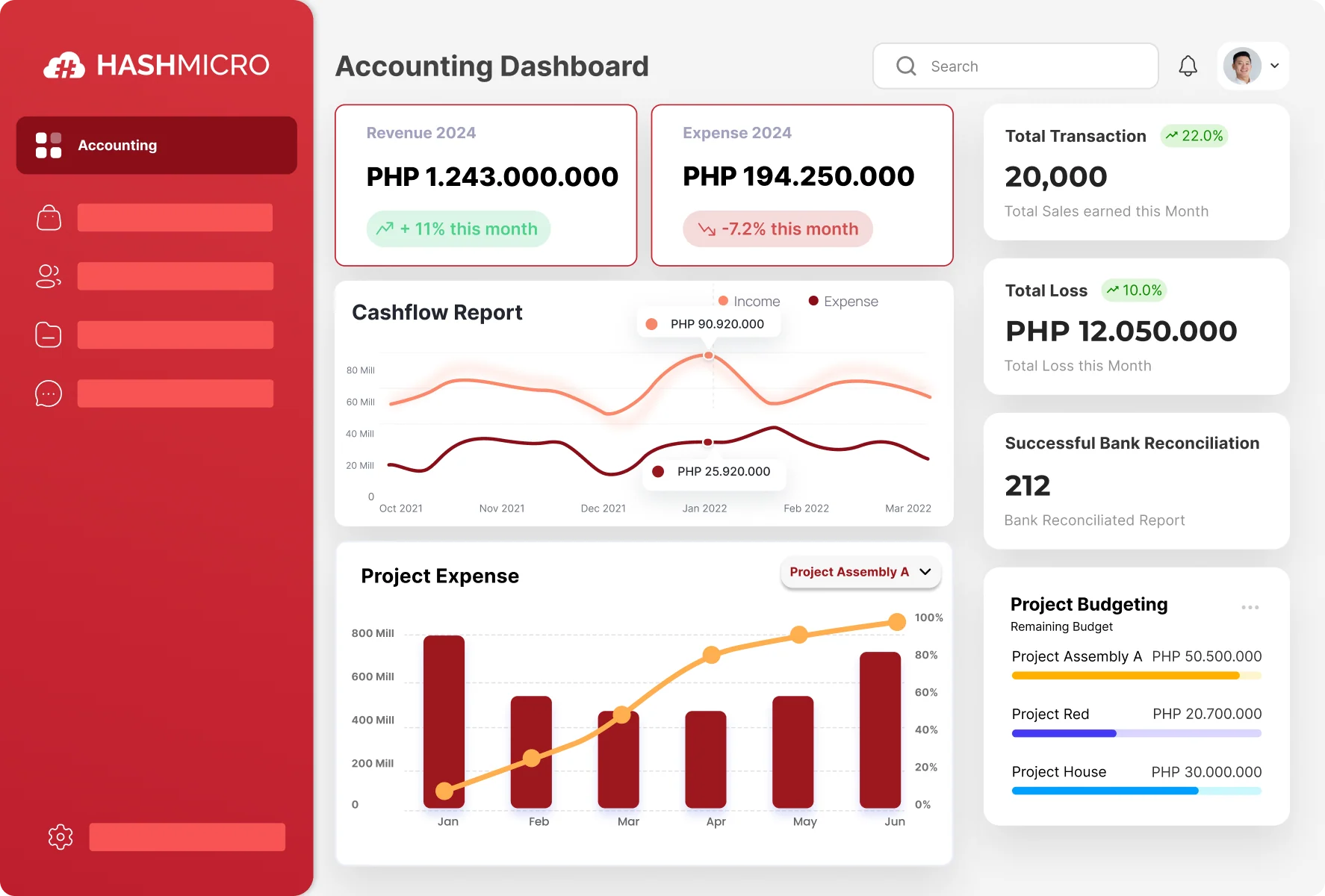
HashMicro provides an integrated ERP system that automates and simplifies business processes, including budget management and variance analysis. With this solution, companies can overcome slow reporting, manual errors, and real-time tracking challenges and move toward proactive financial control.
Through our advanced Accounting Software, companies can process transactions faster, cut human error, and get accurate real-time data. In addition, automated approvals, budget tracking, and integration with other modules turn complex figures into clear, actionable insights.
HashMicro’s system fully integrates all modules, so data from accounting, inventory, purchasing, and sales is seamlessly connected. As a result, you get better visibility, eliminate data silos, and create a single, accurate source of truth for the entire organization.
Features of HashMicro Accounting Software:
- Budget Management: Allows for the creation, tracking, and management of budgets for different departments or projects, providing real-time alerts when spending approaches its limit.
- Real-Time Financial Reporting: Automatically generates comprehensive financial statements, including balance sheets, income statements, and cash flow reports with variance analysis.
- Multi-Level Approval Workflow: Provides a customizable tiered approval system for expenses and purchases, ensuring every transaction undergoes proper verification according to company policy.
- Automatic Reconciliation: Streamlines the bank reconciliation process by automatically matching transactions, saving significant time and reducing manual errors.
- Integration with All Modules: Connects seamlessly with procurement, sales, and inventory systems to ensure financial data is always synchronized with operational activities without manual input.
With HashMicro, your company can enhance operational efficiency, data transparency, and business process automation. To see how our solutions can tangibly help your business, do not hesitate to try our free demo now.
Conclusion
Budget variance analysis is essential for maintaining business control by comparing planned budgets with actual results. It helps identify inefficiencies, uncover cost drivers, and respond quickly to financial gaps. This approach enables better forecasting, accountability, and informed decision-making.
To manage budget variances more effectively, HashMicro offers accounting and budgeting software with real-time tracking, automated variance reporting, and centralized financial data. These features reduce manual work, improve visibility, and help businesses maintain stronger financial discipline.
If you want clearer insights into budget performance and stronger financial control, now is the right time to take action. Book a free demo with HashMicro to see how its budgeting and accounting solutions support smarter planning and more confident decisions.
FAQ about Budget Variance
-
What percentage of budget variance is considered acceptable?
There is no universal figure, but many companies consider a variance under 5% to be within a reasonable limit. However, for low-cost items, a 10% variance might be acceptable, while for high-cost items, even a 1% variance may warrant investigation.
-
How often should budget variance analysis be performed?
The frequency depends on your business nature. For dynamic construction projects, a weekly analysis is highly recommended. For more stable operational departments, a monthly review is usually sufficient to monitor performance and make necessary adjustments.
-
Is a favorable variance always a good thing?
Not always. For instance, a favorable material cost variance could be due to purchasing lower-quality materials, which might affect the final product’s quality. Similarly, an unspent training budget could mean employees are not getting the development they need.
-
What is the first step if a large unfavorable variance is found?
The first step is not to panic but to investigate immediately. Talk to the manager responsible for that budget to understand the context. Gather all supporting data, such as invoices or operational reports, to identify the root cause of the problem.