







In the Philippines, businesses often struggle with attendance issues like time theft and buddy punching, which can silently drain resources. Time theft and buddy punching are not just minor inconveniences, they represent a substantial cost to businesses in the Philippines.
These attendance issues can lead to a loss of productivity and, ultimately, profits. By implementing an effective attendance management system, businesses can address these problems head-on, ensuring a more disciplined and productive workforce.
This article explores the benefits of attendance management systems, highlighting how they can solve these common headaches. We aim to show businesses why adopting such a system isn’t just a good move, it’s essential for staying sharp and competitive.
Key Takeaways
An attendance management system ensures accurate time tracking, payroll accuracy, and compliance with labor regulations through systematic monitoring of employee work hours.
Manual attendance tracking increases the risk of human error, time theft, inefficiency, and compliance violations.
Automated attendance systems can significantly reduce operational costs while improving workforce planning and shift management.
Real-time data analytics from attendance systems enable faster and more informed managerial decision-making.
What is an Employee Attendance Management?

Employee attendance management is a systematic process used by organizations to record, monitor, and analyze their employees’ work hours.
It’s an essential part of human resource management that ensures employees are working the hours they’re supposed to, helps calculate pay accurately, and maintains compliance with labor laws.
Here’s a detailed breakdown of what it involves:
- Integrated attendance and presence management: This feature efficiently records work hours and monitors staff presence, which is essential for managing attendance and leave using a reliable leave form template.
- Analyzing work hours: By collecting data on attendance, companies can analyze work patterns, identify trends, and make informed decisions about staffing and productivity.
- Ensuring compliance: Accurate attendance records are necessary to comply with labor laws regarding work hours, overtime pay, and breaks.
- Payroll integration: Attendance data is often integrated with payroll systems to ensure that employees are paid correctly for the time they’ve worked.
- Policy enforcement: It helps enforce company policies regarding punctuality, absenteeism, and time management.
For a more detailed explanation regarding this topic, you may visit our previous article about what is attendance management system.
Modern attendance management systems can be manual or software-based, with the latter providing more efficiency and accuracy. They may use various technologies, such as digital time clocks, biometric systems, RFID tags, or mobile applications, to automate the process.
Why is Attendance Management Important?
Before we go further, you may ask why is attendance management important? Now, imagine that you are an HR person responsible for managing the attendance of thousands of employees. That doesn’t include managing the productivity levels of your employees. Without an organized system in place, you would be overwhelmed, right?
So, this is where attendance management is important. With an organized system, companies can record employee working hours, leave, lateness, and attendance more easily. This helps prevent manual errors that can affect employee paychecks as well as reduce potential attendance-related disputes.
The importance of an attendance management system also lies in its function of helping companies to increase productivity. With the right data on attendance, managers can plan work schedules more effectively. It also helps optimize human resources, so that business operations run more smoothly.
One of the reasons attendance management systems are important is their ability to maintain compliance with labor regulations. Many countries, including the Philippines, have regulations that govern employee working hours and breaks. With attendance management, companies can monitor compliance with these regulations, avoiding violations that could lead to fines or legal sanctions.
Challenges in Managing Employee Attendance
Before we discuss the benefits of using an employee attendance management system, let’s talk about the challenges and problems Philippines companies may encounter regarding managing employee attendance.
When companies continue to use manual methods for employee attendance management, they may face several challenges and problems:
- Human error: Manual tracking, like using time cards or sheets, can lead to mistakes in recording work hours, which can affect payroll accuracy.
- Time theft: Employees might clock in for each other, known as buddy punching, which is hard to detect with manual systems.
- Inefficiency: Manual entry is time-consuming, often requiring queues for clocking in and out, and HR spends extra time correcting errors.
- Outdated systems: Traditional attendance methods can be outdated and ineffective, impacting the company’s overall performance.
- Compliance risks: There’s a risk of failing to comply with labor laws due to inaccurate timekeeping and record-keeping.
- Integration issues: Lack of integration between manual attendance records and other HRIS systems can lead to disjointed data management.
- Excessive paperwork: Manual systems often involve a lot of paperwork, which can be cumbersome and environmentally unfriendly.
These challenges highlight the importance of modernizing attendance systems to improve accuracy, efficiency, and compliance. By using a comprehensive and effective attendance management system, companies could minimize or avoid the risk of those issues happening.
Additionally, an advanced system can enhance employee trust by ensuring fair and transparent attendance tracking. This, in turn, contributes to better employee retention by fostering a sense of reliability and professionalism within the workplace.
The Main Benefits of Using an Attendance Management System

An attendance management system (AMS) offers a range of benefits that can lead to significant cost savings and effectively address time theft issues. Here are some detailed advantages.
1. Streamlined operational management
It’s known that organizations that switch to automated systems can see a 30% drop in the costs of keeping track of who’s at work. That’s because the system does everything independently, without mistakes, and doesn’t need breaks or vacations.
Also, when you have a system that works like clockwork, you can figure out things like how many people you need for a shift or if you need to hire more employees during busy times. With all the information right there, managers can make these calls quickly, which is great for business.
2. Insightful data analysis
This is where data analysis comes in to asses helping to spot the patterns, like whether the employees tend to take more breaks during certain times. With this information, the leader can ensure there are always enough people on business to keep things running well.
For example, if the data shows that more people take time off in December, the company can plan by maybe hiring extra help or asking some employees to shift their holidays around. This way, the company doesn’t slow down because some people are off.
Data analysis is powerful. Companies that use data well can make decisions five times faster than those that don’t. And when managers can see what’s going on quickly, they can keep their team happy and the business strong.
3. Customization and adaptability
A good attendance system can be set up to know when each team is working, even if they’re starting their day when another team is having lunch. This is super important because more and more people are working in different ways. Some might work from home, others have flexible hours, and some work part-time. A report says that about 16% of companies worldwide are fully remote.
That means they don’t have an office at all, and everyone works from different places. So, a customizable attendance system is perfect for this kind of work. Also, when a system is adaptable, it can grow with the company. If the business opens a new office in another country, the system can be updated to include that new location without trouble. This makes sure that everyone’s work hours are tracked correctly.
4. Eco-friendly and clutter-free office
When a company stops using paper and starts keeping records on computers, it’s not just about being neat. It’s a big deal for saving money and caring for our planet.
Now, let’s talk numbers. Businesses in the United States could spend around $8 billion just on managing paper. It costs about $20 to file one paper document, if you have to find it later or make a copy, that’s even more money. But if you have everything on a computer, you can find what you need with a few clicks, and it doesn’t cost extra.
In short, from a business perspective, when a company goes paperless, it saves money and makes your office much less messy. It’s a smart move for any business that wants to do well and do good simultaneously.
5. Upholding organizational value
Having an attendance system is like setting a standard in the office to show everyone that the company takes this seriously and that they should, too. When there’s a system that monitors when people come and go, it’s easier for everyone to follow the rules. It’s fair because it applies to everyone, from the newest intern to the boss.
When a company has clear attendance rules and uses a system to track them, people are likelier to be on time and less likely to skip work without a good reason. This is because they know their actions are being recorded and that reliability is important to the company. Also, when people follow the rules, it creates a better work environment for everyone.
6. Swift report retrieval
Quick access to reports is beneficial for managers because it allows them to see what’s going on in their team right away and make smart choices quickly. For example, if a report shows that there aren’t enough people working in a department, the manager can quickly devise a plan. They might decide to hire more people or change when people work to ensure everything gets done on time.
Having this kind of information at your fingertips is a big deal. When information is easy to see and understand, it can help you make better and faster decisions. This is because pictures or graphs of data are easier to read than lots of words. It’s like getting the story at a glance instead of having to read the whole book.
7. Efficient request handling
In the old days, you’d have to fill out a bunch of forms, hand them in, and then wait around to hear back. But now, you can just type in when you want your time off, hit send, and it’s done. Your manager gets the message immediately and can say yes or no quickly. This is a big deal because it means less waiting and less paper clutter.
And for a fact, using online systems can cut down the time it takes to handle these requests by more than half. a lot of times saved and also means fewer mistakes because computers are good at keeping track of things without messing up. In short, efficient request handling with an online system is like upgrading from an old flip phone to the latest smartphone. It’s faster, smarter, and makes everyone’s life much easier.
8. Protection of sensitive information
It’s super important to ensure that only the right people can see that info when it comes to keeping track of who’s working and who’s not. Only people like the managers or the HR team, can access the data. This keeps everyone’s details private and the company’s information safe.
If someone who shouldn’t see the records gets in, it could lead to trouble. They could steal identities or mess with the records. That’s why strong security, such as passwords and encryption is a must. Securing this data isn’t just a good idea, it’s the law everywhere. If a company doesn’t protect this information, it could face big fines or even be taken to court. Also, if employees know their information is secure, they’ll trust the company more, making it a better workplace.
9. Regulatory adherence
Continuing from the last benefit, we all know that following the rules about work hours and breaks is super important for companies. An attendance system is like the referee keeping track of everything to ensure the company plays fair.
For example, in some places, the law says you must take a break after working a certain number of hours. If a company doesn’t follow this, it could get in big trouble and pay fines. Keeping track of attendance helps companies avoid legal problems.
Another fact is that these systems can send alerts to remind managers and employees about the rules, example is when someone’s about to work too much overtime. This helps everyone stay on track and keeps the company safe from fines.
10. Versatile attendance tracking
This system ensures that their hours are counted correctly no matter where or how someone works. Companies apply a work-from-home (WFH) or work-from-anywhere (WFA) system. With versatile tracking, companies can keep up with all these different styles.
For example, someone has to work from home because they have a sick kid. With a good system, they can log their work hours from home, such as at the office. This way, they don’t have to worry about their time not being counted.
And it’s not just about being fair to the employees. It’s also about the company knowing exactly how much work is getting done. This can help plan and ensure enough people are working to meet the company’s goals. In fact, It’s a win-win because the company gets the work done, and the employees can work in a way that suits them best.
With all ten benefits above, implementing an attendance management system is crucial and a game-changer for how companies manage their employees. If you’re interested in using the attendance management system, you may refer to our other article about top/best HR software in the Philippines.
How to Choose the Best Attendance Management System (AMS) for Your Business
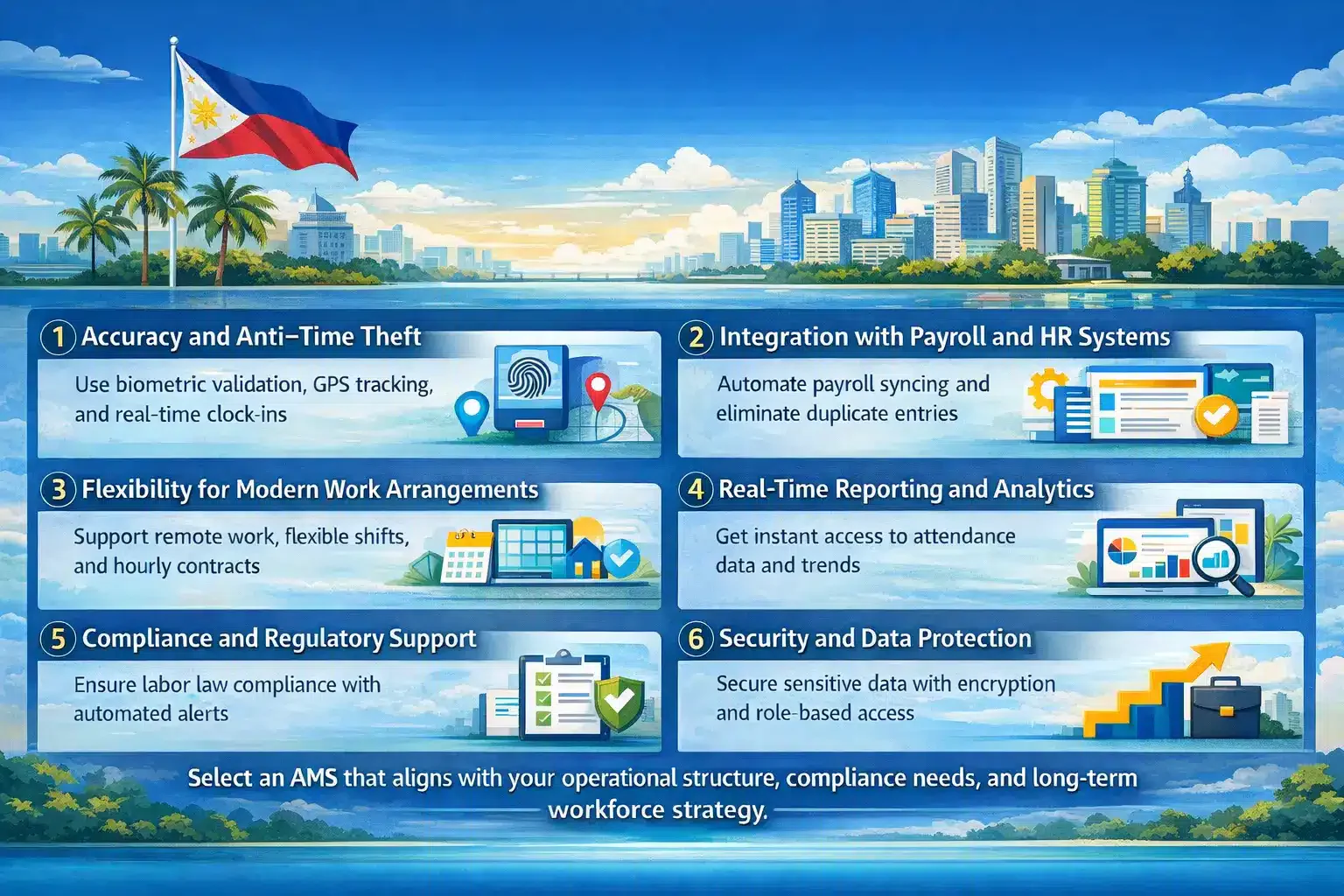
Selecting the right attendance management system is not simply about digitizing time tracking, it is about choosing a solution that aligns with your operational structure, compliance requirements, and long-term workforce strategy. Businesses in the Philippines should evaluate systems based on functionality, scalability, security, and integration capabilities to ensure sustainable value.
Here are the key factors to consider:
1. Accuracy and Anti–Time Theft Features
Choose an AMS that minimizes manipulation risks such as buddy punching and time theft. Features like biometric verification (face recognition or fingerprint), GPS tracking, and real-time clock-in validation significantly improve data accuracy and workforce accountability.
2. Integration with Payroll and HR Systems
A reliable attendance system should integrate seamlessly with payroll and HRIS platforms. Automated synchronization reduces payroll discrepancies, eliminates duplicate data entry, and ensures compliance with labor regulations regarding overtime and working hours.
3. Flexibility for Modern Work Arrangements
With the rise of remote work, hybrid models, daily workers, and hourly contracts, your AMS must support flexible scheduling, shift management, roster adjustments, and work-from-anywhere tracking. The system should adapt to operational changes without requiring complex reconfiguration.
4. Real-Time Reporting and Data Analytics
Advanced reporting capabilities allow managers to monitor attendance trends, overtime patterns, absenteeism rates, and workforce productivity. Systems with visual dashboards and instant report retrieval enable faster, data-driven decisions.
5. Compliance and Regulatory Support
Ensure the system supports local labor law requirements, including overtime limits, mandatory breaks, and proper record retention. Automated alerts and audit-ready documentation help reduce compliance risks and potential legal penalties.
6. Security and Data Protection
Attendance records contain sensitive employee information. The ideal AMS should include role-based access control, encryption, secure cloud storage, and regular system updates to prevent unauthorized access or data breaches.
7. Ease of Use and Employee Self-Service
A user-friendly interface increases adoption rates across departments. Features like online leave requests, automated approval workflows, and mobile accessibility reduce administrative workload and improve employee satisfaction.
8. Scalability and Long-Term Value
As your company grows, your attendance system should scale accordingly. Whether expanding to new locations or increasing workforce size, the system must handle higher data volumes without performance issues.
By carefully evaluating these criteria, businesses can implement an attendance management system that not only resolves attendance-related challenges but also strengthens operational efficiency, compliance integrity, and workforce transparency in the long term.
Conclusion
The right attendance management system can transform your business operations, making them more efficient, secure, and compliant with regulations. It invests in your company’s future, ensuring you have the tools to support your team’s best work.
By adopting a structured and technology-driven attendance solution, companies can enhance transparency, improve workforce planning, and support modern work arrangements such as remote and flexible schedules. Ultimately, an effective attendance management system strengthens organizational accountability, protects sensitive data, and provides the analytical insights needed to sustain productivity and long-term business growth.
FAQ about the Benefits of Attendance Management System
An attendance management system improves security by eliminating manual interpretation of working hours, thereby reducing instances of time fraud like buddy punching. It ensures accurate and reliable employee attendance tracking and compliance with labor laws. Advanced features such as biometric verification and GPS-based logging further enhance precision and security, providing peace of mind and better workforce management.
Self-service attendance management systems empower employees by giving them access to their attendance records and the ability to manage their own data. Employees can request time off, check attendance status, and update records with prior approval. This reduces the administrative burden on HR departments and enhances employee satisfaction by providing more control over their schedules and attendance records.
By automating the attendance tracking process, an attendance management system minimizes human errors associated with manual data entry. This ensures that attendance records are accurate and reliable, which is crucial for correct payroll processing. Automation also reduces administrative workload, allowing HR personnel to focus on more strategic tasks.
An attendance management system helps businesses comply with labor regulations by accurately tracking working hours, overtime, and night differentials. It provides comprehensive reports that help in auditing and compliance checks. The system’s automation capabilities ensure that all employee attendance data is recorded and stored correctly, reducing the risk of non-compliance with labor laws.
Real-time attendance tracking allows businesses to monitor attendance instantly, providing accurate data on employee presence and absences. This real-time data helps managers make informed decisions regarding shift planning and resource allocation. Automated alerts and notifications ensure timely attendance logging, improving overall attendance accuracy and efficiency.