














Inventory errors are more common than most businesses realize. According to a study by Leyte Normal University, 80% of business owners in the Philippines reported needing a better inventory system, citing time consuming manual processes, difficulty tracking item locations, and frequent inaccuracies in inventory reports. These pain points signal a clear need for a smarter approach to stock control.
RFID inventory management addresses these challenges by using radio frequency identification technology to automatically track items in real time, without requiring manual scanning or direct line of sight.
This article covers how the system works, the types of RFID tags available, how it compares to barcodes, and what to consider when choosing the right solution for your business.
Table of Contents
Key Takeaways
|
What is RFID Inventory Management?
RFID inventory management is a system that utilizes radio frequency identification technology to automatically track inventory items, providing real time data on their location and status. This method greatly enhances accuracy and efficiency in stock control and reduces overhead costs.
RFID systems significantly enhance inventory management by assigning an RFID tag to each product in a warehouse, thus streamlining the tracking process. These tags, which carry vital data about the items, allow for precise monitoring of stock levels as products move in and out, ensuring real time accuracy.
Types of RFID Inventory Management Tags
 There are 2 types of RFID enabled inventory systems you should know when operating a warehouse in the Philippines, such as:
1. Active RFID tags for inventory: These tags have a power source, allowing them to send signals over longer distances. They’re useful for tracking valuable items or large objects across vast areas. For example, vehicle tracking devices, hospital equipment tags, and shipping container trackers.
2. Passive RFID tags for inventory: These tags rely on the scanner’s signal for power, making them cost efficient and durable. Commonly used in retail, passive tags track products. For example, clothing tags, book labels, product stickers, and event badges.
Pros and Cons of Using RFID Inventory Management for Businesses
We understand that you may be unsure whether RFID inventory management is suitable for your business in the Philippines. Therefore, here are the pros and cons to help you make the right decision.
| Pros | Cons |
|---|---|
| Reduces manual errors | Requires ongoing maintenance |
| Offers real time and accurate updates on inventory locations and statuses | The price of RFID implementation with built in systems may vary according to your previous business technology |
| Saving time and labor during stock counts | |
| Giving you flexible control over stocks | |
| Improved customer service ensures product availability, boosting satisfaction |
For businesses that are weighing cost as a primary concern, it is worth noting that most modern inventory platforms allow you to review pricing and projected ROI before any commitment is made.
RFID vs Barcode System and Their Differences
 Business people, did you know that the RFID inventory system and barcode are two different things? They may look similar, but barcode and RFID tracking work in different ways. To better understand, let’s take a look at the table below.
| Features | RFID | Barcode |
|---|---|---|
| Data capture | Reads without direct sight using radio frequency | Requires direct sight for scanning |
| Data capacity | Stores and updates a lot of data on the tag | Limited to printed data, typically product ID |
| Read range | Reads tags from several meters away, simultaneously | Scans individually and close to the scanner |
| Durability | Durable and reusable, even in harsh conditions | Can be damaged or dirtied, becoming unreadable |
| Cost | More expensive due to technology | Cheaper and easier to produce. |
| Implementation | Complex setup and higher maintenance | Easy and cheap to set up and maintain |
So, which one is better?
After knowing the differences between the RFID tracking system and barcode system above, you might be wondering which system is better to use in Philippine companies.
Here are some points that you can take into consideration in choosing one:
- Operational volume: Assess whether your business handles high inventory volumes that require rapid processing. For larger operations, RFID might be more beneficial.
- Budget constraints: Consider your budget for initial setup and ongoing costs. If budget is limited, barcode systems could be more cost effective.
- Inventory complexity: Evaluate the complexity of your inventory management needs. RFID is ideal for complex scenarios with varied inventory types and high turnover rates.
- Data accuracy requirements: If your business demands high accuracy and real time data tracking, RFID provides superior capabilities.
- Physical environment: Consider the environment in which the system will be used. RFID is less affected by environmental factors such as dirt, dust, and moisture than barcodes.
- Technological compatibility: Ensure the new system is compatible with your current technological setup.
For businesses exploring how warehouse management software can complement these tracking systems, there are platforms that integrate both RFID and barcode capabilities on a single system.
How to Implement RFID Inventory Management
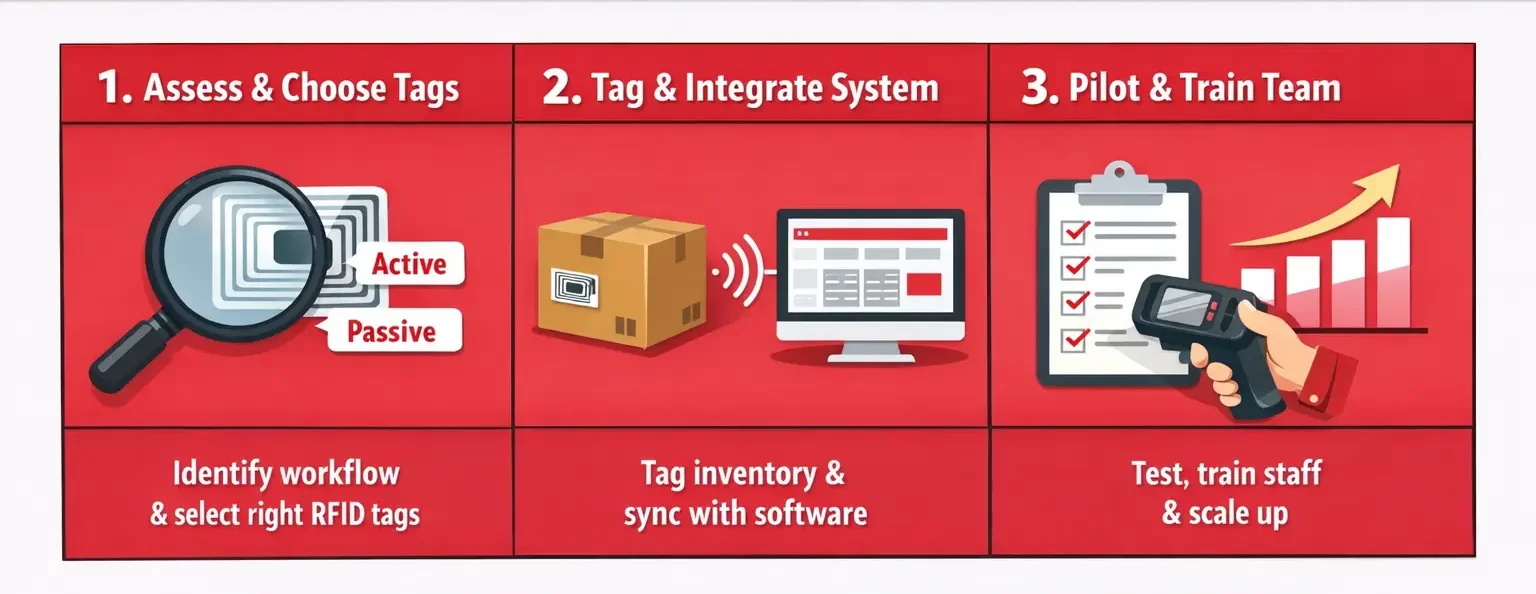 Implementing RFID inventory management works best when done in stages rather than all at once. Most businesses complete a full rollout within three to six months, depending on the size of their operation.
1. Assess your workflow and choose the right tag type
Identify where errors or delays occur most frequently, then decide between active or passive RFID tags based on your tracking area and budget, as outlined in the previous section.
2. Tag your stock and integrate with your system
Attach RFID tags to existing inventory and connect the hardware to your inventory management software so that stock levels update automatically each time a tag is detected.
3. Run a pilot, train your team, then scale
Test on a specific product category first before committing to a full rollout. Use this phase to identify issues like signal interference from metal surfaces or liquids, and ensure your team understands how to operate readers and act on the data. For context on how different types of inventory software handle RFID integration, comparing platforms early can save time later.
Conclusion
RFID inventory management helps businesses in the Philippines reduce manual errors, improve stock visibility, and track inventory in real time. The right approach depends on operational scale, tag type selection, and how well the system integrates with existing software. Businesses that implement in stages and invest in proper staff training tend to see more consistent and measurable results.
For those ready to move forward, the choice of platform matters as much as the technology itself. Taking time to compare available options carefully helps avoid costly switching down the line. Reviewing the best inventory management software on the market today is a practical starting point for finding a solution that fits your specific needs.
FAQ About RFID Inventory Management
-
How is RFID used for inventory management?
RFID tags for inventory management, when attached to products or pallets, automatically relay information to RFID readers. This enables real time tracking of product details, enhancing the efficiency, accuracy, and transparency of inventory management.
-
How does RFID help increase inventory accuracy?
After adopting RFID labels, companies can bypass the limitations of barcode scanning, such as the need for direct visibility and the need to handle each item to count. RFID technology enables the counting of multiple items at once without a direct line of sight, each tagged with a unique ID for easy tracking.
-
How do you locate items with RFID?
The most common and simplest method for locating an item using RFID is to use handheld readers. These readers work similarly to a Geiger Counter, beeping or ticking faster as they get closer to the tagged item.