












In today’s digital age, retail businesses must continue to innovate and evolve along with the rapid development of technology. Without the right retail management system, your business might have limited insights into sales trends, limiting effective business strategies. Therefore, the need for accurate and efficient retail management has never been more important, making retail management tools essential for Philippine businesses.
Additionally, the retail market size in the Philippines is estimated to reach USD 66.70 billion by 2024, with projected growth to USD 96.02 billion by 2029, at a CAGR of 7.56%, according to Mordor Intelligence. This fact shows that businesses in the Philippines need systems to stay competitive in an ever-evolving market.
This article will discuss the benefits of retail software for Philippine businesses, exploring how these systems can streamline retail processes, improve efficiency, and drive sustainable business growth.
Key Takeaways
|
Features in Retail Management Software Needed to Optimize Your Retail Operations

When selecting a retail system for your business in the Philippines, it is crucial to consider your options carefully. The right retail system can profoundly impact your operations by streamlining processes, synchronizing data, and enhancing efficiency. Therefore, it’s important to choose the best retail management system that can support your business’s operational needs.
The software need to be able to covers end-to-end business processes and provides comprehensive functionality to align sales and inventory data, improve stock control, ensure procurement efficiency, optimize multi-channel operations, have sufficient insight into sales trends and enhance proactive business strategies. Below are some of the essential features that Retail Management System need to offers:
- CRM software integration. Integration capabilities enable businesses to manage customer relationships effectively. This feature helps you understand customer preferences and offer more personalized and satisfying services.
- Procurement efficiency. This feature improves procurement efficiency, ensuring that stock is always available as needed and reducing waiting time and unnecessary storage costs.
- Complete POS analysis. The system need to be able to provides deep insights into sales performance at every point of sale. This feature helps you understand sales trends, product performance, and customer behavior, allowing you to make better business decisions.
- Optimize marketing and sales. This feature helps optimize marketing and sales strategies by providing the data and analysis needed to design effective campaigns.
- Integration with e-commerce. You can ensure that inventory and sales data are always in sync between physical and online stores. This provides a consistent shopping experience for customers and makes stock management easier.
- Sales management. With this feature, you can monitor the sales process from start to finish on a regular basis, including sales tracking, order management, and sales performance analysis, ensuring efficient operations and increased sales.
- Stock aging analysis. System should be a help for businesses to understand the age of stock items in the warehouse. This feature is important for identifying slow-moving products and taking necessary actions to reduce unsold stock, thus optimizing inventory management.
With these features, retail management software expected to provides a comprehensive solution for managing various aspects of a retail business, improving operational efficiency and driving sales growth.
Benefits of Retail Management Software for Philippine Business
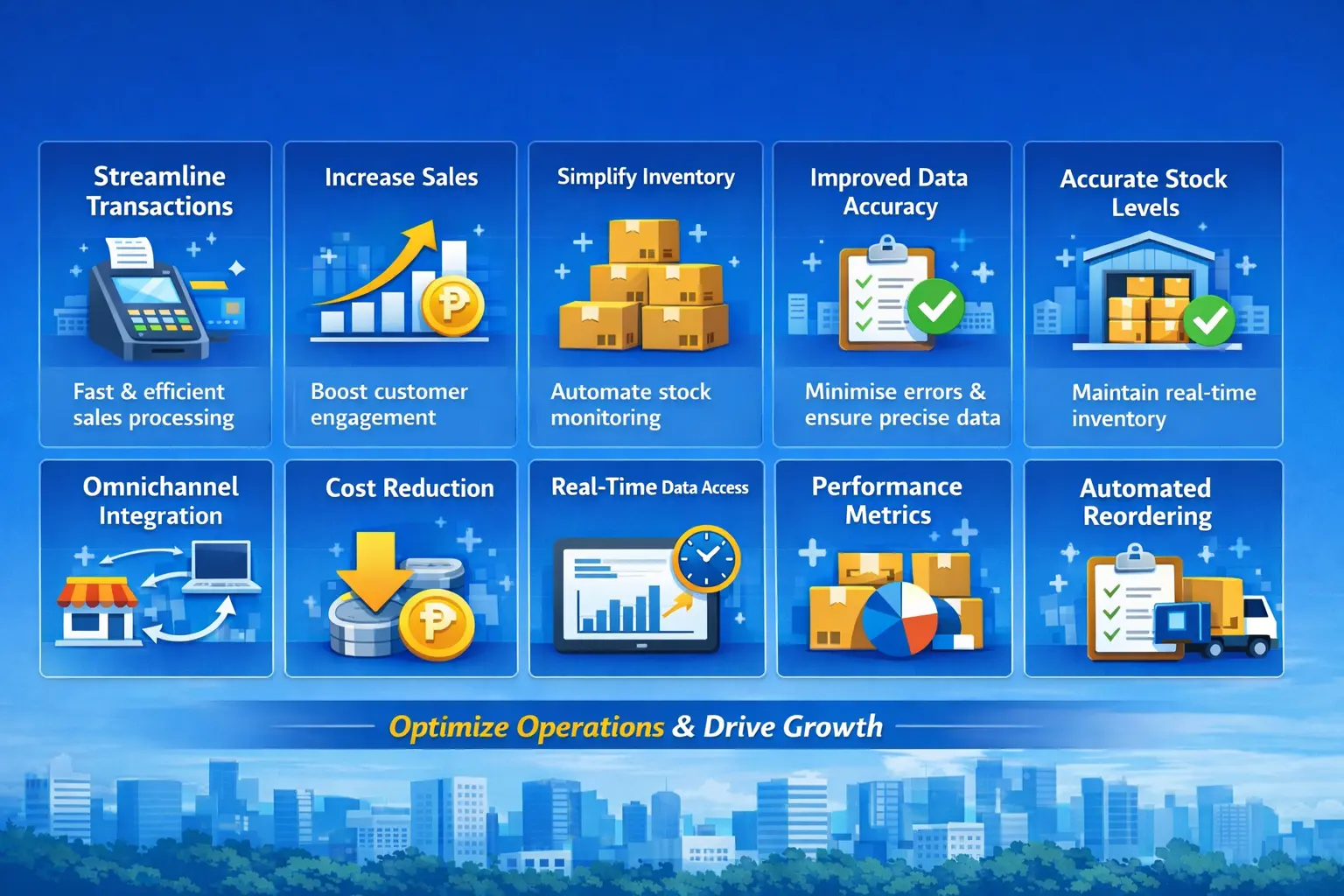
Implementing retail management software offers many benefits to Philippine businesses. It simplifies the stock management process and drives sustainable sales. Below are 10 important benefits of retail software for businesses.
1. Streamline the transaction process
Retail management software seamlessly automates and integrates various business processes, covering everything from inventory management to sales tracking and customer relationship management (CRM). The software also enhances the transaction process through an efficient point-of-sale (POS) system in the business ensuring fast and efficient payments.
This integration and automation significantly reduce the time and effort required for manual tasks, resulting in more efficient operations. As a result, staff members can dedicate more time to strategic activities, fueling overall business growth and improving customer satisfaction.
2. Increase sales
Driving sales growth is one of the benefits of retail management software, by improving customer service, optimizing targeted marketing efforts, and ensuring efficient inventory management. With features such as CRM management, businesses can facilitate personalized marketing campaigns and promotions that resonate with their audience.
3. Simplify inventory management
Another benefit of retail management software improves inventory management by automating the tracking and recording of stock levels. This automation significantly reduces the manual labor involved in inventory monitoring, making it easier to monitor stock items, reorder products when needed, and manage inventory in real-time across multiple locations.
With real-time inventory status updates, the software helps businesses maintain optimal stock levels, preventing overstocking and stockouts. This ensures that businesses can meet customer demands while minimizing the cost of excess inventory, ultimately leading to smoother operations and increased profitability.
4. Improved data accuracy
One of the key benefits of retail management software is its ability to enhance data accuracy. By automating data entry and integrating various business processes, the software minimizes human errors that often occur with manual data handling. This precise data accuracy is crucial for making informed decisions, generating reliable reports, and maintaining accurate financial records.
Additionally, the software’s ability to streamline inventory management ensures that best-selling products are consistently in stock, thus effectively meeting customer demand. This not only prevents lost sales due to out-of-stock but also increases customer satisfaction and loyalty, ultimately leading to increased sales and business growth.
5. Accurate stock levels
Maintaining accurate stock levels is critical to retail success, and retail management software excels in this area. The software provides real-time visibility into inventory across all sales channels so businesses can monitor stock levels accurately.
This ensures that businesses can immediately reorder products before they run out, thereby reducing the risk of out-of-stock and lost sales opportunities. Accurate stock levels also help optimize storage space and reduce excess inventory costs.
6. Omnichannel integration
Omnichannel integration is a crucial feature of retail management software that enables businesses to harmonize their sales and customer service operations across various channels. This integration ensures that inventory, sales, and customer data are seamlessly synchronized between physical stores, online shops, and multiple marketplaces, providing a unified and cohesive approach.
Moreover, businesses gain significant advantages in inventory management through real-time data synchronization, which helps prevent stockouts and overselling. This improved inventory control not only boosts sales but also enhances operational efficiency, ensuring that businesses can meet customer demand effectively and maintain smooth operations.
7. Cost reduction
Implementing retail management software can significantly reduce operational costs. By automating routine tasks such as inventory management, sales processing, and accounting, businesses can minimize labor costs and reduce errors associated with manual processes. This efficiency leads to lower operational expenses and maximizes profitability.
8. Real-time data access
The ability to access real-time data is a significant advantage of retail management software. Managers can monitor sales, inventory, and customer behavior in real-time, enabling them to make informed decisions quickly. This agility helps businesses respond to market changes and customer demands more effectively.
9. Performance metrics
Retail management software offers robust reporting and analytics capabilities. Businesses can track key performance indicators (KPIs) such as sales trends, inventory turnover, and customer engagement. These insights help managers make data-driven decisions to optimize performance and drive growth.
10. Automated reordering
Automated reordering features help maintain optimal inventory levels. The system can automatically generate purchase orders based on predefined thresholds and historical sales data, ensuring that stock is replenished quickly. This automation reduces the risk of stockouts and overstocking, improving inventory management.
By leveraging these benefits, businesses can optimize operations, improve customer satisfaction, and achieve sustainable growth. Implementing retail management software is a strategic investment that can transform retail operations and drive long-term success.
Conclusion
Having Retail Management Software is a must for businesses in the Philippines. The software offers many benefits, from streamlining operations and improving inventory management to providing real-time data insights and increasing customer satisfaction. By integrating various business functions into a single platform, Retail Management Software ensures that businesses can synchronize data across multiple sales channels, thereby increasing loyalty and sales.
Choosing a comprehensive Retail Management Software serves as a strategic foundation for modernizing business operations. By prioritizing platforms that integrate CRM data, automated procurement, and multi-channel POS analytics, retailers can move beyond basic record-keeping toward data-driven decision-making. These advanced features are essential for synchronizing inventory across diverse storefronts and extracting the deep operational insights necessary to refine marketing strategies and sustain long-term growth in a competitive digital economy.
FAQ About Retail Management Software
-
What is retail management software and why is it essential for Philippine businesses?
It is an integrated digital tool that automates operations like inventory and sales, which is crucial for staying competitive in a Philippine retail market projected to reach USD 96.02 billion by 2029.
-
What are the core features of the best retail management software for increasing sales?
Top-tier systems must include efficient Point of Sale (POS) integration, CRM management for personalized marketing, and real-time inventory tracking to prevent stockouts and drive growth.
-
Why is automated reordering vital for cost reduction in retail businesses?
Automated reordering maintains optimal stock levels by generating purchase orders based on real-time data, which minimizes excess inventory costs and manual labor errors.
-
How does a retail management system streamline omnichannel operations?
The software harmonizes sales and customer data across physical stores, online shops, and marketplaces through real-time synchronization to ensure a unified shopping experience.