






Employee compensation is a highly complicated process for both human resources professionals and employees alike. Understanding the precise distinctions between various pay components is a fundamental aspect of financial literacy and strategic workforce management. At the heart of this financial ecosystem lies a common point of confusion that has sparked countless questions: the critical distinction between different tiers of compensation.
Many see an employment contract as having a straightforward monetary exchange for services rendered. However, in reality, they pay by balancing competitiveness, fairness, and compliance. By clearly explaining the difference between basic salary and gross salary, organizations can increase transparency, strengthen psychological contracts with their workforce, and ensure accurate, fair, and legally compliant payroll.
Table of Contents
Key Takeaways
|
Understanding the Fundamentals of Employee Compensation
Compensation is the total cash and non-cash payments that an organization gives to an employee in exchange for their service. It’s designed so that they stay competitive in the market, maintain fairness across roles, and meet regulatory requirements. This approach helps businesses attract talent, support employee trust, and manage compensation more consistently.
The Evolution of Payroll Structures
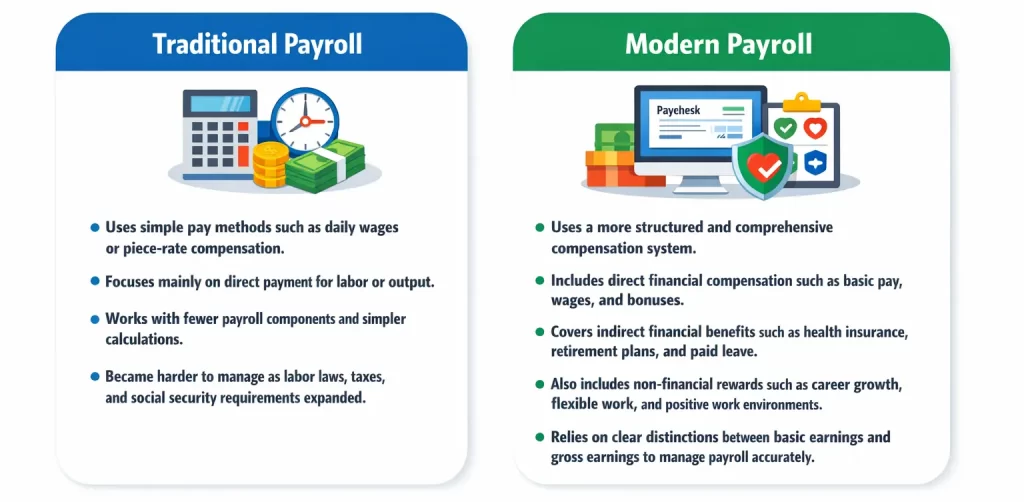
Historically, compensation was just a flat rate payment in exchange for a day’s labor. But it all changed during the modern age. When laws, tax systems, social security programs, and corporate structures became more complex, so did the compensation packages. Here are the key different elements of traditional and a modern multifaceted payroll structure:
The Importance of Clear Payroll Terminology
Clear terminology is a must for human resources and accounting. Vague terms can lead to misaligned expectations, administrative errors, and potential legal disputes. For instance, if a candidate negotiates a “salary of ₱30,000,” it is crucial to clarify whether this figure represents the basic pay, the gross pay, or the total Cost-to-Company (CTC). Clear terminology is also a legal imperative; government tax authorities and labor departments have specific definitions for various pay components.
What is Basic Salary?
At the very core of any employment contract lies the basic salary. It is the fundamental building block of an employee’s compensation package. It functions as the primary metric for evaluating the financial value of a specific job role within an organization. Knowing its characteristics is the first step in mastering payroll management.
Definition and Core Characteristics
Basic salary is the guaranteed amount of money paid to an employee in return for the work. It is based on the initial figure before any additions (allowances, bonuses, or overtime) and deductions (taxes, insurance premiums, or retirement contributions). Payment is given over a specific period, typically a month or a year.
Basic salary, at its core, is about stability. The pay stays fixed, and they will get paid as long as employees fulfill their standard working hours. Therefore, it can be a reliable source of income that employees can depend on for their primary financial planning.
Factors Influencing Basic Salary Calculations
Determining the appropriate basic pay for a specific role is a complex process that involves significant research and strategic decision-making by HR professionals. Several key factors influence this calculation:
- Job Evaluation and Internal Equity: Organizations use job evaluation methodologies to assess the relative worth of different roles within the company. Factors such as the level of responsibility, required skills, complexity of tasks, and decision-making authority are analyzed to ensure that internal pay structures are fair and equitable.
- Market Benchmarking: HR departments conduct extensive market research and participate in salary surveys to understand the going rate for specific roles in their industry and geographic location. To remain competitive and attract top talent, a company’s basic pay offerings must align with or exceed market averages.
- Employee Qualifications and Experience: An individual’s educational background, specialized certifications, and years of relevant experience significantly impact their starting basic pay. Candidates with highly sought-after skills or extensive industry knowledge typically command higher base salaries.
- Geographic Location and Cost of Living: The cost of living in the area where the employee resides or works plays a crucial role. Roles based in major metropolitan areas with high living costs generally offer higher basic salaries compared to similar roles in rural or lower-cost regions.
The Role of Basic Salary in Total Rewards
Basic pay only forms one part of the total compensation package, but it carries much more weight in payroll calculations. Companies use it as the foundation for many pay-related decisions because bonuses, retirement contributions, and salary increases often depend on this fixed amount. Basic pay also plays a direct role in tax compliance. Since it represents guaranteed income, employers must treat it as fully taxable and withhold the required income tax before releasing the employee’s final pay.
What is Gross Salary?
Gross salary represents all the direct financial compensation before any deductions from the tax authorities and other institutions. It provides a comprehensive view of the total monetary value an employer is providing within a specific pay period.
Definition and Components of Gross Pay
Gross salary refers to the total amount of money an employee earns over a specific period. It includes the basic pay along with all additional financial benefits, allowances, and variable pay components before employers apply any statutory or voluntary deductions. This amount appears as the “top line” figure on an employee’s payslip. Employers add several components on top of the basic pay, and these additions generally fall into three categories: standard allowances, variable pay, and situational earnings.
Standard Allowances
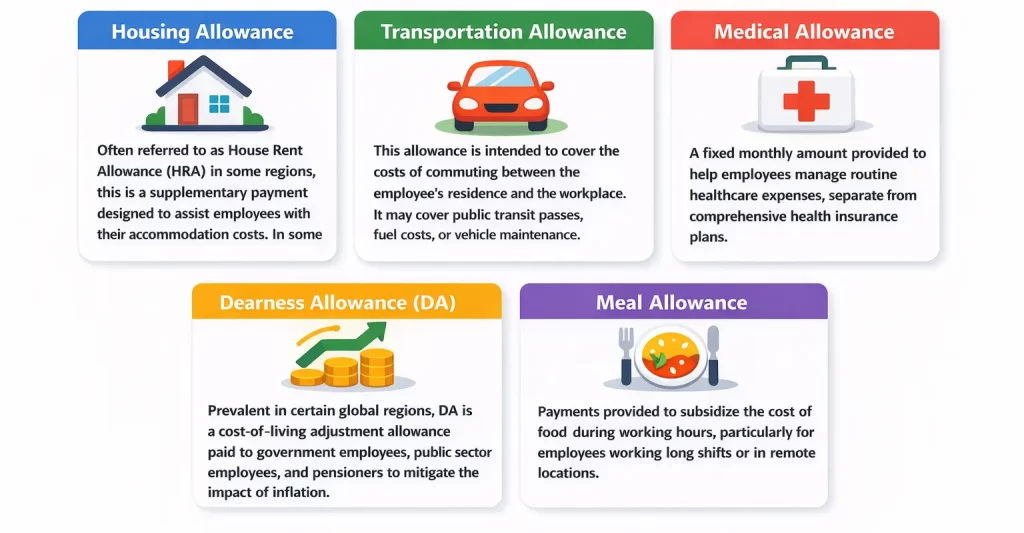
Allowances are fixed monetary amounts provided by the employer to help employees cover specific expenses associated with their job or their general well-being. The types and amounts of allowances vary significantly depending on the industry, geographic location, and corporate policies. Common allowances include:
Variable Pay and Performance Incentives
Unlike standard allowances, variable pay fluctuates based on specific performance metrics, company profitability, or other predetermined criteria. These components are designed to motivate employees and align their financial interests with the success of the organization.
- Bonuses: These can take many forms, including annual performance bonuses, holiday bonuses, sign-on bonuses, or retention bonuses. They are typically discretionary or based on achieving specific corporate or individual goals.
- Commissions: Highly common in sales roles, commissions are a percentage of the revenue generated by the employee. For a sales executive, commissions can often make up a larger portion of their gross pay than their basic pay.
- Profit-Sharing: A system in which employees receive a direct share of the company’s profits, usually distributed annually or quarterly.
Situational Earnings: Overtime and Shift Differentials
Gross pay also includes earnings that are dependent on the specific hours or conditions worked during a given pay period.
- Overtime Pay: When hourly or non-exempt employees work beyond their standard scheduled hours (typically 40 hours per week in many jurisdictions), they are legally entitled to overtime pay. This is usually calculated at a premium rate, such as “time and a half” (1.5 times their regular hourly rate derived from their basic pay).
- Shift Differentials: Employees who work less desirable shifts, such as night shifts, weekends, or public holidays, may receive a shift differential, like an additional hourly rate for those specific hours, to compensate for the inconvenience.
Gross Salary Formula and Case Study
The formula for calculating Gross Salary can be summarized as:
Gross Salary = Basic Salary + Allowances + Bonuses + Commissions + Overtime + Other Earnings.
Below this is an example that can be seen in real-life:
Gabriel works as a data entry specialist at Work Solution in the Philippines. He receives a basic salary of ₱18,000 as his fixed monthly pay for completing his regular duties and ₱4,000 in allowances for his food allowance, transportation allowance, and internet support for work-related needs.
Additionally, he earns a ₱2,000 bonus for meeting monthly accuracy and productivity targets. Gabriel earns ₱1,500 in commissions when the company gives incentives for helping process client accounts faster or supporting additional billable output. After working beyond regular office hours to meet deadlines, he was given ₱1,200 in overtime pay. Lastly, he receives ₱800 in other earnings, which may come from holiday pay, night differential, or special attendance incentives.
Gabriel’s Gross Salary = ₱18,000 + ₱4,000 + ₱2,000 + ₱1,500 + ₱1,200 + ₱800
In total, his gross salary is ₱27,500.
Basic Salary vs Gross Salary: A Comprehensive Comparative Analysis
It is crucial to examine the relationship and the key differences between basic salary and gross salary. Understanding this dichotomy is essential for HR professionals designing compensation packages and for employees evaluating job offers:
| Basic Salary | Gross Salary |
| Basic salary serves as the fixed and guaranteed foundation of employee compensation. It stands on its own as the minimum pay for work performed and supports other payroll calculations, including bonuses, increments, and benefit-linked computations. | Gross salary represents the full earnings package before deductions. It combines basic salary with allowances, bonuses, overtime, commissions, and other earnings, so it depends on basic salary as the core element that shapes the total compensation amount. |
| Employers treat basic salary as fully taxable income because it represents guaranteed pay. Tax authorities require companies to withhold income tax from this amount, which makes it one of the most straightforward and consistent elements in payroll taxation. | Gross salary includes total earnings, but not every component follows the same tax treatment. Some allowances may qualify for partial or full tax exemptions under local rules, so gross salary does not always match the employee’s total taxable income. |
| Employers usually use basic salary to calculate statutory contributions, pension, provident fund, and other long-term benefits. Because of this, a stronger basic salary can improve retirement savings and support better government-linked compensation obligations over time. | Gross salary may raise take-home pay, but it does not always improve statutory contributions and long-term benefits. When employers place more value on allowances instead of base pay, employees may enjoy higher short-term earnings while reducing future contribution-based retirement benefits. |
The Employer vs. Employee Viewpoint
Employers and employees often view the basic vs gross dynamic through different lenses based on their respective financial priorities.
The Employer’s Perspective: Many organizations keep basic salary at a manageable level while increasing gross pay through allowances and variable pay. This approach helps control fixed costs. Keeping basic pay low reduces the company’s long-term financial liabilities since it determines the cost of statutory contributions, overtime, and severance. At the same time, variable pay lets companies reward performance without raising long-term payroll obligations.
The Employee’s Perspective: Employees, conversely, generally benefit from a higher basic salary. A higher base provides greater financial stability, ensures larger contributions to retirement funds, guarantees higher payouts for overtime work, and results in better severance or redundancy packages if employment is terminated. While high allowances might offer short-term tax advantages, a robust basic pay is generally indicative of long-term financial security.
Tailoring Basic and Gross Salary in Specific Industries
Basic salary and gross salary remain constant across the business world. However, the way these compensations are used varies wildly depending on the industry. Different sectors leverage the ratio between basic and gross pay to achieve specific strategic business goals. Here are the key differences in different industries:
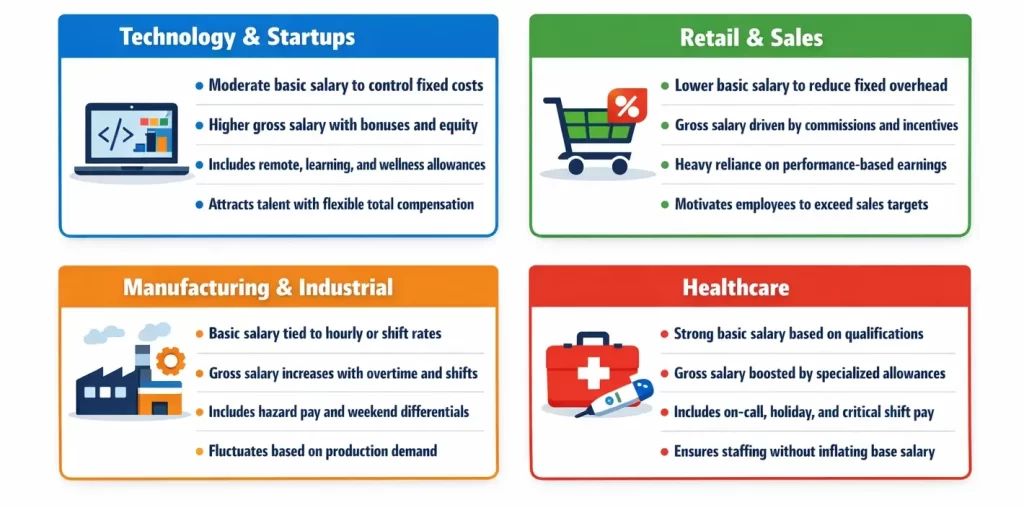
Understanding these industry-specific use cases provides valuable insight into how compensation strategies are deployed in the real world.
Strategic Implementation: Steps to Structure Compensation Packages
Designing the optimal split between basic salary and gross salary requires a methodical, data-driven approach. Human resources and payroll professionals must carefully construct these packages to ensure they are competitive, legally compliant, and financially sustainable. Here are the critical steps for implementing a robust salary structure:
Step 1: Conduct Comprehensive Market Benchmarking
The first step in structuring compensation is determining the market rate for a specific role. Organizations must utilize salary surveys and industry benchmarks to establish a competitive basic salary. This foundational figure must be strong enough to attract talent but sustainable enough to allow room for additional allowances and benefits that will eventually make up the gross salary. Benchmarking ensures that the core of the compensation package aligns with industry standards and geographic economic realities.
Step 2: Define the Allowance and Benefits Framework
After establishing the basic salary, organizations must decide which allowances will be added to calculate the gross salary. This involves analyzing the specific needs of the workforce and the tax implications of various allowances. Common additions include housing allowances, transportation stipends, and meal vouchers. The HR team must decide whether these allowances will be fixed or variable. This framework bridges the gap between the base rate and the total gross figure presented to the candidate.
Step 3: Establish Performance and Variable Metrics
Companies must integrate variable pay components to finalize the gross salary structure. This step requires close collaboration with department heads to define what triggers bonuses, commissions, or profit-sharing payouts. Clear, quantifiable metrics must be established so employees understand exactly what they need to achieve to maximize their gross salary. This step is crucial for ensuring that variable pay drives the desired business outcomes without creating unpredictable spikes in payroll liabilities.
Step 4: Ensure Legal and Tax Compliance
Undergo a rigorous compliance review before rolling out a new compensation structure. Payroll teams must verify that the basic salary meets or exceeds all local, state, and national minimum wage laws. Furthermore, they must ensure that the categorization of allowances within the gross salary complies with tax authority regulations. Misclassifying a taxable allowance as a non-taxable benefit can lead to severe financial penalties for both employers and employees.
Step 5: Execute Transparent Communication
The final, and often most overlooked, step is the communication of the salary structure to the employee. HR should provide a detailed breakdown of the basic salary vs gross salary during the onboarding process. Employers should provide clear pay breakdowns that show allowances, gross salary, deductions, and the final net pay employees receive. Transparency at this stage prevents future disputes and builds trust.
Common Pitfalls in Salary Structuring
Organizations frequently make critical errors when designing their compensation structures. Mismanaging the delicate balance between basic salary and gross salary can lead to legal liabilities, increased turnover, and administrative chaos. Recognizing these pitfalls is essential for any HR professional or business owner. So, here are the common pitfalls that you have to keep in mind:
| Pitfall | Impact |
| Artificially deflating basic salary by shifting value into allowances | Triggers compliance risks, audits, fines, back-pay liabilities, and potential legal action due to reduced statutory contributions |
| Overcomplicating gross salary with too many micro-allowances | Increases payroll errors, slows processing, complicates tax calculations, and confuses employees about actual earnings |
| Ignoring regional tax and labor regulations in salary structuring | Leads to compliance violations, incorrect taxation, inconsistent take-home pay, and employee dissatisfaction across locations |
| Misalignment of allowances with actual employee working conditions | Creates financial inefficiency, outdated benefits, and reduced employee satisfaction due to irrelevant or missing allowances |
Advanced Practices in Compensation Management

Forward-thinking organizations have evolved and adapted and are adopting advanced practices to optimize their compensation strategies. They leverage technology, data analytics, and progressive HR philosophies. By doing so, they are moving beyond traditional payroll processing to create dynamic, highly effective salary structures.
Dynamic Compensation Modeling and Predictive Analytics
Modern HR departments are increasingly utilizing predictive analytics and dynamic modeling software to design their salary structures. Instead of relying on static spreadsheets, these tools allow payroll professionals to simulate how changes to the basic salary will impact the overall gross salary and, consequently, the company’s total payroll budget.
For example, if a company decides to increase the basic salary by 4% to combat inflation, the modeling software instantly calculates how this will compound across overtime rates, percentage-based bonuses, and employer tax liabilities. This foresight prevents budget overruns and ensures long-term financial stability.
Personalized Total Rewards and Cafeteria-Style Compensation
Advanced organizations are implementing “cafeteria-style” compensation models to handle the diverse needs of a diverse workforce. In this approach, the employer guarantees a fixed basic salary but offers employees a set budget to build their own gross salary additions. An employee with a family might choose to allocate their allowance budget toward childcare stipends, while a younger single employee might choose student loan repayment assistance. This maximizes the perceived value of the gross salary without increasing the employer’s bottom-line cost.
Real-Time Payroll Integration and Earned Wage Access (EWA)
The traditional monthly or bi-weekly payroll cycle is being disrupted by Real-Time Payroll integration. Advanced Human Resources Information Systems (HRIS) now calculate the gross salary on a daily or even hourly basis, factoring in basic salary accrual, real-time commission data, and daily allowances.
This technological leap enables the implementation of Earned Wage Access (EWA). EWA allows employees to withdraw a portion of their accrued gross salary before the official payday. This practice provides immense financial flexibility for employees, reduces financial stress, and serves as a powerful retention tool.
Rigorous Pay Equity Audits
In response to growing demands for workplace fairness and increasing legislative pressure, advanced organizations are conducting regular, rigorous pay equity audits. These audits analyze the structural breakdown of basic salary vs gross salary across different demographic groups to identify hidden biases.
For instance, an audit might reveal that men and women are being paid the same amount of basic salary, but the men have a disproportionate amount of allowances or bonuses. By identifying these companies can correct structural imbalances, ensure true pay equity, maintain compliance with equal pay legislation, and foster a culture of genuine inclusion and fairness.
Conclusion
Basic salary forms the core of employee pay, while gross salary reflects total earnings before deductions. When companies understand both, they build fairer compensation, improve payroll accuracy, and reduce compliance risks. To manage this well, businesses need to find the best HRIS platform that supports better HR payroll decisions. With the system, you can organize salary structures, allowances, and payroll data easily and efficiently.
FAQ for Basic Salary and Gross Salary
-
How to calculate a basic salary?
Calculate basic salary by using the fixed amount an employer pays for regular work hours before adding allowances, bonuses, overtime pay, or other earnings.
-
What are examples of basic pay?
Examples of basic pay include a monthly salary, daily wage, or hourly wage that covers regular working days and standard working hours only.
-
What is the difference between gross salary and net salary?
Gross salary shows total earnings before deductions. Net salary shows the amount employees actually receive after taxes and statutory contributions.
-
Is gross salary taxable in the Philippines?
Yes, gross salary can be taxable in the Philippines, but employers first exclude non-taxable benefits and apply allowed deductions before computing withholding tax.