






Organizations today face increasing pressure to achieve better results while using resources efficiently, making the productivity index an increasingly important metric in modern business operations.
Evaluating efficiency often involves comparing inputs such as time, labor, and materials with the outputs produced. This comparison helps businesses identify operational gaps, set realistic performance benchmarks, and make more informed decisions.
By using the productivity index as a measurable reference point, organizations can monitor performance consistently and uncover opportunities to improve efficiency across projects and daily operations.
Table of Contents
Key Takeaways
|
What Is a Productivity Index?
A productivity index is a quantitative metric used to measure operational efficiency by comparing the output produced to the input consumed. It helps companies track performance over time and compare efficiency across teams or projects.
In general, a higher productivity index indicates greater efficiency, meaning more output is generated from the same or fewer inputs. A value of 1.0 is commonly used as a performance benchmark, where values above it reflect improved efficiency.
By using the productivity index, managers and business leaders can rely on objective data to assess strategic operational performance, support better decision-making, and encourage continuous improvement across operations.
Why Is the Productivity Index Crucial for Your Business?
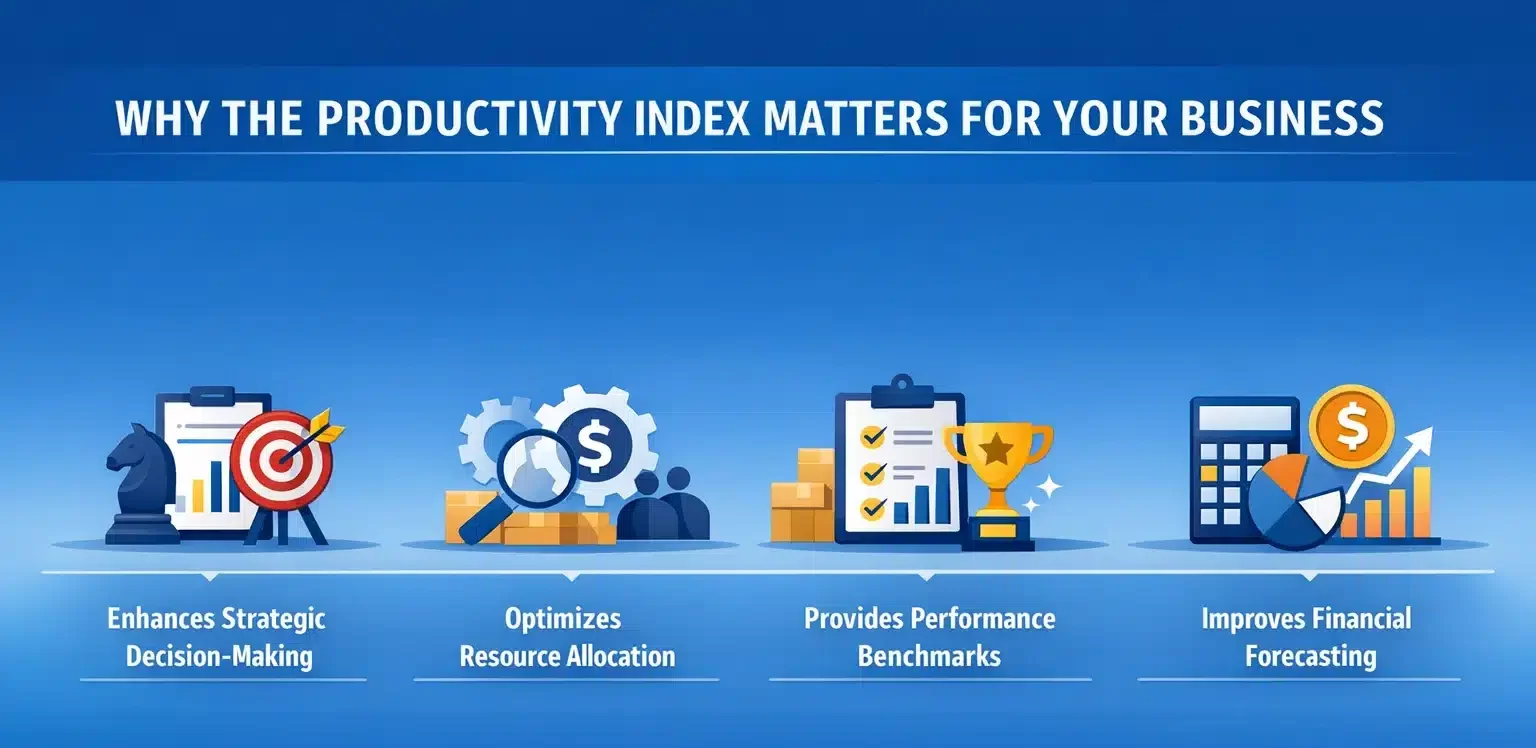
The productivity index is more than just a metrics, it helps businesses measure efficiency and make better operational decisions. By providing clear visibility into performance across departments and processes, companies can identify issues early.
It also serves as a reliable basis for setting KPIs and evaluating results. With measurable benchmarks in place, organizations can encourage continuous improvement, strengthen accountability, and support long-term business growth.
1. Enhances strategic decision-making
The productivity index provides quantitative data that helps executives make more precise strategic decisions. Instead of relying on intuition, leaders can identify efficient departments, high-ROI projects, and areas that need investment in technology.
This insight supports better planning for expansion, operational improvements, and budget allocation, ensuring resources are directed toward activities that create the most value and sustain long-term growth.
2. Optimizes resource allocation
With a clear understanding of productivity across various business areas, management can allocate resources such as labor and materials more effectively. If one team or project consistently demonstrates a high productivity index, the company can analyze their best practices.
Conversely, areas with a low index signal the need for intervention, whether through additional resources or process re-engineering, to prevent waste and ensure that every asset contributes optimally to the company’s objectives.
3. Provides objective performance benchmarks
The productivity index eliminates ambiguity in performance evaluation by providing clear, measurable benchmarks. This allows for fair comparisons between different teams or even facilities, as well as tracking progress over time against established standards.
Having objective benchmarks also helps in setting realistic targets and motivating employees by giving them clear goals to achieve. This transparency can boost morale and create a healthy competitive environment focused on continuous improvement.
4. Improves financial forecasting and budgeting
Accurate productivity data is directly linked to a company’s financial health, especially in the context of expense variance analysis. By knowing how much output can be expected from a certain amount of input, the finance team can create more accurate forecasts.
When deviations from the budget occur, an analysis of the productivity index can help explain why it happened, whether due to a drop in efficiency, external market factors, or other operational issues.
How to Calculate the Productivity Index with Practical Examples
The productivity index is calculated by dividing total output by total input, but its usefulness depends on defining both elements clearly within the business context. The selected metrics should reflect meaningful results and the resources used to achieve them.
First, determine the output, such as units produced, projects completed, or customers served. Then identify the inputs, including labor hours, material costs, or machine time. Accurate data collection is essential for reliable measurement.
After applying the formula Productivity Index = Total Output ÷ Total Input, the result can be compared with past performance or benchmarks to evaluate efficiency and guide improvement efforts.
Example in the construction industry
In a construction project, a team is tasked with installing 1,000 square meters of drywall within a workweek (40 hours) with 5 workers. The total labor hours (input) are 5 workers × 40 hours = 200 labor hours.
If at the end of the week they successfully install 1,200 square meters (output), their labor productivity is 1,200 m² / 200 hours = 6 m²/hour. If the established baseline was 5 m²/hour, their Productivity Index is 6 / 5 = 1.2, indicating a performance 20% above the target.
Example in the manufacturing sector
A factory has a machine scheduled to operate for 8 hours a day to produce widgets. In one day, the machine consumes 500 kWh of electricity (input) and successfully produces 2,000 widgets (output).
The machine’s productivity is 2,000 widgets / 500 kWh = 4 widgets per kWh. If in the previous month, with the same type of input, the machine only produced 1,800 widgets, there is a productivity increase that needs further analysis.
Example in the service industry
A client service operations team consisting of 10 agents works a total of 80 hours in one day (input). During that time, they successfully resolve 400 customer complaint tickets (output).
The team’s productivity is 400 tickets / 80 hours = 5 tickets per labor hour. This metric can be used to track the team’s efficiency from day to day and identify needs for training or system improvements if productivity declines.
A Step-by-Step Guide to Implementing Productivity Index Measurement
Effectively implementing productivity index measurement requires a structured approach that goes beyond simply calculating numbers. Businesses need to build a sustainable system for data collection, analysis, and corrective action.
Accurate and consistent data is essential to avoid misleading results and poor decision-making. Using structured procedures or automated systems can help maintain data integrity and ensure the productivity index reflects actual business performance.
1. Define clear objectives and scope
Start by setting your specific goals. For example, “Reduce labor cost per unit by 10% in the next 6 months” or “Increase the number of tasks completed per week by the development team by 15%.”
Also, define the scope: will you measure productivity for the entire company, a single department, or a specific project? This clarity ensures your efforts are focused and the results are directly tied to strategic business outcomes.
2. Identify relevant inputs and outputs
Based on your objectives, identify the most relevant input and output metrics. For a construction project, inputs could be labor hours, and equipment rental hours, while the output could be cubic meters of concrete poured or the number of units installed.
Ensure these metrics are easy to measure consistently and accurately. The selection of these variables is critical as they form the foundation of your entire productivity analysis, as highlighted by research from institutions like the McKinsey Global Institute.
3. Establish a data collection system
Determine how you will collect input and output data in a consistent and reliable way. Manual processes such as timesheets or daily reports are often prone to errors, duplication, and delays, which can reduce the accuracy of productivity measurements.
To improve data accuracy and timeliness, consider using a centralized system like construction management software or an ERP system that can automatically track work hours, material usage, and project progress in real time.
4. Calculate and analyze the index regularly
Set a frequency for calculating and reviewing the productivity index, such as weekly or monthly. Calculate the index and compare it with previous periods or with established benchmarks.
Analyze its trends: is there an improvement, a decline, or stagnation? Investigate the reasons behind any significant changes. This regular review cycle is essential for proactive management rather than reactive problem-solving.
5. Take action based on insights
Use the analysis results to take concrete actions. If productivity declines, investigate the root cause and implement corrective solutions. If productivity improves, identify the contributing factors and apply those best practices to other areas of the business.
Sharing these results with the team is equally important. Clear communication helps build transparency, align everyone with efficiency goals, and encourage a culture of continuous improvement across the organization
Case Study: Leveraging Constrcution Technology to Automate Productivity Index Tracking
BSPT Construction faced difficulties tracking productivity across projects due to manual reporting of labor hours, material usage, and project progress. This often delayed productivity index calculations and made performance monitoring less accurate.
To solve this, BSPT Construction implemented HashMicro’s Construction Suite to automatically collect project data in one system. The software integrates timesheets, materials, and progress tracking, enabling real-time productivity index monitoring.
With automated tracking, managers can quickly identify inefficiencies, allocate resources more effectively, and improve decision-making across construction projects. As a result, BSPT Construction also gained better visibility and was able to improve operational efficiency across projects.
Conclusion
The productivity index is a practical tool for understanding operational efficiency and improving business performance. It helps companies identify improvement opportunities, allocate resources more effectively, and build a data-driven performance culture.
Consistently measuring productivity with accurate data allows leaders to evaluate performance trends and make better strategic decisions. This ongoing analysis supports continuous improvement across operations.
Technology helps simplify productivity tracking through automated data collection and real-time insights. To get started, you can schedule a free consultation to find the right productivity measurement approach for your business.

Frequently Asked Questions
-
What is the main difference between productivity and efficiency?
While often used interchangeably, productivity measures the volume of output per unit of input (e.g., 10 units per hour), whereas efficiency compares actual performance against a standard or maximum potential.
-
How often should I measure the productivity index?
The frequency depends on your business nature and operational cycle. For fast-moving construction or manufacturing projects, weekly measurement might be ideal. For other business functions, a monthly or quarterly review may be sufficient.
-
Can the productivity index be used to evaluate individual performance?
Yes, it can be, but it must be done carefully. The index is most effective for evaluating processes or team performance. If used for individuals, ensure that factors outside the employee’s control (like tool or material availability) are also considered to keep the evaluation fair.
-
What is considered a good productivity index value?
There is no universal number considered ‘good.’ The index value is relative and most useful when compared to your own past performance (trends) or against industry standards (benchmarks).