













It’s the last week of the quarter. Your accountant tells you the trial balance doesn’t match, there’s a ₱47,000 discrepancy somewhere across hundreds of journal entries. Now you’re pulling receipts, cross-checking bank statements, and pushing your BIR filing dangerously close to the deadline. Sound familiar?
That discrepancy almost always traces back to one thing: how your business records and organizes its financial transactions. In the Philippines, where MSMEs make up 99.6% of all registered businesses and the BIR continues tightening its requirements for computerized accounting systems, getting your general ledger right isn’t optional, it’s the difference between a clean audit and a compliance headache.
Below, you’ll find the building blocks of a solid general ledger system, a walkthrough of the accounting cycle, and practical fixes for the most common problems Philippine businesses run into.
Key Takeaways
|
Why Your General Ledger Is the Most Important Record in Your Business
Your general ledger is where every financial transaction ends up, every sale, purchase, payroll run, and expense. It’s the single source your financial statements pull from, and it’s what the BIR looks at during an audit.
But here’s what most business owners miss: the ledger isn’t just an accounting requirement. It’s the tool that tells you whether your Cebu branch is actually profitable, whether your cost of goods has been creeping up for three months, or whether you can afford to hire two more people next quarter. Without it, you’re guessing.
Here’s why keeping it accurate matters at every level.
It’s the foundation of every financial report you produce
Your balance sheet, income statement, and cash flow statement all come from the general ledger. If entries are wrong or missing, those reports are wrong too, and that affects everything from loan applications to investor confidence. For Philippine businesses, clean ledger data also means your BIR Form 1702, 2550M, and 2550Q filings are backed by traceable numbers rather than rough estimates.
It shapes the quality of your business decisions
When your ledger is current and accurate, you can spot patterns quickly. You’ll see which product lines have the highest margins, which months drain your cash flow, and where overhead is piling up. One retail chain owner in Metro Manila cut 12% off monthly operating costs just by reviewing ledger data that showed duplicate vendor payments going unnoticed for months. That’s the kind of insight a spreadsheet dump can’t give you.
It keeps you on the right side of Philippine regulations
The BIR requires businesses to maintain books of accounts, either manual or computerized, and to retain records for at least 10 years from the last entry. If you’re classified as a large taxpayer or you’re using any kind of accounting software, you’ll likely need to register under the Computerized Accounting System (CAS) or Computerized Books of Accounts (CBA) framework. Your general ledger needs to generate the reports the BIR expects: journal entries, subsidiary ledgers, and summary lists of sales and purchases. Falling short can mean audit flags, penalties, or disallowed deductions.
The Philippine Financial Reporting Standards (PFRS), which align with IFRS, also set the rules for how you recognize revenue, classify expenses, and present financial data. A clean ledger makes compliance with these standards far less painful.
It makes audits faster and cheaper
Whether it’s an internal review or an external audit, organized ledger data cuts the preparation time significantly. Auditors want clear transaction histories and supporting documents, not a folder of loose receipts and a prayer. When everything is categorized and reconcilable, your audit prep goes from weeks to days.
The Four Core Parts of a General Ledger System
A general ledger runs on four connected parts. Get anyone wrong, and your financial statements won’t add up.
1. Chart of Accounts (COA)
Think of the COA as your ledger’s filing system. It’s a structured list of every account, assets, liabilities, equity, revenue, and expenses, each with a unique code. A well-built COA makes reporting consistent and lets you slice data by branch, department, or cost center. For a Philippine MSME, this might mean separating accounts for your Makati showroom and your Cavite warehouse so you can see profitability per location.
2. Journal entries
Every transaction starts here. Journal entries record the date, the accounts affected, and the debit and credit amounts. Double-entry bookkeeping means every entry has matching debits and credits; that’s how the system catches mistakes early. These entries create the chronological log that auditors and the BIR trace back to when they review your books.
3. Trial balance
A trial balance is your checkpoint. It lists all accounts and their balances at a specific date, and confirms that total debits equal total credits. If they don’t, something’s off in your journal entries or posting. Catching it here is much cheaper than catching it during a BIR audit.
4. Financial statements
These are the final outputs: the income statement (how you performed), the balance sheet (what you own and owe), and the cash flow statement (where the money actually went). Together, they’re what lenders, investors, and the BIR use to evaluate your business.
The Accounting Cycle: How Ledger Entries Become Financial Statements
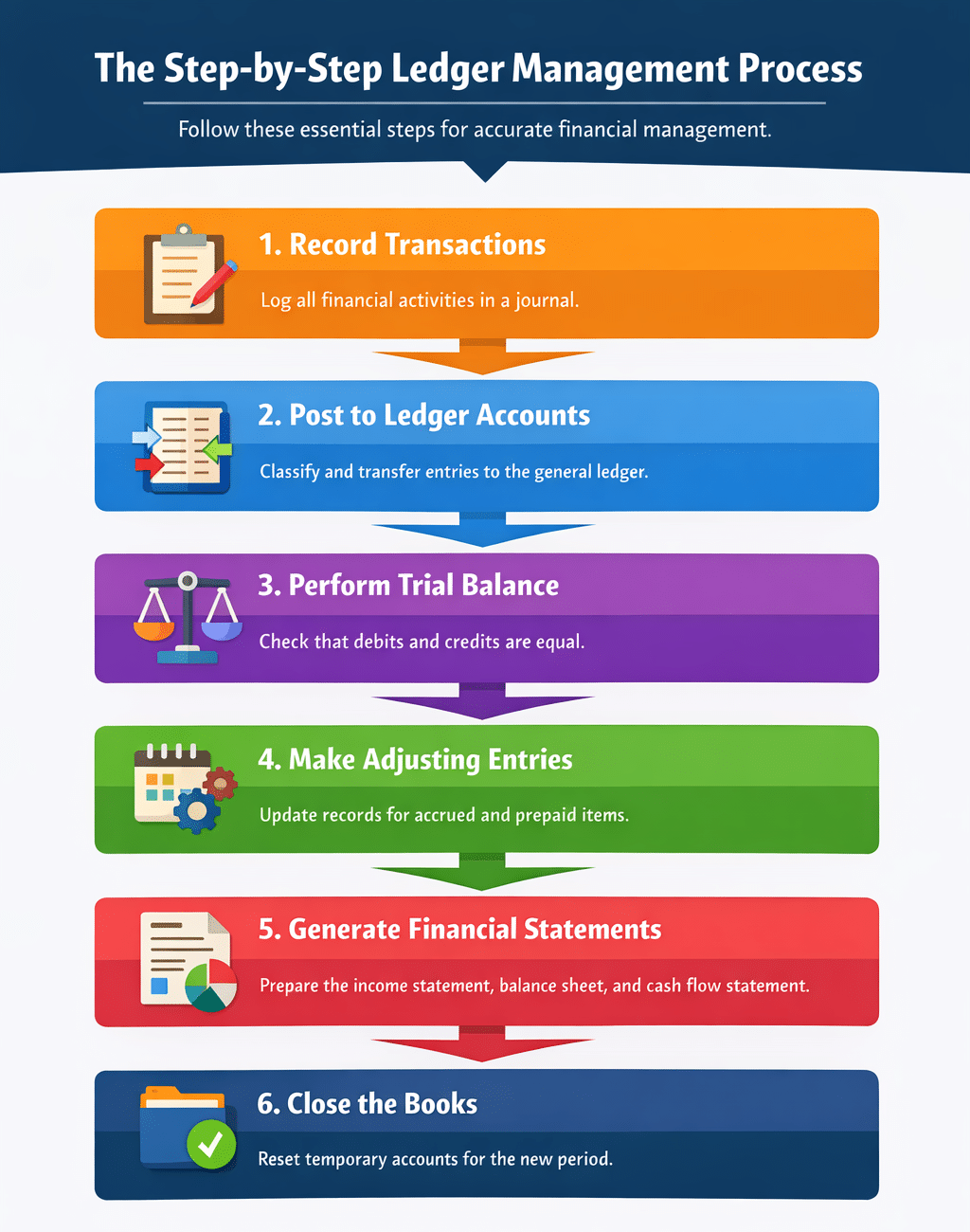
The process of maintaining your ledger follows a repeatable cycle, monthly, quarterly, or annually. Understanding the full record-to-report workflow helps you spot where breakdowns usually happen.
Step 1: Record every transaction as it happens
Every sale, purchase, and payment gets recorded in the journal the moment it occurs, backed by source documents like official receipts (ORs), sales invoices, or bank statements. This is where accuracy starts, and where most errors get introduced.
Step 2: Post entries to the right ledger accounts
Each journal entry gets classified and posted to the matching account in your COA. A cash sale, for example, increases both your Cash account and your Sales Revenue account. This step groups all activities for each account so you can see its running balance.
Step 3: Run a trial balance
Before you prepare any financial statements, run a trial balance to confirm that debits and credits match. If they don’t, go back and find the error. Don’t skip this, it’s far easier to fix a posting mistake now than after you’ve submitted your reports.
Step 4: Record adjusting entries
At the end of the period, you’ll need adjusting entries for things that don’t show up in day-to-day transactions: accrued salaries, prepaid insurance, depreciation, and unbilled revenue. These adjustments make sure your statements reflect the period they’re supposed to. For businesses tracking customer billing cycles, this step is where your accruals and deferrals come into play.
Step 5: Prepare your financial statements
With everything adjusted and balanced, you can generate the income statement, balance sheet, and cash flow statement. These are what your stakeholders, lenders, and the BIR need to evaluate your business.
Step 6: Close the books
Temporary accounts: revenue, expenses, dividends, get zeroed out and transferred into retained earnings. This resets the system for the next period and locks in your historical data.
Common Problems with Ledger Keeping (And How to Fix Them)
Most ledger problems aren’t complicated. They just compound over time. An Ernst & Young report on finance team productivity found that finance functions spend most of their time on transactional processing, leaving little room for the analysis that actually drives business decisions.
Here are the four issues that trip up Philippine businesses the most.
1. Too much manual data entry
If your bookkeeper is still copying invoice amounts into a spreadsheet by hand, you’re exposed to typos, transposed numbers, and misclassified accounts. A single decimal error in one entry can cascade into a trial balance that takes hours to untangle. The fix: use accounting software that pulls transaction data automatically from your POS, bank feeds, and procurement system.
2. Delayed ledger updates
When the ledger only gets updated weekly or monthly, you’re always looking at old data. You can’t make good cash flow decisions based on numbers that are two weeks stale. Cloud-based accounting systems solve this by posting transactions in real time, so your ledger balance at 2 PM today actually reflects what happened at 2 PM today.
3. Growing pains
A ledger setup that works for a single-branch retail store in Quezon City won’t hold up when you expand to three branches across Luzon. More transactions, more entities, multi-branch reporting, manual or semi-automated systems buckle under this pressure. That’s when businesses typically need an ERP system with a built-in accounting module that scales with them.
4. Security and compliance gaps
Your general ledger holds sensitive financial data. Shared passwords, no role-based access, and missing audit trails create fraud risks and BIR compliance issues. Under the BIR’s CAS/CBA framework, your system must generate accurate reports and maintain data integrity. Modern software solves this with user-level permissions, encrypted storage, and unalterable audit logs, which is exactly what the BIR expects during evaluation.

How Technology Changes the Game
Manual ledger management stops working once your business reaches a certain size. The shift to automated, cloud-based systems isn’t about chasing trends; it’s about eliminating the specific problems listed above.
Modern accounting software and ERP platforms connect your ledger to your sales, procurement, and inventory data. That means when a cashier processes a sale in your Alabang branch, the journal entry posts to the ledger automatically, no manual keying, no delay, no discrepancy between what your POS says and what your books say.
You also get features that used to be reserved for large enterprises: automated bank reconciliation, real-time dashboards, multi-branch consolidated reporting, and built-in tax computation aligned with Philippine requirements. For businesses looking at their options, a comparison of the top accounting software for Philippine businesses is a good starting point.
The real shift isn’t just efficiency, it’s turning your finance team from data entry operators into analysts who can actually influence business decisions.
Red Flags: 5 Signs Your Ledger Process Is Holding You Back
Not sure whether your current process is a problem? Check these warning signs:
- Your month-end close takes more than 10 business days. If your team is spending two weeks reconciling accounts and correcting errors, your process has outgrown your tools.
- You can’t produce a trial balance on demand. If generating a trial balance requires pulling data from three different spreadsheets and a WhatsApp thread with your bookkeeper, that’s a control failure.
- You’ve been flagged or questioned during a BIR audit in the past 2 years. Repeat findings usually trace back to incomplete ledger records or missing supporting documents.
- Your branch managers can’t see their own P&L. If branch-level profitability is a mystery until head office runs the numbers at quarter-end, you’re making decisions blind.
- You’re still using Excel as your primary ledger. Spreadsheets don’t enforce double-entry rules, don’t create audit trails, and don’t scale. They’re fine for tracking a side project, not for running a business that the BIR classifies as needing CAS or CBA.
If three or more of these apply, it’s worth evaluating whether your current setup can keep up with where your business is headed.
Quick Cost Comparison: Manual vs. Automated Ledger Management (PHP)
| Cost Factor | Manual / Spreadsheet | Cloud Accounting Software | ERP with Accounting Module |
|---|---|---|---|
| Monthly bookkeeper salary | ₱18,000 – ₱25,000 | ₱18,000 – ₱25,000 (reduced workload) | ₱18,000 – ₱25,000 |
| Software subscription | ₱0 | ₱1,500 – ₱5,000/month | ₱8,000 – ₱25,000+/month |
| Audit preparation time | 40 – 80 hrs/quarter | 15 – 25 hrs/quarter | 8 – 15 hrs/quarter |
| Error correction cost | High (manual re-checking) | Low (auto-validation) | Very low (real-time posting) |
| BIR CAS compliance readiness | ❌ Not compliant | ✅ If BIR-accredited | ✅ Typically BIR-accredited |
| Multi-branch reporting | Manual consolidation | Basic | Built-in consolidated view |
The cheapest option up front (spreadsheets) often turns out to be the most expensive once you factor in audit risk, error correction, and compliance gaps.
Conclusion
Getting your general ledger right isn’t glamorous work. But it’s the foundation that everything else — your financial reports, your tax filings, your business decisions — sits on.
For Philippine businesses, the stakes are higher than just “good bookkeeping.” BIR requirements around CAS and CBA are only getting stricter, and with e-invoicing mandates rolling out starting March 2026 for large taxpayers and CAS users, the margin for sloppy record-keeping is shrinking fast.
If your current process still depends on spreadsheets or manual posting, it’s worth looking at what automation can actually save you — in time, in audit stress, and in compliance risk. A good place to start is comparing which accounting tools actually fit your size, budget, and BIR requirements.
FAQ About Ledger and Accounting Records
-
What is the main purpose of a ledger?
A ledger serves as the central record of all company financial transactions, organized by account. It is the primary source used to prepare financial statements such as the balance sheet, income statement, and tax reports.
-
What’s the difference between a journal and a ledger?
A journal records transactions in the order they occur and acts as the first point of entry. A ledger then organizes those same transactions by account, allowing businesses to track balances and movements over time.
-
Why does double-entry bookkeeping matter?
Double-entry bookkeeping requires every transaction to be recorded in at least two accounts with equal debits and credits. This structure helps detect errors early, as unbalanced entries signal issues before financial statements are finalized.
-
Do I need BIR CAS accreditation if I use accounting software?
Yes. If your accounting software records transactions, generates journals or subsidiary ledgers, or produces reports required by the BIR, it generally needs to be registered under the CAS or CBA framework. Using software alone does not automatically mean BIR compliance without proper accreditation.