






In today’s digital era, customer expectations have fundamentally shifted. They no longer see online and offline channels as separate entities but expect an integrated and seamless shopping experience at every touchpoint. To meet this challenge, modern companies are turning to an omni-channel fulfillment strategy.
This is no longer just a trend but a strategic necessity for survival and success in a competitive market. A well-executed approach ensures that whether a customer buys online, in-store, or through a mobile app, the fulfillment process is smooth, fast, and consistent, directly impacting their satisfaction and loyalty.
This shift requires a complete reimagining of the supply chain, where inventory is no longer siloed but unified across all locations. By leveraging omni-channel technology to gain a single view of stock, businesses can make smarter fulfillment decisions, reduce costs, and accelerate delivery times.
This article will serve as your complete guide to understanding, designing, and implementing an effective omni-channel fulfillment strategy, from basic concepts to the metrics needed to measure its success, and to prepare your business for the demands of 2026 and beyond.
Key Takeaways
|
Table of Contents
What Is Omni-Channel Fulfillment?
Omni-channel fulfillment is a strategic approach to logistics and supply chain management where a company’s entire inventory, whether in warehouses, distribution centers, or physical stores, is integrated into a single, centralized system.
The primary goal is to fulfill customer orders from whichever location is most efficient, regardless of the channel through which the customer made the purchase. This customer-centric approach ensures that the ordering, shipping, and return processes are seamless and consistent across all platforms.
Unlike traditional methods that maintain separate stock pools for e-commerce and physical stores, the omni-channel model unifies them, providing maximum flexibility and efficiency. For example, a customer can order a product online and choose to pick it up at a nearby store (BOPIS).
This not only speeds up delivery but also helps liquidate store inventory more effectively. To fully grasp its power, it is essential to understand its core definition and how it fundamentally differs from the often-confused concept of multichannel.
Definition of omni-channel fulfillment
At its core, omni-channel fulfillment is defined by the integration of inventory, processes, and customer data across all sales and fulfillment channels. It treats the entire business network as a single entity, allowing orders to be sourced and fulfilled from the most logical point.
This strategy requires a sophisticated technological backbone, typically an integrated software system that provides real-time inventory visibility across the entire network. The ultimate objective is to meet customer demand as quickly and cost-effectively as possible.
Key differences with multichannel fulfillment
While both multichannel and omni-channel involve selling through multiple channels, their underlying philosophies are vastly different. Multichannel fulfillment operates with a siloed approach, where each channel manages its own inventory, operations, and customer data independently.
This often leads to disjointed customer experiences, such as being unable to return an online purchase in-store. The focus of multichannel is to provide customers with multiple places to buy, but the channels themselves do not interact with one another.
In contrast, omni-channel fulfillment is integrated and customer-centric, focusing on creating a single, unified experience across all touchpoints. The channels are not just present; they work together seamlessly.
For example, a customer might browse a product on their phone, try it in a store, and complete the purchase online later, with all data and interactions tracked under a single customer profile.
This integration allows for advanced fulfillment options like BOPIS and BORIS, which are impossible in a purely multichannel setup. Ultimately, while multichannel is about channel diversity, omni-channel is about customer experience unity.
Why Is Omni-Channel Fulfillment Crucial for Modern Business?

Adopting an omni-channel fulfillment strategy is no longer a luxury but a crucial investment for long-term business growth and sustainability. In a highly competitive retail landscape, companies that fail to provide a unified and convenient experience will inevitably be left behind.
The benefits of this implementation extend far beyond operational efficiency, as they directly impact customer perception, profitability, and the business’s ability to adapt to dynamic market conditions.
By elevating customer loyalty through enhanced convenience and flexibility, businesses can significantly increase their customer lifetime value. Furthermore, optimizing inventory turnover across the entire distribution network ensures that capital is not tied up in slow-moving stock, improving overall financial health.
This strategy empowers companies to turn their physical stores from mere points of sale into dynamic mini-distribution hubs. According to a report from McKinsey, companies that successfully integrate channels can see significant gains in customer satisfaction.
Improve customer satisfaction and loyalty
In the modern retail environment, convenience is king. Customers expect to shop on their own terms, and an omni-channel strategy directly addresses this demand by offering flexible fulfillment options.
The ability to buy online and pick up in-store (BOPIS) within hours, or return an online purchase at a local store (BORIS), removes significant friction from the shopping journey. This level of convenience demonstrates that a brand values its customers’ time, which is a powerful driver of satisfaction.
Optimize inventory management comprehensively
One of the most significant advantages of omni-channel fulfillment is the ability to achieve a single, enterprise-wide view of inventory. By breaking down the silos between e-commerce warehouses and retail stores, businesses can utilize their entire stock pool to fulfill any order.
This unified approach prevents common issues like online stockouts when the product is available in a nearby store, or conversely, having to offer deep discounts on excess store inventory.
It allows for smarter inventory allocation, reduces the risk of overstocking or understocking, and improves the overall inventory turnover rate, leading to better capital efficiency and higher profitability.
Increase operational efficiency and reduce costs
While the initial investment in technology can be substantial, an effective omni-channel strategy leads to significant long-term cost savings. By enabling ship-from-store, businesses can reduce shipping distances and delivery times, which in turn lowers logistics costs.
Fulfilling orders from a store closer to the customer is often cheaper and faster than shipping from a distant centralized warehouse. Furthermore, BOPIS reduces last-mile delivery expenses entirely.
This optimization also extends to labor efficiency, as store staff can be trained to handle fulfillment tasks during quieter periods, maximizing their productivity and turning every retail location into a valuable part of the supply chain network.
Expand market reach and sales flexibility
An omni-channel approach effectively blurs the lines between physical and digital commerce, allowing businesses to capture sales wherever and whenever customers are ready to buy.
A physical store is no longer limited by its foot traffic; it becomes a fulfillment hub that serves a broader geographic area through ship-from-store capabilities. This strategy also enables businesses to enter new markets without the need for a large physical footprint, using models like dropshipping.
This flexibility makes the business more resilient and adaptable to changing consumer behaviors and market disruptions, ensuring a consistent revenue stream across multiple integrated channels.
Exploring Key Omni-Channel Fulfillment Models
An omni-channel fulfillment strategy is not a one-size-fits-all solution; it is composed of various models that can be adapted to suit your operational capabilities, product types, and target market behaviors.
Each model offers unique advantages in meeting diverse customer expectations, from the demand for rapid delivery to the need for convenient returns. Understanding these models is the first crucial step in designing a fulfillment architecture that is most effective for your business.
For instance, the Buy Online, Pick-up In-Store (BOPIS) model leverages physical store assets to provide instant gratification to local customers, effectively merging the convenience of online shopping with the immediacy of traditional retail.
Meanwhile, Ship-from-Store transforms each retail location into a mini-distribution center, significantly speeding up delivery times and reducing logistical costs for online orders. As businesses evolve, they may also explore more advanced models, such as dark stores.
Buy online, pick-up in-store (BOPIS)/Click and collect
BOPIS, also known as Click and Collect, is a cornerstone of omni-channel retail. This model allows customers to browse and purchase products online and then collect them from a physical store location at their convenience.
It offers the best of both worlds: the ease of online shopping and the instant gratification of in-person pickup, eliminating shipping costs and wait times for the customer. For retailers, BOPIS drives foot traffic to stores, creating opportunities for additional in-store purchases.
It also allows businesses to leverage their existing store inventory and staff, turning each location into a convenient pickup point and enhancing the overall customer experience.
Ship-from-store
The ship-from-store model transforms physical retail locations into active distribution hubs for fulfilling online orders. When an e-commerce order is placed, the system identifies the store closest to the customer’s delivery address that has the item in stock and routes the order.
This approach offers several key benefits, including faster delivery times, lower shipping costs due to reduced distance packages travel, and improved inventory turnover by selling slow-moving store stock online.
It maximizes the value of a retailer’s physical footprint and helps meet customer expectations for quick and efficient delivery.
Buy online, return in-store (BORIS)
BORIS is another critical component of a seamless omni-channel experience, allowing customers to return products purchased online at any of the company’s physical stores. This model removes a major point of friction in the e-commerce journey, as managing return shipping can be a hassle for many consumers.
For businesses, BORIS offers a significant opportunity to save a sale; when a customer enters the store for a return, there is a high probability they will browse and make an exchange or a new purchase.
It also simplifies reverse logistics by consolidating returns at the store level, reducing return processing costs and getting products back into sellable inventory faster.
Integrated dropshipping
In an omni-channel context, dropshipping can be integrated to expand product assortments without increasing inventory risk. With this model, a business can list products from third-party suppliers on its website.
When a customer places an order for one of these items, the order is automatically forwarded to the supplier, who then ships the product directly to the customer. This allows a retailer to offer a much wider range of products, test new items with minimal financial commitment.
Dark stores and micro-fulfillment centers
Dark stores and micro-fulfillment centers (MFCs) are advanced fulfillment models designed to support high-volume online order fulfillment in densely populated urban areas. A dark store is a traditional retail location converted exclusively for fulfillment operations.
An MFC is a small, highly automated warehouse strategically placed within a city. Both models position inventory closer to the end customer, enabling ultra-fast delivery options like same-day or one-hour delivery.
Step-by-Step Guide to Implementing an Omni-Channel Strategy
Implementing omni-channel fulfillment is a significant business transformation that demands careful planning. This process involves much more than just adopting new technology; it requires a fundamental shift in workflows, inventory management, and even corporate culture.
To ensure a smooth transition that delivers the expected results, it is crucial to follow a structured, phased approach. This journey begins with a deep understanding of your current operational landscape, followed by the selection.
Once the technological foundation is in place, the next step is to redesign operational processes and train your teams to adapt to new ways of working. This includes establishing clear standard operating procedures (SOPs) for in-store fulfillment and ensuring consistent customer service.
A gradual rollout allows for testing, learning, and refinement before a full-scale launch, minimizing disruptions and maximizing the chances of success. Here is a four-stage guide to help you implement a successful omni-channel fulfillment strategy from the ground up.
Stage 1: Audit current systems and processes
The first step in any successful implementation is a thorough audit of your existing infrastructure. This involves mapping out your current fulfillment processes and identifying technological capabilities and limitations.
You need to ask critical questions: Do we have a real-time view of inventory? Are our e-commerce platform and point-of-sale (POS) system able to communicate? What are the current bottlenecks in our supply chain?
This comprehensive assessment will reveal the gaps that need to be addressed and provide a clear baseline for building your omni-channel strategy.
Stage 2: Integration of the right technology
Based on the findings from your audit, the next stage is to select and integrate the necessary software solutions. This typically includes a centralized Inventory Management System (IMS), an Order Management System (OMS) to route orders intelligently, and a Warehouse Management System (WMS).
Crucially, these systems must be integrated with each other and with your customer-facing platforms, such as your e-commerce site and POS systems. An Enterprise Resource Planning (ERP) system often serves as the central hub, unifying data from all these disparate systems into a single source of truth.
Stage 3: Redesign workflows and standard operating procedures (SOPs)
With the right technology in place, you must redesign your operational workflows to support omni-channel fulfillment. This means creating clear and detailed SOPs for new processes, like in-store picking and packing for online orders and handling cross-channel returns.
These SOPs should define roles and responsibilities, establish performance standards, and outline the step-by-step procedures for each task. It is vital to involve store managers and front-line staff in this process to ensure the workflows are practical.
Stage 4: Team training and phased rollout
The final stage is to prepare your team for the new way of working. This requires comprehensive training programs for all relevant staff, from warehouse workers to in-store associates, ensuring they understand the new processes and are proficient in using the new technologies.
Instead of a ‘big bang’ launch, consider a phased rollout, starting with a few pilot stores or a specific region. This approach allows you to test the system in a controlled environment, gather feedback and build momentum before a full-scale, company-wide implementation.
The Core Technology Behind Successful Omni-Channel Fulfillment
The success of any omni-channel fulfillment strategy hinges on a solid and deeply integrated technology foundation. Without the right platforms working in harmony, attempts to unify inventory and deliver a seamless customer experience are destined to fail.
This technology stack acts as the central nervous system of your retail ecosystem, connecting every node, from the e-commerce storefront and mobile app to the in-store POS system and the warehouse shelves.
Each software component within this ecosystem plays a specific, critical role—from providing an accurate, real-time view of inventory across all locations to orchestrating the most efficient fulfillment path for every single order.
When these technologies are properly integrated, they create a powerful, unified platform that drives efficiency, improves customer satisfaction, and provides the data-driven insights needed for strategic decision-making.
Inventory management system (IMS)
An Inventory Management System (IMS) is the cornerstone of omni-channel fulfillment. Its primary function is to provide a single, accurate, real-time view of all inventory across the entire enterprise, including warehouses, distribution centers, and physical stores.
This centralized visibility is what makes strategies like ship-from-store and BOPIS possible, as it allows the system to know exactly what stock is available and where. A modern IMS uses technologies like RFID and barcode scanning to track inventory movements precisely, ensuring data accuracy and minimizing discrepancies.
Order management system (OMS)
The Order Management System (OMS) acts as the operational brain of the fulfillment process. It captures orders from all sales channels (e-commerce, in-store, mobile, etc.) and consolidates them into a single platform.
The true power of an OMS lies in its sophisticated logic, which automatically determines the most efficient and cost-effective way to fulfill each order. Based on a set of configurable rules, such as inventory location, shipping costs, and delivery speed requirements.
The OMS routes the order to the optimal fulfillment point, whether it is a central warehouse, the nearest retail store, or a dropship vendor. This automation is critical for managing a high volume of orders efficiently.
Warehouse management system (WMS)
While an IMS tracks what you have, a Warehouse Management System (WMS) optimizes how you handle it within a fulfillment center or store backroom. A WMS directs all activities within the four walls of a warehouse.
In an omni-channel environment, the WMS must be agile enough to handle different types of fulfillment processes, from bulk shipments to other stores to picking single-item e-commerce orders.
By optimizing picking paths, managing labor, and ensuring order accuracy, a WMS significantly increases the efficiency and throughput of your fulfillment operations, which is essential for meeting customer delivery expectations.
Enterprise resource planning (ERP) as the integration hub
An Enterprise Resource Planning (ERP) system serves as the central hub that connects all the core technologies and business functions. It integrates data from the IMS, OMS, and WMS, as well as from other key departments, such as finance and customer service.
This integration creates a single source of truth for the entire organization, ensuring data consistency and providing a holistic view of business operations. By centralizing this data, an ERP system enables more accurate forecasting and better financial management.
Common Challenges in Omni-Channel Fulfillment and How to Overcome Them
While the benefits of omni-channel fulfillment are compelling, the transition is not without its challenges. Many companies encounter significant operational, technological, and logistical hurdles that can derail a successful implementation if not properly addressed.
Identifying these potential roadblocks early and developing proactive strategies to mitigate them is crucial for ensuring your transformation project stays on track and delivers the expected return on investment.
Common issues such as inaccurate inventory data can quickly lead to customer frustration and lost sales, while the logistical complexities of managing multiple fulfillment points can erode profit margins if not carefully managed.
Furthermore, organizational silos between departments like e-commerce and retail often represent the biggest barrier to creating a unified view of the customer and operations. A successful strategy requires not only the right technology but also a commitment to process change.
Here are some of the most common challenges in omni-channel fulfillment and practical solutions to overcome them.
Lack of real-time inventory visibility
Perhaps the most significant challenge is achieving a single, accurate, real-time view of inventory across all locations. Without it, you risk promising a customer a product for in-store pickup that has already been sold, or routing an online order to a store with inaccurate stock levels.
This leads to cancelled orders and a poor customer experience. The solution lies in implementing a robust, centralized inventory management system (IMS) and enforcing strict inventory accuracy processes, such as regular cycle counting and the use of barcode.
Logistical complexity and shipping costs
Managing fulfillment from dozens or hundreds of store locations adds a new layer of logistical complexity. Each store must be equipped and trained to handle picking, packing, and shipping, and managing carrier pickups from multiple locations can be challenging.
To overcome this, businesses should leverage an Order Management System (OMS) with intelligent order-routing logic that factors in shipping costs, carrier service levels, and inventory location to determine the most cost-effective fulfillment option for each order.
Data silos between departments and channels
Historically, e-commerce and brick-and-mortar retail have operated as separate business units with their own systems, teams, and P&Ls. These organizational silos are a major barrier to a successful omni-channel strategy, as they prevent the seamless flow of data and create a disjointed customer experience.
Overcoming this requires a top-down commitment to breaking down these walls. The solution involves integrating key technology systems to create a single view of the customer and inventory, as well as restructuring teams and incentives to encourage cross-channel collaboration and a shared focus on the overall customer journey.
Difficulty in managing returns (reverse logistics)
Omni-channel retail increases the complexity of managing returns, a process known as reverse logistics. Customers expect to be able to return items through any channel, regardless of where they made the purchase.
This requires clear processes and systems to handle returns efficiently, inspect the items, and get them back into sellable inventory as quickly as possible. A key solution is to establish a clear and consistent return policy across all channels.
Additionally, implementing a robust returns management system can help automate the process, provide visibility into return status, and gather data on return reasons to identify potential product quality or description issues.
Measuring Success: Key KPIs for Omni-Channel Fulfillment
To ensure your omni-channel fulfillment strategy is effective and delivering a positive business impact, you must track the right Key Performance Indicators (KPIs). Measuring success is not just about observing an increase in sales; it involves evaluating operational efficiency and the overall health of your inventory management.
These KPIs provide objective data to identify areas for improvement and make strategic, data-driven decisions. Without consistent measurement, it is impossible to know if your investments in technology and process changes are truly paying off.
By monitoring metrics such as order fulfillment rates and cost per order, you can assess the efficiency of your logistics processes and identify opportunities for cost savings. On the other hand, metrics like inventory turnover and customer lifetime value provide a broader view of your financial health.
According to a Forbes report, tracking these metrics is essential for optimizing the balance among speed, cost, and customer experience. Here are some of the most essential KPIs you should monitor to measure the success of your omnichannel fulfillment strategy.
Order fulfillment rate
This KPI, also known as the perfect order rate, measures the percentage of orders that are fulfilled completely, accurately, on time, and without damage. It is a comprehensive measure of your fulfillment process’s reliability and effectiveness from the customer’s perspective.
A high order fulfillment rate indicates that your operations are running smoothly and that you are consistently meeting customer expectations. To calculate it, you divide the number of perfect orders by the total number of orders over a specific period.
Tracking this metric helps you identify and address systemic issues in your picking, packing, or shipping processes.
Inventory turnover
Inventory turnover measures how many times your inventory is sold and replaced over a given period. It is a critical indicator of how efficiently you are managing your stock. In an omni-channel environment, a healthy turnover rate indicates you are effectively using inventory across all locations.
A low turnover rate may indicate overstocking, slow-moving products, or poor inventory allocation, tying up capital and increasing holding costs. Conversely, an excessively high rate could signal understocking and potential lost sales.
Cost per order
This metric calculates the total cost of fulfilling an average order, including labor for picking and packing, shipping expenses, and packaging materials. In an omni-channel model, it is essential to track this KPI separately for different fulfillment methods to understand the true cost of each.
Monitoring cost per order helps you identify inefficiencies in your fulfillment processes and make informed decisions about shipping strategies, carrier negotiations, and labor management.
Customer lifetime value (CLV)
Customer Lifetime Value (CLV) is a crucial metric that predicts the total net profit a business can expect to make from a single customer over the entire duration of their relationship. In an omni-channel context, CLV is particularly insightful because it helps measure the long-term impact of a superior.
Customers who have a positive experience across multiple channels are more likely to become loyal, repeat purchasers, thus increasing their CLV. By segmenting customers and analyzing their CLV, you can identify your most valuable customer groups.
Optimize Your Business Management with a Solution from HashMicro
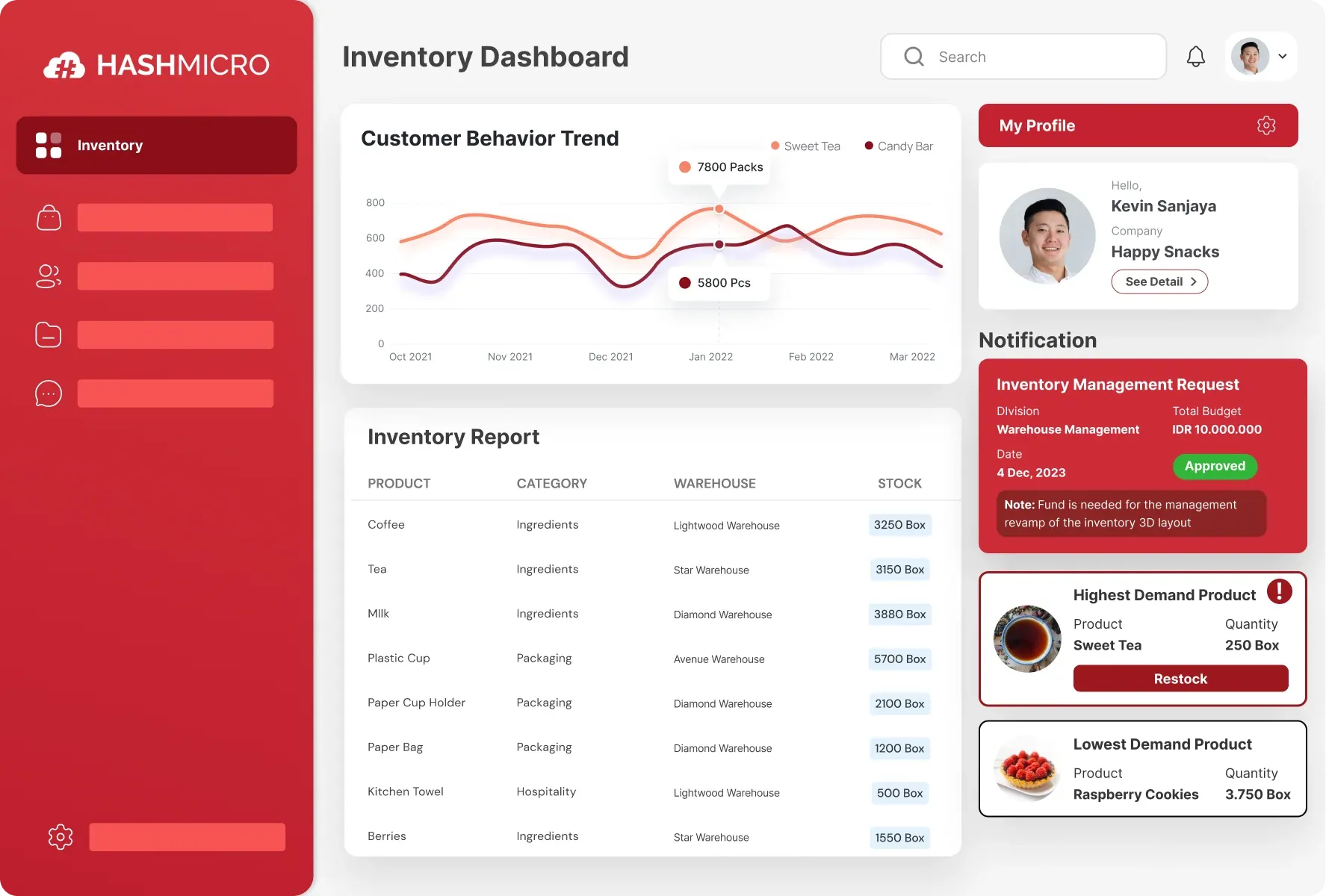
HashMicro provides an integrated ERP system specifically designed to simplify complex business processes, including omni-channel fulfillment. With a comprehensive solution, companies can overcome challenges such as inaccurate reporting and manual data errors.
Through advanced modules like Inventory Management, Order Management, and WMS, companies can process transactions faster, reduce human error, and gain accurate real-time data.
The system is equipped with features for automated approval workflows, shipment tracking, and direct integration with accounting modules to ensure every transaction is recorded properly.
HashMicro’s system is designed with full integration between modules, allowing data from various departments such as accounting, inventory, purchasing, and sales to connect seamlessly.
This provides enhanced visibility into the entire business operation and ensures that every decision is based on accurate, up-to-date information. This integrated approach is the key to unlocking the true potential of an omni-channel strategy.
Features of HashMicro’s ERP Software for Omni-Channel:
- Centralized Inventory Management: Provides a real-time, unified view of stock across all warehouses, stores, and channels, enabling accurate order fulfillment and preventing stockouts.
- Intelligent Order Management System: Automates order routing to the most efficient fulfillment location based on custom rules like proximity, cost, and inventory levels.
- Integrated Warehouse Management: Optimizes picking, packing, and shipping processes within warehouses and store backrooms to increase speed and accuracy.
- Real-Time Reporting & Analytics Dashboard: Offers comprehensive dashboards and reports on sales, inventory, and fulfillment performance to support data-driven decision-making.
- Multi-Channel Integration: Seamlessly connects with e-commerce platforms, marketplaces, and POS systems to create a single, unified commerce ecosystem.
With HashMicro, your company can improve operational efficiency, data transparency, and business process automation. To see how our solutions can concretely help your business, do not hesitate to try our free demo now.

Conclusion
Adopting omni-channel fulfillment is a fundamental evolution in how businesses must operate to meet modern customer expectations. By integrating HashMicro’s ERP Software for Omni-Channel, companies can create a superior customer experience and build a strong foundation for sustainable growth.
This strategic shift transforms the supply chain from a simple logistical function into a powerful engine for competitive advantage, enabling businesses to be more agile, responsive, and customer-focused in a rapidly changing market.
Although the implementation journey presents its challenges, the long-term benefits in the form of customer loyalty, increased profitability, and market resilience are invaluable. The journey requires a holistic approach that combines the right technology with a commitment to process re-engineering.
Your first step is to evaluate your existing systems and plan how technology can unify your entire business operations into a harmonious, efficient ecosystem, ready to thrive in the retail landscape of 2026. Get a free demo now!
Frequently Asked Questions
-
What is the most important first step to start omni-channel fulfillment?
The most critical first step is to conduct a thorough audit of your current systems, processes, and inventory management. This helps identify technological gaps and operational silos that need to be addressed before you can build an integrated strategy.|
-
Is an omni-channel strategy only suitable for large retail companies?
No, while large retailers have pioneered it, omni-channel fulfillment is scalable and beneficial for businesses of all sizes. Cloud-based software solutions have made the necessary technology more accessible and affordable for small and medium-sized enterprises (SMEs)
-
What is the role of artificial intelligence (AI) in the future of omni-channel fulfillment?
AI will play a huge role in optimizing omni-channel operations. It can be used for more accurate demand forecasting, intelligent order routing that considers hundreds of variables in real time, and personalizing the customer experience by predicting customers’ needs across channels.
-
How does omni-channel fulfillment affect the role of staff in physical stores?
It transforms their role significantly. Store staff serve as brand ambassadors and are also involved in fulfillment tasks such as picking online orders, managing in-store pickups, and handling returns. This requires new training and skills to blend customer service with logistics.