







Many businesses underestimate how much profit is affected by limited inventory visibility. Issues like stockouts, order inaccuracies, and slow-moving items are often symptoms of delayed data and inconsistent tracking across operations.
Industry insights show how critical this issue has become. Gartner reports that many supply chain leaders now prioritize real-time visibility to boost efficiency, reduce errors, and maintain better stock control.
Inventory visibility is no longer just an operational benefit. With the right strategies and systems, businesses can improve accuracy, minimize losses, and keep supply chain operations running smoothly.
Table of Contents
Key Takeaways
|
What Is Inventory Visibility?
Inventory visibility is the ability to see accurate, real-time information on stock quantities, locations, and movements across operations. It helps teams track inventory precisely, reduce manual errors, and respond quickly to issues.
Unlike manual tracking, modern inventory visibility relies on connected systems that update data instantly. This eliminates delays and improves accuracy across warehouses, stores, and sales channels.
With real-time insights, businesses can prevent stock discrepancies, avoid unexpected shortages, and reduce excess inventory that ties up cash flow. Clear visibility also supports better demand forecasting and replenishment planning.
Why Is Inventory Visibility So Important for a Business?

Inventory visibility is essential for helping businesses respond quickly to changes in demand and operations. With real-time stock data, teams can reduce delays and maintain smooth workflows across warehouses, stores, and distribution channels.
According to IHL Group, poor inventory practices cost retailers about $1.1 trillion globally each year. Real-time visibility helps reduce these losses by improving forecasting accuracy, minimizing discrepancies, and ensuring inventory levels align with actual demand.
Key Benefits of Improving Inventory Visibility
Better visibility also supports sales teams by giving them accurate stock information, allowing them to commit to delivery dates confidently. It reduces stockouts, limits financial losses, and improves customer satisfaction.
Improving inventory visibility strengthens decision-making by giving teams real-time insight into stock levels, order status, and movement across locations. This reduces errors, eliminates miscommunication, and speeds up daily operations.
1. Enhances customer satisfaction
Real-time visibility lets you share accurate stock levels and reliable delivery estimates with customers. This transparency reduces cancellations and prevents frustration caused by unavailable items. When orders arrive correctly and on time, trust grows and long term loyalty strengthens.
2. Optimizes inventory costs
Better visibility helps you avoid overstocking that ties up capital and stockouts that lose sales. Maintaining balanced levels reduces carrying costs, goods management area fees, and product risks like damage or expiry.
3. Streamlines order fulfillment processes
When every item’s location is known, picking, packing, and shipping move faster and with fewer errors. Staff spend less time searching and more time completing orders, raising throughput. This efficiency leads to shorter delivery times and a smoother experience for both teams and customers.
4. Enables more accurate demand forecasting
Real-time inventory data combined with sales patterns creates a solid base for forecasting future needs. Understanding stock movement helps you plan purchases and prevent shortages or excess. This alignment between supply and demand ensures stronger operational control.
5. Drives strategic decision-making
Inventory reports reveal which products perform best, where demand is growing, and which locations need support. Leaders can use these insights to guide expansion, pricing, and promotions. With reliable data instead of guesswork, strategies become more targeted.
6. Supports a seamless omnichannel strategy
In modern retail, inventory visibility enables BOPIS and ship-from-store services. As Forbes Tech Council experts note, offering the seamless omnichannel experience customers expect is impossible without precise stock levels across all locations (warehouses and stores).

Common Challenges in Achieving Inventory Visibility
Despite its benefits, achieving full inventory visibility remains difficult for many organizations. Challenges often stem from outdated systems, inefficient workflows, and internal resistance to change.
Many established companies still rely on legacy systems that cannot communicate with each other, resulting in fragmented and inconsistent data. Each department may work with its own version of inventory records, weakening decision making.
1. Data silos between departments
A major challenge is inventory data scattered across accounting tools, e-commerce platforms, and manual spreadsheets. When teams access different datasets, errors and misalignment occur. These discrepancies affect order fulfillment, material status reports, and daily operational decisions.
2. Manual processes and human error
Relying on paper counts or manual data entry greatly increases the risk of mistakes. Even small errors can spread across systems and distort overall stock accuracy. This reduces trust in the data and weakens the reliability of any decisions made using outdated or incorrect information.
3. Lack of an integrated system
Without a centralized platform that connects procurement, sales, and warehouse operations, gaining a full view of inventory is nearly impossible. For data to stay consistent, every transaction must update instantly across all systems, something disconnected tools simply cannot support.
4. Inaccurate or outdated data
In fast paced environments, even minor delays in updating stock data can cause major issues. Real time accuracy is essential for effective decisions. Outdated information can lead to overselling, unnecessary purchases, and operational inefficiencies that disrupt supply chain performance.
5. Complexity of modern supply chains
Today’s supply chains involve multiple warehouses, suppliers, sales channels, and logistics partners. This complexity makes it harder to track inventory movement at every stage. Without advanced technology to consolidate and monitor these flows, errors and blind spots become far more common.
Effective Strategies to Improve Inventory Visibility
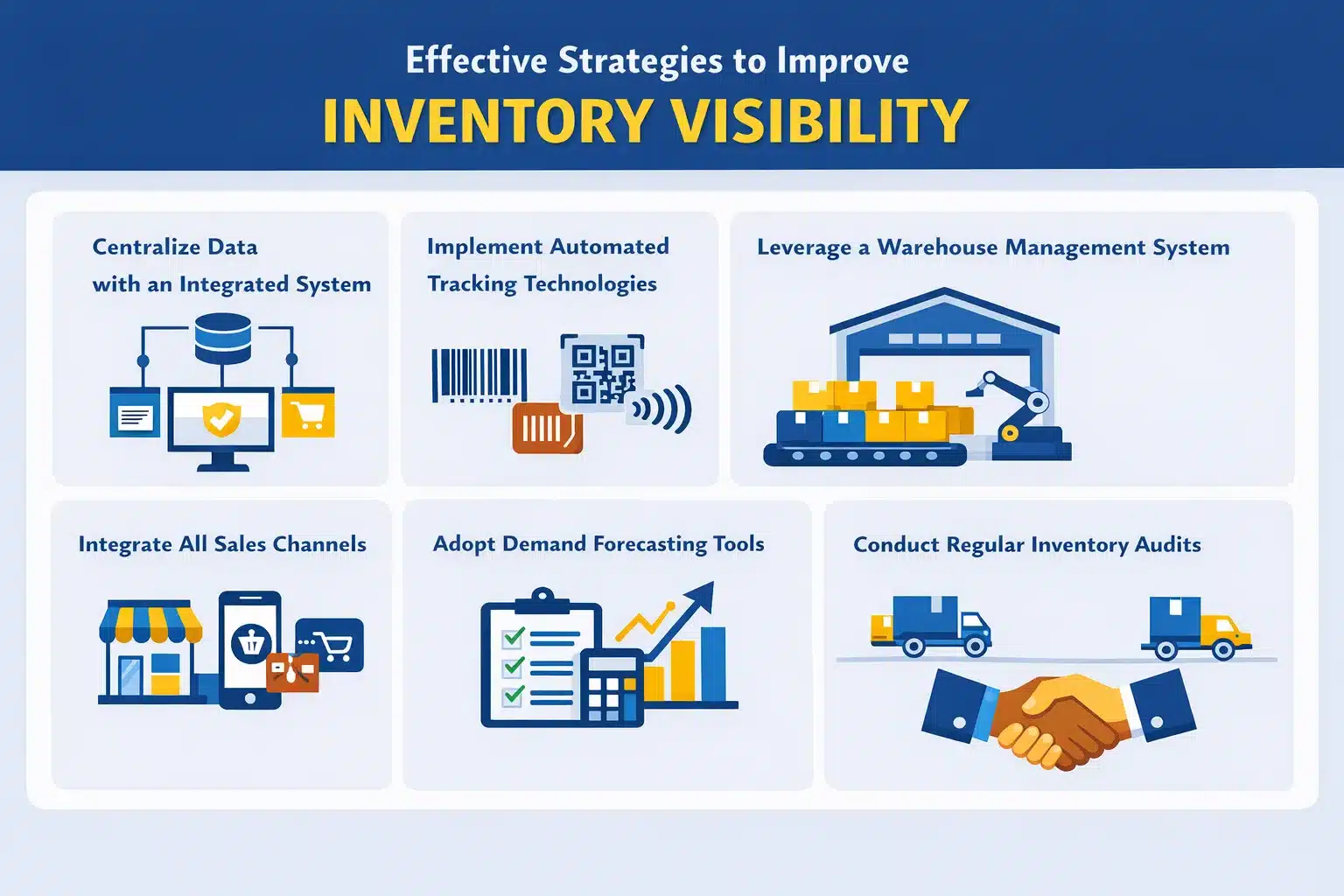
Improving inventory visibility requires a strategic approach that blends technology, refined processes, and strong collaboration. When applied correctly, these methods turn inventory management from a cost burden into a competitive advantage.
These strategies work best when treated as an ongoing improvement journey. It starts with solid technology, followed by disciplined processes and coordinated partnerships. With this holistic method, companies build visibility systems that stay accurate.
1. Centralize data with an integrated system
Centralizing data through an integrated platform like Enterprise Resource Planning (ERP) ensures all departments share the same information. By connecting sales, accounting, and warehouse operations, the system maintains consistent, accurate inventory records.
2. Implement automated tracking technologies
Switching from manual tracking to tools like barcodes and QR codes increases accuracy and speeds up receiving and dispatching. More advanced IoT-based inventory tracking allows multiple items to be tracked at once without direct scanning.
3. Leverage a warehouse management system (WMS)
A Warehouse Management System (WMS) enhances operations from receiving to shipping. It provides real time visibility of each SKU’s location and improves picking accuracy. With better control over stock movement, warehouses operate more efficiently.
4. Integrate all sales channels
Connecting physical stores, e-commerce sites, and marketplace channels to one inventory system ensures updates happen instantly across all platforms. When a sale occurs, stock levels adjust in real time. This prevents overselling and supports a smoother buying experience.
5. Adopt demand forecasting tools
Forecasting tools analyze sales history and market trends to predict demand more accurately. With these insights, businesses can order stock proactively and maintain balanced inventory levels. This prevents shortages during peak periods.
6. Conduct regular inventory audits
Cycle counting, which reviews smaller inventory sections regularly, helps maintain reliable data without halting operations. These audits prevent errors from compounding and support long term accuracy.
7. Foster collaboration with suppliers
Sharing data with key suppliers increases upstream visibility and improves planning. Knowing production status and shipment timelines helps anticipate delays. Strong supplier collaboration builds a more resilient and predictable supply chain.
The Role of Technology in Achieving Real-Time Inventory Visibility
Technology is the foundation of real-time inventory visibility, enabling businesses to track stock across a complex supply chain. With connected tools, companies gain real-time data access in the cloud to capture and analyze information that guides smarter decisions.
Selecting the right technology stack is a strategic investment that improves efficiency. Integration is essential so data flows smoothly across all operations. According to Harvard Business School, firms that digitize supply chains can increase EBIT growth by 3.2 percent annually.
1. Enterprise Resource Planning (ERP)
An Enterprise Resource Planning (ERP) system acts as the core hub for inventory data by unifying sales, purchasing, and accounting information. It provides a complete view of how each transaction affects stock levels. With one shared database, teams access consistent and accurate inventory records.
2. Warehouse Management System (WMS)
A WMS manages warehouse activities such as receiving, putaway, picking, and shipping. It offers detailed visibility of each SKU’s location and guides workers through efficient routes. By improving accuracy and speed, a WMS is essential for businesses aiming to streamline fulfillment operations.
3. Barcodes and RFID
Barcodes and scanners enable fast, cost effective tracking at key checkpoints, reducing manual entry errors. RFID expands these capabilities by scanning multiple items simultaneously and without direct sight.
4. Internet of Things (IoT)
IoT devices attached to goods, pallets, or vehicles deliver real time information on location and condition. This is vital for sensitive or high value products. With continuous monitoring, businesses can detect issues early and take corrective actions to protect inventory quality.
5. Artificial Intelligence (AI) and machine learning
AI and machine learning elevate visibility through predictive analytics. These tools analyze large datasets to detect patterns, forecast demand accurately, and suggest optimal stock levels.
Key Metrics to Measure the Success of Inventory Visibility

To ensure your inventory visibility strategies are effective, you must track the right Key Performance Indicators (KPIs). These metrics provide the quantitative data needed to measure system effectiveness, highlight successes, and pinpoint areas for improvement.
Regular monitoring of these metrics offers actionable insights for management. A well-designed dashboard visualizing performance tracking metrics trends can detect issues early and validate investments’ positive impact.
1. Inventory turnover ratio
Inventory turnover measures how often stock is sold and replaced. A high ratio indicates efficient inventory and strong demand; a low ratio suggests overstocking, slow sales, or declining demand, signaling a need for adjustments.
2. Stockout rate
This is the percentage of items that are unavailable when a customer places an order. A high stockout rate is a direct consequence of poor inventory visibility and inaccurate forecasting, leading directly to lost sales and damaging customer satisfaction.
3. Inventory accuracy
This metric compares the stock quantity recorded in the system against the actual physical stock count in the warehouse, typically expressed as a percentage. Achieving an inventory accuracy rate close to 100% is a primary goal and serves as the most direct proof that your visibility system is functioning correctly.
4. Order fill rate
This is the percentage of customer orders that can be completely fulfilled from existing stock without any backorders or lost sales. A high fill rate demonstrates that you have the right products in the right place at the right time to meet customer demand.
5. Days Sales of Inventory (DSI)
DSI measures the average number of days it takes for a company to convert its inventory into sales. A lower DSI is generally better, as it indicates that the company can quickly sell its stock and is not tying up excessive capital in inventory for long periods.
Conclusion
Inventory visibility is essential for reliable operations, accurate decision-making, and strong customer satisfaction. By understanding its challenges and applying the right strategies and technologies, businesses can build more efficient supply chains that support long-term growth.
A unified and well-integrated inventory system enables real-time tracking, improves data accuracy, and ensures better coordination across warehouses and sales channels. With automation control, daily operations become more efficient and easier to manage.
For businesses looking to strengthen inventory visibility and operational efficiency, exploring a free consultation can be a valuable first step toward identifying the right approach and tools to support smarter, data-driven decisions.
FAQ about Inventory Visibility
-
What is the main difference between inventory visibility and inventory control?
Inventory visibility is the ability to see accurate inventory data across the supply chain. In contrast, inventory control involves the processes and strategies used to manage inventory based on that data, such as setting reorder points. Visibility is the foundation that enables effective control.
-
How often should a company conduct a physical inventory audit?
Best practice is to use cycle counting, where small sections of inventory are counted regularly (daily or weekly). This method is less disruptive than a full annual audit and continuously maintains data accuracy.
-
Is inventory visibility only for large companies?
Not at all. While essential for large enterprises, small and medium-sized businesses (SMBs) also gain significant benefits. Affordable cloud-based solutions now make advanced inventory technology accessible to businesses of all sizes, helping them compete more effectively.
-
What is the first step to improving inventory visibility?
The most crucial first step is to centralize your data. Implementing a central system, like an inventory management software or ERP, that integrates your operations creates the foundation upon which all other visibility strategies can be built.