







Most employees receive their payslip each month, glance at the figures, and move on without fully understanding the details. Yet this document reflects important information about income, deductions, and take-home pay.
A payslip promotes transparency between employers and employees by clearly outlining earnings and deductions, while also supporting compliance with payroll regulations in the Philippines.
For HR teams, creating payslips manually can be time-consuming and repetitive, which is why many organisations are turning to digital and automated HR tools to streamline payroll processes.
Key Takeaways
|

How to Generate a Payslip for Compressed Work Week Employees
Under a compressed work week (CWW) arrangement, employees work fewer days but longer daily hours, typically 4 days × 10 hours or 3 days × 12 hours. This changes how payslip components are calculated, especially for overtime and night differential.
While the basic payslip format remains the same, three fields become particularly important to track correctly:
Payslip Format Changes Under CWW
| Payslip Field | Standard Payslip | CWW Payslip |
| Daily Hours | 8 hrs/day, 5 days | 10–12 hrs/day, 3–4 days |
| Overtime Threshold | After 8 hrs/day | After agreed CWW hours (e.g., after 10 hrs) |
| Night Differential | If shift extends past 10 PM | Higher likelihood; must be itemized |
| Rest Day Pay | 2 days off per week | 3–4 days off; separate rest day rate applies |
| Deductions (SSS, etc.) | Based on monthly salary | Unchanged and still based on monthly salary |
New Fields to Add on CWW Payslip
| Field | Description | Computation Basis |
| Overtime Pay (OT) | Extra hours beyond the agreed CWW hours per day | Hourly rate × 125% (regular day OT rate under DOLE rules) |
| Night Differential (ND) | Hours worked between 10:00 PM and 6:00 AM | Hourly rate × 10% premium (minimum under Labor Code Art. 86) |
| Rest Day / Special Holiday Pay | Pay for working on a scheduled rest day or special holiday | Daily rate × 130% (rest day rate) per DOLE guidelines |
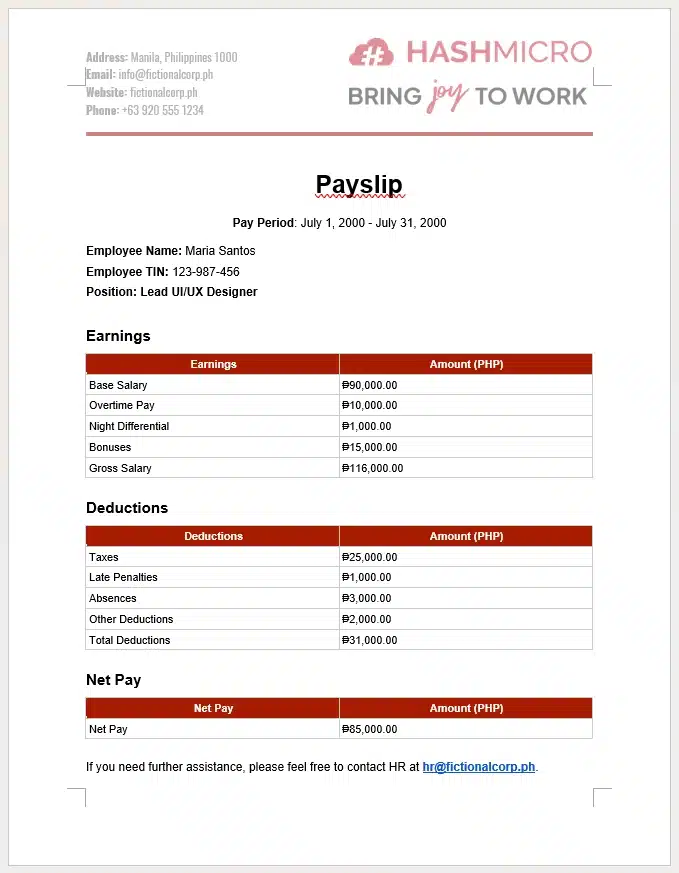
Sample CWW Payslip Template
| PAYSLIP — COMPRESSED WORK WEEK (CWW) Pay Period: [Month] [Year] | Work Arrangement: CWW (4×10) |
|
| Employee Name: [Full Name] | Department: [Department] |
| Position: [Job Title] | Employee ID: [ID] |
| EARNINGS | Amount (₱) |
| Basic Salary | [Amount] |
| Allowances (transport, meal, etc.) | [Amount] |
| ★ Overtime Pay (OT) — CWW Field | [Amount] |
| ★ Night Differential (ND) — CWW Field | [Amount] |
| GROSS PAY | [Gross Total] |
| DEDUCTIONS | Amount (₱) |
| SSS Contribution | [Amount] |
| PhilHealth Contribution | [Amount] |
| Pag-IBIG Contribution | [Amount] |
| Withholding Tax (BIR) | [Amount] |
| TOTAL DEDUCTIONS | [Total] |
| NET PAY | ₱ [Net Amount] |
For employees under a compressed work week arrangement, the payslip above should also include the following additional fields. You can download the full template below to get started.
Download Payslip Template
The Definition of a Payslip

Payslip is a document that shows an employee’s earnings, deductions, and net pay for a given period. It usually includes gross income, tax withholdings, and take-home pay details.
It works by showing exactly how your earnings are calculated, listing contributions like SSS, PhilHealth, Pag-IBIG, and taxes, so you know where your money goes and how much you’ll take home.
Payslips help ensure transparency between employees and employers. By understanding each line item, employees can manage their finances better and make informed decisions like budgeting or applying for loans.
The Purpose of a Payslip
A salary payslip is important for both transparency and financial documentation. It helps employees apply for loans or credit cards and assists companies in payslip management to monitor and record salary disbursements accurately.
This transparency builds trust between employees and employers and ensures employees have a clear record of their income.
- See Exactly What You Earn: Payslips show all the details of your pay, including your basic salary and deductions like SSS and PhilHealth. This means you know exactly what you’re getting and what’s being taken out.
- Easier Loan and Credit Approvals: When you want a loan or a credit card, banks look at your payslip to check your income. A payslip makes applying easy and shows banks you’re financially stable.
- Power in Salary Negotiations: Your payslip proves what you earned at your last job, which can be a strong tool when asking for a higher salary in a new job.
- Qualify for Government and Other Services: Payslips help you access services like government benefits or rental agreements since they show you have a steady income.
- Stay on Top of Taxes: Payslips list all your tax deductions, making tracking what you’ve paid easy and helping you prepare for tax season without any hassle.
In summary, payslips are a powerful tool beyond just showing salary details. They assist employees with loan repayment management applications, government services, and tax management, reinforcing their financial stability.
Important Components of a Payslip Explained
The payslip provided offers a straightforward breakdown of an employee’s earnings and deductions, making it easy to understand where the final take-home pay comes from. Each section is designed to provide clarity on the payment details.
- Company Info: The top of the payslip lists “exceltemplate.NET,” which would typically be replaced by the actual company name for authenticity and record-keeping.
- Employee Details: Basic information, including the employee’s name (Wayne Doorprize), job title (Cleaning Service Staff), and department (General Affairs), identifies the person receiving the salary.
- Payment Date & Bank Info: The bottom left shows when and where the company paid the salary, listing the payment date (January 28, 2017), bank name (BDO/BPI/Metrobank), account name (Wayne Doorprize), and account number (1234567890).
- Earnings Breakdown: This section includes the base salary of ₱2,000.00 and additional allowances for meals, transportation, and medical expenses, each listed at ₱300.00.
- Deductions: Retirement insurance and tax deductions, each at 25.00, total to 50.00.
- Net Pay: After all deductions, the final amount received is ₱2,850.00, prominently shown in the “NET PAY” section.
| Deduction | Employee Share | How It Is Usually Computed | Example on ₱25,000 Pay |
| SSS | 5% of MSC | Use the applicable Monthly Salary Credit (MSC) under the current SSS contribution schedule. | ₱1,250 if MSC used is ₱25,000 |
| PhilHealth | 2.5% | Employee pays half of the 5.0% premium based on monthly basic salary. | ₱625 |
| Pag-IBIG | 2% | Usually 2% for employees earning above ₱1,500, capped at the current mandatory maximum. | ₱200 |
| Withholding Tax | Varies | Based on the BIR withholding tax table and taxable compensation after non-taxable statutory deductions. | About ₱313.80 monthly, if taxable pay is ₱22,925 |
A Practical Guide to Creating Payslips
Creating payslips requires gathering precise information on employee earnings, deductions, and contributions. This process ensures that employees understand their compensation details clearly.
- Include Basic Information – Start by listing essential details such as the company name, employee information (name, position), and the pay period.
- Itemize Earnings – Break down the earnings into sections. This section should identify the employee’s basic pay and, when applicable, separate lines for overtime pay, holiday pay, night differential, allowances, commissions, or other taxable and non-taxable pay items. For compressed work week setups, the payslip should also separate regular pay from any hours that exceed the agreed daily schedule, instead of lumping everything into one salary line.
- Detail Deductions – List deductions like taxes, SSS, PhilHealth, and Pag-IBIG contributions to reflect the amount withheld. For example, if an employee earns ₱25,000 a month and no other adjustments apply, the payslip may show SSS: ₱1,250, PhilHealth: ₱625, Pag-IBIG: ₱200, and withholding tax: about ₱313.80, depending on the applicable payroll tax treatment. Showing each deduction in its own line helps employees understand why their take-home pay is lower than their gross pay.
- Calculate Net Pay – After accounting for deductions, show the final amount the employee will receive, while HR and payroll teams should be able to use it as a clean record for audits, employee queries, and salary disputes.

Smart Payslip Management Solution
Managing payslips becomes much easier with payroll software. Instead of relying on manual processes, businesses can automate distribution of salary slips. This software helps ensure every payslip is easy to access for both HR teams and employees.
Here’s how companies can streamline the process of handling payslips with the right automated payroll solution in place.
- Regularly Review Payslip Accuracy: For each pay cycle, verify that all payslips reflect the correct salary, deductions, and allowances. Ensuring accuracy builds trust with employees and reduces the likelihood of payroll disputes.
- Store Digital Records Securely: Maintain a secure digital record of each payslip. This will facilitate employee access and simplify compliance with financial and legal audits.
- Clarify Deductions and Contributions: Make sure employees understand their deductions, including taxes, health insurance, and retirement contributions. Clear communication helps employees feel confident about their compensation.
- Utilize HRIS Software: Implementing HRIS (Human Resources Information System) software can automate the generation, distribution, and management of payslips. This reduces manual errors and saves time.
- Provide Clear Channels for Queries: Establish a straightforward process for employees to reach HR with any payslip-related questions. This fosters a transparent workplace and enhances employee satisfaction.
Conclusion
Efficient payslip management play a vital role for both employees and businesses. Clear and accurate payslips help employees understand their earnings, deductions, and take-home pay, while promoting transparency in the payroll process.
For companies, well-managed payslips contribute to stronger employee trust and better compliance with local payroll regulations. Streamlining this process also reduces administrative workload and minimizes the risk of errors.
To improve payroll efficiency and accuracy, many businesses seek expert guidance to evaluate their needs and optimize payslip management. A free consultation can help identify the right approach and support smoother payroll operations.

Frequently Asked Questions around Payslip
-
What is the purpose of a payslip?
A payslip provides a detailed record of an employee’s earnings, deductions, and contributions. It ensures transparency and helps employees track income for budgeting, loans, and taxes.
-
How do I make a payslip?
To make a payslip, include details like the company name, employee information, earnings, and deductions. You can automate and simplify this process using HRIS software for payroll management and Accounting Software to ensure all salary records stay accurate and compliant.
-
Is an employer legally required to give a payslip in the Philippines?
Yes, employers should issue an itemized wage statement every payday showing the employee’s earnings and deductions. In practice, this supports compliance with Philippine wage-payment and deduction rules, helps employees verify whether their pay was computed correctly, and gives employers proper documentation if a labor dispute arises. If an employer does not provide a payslip, employees may question underpayment or unauthorized deductions, while the employer weakens its documentary proof of proper salary payment.
-
How does a compressed work week affect payslip computation?
Under a CWW arrangement, employees work longer daily hours across fewer days. The overtime threshold shifts to match the agreed daily hours (e.g., OT only kicks in after 10 hours for a 4×10 setup). Night differential must also be itemized if shifts extend past 10:00 PM. Statutory deductions remain unchanged.