












Many schools and universities in Malaysia still manage admissions, attendance, grades, and fee records across disconnected systems. This fragmented approach often leads to data inconsistencies and limited visibility into student information.
For educational institutions in Malaysia managing large student populations, these challenges can affect reporting accuracy, operational efficiency, and the overall student experience. A student information system (SIS) helps address these issues by centralizing academic, administrative, and student records within a single platform.
By managing student and academic data, a student information system helps institutions reduce administrative workload, improve accuracy, and make better-informed decisions.
Key Takeaways
|
Managing student records across multiple systems can lead to inefficiencies and reporting challenges. A Student Information System helps centralize data and simplify administration in one platform.
What Is a Student Information System?
A student information system, commonly referred to as SIS, is software that centralizes student data and academic administration in one platform. It typically manages everything from the moment a student applies for admission through to graduation, including enrollment records, attendance, grades, fee payments, communication, and reporting.
Unlike a standalone database or a basic records tool, an SIS is built around the workflows of educational institutions. It connects academic and administrative functions so that different teams, including admissions staff, teachers, finance officers, and management, can access the same consistent information without duplication or manual coordination.
The term student management system or school information system is often used interchangeably with SIS, though some institutions use these terms to refer to tools with slightly different scope. The core purpose is the same, to give educational institutions accurate, accessible, and centrally managed student data.
How Does a Student Information System Work?
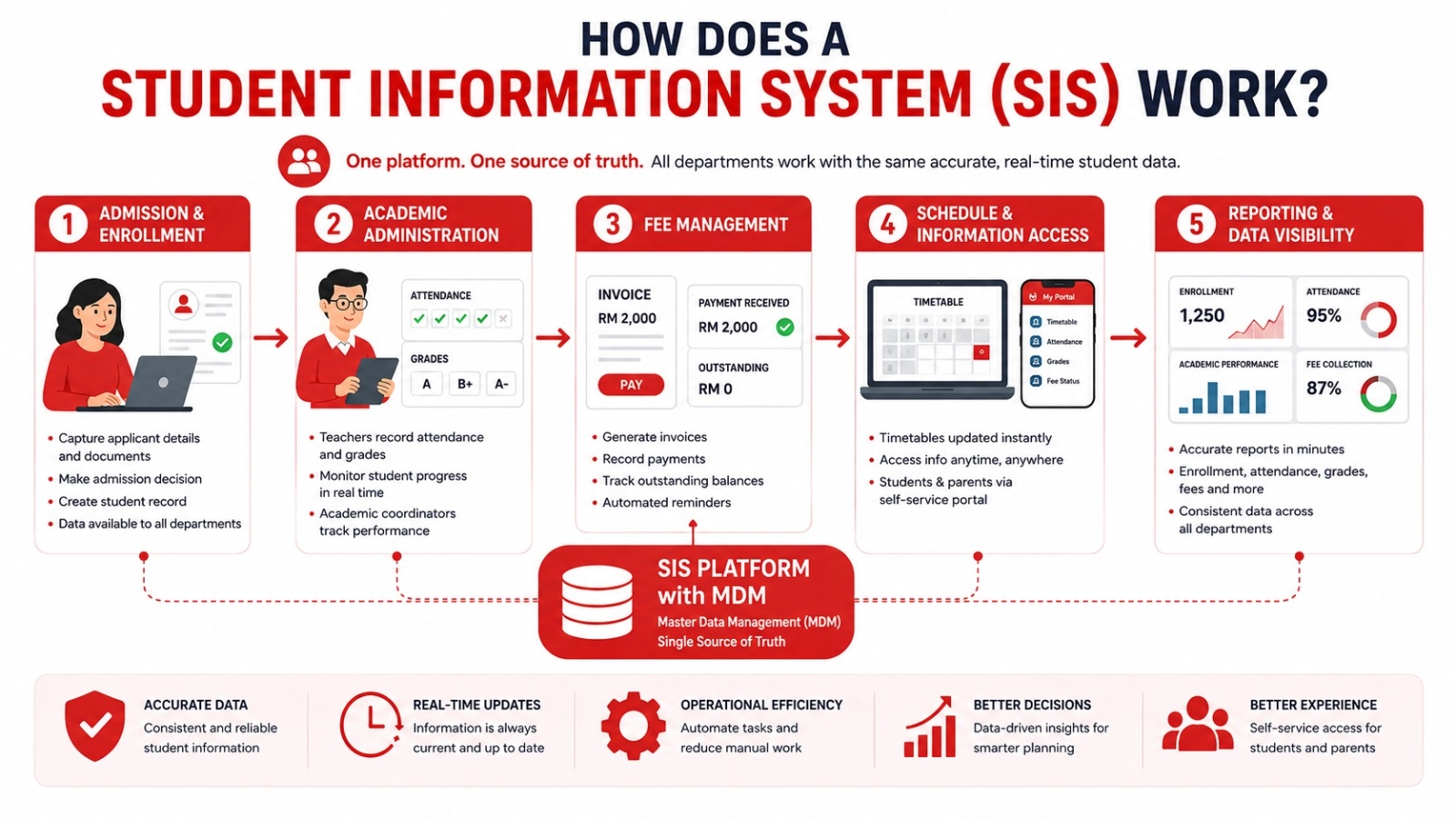
A student information system works by connecting each stage of a student’s academic journey into one continuous data flow, while Master Data Management (MDM) keeps student data accurate and consistent. Here is how that process typically unfolds across the key functions an institution manages:
1. Student Admission and Enrollment
When a student applies, the SIS captures their personal details, documents, and admission decision in one profile. Once accepted, that record is immediately available to finance, academic staff, and admin, no one needs to re-enter the same information.
2. Academic Administration
Teachers record attendance and grades directly in the system throughout the term. Academic coordinators can monitor student progress in real time without waiting for a manual report to be compiled.
3. Fee Management
The system generates invoices based on each student’s enrolled programme and records payments as they arrive. Finance teams can view outstanding balances across the entire student body without manual reconciliation, and automated reminders reduce the need for follow-up calls.
4. Schedule and Information Access
Timetables are managed centrally, so any changes are updated immediately and visible to staff, students, and parents through self-service portals. Students can check their schedule, attendance, grades, and fee status at any time without contacting the administration office.
5. Reporting and Data Visibility
Because all student data sits in one database, management can generate accurate reports on enrollment, attendance, grades, and fee collection within minutes. Every department draws from the same source, which means reports are consistent regardless of who runs them.
Why Student Information Systems Matter for Malaysian Institutions?
As educational institutions expand and administrative requirements become more complex, managing student information efficiently becomes increasingly important. A Student Information System (SIS) helps address many of these challenges by centralizing data and supporting day-to-day academic and administrative operations.
- Supports PDPA Compliance and Data Security
Educational institutions in Malaysia manage large volumes of sensitive student information, including personal details, academic records, and financial data. A Student Information System (SIS) helps store this information securely, control user access, and maintain data accuracy while supporting compliance with the Personal Data Protection Act (PDPA). - Improves Administrative Efficiency
As private schools, international schools, and higher education institutions continue to grow, managing admissions, student records, and fee collection manually becomes more challenging. An SIS automates these processes, reducing paperwork, minimizing errors, and helping staff complete administrative tasks more efficiently. - Centralizes Data Across Multiple Campuses
Institutions with multiple campuses, branches, or faculties often struggle with fragmented information. A centralized SIS allows administrators to access student records, schedules, attendance, and financial data from a single system, improving visibility and coordination across the organization. - Simplifies Reporting and Regulatory Requirements
Education providers frequently need to generate reports on enrollment, attendance, academic performance, and other operational metrics. An SIS helps compile this information automatically, making reporting faster, more accurate, and easier to manage for internal reviews and regulatory purposes.
Student Information System vs LMS vs School Management System
One of the most common sources of confusion is the distinction between an SIS, a learning management system, and school management software system. While these systems often operate alongside each other, they serve different purposes.
| System | Primary Purpose | Who Uses It | Key Functions |
|---|---|---|---|
Student Information System (SIS) |
Manages student records and academic administration | Admissions staff, academic coordinators, finance, management | Enrollment, attendance, grades, fees, student database, reporting |
Learning Management System (LMS) |
Supports teaching and learning activities | Teachers and students | Online courses, assignments, quizzes, learning content, progress tracking |
School Management System |
Covers broader school operations | Admin, HR, finance, procurement | Timetabling, HR, payroll, inventory, communication, billing, SIS functions |
ERP (Education) |
Institution-wide operations across all departments | All departments including academic, finance, HR, and facilities | Integrates SIS, HR, finance, procurement, and reporting into one platform |
Key Features of a Student Information System
A Student Information System combines multiple functions that help institutions manage admissions, academic records, attendance, finances, and communication more efficiently. The following table highlights the main SIS features and explains how each contributes to smoother school operations.
| Feature | What It Does | Operational Value |
|---|---|---|
| Student Database Management | Stores individual student profiles including personal details, programme, contacts, and documents | Single source of truth for all student information, eliminating duplicate records across departments |
| Admission and Enrollment | Manages the application process, document collection, placement, and registration | Reduces manual coordination between admissions and academic teams during intake periods |
| Attendance Tracking | Records daily or session-based attendance per student and class | Enables early identification of at-risk students and simplifies report generation for parents or management |
| Grade and Assessment Management | Records results, calculates GPA or cumulative grades, and tracks academic progress | Provides consistent grade records that academic staff, students, and management can access in real time |
| Fee Management | Generates invoices, records payments, and tracks outstanding balances | Improves payment visibility and reduces the administrative burden of manual follow-ups |
| Timetable and Scheduling | Manages class schedules, room allocation, and teacher assignments | Prevents scheduling conflicts and makes timetable changes easier to communicate |
| Student and Parent Portal | Allows students and parents to view grades, attendance, timetables, and fee status | Reduces inbound enquiries to admin staff and improves communication with families |
| Document Management | Stores and retrieves academic and personal documents linked to a student profile | Eliminates paper filing and makes records accessible to authorised staff regardless of location |
| Reporting and Analytics | Generates reports on enrollment, attendance, grades, fees, and other operational metrics | Supports management decisions with accurate data rather than manually compiled summaries |
Benefits of a Student Information System for Educational Institutions
Deploying a student information system changes how administrative and academic teams operate day to day. The following benefits are grounded in the workflow improvements that SIS adoption typically produces.
- Accurate Student Records
A student information system centralises student data in one database, ensuring updates are reflected across all departments instantly. This helps maintain consistent records, reduces duplicate data entry, and minimises administrative errors. - Faster Academic Administration
By automating tasks such as enrollment tracking, attendance monitoring, grading, and report generation, an SIS reduces manual workload and allows staff to complete administrative processes more efficiently. - Better Communication Between Departments
An SIS enables departments such as admissions, academics, and finance to access the same up-to-date information, improving coordination and reducing the need for manual data sharing or follow-up communications. - Improved Reporting and Operational Visibility
Real-time dashboards and automated reports provide institutions with current insights into enrollment, attendance, academic performance, and financial data, supporting faster and more informed decision-making. - Better Experience for Students and Parents
Self-service portals allow students and parents to access grades, schedules, attendance records, and fee information anytime, improving transparency, convenience, and overall satisfaction with the institution’s services.
Common Challenges Without a Student Information System
Institutions that rely on manual processes or disconnected tools often encounter the same recurring problems. Understanding these challenges helps administrators assess how much operational risk they are currently carrying.
- Scattered Student Records
Student information stored across multiple systems often leads to inconsistent records between departments. This makes it difficult for staff to access accurate, up-to-date information and creates extra work when updates need to be made across different platforms. - Manual Attendance and Grade Tracking
Attendance and grades managed through paper records or spreadsheets require additional manual input, which slows reporting and increases the risk of data entry errors. As a result, institutions may face delays in identifying academic or attendance-related issues. - Slow Fee and Payment Monitoring
Without a centralized system, finance teams must manually match payments with student records, making fee tracking slower and more prone to mistakes. Limited visibility into outstanding balances can also delay follow-ups on overdue payments and affect cash flow. - Limited Management Visibility
When academic, attendance, and financial data are stored separately, management lacks a real-time view of institutional performance. This makes it harder to identify trends, address operational issues promptly, and make informed decisions.
How to Choose the Right Student Information System?

Student Information System needs to fit the specific scale, structure, and workflows of the institution, as well as the technical capacity of the team that will manage it. The following criteria provide a vendor-neutral framework for evaluation.
- Ease of use.
An SIS that requires extensive training for every administrative task will slow adoption across departments. Prioritise systems where core functions such as attendance recording, grade entry, and report generation can be performed without specialist technical knowledge. - Scalability.
The system should be able to accommodate growth in student numbers, additional campuses, new programmes, or expanded administrative functions without requiring a full platform replacement. Ask vendors how the system performs at higher volumes than your current intake. - Data security and access control.
Given PDPA obligations, the system should allow institutions to define role-based access permissions so that staff only see the student data relevant to their function. Audit logs and data encryption are basic expectations for any system handling personal data. - Customization and configuration.
Malaysian institutions vary considerably in how they structure programmes, fees, and academic calendars. The SIS should be configurable to match local requirements without requiring custom development for every variation. - Integration with other systems.
An SIS that can connect with finance software, HR systems, or a broader education ERP chart platform reduces the need for manual data transfer between departments. If the institution is also using an LMS, check whether the SIS can exchange data with it to avoid maintaining duplicate student records. - Reporting capabilities.
Evaluate whether the system can generate reports in the formats required by internal management and external reporting requirements. The ability to filter, customize, and export reports directly from the system is a meaningful operational advantage. - Local support and implementation.
Implementation quality and ongoing support have a significant impact on whether the system is actually used effectively. Prioritize vendors with local presence in Malaysia, demonstrated experience with institutions of a similar type, and clear employee onboarding processes.
Conclusion
A student information system plays an important role in helping educational institutions manage student data more accurately and efficiently. By centralizing records, academic information, attendance, and administrative processes in one platform, institutions can reduce manual work, improve data consistency, and support better decision-making across departments.
As student populations grow and reporting requirements become more demanding, relying on disconnected spreadsheets and manual processes can create unnecessary complexity. An SIS provides a structured approach to managing information, improving operational visibility, and ensuring that key data remains accessible when needed.
If you are currently evaluating student information systems for your institution, requesting a free demo and see which solution aligns with your administrative and academic requirements.

FAQ about Student Management System
-
What is the difference between a SIS and an LMS?
A SIS manages student records and academic administration, while an LMS supports teaching and learning activities. For example, a SIS handles enrollment, attendance, grades, student profiles, and reports. An LMS is used for online classes, course materials, assignments, quizzes, and learning progress tracking.
-
Can a Student Information System be integrated with an existing LMS?
Yes. Many SIS platforms can integrate with LMS solutions to synchronize student records, enrollment data, attendance, and academic results. This reduces duplicate data entry and helps maintain consistency across both systems.
-
What should institutions prioritize when migrating student data into a new SIS?
Data accuracy should be the primary focus. Before migration, institutions should review existing records, remove duplicates, standardize data formats, and verify that student information is complete to avoid carrying historical errors into the new system.
-
Can an SIS support different fee structures and payment models?
Most modern SIS solutions can accommodate various fee categories, installment plans, scholarships, discounts, and programme-specific pricing. This flexibility is especially useful for private schools, colleges, and international institutions.
-
How can an SIS help institutions comply with Malaysia’s PDPA requirements?
An SIS supports compliance by centralizing student data, restricting access based on user roles, maintaining audit trails, and reducing the risks associated with storing sensitive information across multiple spreadsheets or disconnected systems.