













Many businesses struggle to maintain compliance when records, approvals, and operational data are managed manually. This can lead to missing documents, weak internal controls, and regulatory risks. A compliance audit helps identify these gaps early and ensures business processes align with applicable requirements and internal policies.
For Malaysian businesses, compliance is becoming increasingly important as regulators and stakeholders expect greater transparency and accountability. Under the Companies (Amendment) Act 2024, companies must now identify their beneficial owners and report the information to the Companies Commission of Malaysia (SSM), keeping these records for at least seven years.
This guide explains everything businesses need to know about HR compliance audits in Malaysia, from their purpose and regulatory requirements to practical strategies for maintaining compliant HR records and processes.
Key Takeaways
|
As regulatory requirements and business operations become more complex, keeping track of records manually can increase compliance risks. Digital systems help businesses maintain accurate documentation and stronger internal controls.

What Is a Compliance Audit?
A compliance audit is a structured review that assesses whether a company’s records, processes, and controls comply with applicable laws, regulations, and internal policies. Its purpose is to identify compliance gaps and ensure business operations meet required standards.
Unlike a financial audit, which focuses on financial statements, a compliance audit reviews broader areas such as HR, payroll, tax, procurement, IT access, and operational controls. It can be conducted internally or externally, depending on the audit objectives and business needs.
Why Compliance Audits Matter for Malaysian Businesses?
Many businesses only discover compliance issues when preparing for an external audit, resulting in unnecessary delays and corrective work. Conducting regular compliance audits helps identify risks early and strengthens internal controls before they affect operations.
1. Prevent Compliance Risks
Regular compliance audits help identify issues before they lead to penalties, disputes, or reputational damage. Addressing problems early is often faster and less costly than fixing them after a formal review.
2. Strengthen Internal Controls
Audits evaluate approvals, responsibilities, and business processes to uncover control weaknesses. This improves accountability and ensures transactions are properly monitored and documented.
3. Improve Documentation Quality
A compliance audit encourages businesses to maintain accurate, complete, and up-to-date records. Well-organized documentation also makes it easier to provide evidence during reviews or inspections.
4. Enhance Audit Readiness
Companies that conduct regular compliance reviews are better prepared for external audits. Organized records and established processes help reduce disruptions and speed up the audit process.
5. Build Stakeholder Confidence
Demonstrating effective compliance controls can increase trust among management, investors, regulators, and business partners. Strong compliance practices show that the business is committed to transparency and accountability.
By understanding these benefits, businesses can view compliance audits as more than a regulatory requirement. Regular audits help reduce risk, improve accountability, and build a stronger foundation for long-term operational efficiency and business growth.
Types of Compliance Audit
Compliance audits cover a wide range of business functions, with each type designed to assess a specific area of compliance. Understanding these audit categories helps businesses determine the most appropriate review based on their operational and regulatory requirements. The table below outlines the main types of compliance audits and their practical applications.
| Type | What It Checks | Example |
|---|---|---|
| Regulatory compliance audit | Whether company practices follow legal or regulator requirements. | Reviewing statutory records, filings, and required documentation. |
| Financial compliance audit | Accounting records, approvals, controls, and reporting standards. | Checking journal entries, expenses, invoices, and approval trails. |
| Internal compliance audit | Adherence to company policies and SOPs. | Reviewing whether purchases follow the approval matrix. |
| HR compliance audit | Payroll, employee records, leave, claims, and workforce documents. | Checking payroll records and employee documentation for completeness. |
| IT and data compliance audit | Access control, system logs, data security, and user permissions. | Confirming only authorised staff can access financial data. |
| Operational compliance audit | Process adherence in areas like inventory or procurement. | Checking whether inventory adjustments have proper approval. |
Compliance Audit Requirements in Malaysia

Before conducting a compliance audit, businesses should understand the key regulations and authorities that influence record-keeping and compliance requirements in Malaysia. While the following points provide a useful overview, companies should consult qualified professionals to confirm any obligations that apply to their specific circumstances.
- Companies Commission of Malaysia (SSM)
SSM oversees company registration and statutory compliance. Businesses are generally expected to maintain accurate and up-to-date statutory records, including company registers, resolutions, and regulatory filings. - Companies Act 2016
This legislation outlines various corporate responsibilities, including record-keeping requirements. It serves as a key reference for understanding what documentation companies should maintain to support compliance. - Malaysian Institute of Accountants (MIA)
MIA regulates the accounting profession in Malaysia and promotes adherence to professional standards that support reliable financial reporting and inventory audit practices. - MFRS and MPERS Reporting Frameworks
Malaysian businesses typically prepare financial statements under either the Malaysian Financial Reporting Standards (MFRS) or the Malaysian Private Entities Reporting Standard (MPERS), depending on their entity type and reporting requirements. - Audit Exemption Criteria
Certain private Malaysian companies may qualify for audit exemption if they meet specific conditions established by regulators. As eligibility requirements may change over time, businesses should verify the latest criteria with qualified advisors before making compliance decisions.
Step-by-Step Compliance Audit Guide
Knowing the theory is not enough. The real value comes from following a clear, repeatable process. The eight compliance audit procedures below show what an auditor or internal team actually does, from planning to follow-up. Use them as a workflow you can adapt.
- Define the audit scope. Clarify what you are reviewing. Name the department, the time period, the process, and the specific requirement being checked. A tight scope keeps the audit focused and prevents wasted effort.
- Identify applicable requirements. List the laws, standards, internal policies, contracts, and SOPs that apply to the area in scope. This becomes your reference point. You can only test against requirements you have clearly defined.
- Prepare a document request list. Gather the evidence you need. This often includes ledgers, invoices, contracts, HR compilance records, approval forms, statutory filings, and system logs. Request these early so the review is not delayed.
- Review policies and controls. Check whether the relevant policies exist, are current, and are actually followed. A policy on paper means little if staff do not apply it in daily work.
- Test sample records. Select a sample of transactions or documents. Compare them against the requirements and approvals. For example, trace a few payments back to their purchase orders and authorization records.
- Record findings and risk level. Document each gap clearly. Note the issue, its severity, the supporting evidence, and the potential impact. A risk level of low, medium, or high helps you prioritize action.
- Prepare the audit report. Summarize what you found. Include the findings, recommendations, assigned owners, and deadlines. A clear report turns observations into action.
- Track corrective actions. The audit does not end at the report. Monitor whether each corrective action is completed. Schedule a follow-up review to confirm the gaps are closed.
Common Compliance Audit Mistakes to Avoid
Even experienced teams fall into the same traps. The good news is that most of these mistakes are easy to avoid once you know them. Steering clear of the issues below will make your next review smoother, faster, and more reliable.
- Starting without a clear scope
An audit without a defined scope can become unfocused and inefficient. Clearly identifying the department, period, and requirements to be reviewed helps keep the audit on track and ensures meaningful conclusions.
- Relying on outdated policies or SOPs
Using outdated policies or procedures may lead to inaccurate audit results. Always verify that the audit is based on the latest regulations and internal guidelines.
- Keeping documents across disconnected spreadsheets and folders
Scattered records make it difficult to gather evidence and increase the risk of missing important documents. Centralized documentation improves accessibility and audit readiness.
- Failing to assign owners for corrective actions
Audit findings are less likely to be resolved when no one is responsible for addressing them. Assigning clear owners and deadlines helps ensure corrective actions are completed.
- Skipping access and system log checks
System access controls and activity logs often reveal compliance risks that documentation alone cannot show. Reviewing them helps strengthen security and accountability.
- Treating the report as the finish line
An audit report is only the beginning of improvement efforts. Regular follow-up and monitoring are necessary to ensure findings are addressed and do not reoccur.
Pre-Audit Review Checklist
An audit checklist helps ensure that important records, processes, and controls are reviewed consistently. The checklist below offers a practical starting point that can be tailored to your business needs, industry requirements, and audit scope.
| Status | Checklist Item | What to Verify |
| ☐ | Company statutory records | Business registration, director and shareholder records, resolutions, and statutory filings are complete and updated. |
| ☐ | Financial statements and ledgers | Reports match supporting ledgers, transactions, and accounting policies. |
| ☐ | Tax and regulatory filings | Relevant filings are submitted on time and supported by proper documentation. |
| ☐ | Approval workflow | Purchases, payments, claims, and journal entries follow the approved authority matrix. |
| ☐ | Contracts and vendor documents | Key agreements are stored, valid, and aligned with procurement records. |
| ☐ | HR and payroll records | Employee data, payroll calculations, claims, leave, and benefits are properly documented. |
| ☐ | Inventory or asset records | Stock, fixed assets, and adjustments are recorded with supporting approvals. |
| ☐ | System access control | User access rights match roles, and sensitive data is restricted. |
| ☐ | Audit trail | System changes, approvals, and transaction edits can be traced to responsible users. |
| ☐ | Corrective action log | Previous audit findings have assigned owners, deadlines, and follow-up status. |
Compliance Audit Report Template
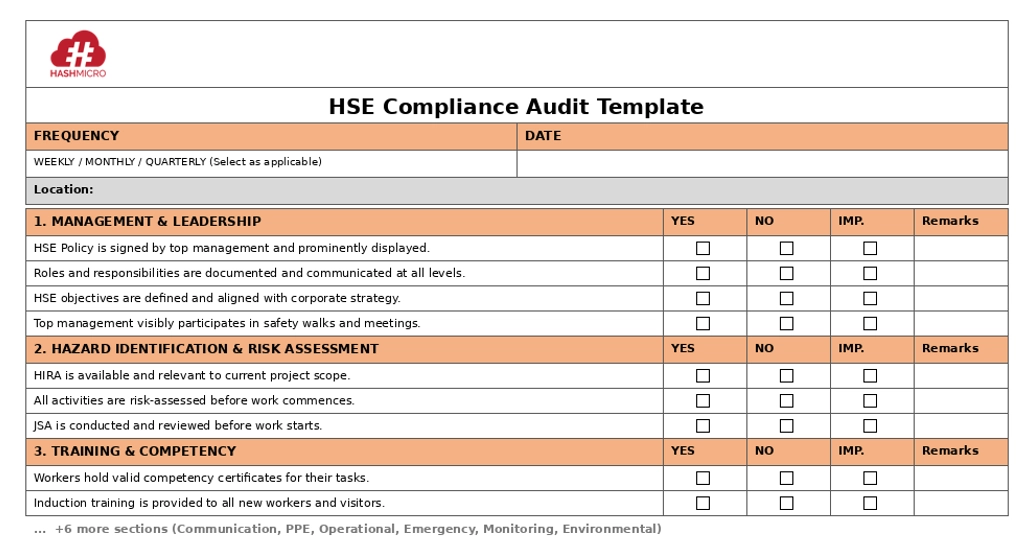
Compliance Audit Template
How Software Helps Automate Compliance Audits?
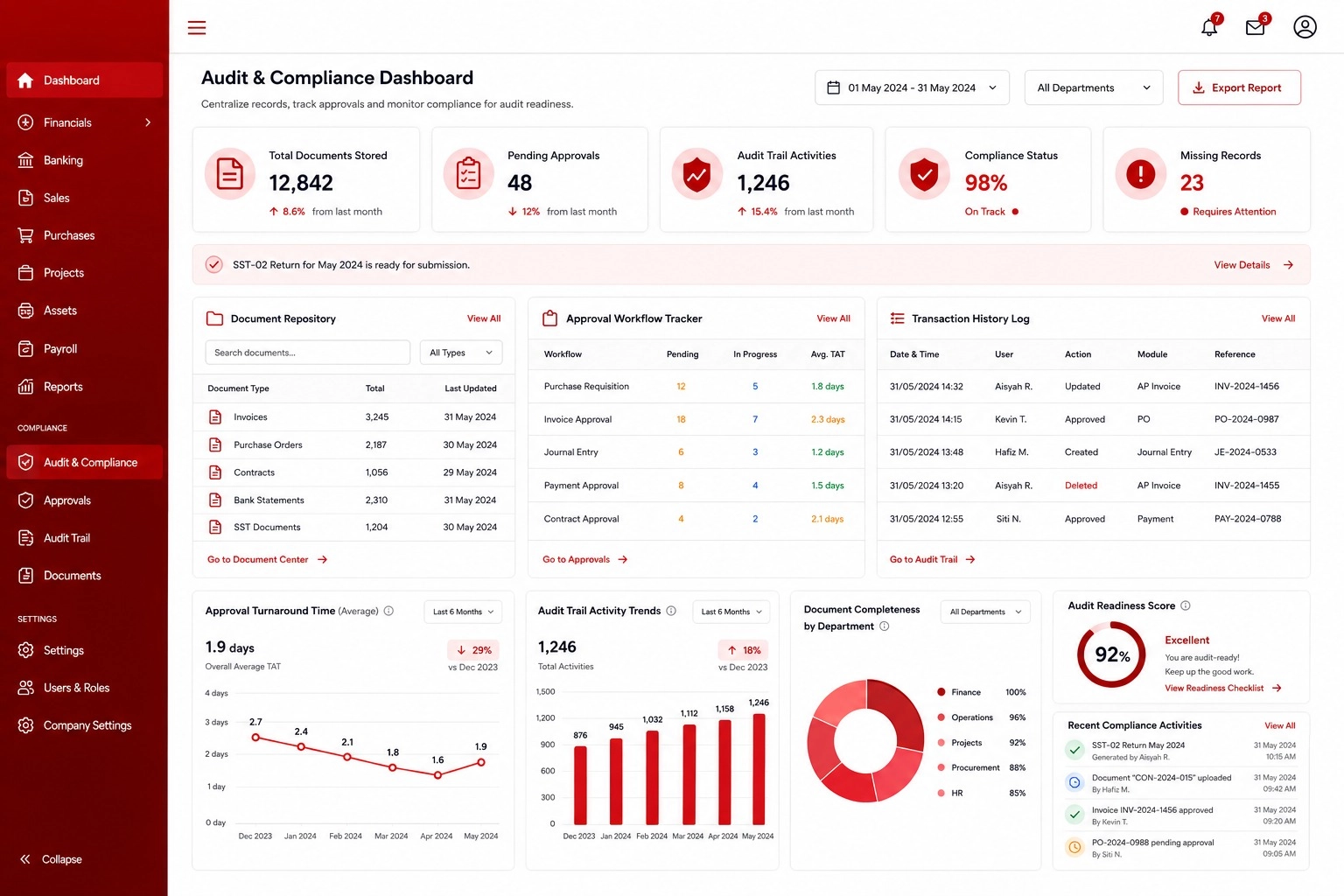
Audit preparation can be challenging when employee records, payroll documents, leave requests, and approval histories are stored across spreadsheets, emails, and multiple systems. HR teams often spend significant time gathering supporting documents and verifying records instead of focusing on compliance requirements. An integrated HR software solution centralizes workforce data, making information easier to access during internal reviews and external audits.
Modern HR systems also provide audit trails and workflow controls that improve transparency and accountability. By maintaining records of employee changes, approvals, attendance, leave, and payroll activities in a single platform, HR software helps Malaysian businesses prepare for audits more efficiently while reducing the risk of missing or inconsistent records.
Conclusion
A compliance audit helps businesses identify gaps, strengthen internal controls, and reduce regulatory and operational risks. With a clear scope, structured checklist, and proper documentation, audits become more efficient and easier to manage over time.
As businesses grow, maintaining audit readiness can be challenging when records are spread across multiple systems. Centralizing data, approvals, and audit trails can improve transparency, simplify audit preparation, and support better operational control.
If you’re exploring ways to streamline these processes, consider scheduling a free demo to see how an integrated business management system can support your audit readiness goals.

FAQ about Compliance Audit
-
What is the purpose of a compliance audit?
A compliance audit checks whether a company’s records, processes, and controls follow applicable laws, standards, and internal policies. Its purpose is to catch gaps early, strengthen internal control, and keep the business ready for external reviews. It also supports cleaner, more reliable documentation.
-
What is included in a compliance audit checklist?
A practical checklist usually covers statutory records, financial statements, tax and regulatory filings, approval workflows, contracts, HR and payroll records, inventory or asset records, system access control, the audit trail, and a corrective action log. Each item states what to verify, so reviewers confirm evidence instead of relying on assumptions.
-
What are the types of compliance audits?
Common types include regulatory, financial, internal, HR, IT or data, and operational compliance audits. Each focuses on a different area, from statutory filings and accounting controls to payroll records, system access, and process adherence. Most companies prioritize the types that match their biggest risk and record-keeping pressure.
-
How often should a company conduct a compliance audit?
Frequency depends on company size, industry, and risk exposure. Many businesses run an internal compliance audit once a year, with smaller focused reviews each quarter for high-risk areas such as payroll or procurement. Regular reviews keep records current and make formal external audits far less disruptive.
-
How do you prepare a compliance audit report?
Start by recording the audit scope, objective, applicable requirements, and documents reviewed. Then list each finding with its risk level, evidence, recommended action, owner, deadline, and status. Close with an overall conclusion and a follow-up plan. A consistent report template keeps the documentation clear and easy to track.