













In today’s global economy, businesses are expected to improve supply chain performance while keeping costs efficient. Managing operations across regions requires accuracy, speed, and the ability to adapt to changing demand and customer expectations.
In Malaysia, this challenge is becoming more significant as companies accelerate digital adoption and strengthen their role in regional trade, supported by initiatives highlighted by MIDA and MDEC. To keep up, many businesses use supply chain BPO for tasks like procurement, order processing, and logistics coordination, allowing them to reduce internal workload and access specialized expertise.
Outsourcing is now seen as a strategic move rather than just cost-saving. This article will explore how supply chain BPO works, its key benefits, and how businesses can choose the right approach for their operations.
Key Takeaways
|
Explore deeper insights on how supply chain BPO helps businesses improve efficiency, manage costs, and enhance overall performance by clicking the banner below.
What Is Business Process Outsourcing in Supply Chain Management?
Supply chain Business process outsourcing (BPO) means outsourcing specific tasks to external providers, such as procurement support, order processing, logistics coordination, freight auditing, and demand planning. These functions help manage the flow of goods, information, and costs more effectively.
Instead of handling everything in-house, businesses use BPO to improve efficiency, ease operational workload, and access specialized expertise. Third-party providers usually manage these tasks based on agreed service levels and performance targets.
The goal is not only to reduce workload but also to improve accuracy and scalability supply chain performance. With the right partner, companies can manage costs better and focus on their core operations.

The Evolution of BPO: From Cost-Cutting to Strategic Partnership

Business process outsourcing (BPO) has changed significantly over time. In the past, companies mainly used BPO to reduce labor costs by outsourcing routine back-office tasks such as payroll, data entry, and administration. The focus was primarily on lowering operational expenses rather than improving business performance.
As supply chains became more complex, businesses realized that cost savings alone were not enough. Inefficient processes and poor coordination across regions created operational challenges, pushing companies to rethink the role of outsourcing in supply chain management.
Today, BPO is seen as a strategic partnership rather than just a cost-saving solution. Supply chain BPO providers help businesses improve efficiency, gain better visibility, and support faster decision-making across operations and the overall value chain.
Key Benefits of Supply Chain BPO
Supply chain BPO offers more than just cost savings. When used strategically, it can help businesses improve efficiency, adapt faster to change, and focus more on long-term growth.
1. Better efficiency and standardized processes
One of the main benefits of business process outsourcing in supply chain management is improved efficiency. BPO providers often use proven workflows, standard operating procedures, and specialized expertise to reduce delays, remove repetitive tasks, and improve process accuracy.
2. More scalability and flexibility
Supply chain needs can change quickly due to demand shifts, seasonal peaks, or market disruptions. Supply chain BPO gives businesses more flexibility by allowing them to scale operations up or down without carrying the full cost of a large internal team.
3. Access to better technology and analytics
Many BPO providers use advanced tools for automation, reporting, and supply chain visibility. This helps businesses improve decision-making and access better technology without making large internal investments.
4. More focus on core business priorities
By outsourcing routine supply chain tasks, companies can free up internal teams to focus on strategy, innovation, supplier relationships, and other high-value activities that support business growth.
Evaluating and Selecting the Right BPO Partner
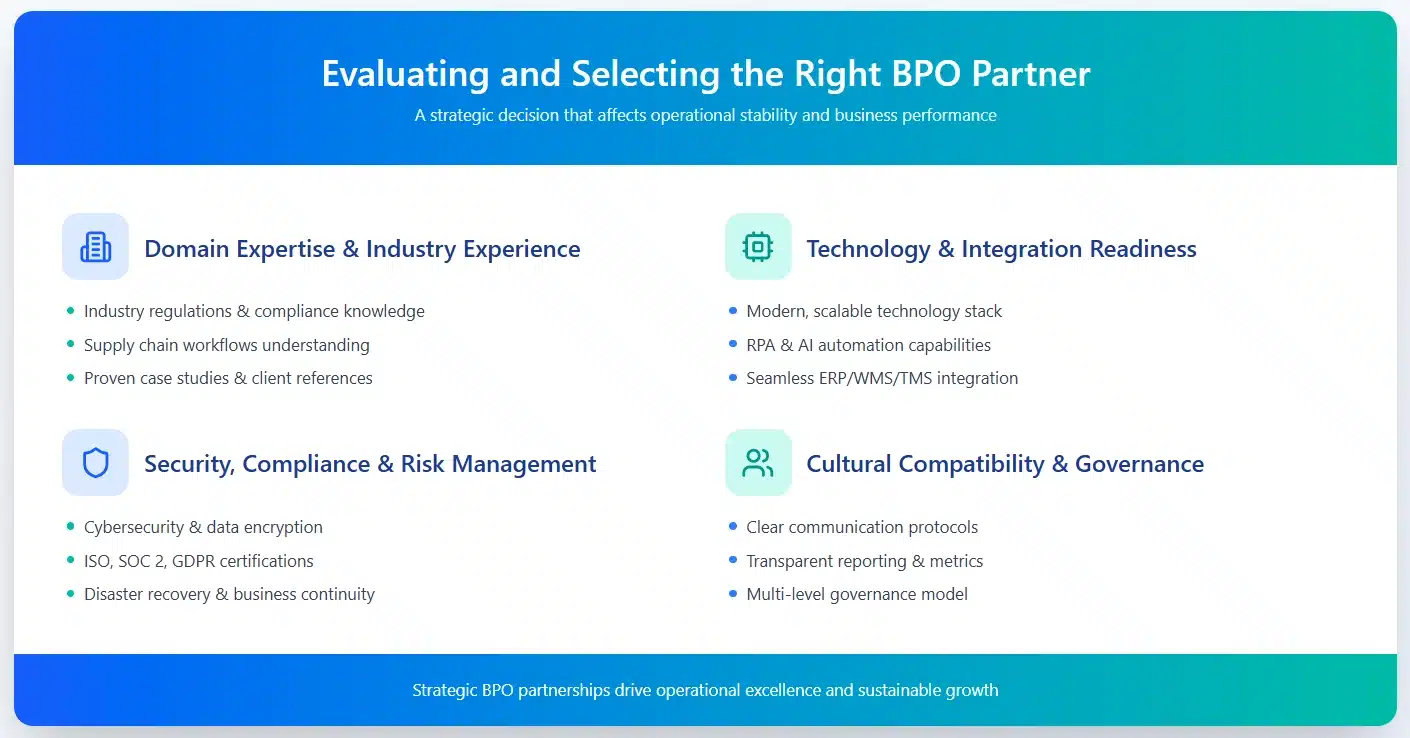
Selecting a BPO partner is a strategic decision that requires careful evaluation. The wrong choice can disrupt operations, while the right provider can strengthen business performance. Companies should use a structured approach to assess potential vendors across several key areas.
1. Domain Expertise and Industry Experience
Choose a provider with strong experience in supply chain management and a clear understanding of your industry. They should be familiar with regulations, workflows, and market challenges. Reviewing case studies and client references helps validate their track record.
2. Technological Capabilities and Integration Readiness
Organizations must evaluate the vendor’s proprietary technology stack, their proficiency in deploying automation (RPA, AI), and their ability to connect smoothly with your existing system and database. Smooth and secure data exchange is essential, along with a technology roadmap that supports your long-term goals.
3. Security, Compliance, and Risk Management Frameworks
The evaluation should include a comprehensive audit of their physical security protocols, cybersecurity infrastructure, data encryption standards, and disaster recovery/business continuity plans. Ensure the provider has strong data protection measures, complies with relevant regulations, and maintains reliable backup and recovery plans. Their approach to managing operational risks is also critical.
4. Cultural Compatibility and Governance Structures
A clear governance structure, including communication, reporting, and issue resolution processes, is key to building a stable partnership. The vendor should offer a clear, multi-tiered governance model that includes operational, tactical, and strategic touchpoints. Clear escalation paths for issue resolution and transparent reporting mechanisms must be established before any contract is signed.
Best Practices for Implementing a Successful BPO Strategy
Choosing the right BPO partner is only the beginning. The real success depends on how the partnership is implemented and managed over time. Moving complex supply chain processes to an external provider requires careful planning, strong project management, and clear communication to minimize disruption.
- Comprehensive Transition Planning
Companies and vendors should work together to create a detailed plan that includes timelines, resources, and risk controls. Many organizations start by transferring processes as they are before making improvements. Clear documentation, knowledge transfer sessions, and parallel testing help ensure accuracy and consistency during this stage. - Setting Clear Service Level Agreements (SLAs)
SLAs define how the partnership operates and should focus on measurable results. Metrics need to be clear and relevant, covering both daily performance and broader business outcomes. Contracts should also outline consequences for unmet targets and rewards for strong performance. - Proactive Change Management
Outsourcing can create uncertainty among employees, especially regarding job security or shifting responsibilities. To address this, companies need a clear change management approach. Open communication from leadership about the goals and benefits of BPO helps maintain trust and encourages collaboration throughout the transition.
Potential Risks and Challenges in Outsourcing Supply Chain Operations
While business process outsourcing (BPO) offers clear advantages, it is not without challenges. Bringing an external provider into core supply chain activities introduces risks that can disrupt operations and affect business reputation if not managed properly. Understanding these potential issues is essential before implementing a BPO strategy.
- Loss of Direct Operational Control
When processes are handled internally, companies can quickly respond to issues. With BPO, control shifts to the vendor, and any adjustments must follow agreed governance processes. This distance can create delays in decision-making and may affect service quality if the provider fails to meet expectations. - Data Security and Intellectual Property Vulnerabilities
Supply chain operations involve sensitive data such as pricing strategies, supplier agreements, and customer information. Sharing this data with third-party providers increases exposure to risks like cyberattacks or data leaks. Ensuring strong security standards and compliance with global regulations is critical to reducing these risks. - Hidden Costs and Vendor Lock-In
Although BPO is often associated with cost savings, unexpected expenses can arise. Transition costs, contract negotiations, ongoing management, and additional services outside the agreed scope can increase overall spending. Over time, companies may also become too dependent on a single provider, making it difficult and costly to switch vendors. - Cultural Misalignment and Communication Barriers
Successful outsourcing depends on strong collaboration, which can be challenging when working with offshore teams. Differences in language, time zones, and work culture may lead to misunderstandings or delays. Without clear communication channels and aligned expectations, these issues can impact performance and weaken the partnership.
How BPO Enhances Supply Chain Resilience and Agility
Business process outsourcing (BPO) helps companies strengthen both resilience and agility in their supply chains. With ongoing disruptions such as pandemics, geopolitical issues, natural disasters, and shifting market demands, businesses need reliable operational support to respond quickly and maintain continuity.
One key benefit of BPO is increased flexibility. By partnering with providers in different regions, companies can spread operational risk and ensure critical processes continue even if disruptions occur in one location. At the same time, BPO allows businesses to scale more easily and adapt to new markets by leveraging external expertise and existing infrastructure instead of building operations from scratch.
Additionally, many BPO providers offer advanced data tools and analytics to identify potential risks early. This enables faster decision-making, better contingency planning, and more effective responses to disruptions. As a result, BPO becomes an important approach for companies looking to build more adaptive and resilient supply chains.
The Role of Technology in Modern Supply Chain BPO

Today’s BPO landscape is driven by advanced technology rather than manual processes. Digital tools play a central role in delivering higher value, enabling outsourcing providers to go beyond basic task execution. For companies using supply chain management systems, it is essential to partner with BPO providers that can integrate effectively and enhance existing technologies.
1. Robotic Process Automation (RPA)
RPA allows BPO providers to automate repetitive, rule-based tasks such as invoice handling, order processing, shipment updates, and data matching across systems. These software bots operate continuously, improving speed and accuracy while reducing human error. This shift allows human teams to focus on more complex tasks that require analysis and decision-making.
2. Artificial Intelligence and Machine Learning
AI and ML help BPO providers move from reactive operations to predictive capabilities. By analyzing large volumes of historical data, these technologies uncover patterns that improve demand forecasting and operational planning. AI can also process unstructured data, such as contracts or shipping documents, making information extraction faster and more accurate.
3. Cloud Computing and Global Visibility Platforms
Cloud technology enables secure, real-time data sharing between companies and their outsourcing partners. Many BPO providers use cloud-based platforms to combine data from ERP systems, suppliers, and logistics networks. This creates a unified view of inventory, shipments, and performance, helping teams make faster and more informed decisions.
4. Blockchain for Traceability and Compliance
Blockchain is gaining attention for its ability to improve transparency and trust in supply chains. BPO providers can use this technology to create secure, trackable records of product movement. This is especially useful in industries with strict compliance requirements, as it supports accurate tracking, simplifies audits, and strengthens accountability across partners.
Conclusion
Supply chain BPO has shifted from a cost-cutting tactic into a strategic approach that helps businesses improve efficiency, scalability, and operational performance. By outsourcing functions such as procurement, order processing, and logistics coordination, companies can access specialized expertise and advanced technologies like RPA, AI, and cloud computing without heavy internal investment.
For businesses in Malaysia, choosing the right BPO partner with clear SLAs, strong governance, and reliable security standards is essential for building a more agile supply chain. To support long-term growth and competitiveness, explore the right solution for your business with a free demo.

FAQ about Business Process Outsourcing (BPO)
-
What is the difference between supply chain BPO and traditional logistics outsourcing?
Traditional logistics outsourcing usually focuses on physical activities such as warehousing, transportation, and freight forwarding. Meanwhile, supply chain BPO covers a broader scope, including end-to-end process management like procurement, order processing, demand planning, and supplier relationship management. In short, logistics outsourcing handles the movement of goods, while supply chain BPO manages the entire process behind it.
-
Is supply chain BPO suitable for small and medium-sized enterprises (SMEs)?
Yes, supply chain BPO is increasingly accessible for SMEs, especially with the rise of cloud-based services and flexible pricing models. SMEs can outsource specific functions, such as order processing or procurement, without committing to large infrastructure investments. This allows them to compete with larger players while keeping operational costs under control.
-
How does supply chain BPO support sustainability and ESG goals?
Modern BPO providers often help businesses meet sustainability targets through better data tracking, optimized routing, reduced paper-based processes, and ethical sourcing support. Many providers also assist in monitoring carbon emissions across the supply chain, which is increasingly important for companies aligning with ESG (Environmental, Social, and Governance) reporting standards.
-
What KPIs should companies track to measure supply chain BPO performance?
Some of the most important KPIs include order accuracy rate, on-time delivery percentage, procurement cycle time, cost per transaction, forecast accuracy, and customer satisfaction score (CSAT). Tracking these indicators regularly helps businesses ensure that the BPO partnership delivers the expected value and supports continuous improvement.